
Key Takeaways
- Information science bridges technology and human needs, making data useful and accessible across industries.
- Information science is critical in the AI era; ensuring algorithms are fair, data is clean, and information systems serve people effectively.
- Career paths for information science professionals span data management, user experience design, digital libraries, and information architecture.
- A degree in information science opens doors in healthcare, finance, government, education, and tech.
We create 2.5 quintillion bytes of data every day. That’s emails, social posts, sensor readings, medical records, financial transactions, and more. But raw data means nothing without structure. Information science transforms that chaos into knowledge you can actually use.
Think of it this way: Google doesn’t just store websites; it organizes them so you find what you need in seconds. Netflix doesn’t just have movies; it structures viewing data to recommend what you’ll love. Behind every smart system is an information scientist asking, “How do we make this useful for people?”
If you’re curious about how information flows, how systems stay ethical, or how data shapes decisions, you’re already thinking like an information scientist. This field brings together technology, psychology, and design, with a focus on making information work for everyone.
What Is Information Science?
Information science is the study of how information is collected, organized, stored, retrieved, and shared. It’s an interdisciplinary field that combines computer science, cognitive psychology, library science, and communication theory to understand the relationship between people, technology, and information. Rather than focusing solely on building technology, information science examines how people interact with systems and how to design those systems to serve human needs effectively.
At its core, information science asks: How do people seek, process, and use information? And how can we design systems that make that easier, faster, and fairer? These questions apply whether you’re building a hospital’s patient records system or creating a search interface for an e-commerce site. Information scientists’ work makes sure the information you need is findable, accurate, and presented in ways that make sense.
The Importance of Information Science in the AI Era
Artificial intelligence has become part of daily life (voice assistants, fraud detection systems, personalized recommendations). But AI is only as good as the information it’s trained on. Information scientists are the ones who ensure that data is accurate, unbiased, and organized in ways AI can interpret correctly.
The “garbage in, garbage out” principle
If an AI system learns from incomplete or biased data, it produces flawed results. Information scientists curate, clean, and validate datasets so machine learning models can make reliable predictions. They remove duplicate records, standardize formats, and verify that training data reflects real-world diversity.
Information scientists also design metadata structures that help AI understand context (not just keywords). For example, a medical AI needs to know that “cold” in a patient record could mean a viral infection or a temperature reading.
Addressing algorithmic bias
AI can inherit human prejudices from training data. If historical hiring records show that a company predominantly hired one demographic, an AI trained on that data might unfairly filter out qualified candidates from other backgrounds. Information science provides the ethical framework to identify and reduce bias in datasets, ensuring AI systems don’t unfairly disadvantage certain groups.
Information scientists audit datasets for representation gaps, work with domain experts to ensure fairness, and build systems that allow for transparency and accountability.
Search and retrieval at scale
Large language models like ChatGPT rely on information retrieval principles (a core concept in information science) to generate responses. These models don’t “know” things; they retrieve and synthesize information based on patterns in massive datasets. Information scientists design the architectures that make retrieval fast, relevant, and context-aware. From search engine rankings and recommendation systems to conversational AI, information retrieval influences how billions of people find and use knowledge each day.
Core Pillars of Information Science
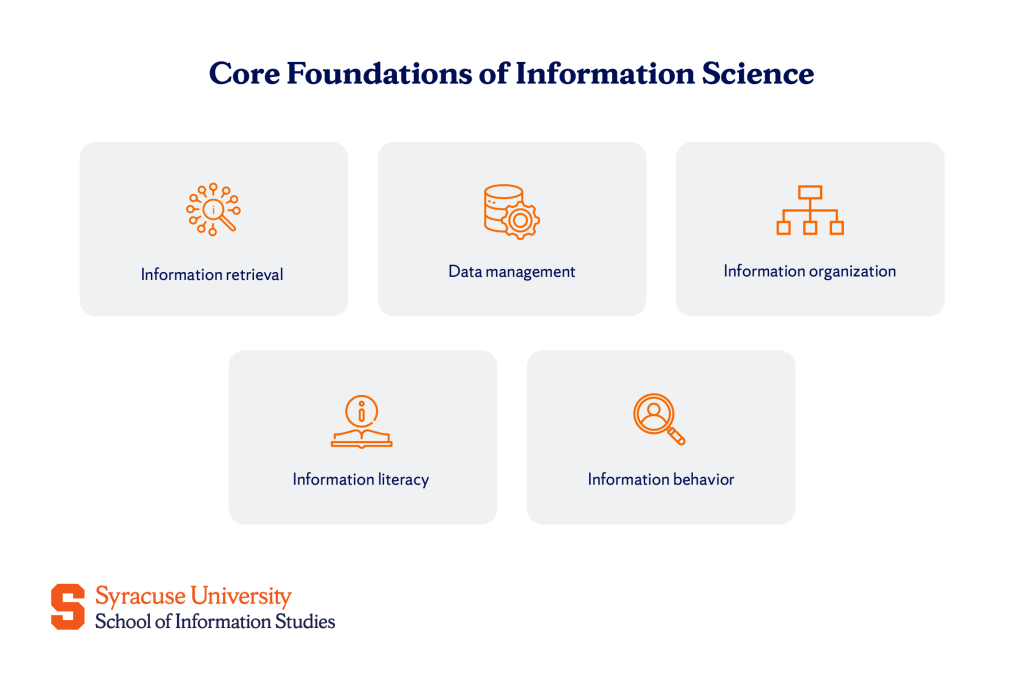
Information science rests on five interconnected pillars. Each one addresses a different aspect of how information moves through systems and reaches people. Understanding these pillars helps clarify what information scientists actually do and why the field matters across so many industries.
Information retrieval
This pillar focuses on how users find information in large databases, libraries, or on the web. It covers search algorithms, indexing methods, and relevance ranking, ensuring the right results appear when you need them. Information retrieval goes further than keyword matching by interpreting user intent, contextual meaning, and the connections between ideas. Effective retrieval systems anticipate what users are looking for and present results in order of usefulness.
Data management
Data management focuses on designing databases and maintaining data quality, while also establishing clear policies for storage and access. When data is poorly managed, organisations face inaccuracies, data loss, compliance failures, and exposure to security risks. Information scientists address these issues by setting governance frameworks, implementing backup and recovery processes, designing scalable database architectures, and defining accountability for data use.
This area extends beyond technical systems to organisational decision-making about what data to collect, how long it should be retained, who can access it, and how it supports operational and strategic goals.
Information organization
How do you structure information so it’s findable and usable? This pillar covers classification systems, taxonomies, metadata standards, and content architecture. Taxonomies group related items together, like organizing a museum’s collection by time period, region, and medium. Metadata adds layers of description that help systems and users understand what each item represents.
Information scientists design these structures to match how people think and search, conducting user research to understand mental models and refining systems based on real-world use.
Information literacy
Information literacy is the ability to find, evaluate, and use information effectively. Information scientists teach others how to assess source credibility, recognize misinformation, and make informed decisions based on evidence. Information literacy programs help students, employees, and community members develop skills to question sources, verify claims, and distinguish credible information from propaganda or speculation.
Information scientists also design systems that make evaluation easier by adding credibility indicators or building fact-checking tools.
Information behavior
This pillar examines how people search for, process, and share information. It asks: Why do users abandon searches? What makes a system intuitive? How do cultural or cognitive factors shape information needs?
Information behavior research might study how nurses look up drug interactions during shifts, how journalists verify sources under deadline pressure, or how families research medical conditions after a diagnosis. By understanding these dynamics, information scientists can design interventions that promote healthier information ecosystems.
Essential Information Science Skills and Competencies
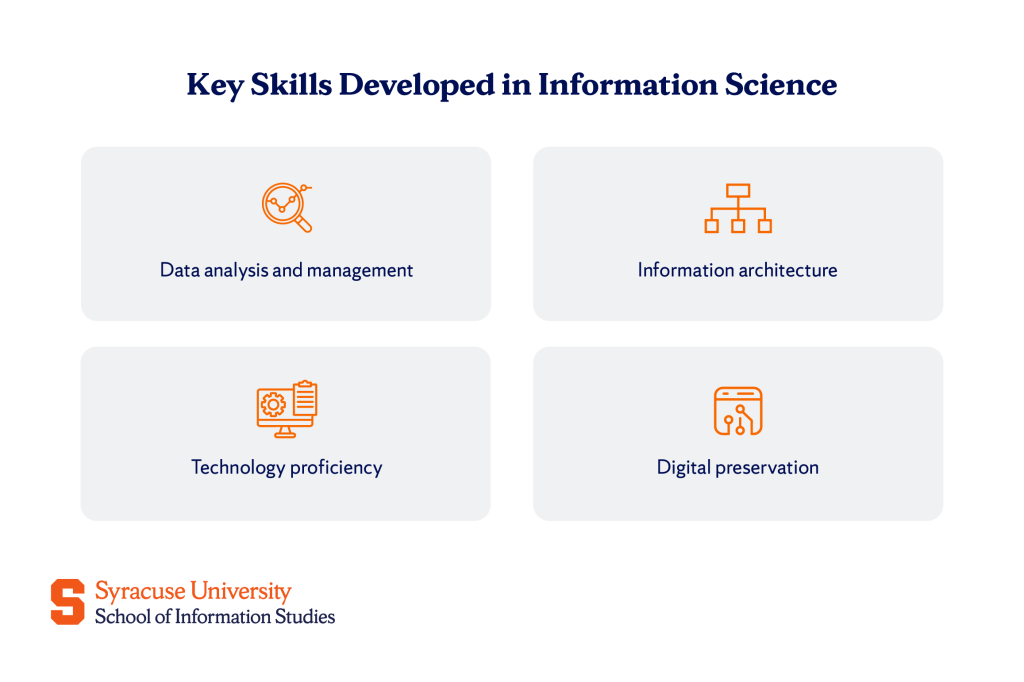
Information science professionals need a mix of technical, analytical, and interpersonal skills. The field values adaptability, critical thinking, and the ability to communicate complex ideas clearly.
Data analysis and management
Information science professionals work with datasets: cleaning them, querying them, and drawing insights from them. That means familiarity with SQL for database queries, spreadsheet tools like Excel, and statistical software such as R or Python for data manipulation and visualization.
Data analysis in information science is about understanding what the data represents, where it came from, and what biases might be embedded in it. Strong data management skills also mean understanding how to structure databases for efficiency and scalability.
Information architecture
Designing systems that organize and present information clearly is central to the field. Professionals create site maps, navigation structures, and metadata schemas that help users find what they need without frustration. Good information architecture anticipates user needs; for example, if someone visits a university website looking for financial aid information, they shouldn’t have to dig through five layers of menus.
Information architects study how people search, what language they use, and what tasks they’re trying to complete, then design structures that support those goals.
Technology proficiency
If you want to work in information science, you don’t need to code like a software engineer, but you should understand how digital libraries, content management systems, and networked databases function. Knowledge of cloud storage, cybersecurity principles, and data privacy regulations is also valuable.
Professionals work with platforms like WordPress or Drupal to organize and publish information, use tools like Tableau or Power BI to visualize data, or collaborate on API integrations. Understanding how these technologies work helps make smart design decisions and collaborate effectively with developers.
Digital preservation
Maintaining digital records, whether archival documents, web-based resources, or multimedia collections, requires understanding file formats, version control, and long-term storage solutions. File formats that were standard 20 years ago might not open on modern systems, so digital preservation involves migration strategies and emulation techniques. This work is critical for archives, museums, government agencies, and any organization that needs to maintain records over decades or centuries.
Career Opportunities in Information Science
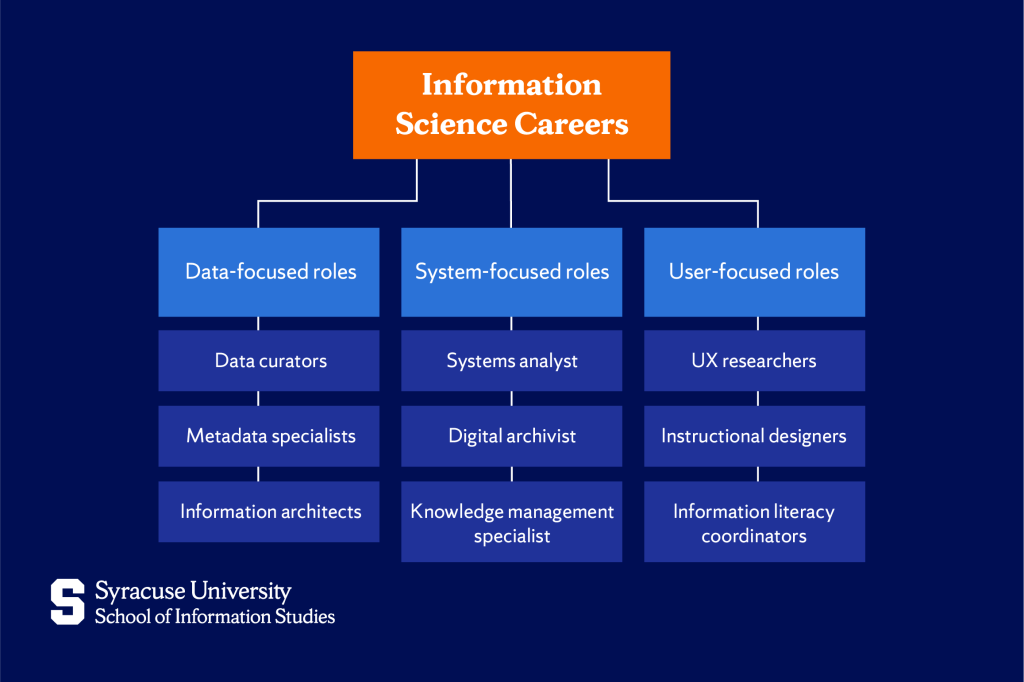
Information science opens doors across numerous industries. The roles vary, but they all center on making information systems work better for people.
Data-focused roles
These positions involve managing, analyzing, or curating data. You might design databases, ensure data quality, or build taxonomies that help organizations find and use their information assets. Industries like healthcare, finance, and government rely heavily on these roles to maintain accurate records, support compliance, and enable evidence-based decisions.
Data-focused information scientists often work as data curators, metadata specialists, or information architects.
System-focused roles
Here, you’re designing or improving information systems, like a digital library, content management platform, or enterprise knowledge base. You might work as a systems analyst, digital archivist, or knowledge management specialist. These roles involve evaluating existing systems, identifying gaps, and implementing solutions that improve efficiency. System-focused work often involves project management skills: gathering requirements, managing timelines, and coordinating across teams.
User-focused roles
These roles prioritize the human side of information systems. You might conduct user research, design interfaces, or teach information literacy skills. User-focused professionals might work as UX researchers, instructional designers, or information literacy coordinators. In these roles, you’ll study how people interact with systems, identify pain points, and propose improvements.
User-focused roles also include education and training: as a school librarian or information literacy instructor, you’ll teach people how to evaluate sources and use information tools effectively.
Why Major in Information Science?
Choosing a major sets the direction for your professional path. Information science offers versatility, a human-centered focus, and strong career prospects.
Versatility across industries
An information science degree provides a flexible foundation for multiple fields. It fits into healthcare (managing patient data systems), finance (organizing risk models), education (building digital learning platforms), and government (improving public records access). You’re not locked into one career path. The skills you build, including data management, system design, and user research, transfer across sectors.
Geographic flexibility is another advantage. Information science jobs exist in major cities, college towns, and increasingly remote settings.
The human-centered tech angle
If you’re drawn to technology but want to focus on how it helps people (not just how it works), this field is for you. Information science places the user at the centre of system design. The focus is on building tools that people can use effectively and responsibly, while accounting for accessibility needs and cultural differences.
In contrast to computer science, which often emphasizes algorithms and optimization, information science asks: Does this system actually help people? Is it usable by people with disabilities? Does it reflect diverse perspectives?
Strong career outlook
According to the U.S. Bureau of Labor Statistics, employment for computer and information research scientists is projected to grow 20% from 2024 to 2034, much faster than the average for all occupations. Organizations need people who can manage, secure, and make sense of information at scale. Salaries reflect this demand, with professionals earning an average of $140,000 per year.
iSchool’s Master of Library and Information Science (MLIS) is ALA-accredited and offered both online and on campus, preparing graduates for careers in libraries, archives, museums, information centres, and related roles. Students can often choose pathways that include digital curation and data services, and the online format can be completed in as few as 18 months without a GRE requirement.
For students focused on advanced research and academic work, the Ph.D. in Information Science and Technology is a residential doctoral program that emphasises human-centred approaches to information technologies and multidisciplinary scholarship. Graduates typically develop expertise in theoretical and methodological approaches to information systems and can pursue careers in research, academia, policy analysis, and technology innovation.
The Field Behind Smarter Information Work
Information science links data and systems to real human needs. It explains why search tools surface useful results, how digital collections preserve knowledge, how information platforms remain usable at scale, and how emerging technologies function responsibly when guided by context and ethics.
As the volume of information continues to expand, the demand for professionals who can organise it, protect it, and apply it thoughtfully keeps growing. Large-scale data creation creates new possibilities, while also raising questions about privacy, reliability, access, and fairness. Information scientists work at this boundary, designing systems that support people instead of overwhelming them.
Whether your interests point toward school librarianship, information system design, data stewardship, or responsible AI development, information science offers a practical foundation for meaningful work. For those looking to take the next step, programs at Syracuse University’s iSchool provide structured pathways to study how information influences society and how professionals can guide it with purpose.
Frequently Asked Questions (FAQs)
Is information science a high-paying major?
Yes, information science graduates enter fields like data management, UX design, and digital libraries, with median salaries ranging from $60,000 to over $100,000 depending on role and location. Specialized roles in information security or data architecture often command even higher compensation.
What is the future of information science?
The field is expanding as organizations face growing data volumes, increased demand for ethical AI, and the need for professionals who can bridge technology and human needs. Emerging areas include information ethics, digital preservation, and human-AI interaction design.
What is the difference between information science and information studies?
Information science focuses on systems, data, and retrieval technologies, while information studies takes a broader view, examining social, cultural, and policy dimensions of information. Both fields overlap significantly, and many programs integrate perspectives from both.