
Key Takeaways
- An AI research scientist invents and tests new methods in artificial intelligence, designing algorithms, running experiments, and publishing results rather than applying existing models to a product.
- The role is focused on the research end of the AI career spectrum, separate from the machine learning specialist who takes finished models and deploys them into production.
- Core competencies span deep mathematical and machine learning foundations, strong programming and experimentation ability, and the scholarly habits that define research work: reading papers, framing hypotheses, and publishing.
Through 2025 and into 2026, the competition for AI research talent became a public spectacle, with Meta offering pay packages worth as much as $300 million over four years and OpenAI answering with retention bonuses as high as $1.5 million, according to The Wall Street Journal. Behind those headlines sits an ordinary job title with an extraordinary amount of leverage attached to it: the AI research scientist, the person who invents the methods everyone else later builds on.
An AI research scientist pushes the state of the art forward. That means framing research questions nobody has answered yet, designing and running experiments to test possible answers, and publishing what holds up so the rest of the field can use it. It’s a discovery role, which sets it apart from the work of shipping an AI feature to customers.
The questions worth answering, if you’re considering this path, are what the work actually looks like day to day, which skills it demands, how it compares with a machine learning specialist, what education it takes, and what it pays.
What Does an AI Research Scientist Do?
AI research scientists work at the edge of what artificial intelligence can currently do. They find open problems, invent or improve methods to address them, prove through careful experiments that those methods work, and share the results so others can build on them. The work breaks down into five kinds of activities:
- Frame research questions: Identify gaps in the current state of the art in areas such as natural language processing, computer vision, reinforcement learning, or AI safety, and turn them into hypotheses that an experiment can actually test.
- Survey the literature: Read recent papers from venues like NeurIPS, ICML, ICLR, and ACL critically enough to know what has already been tried, what failed quietly, and where a genuine contribution is still possible.
- Design and run experiments: Build prototypes, train models, run controlled comparisons and ablations against established baselines, and analyze what the numbers show, often on large compute clusters.
- Publish and present findings: Write papers, submit them to peer review, present at conferences, and release open-source code or datasets so other researchers can reproduce and extend the work.
- Work with research and product teams: Partner with other scientists, research staff, and specialists to turn promising results into working systems, and to bring hard problems from production back into the research agenda.
The balance among these duties depends on the setting. In an academic or open research lab, publishing and advancing the field carry the most weight, while at an industry lab the same scientist may steer a research agenda toward questions with a visible path to products.
Essential Skills and Qualities of an AI Research Scientist
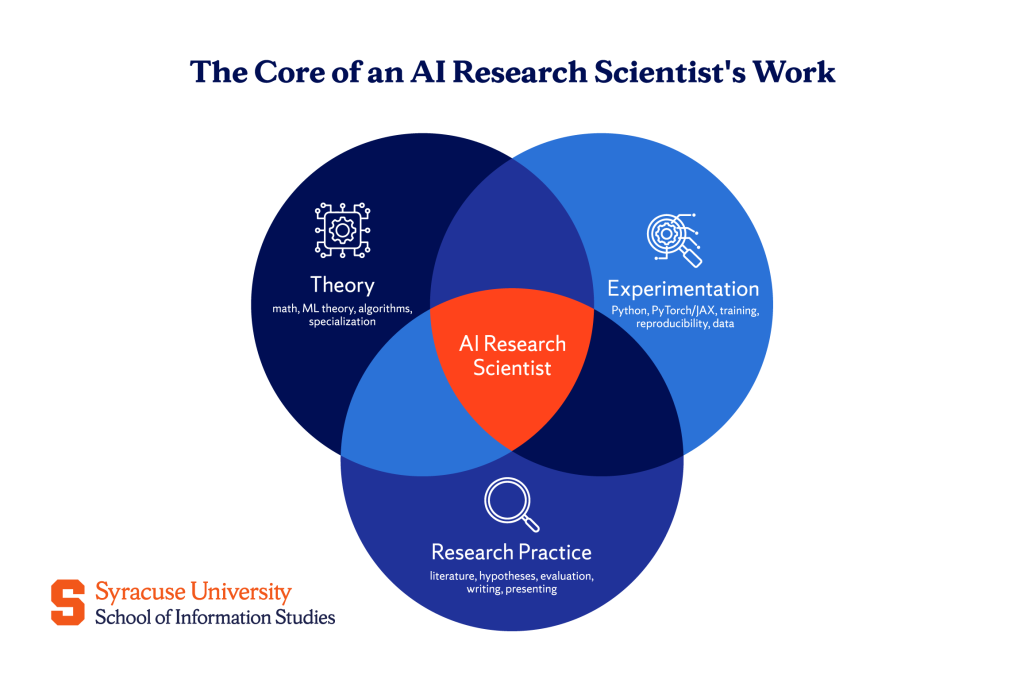
AI research scientists pair deep theoretical grounding with the ability to build and test their own ideas, plus the scholarly habits that separate research from product work. Some of this comes from coursework in mathematics and machine learning. The rest accumulates through years of reading papers, running experiments that fail, and writing up what the failures taught.
Mathematical and machine learning foundations
The theoretical core of the role includes:
- Linear algebra, calculus, probability, and statistics: the mathematics sitting underneath every model and every optimization method.
- Machine learning and deep learning theory: optimization, generalization behavior, and architectures such as transformers and diffusion models.
- A research specialization: real depth in at least one subfield, whether that’s NLP, computer vision, reinforcement learning, generative models, or AI safety and alignment.
- Algorithms and computational complexity: including the ability to reason about whether a method will still work at a hundred times the scale.
- Experimental and statistical rigor: designing fair comparisons, controlling variables, and reporting results honestly even when they undercut the hypothesis.
Mathematical maturity is the baseline the rest rests on, since it’s what allows someone to invent a method rather than apply one that already exists.
Programming and experimentation
Research runs on code, and the tooling is specific:
- Python, along with the deep-learning frameworks research is written in, chiefly PyTorch and JAX
- Building, training, and debugging models at scale, including distributed training across GPUs and TPUs
- Reproducible experimentation: version control, experiment tracking, and clean evaluation pipelines
- Working with messy data at volume, from dataset construction through preprocessing and quality checks
Research scientists are not production developers, but they write enough solid code to prototype and test their own ideas, which makes the line between research and production thinner here than in most fields.
Research methodology and communication
The scholarly side of the job comes down to concrete activities:
- Reading the literature critically and spotting where a real contribution is possible
- Framing a clear hypothesis and designing an experiment that can confirm or reject it
- Writing findings up precisely enough that another lab can reproduce them
- Explaining results in talks to expert and non-expert audiences alike
A track record of publications remains the field’s most visible proxy for all of this.
That combination of technical depth and human judgment has a long history at the iSchool. Laura Challman Anderson G’80 has spent more than four decades as a research scientist at IBM Research in Almaden, where she studies how scientific and technical teams share information:
“I have always been interested in the intersection of people, technology and information.”
Laura Challman Anderson G’80, Staff Research Scientist, IBM Research
How an AI Research Scientist Differs From Related AI Roles
AI titles overlap, and companies use them loosely, but they separate mainly by goal: whether the job is to create new knowledge or to build and ship working systems.
| Role | Primary goal | Owns |
|---|---|---|
| AI research scientist | Advance the state of the art | New methods and algorithms, experiments, and published findings; usually expects a Ph.D. or a strong publication record |
| Applied scientist | Solve a product problem with research methods | A hybrid role, common at large tech firms, adapting published techniques to a specific business problem |
| Research specialist | Make research run at scale | Training infrastructure and experiment tooling |
| Machine learning | Ship models into production | Deploying, serving, and maintaining models reliably in live products, usually built on existing methods |
Think of these as points on a line running from pure research to pure production, with the research scientist anchored at the research end. Titles travel, though: one firm’s applied scientist is another’s research scientist, and the same person often moves along that line several times over a career.
How to Become an AI Research Scientist
Few roles in technology are this credential-heavy. Entry rests on deep education and a visible record of research output, which no short certificate program substitutes for.
Common degree backgrounds include computer science, mathematics, statistics, data science, and related quantitative fields. What counts most is building the mathematical and machine learning foundation early, since later work depends on it. Undergraduates can start that groundwork at the iSchool through the Integrative Artificial Intelligence Bachelor’s degree, or add the Applications of AI Minor alongside a major in a related discipline.
Most AI research scientist roles expect a master’s, and very often a Ph.D., because the doctorate is where candidates produce the original peer-reviewed research they are ultimately hired on. The iSchool’s Master’s in Applied Human-Centered AI builds advanced AI competencies and can serve as a bridge toward research-track work, while the Master’s in Applied Data Science covers the data-and-modeling side. For students aiming squarely at a research career, the Ph.D. in Information Science and Technology is the research-track credential.
Beyond the degree, the role is earned through demonstrated research: working in a lab, co-authoring papers, contributing to open-source projects, and assembling a portfolio of published work. Industry research internships and research assistantships during graduate study are the two most common ways to build that record. iSchool doctoral researcher Lizhen Liang followed exactly this route, using natural language processing and network analysis to study inequality between industry-led and university-led AI research teams. In this field, publications and reproducible code are the resume.
AI Research Scientist Salary and Job Outlook
The BLS doesn’t publish a separate AI research scientist occupation, so the closest official comparison is Computer and Information Research Scientists, who earned a median annual wage of $140,300 in May 2025. BLS projects employment in that occupation to grow 22 percent from 2025 to 2035, much faster than the 3 percent average for all occupations, putting it among the fastest-growing computing occupations.
Pay at leading industry labs runs far above that median, with total packages of base, bonus, and equity frequently reaching the high six figures. The bidding war reported in 2025 pushed offers for a small number of senior researchers into eight and nine figures, which is well outside anything federal wage data captures.
Final Reflections on the AI Research Scientist Role
Not long ago, AI research was a quiet academic specialty whose results took years to reach anyone outside a lab. Methods invented in research groups now reach products, policy debates, and daily routines within months, which has raised the bar for entry and the stakes of the work at the same time. It has also put more weight on doing this research responsibly, with a clear view of who the systems affect and how.
At Syracuse University’s iSchool, our Master’s in Applied Human-Centered AI is built around that pairing of technical depth and human-centered judgment, and students aiming at a full research career can continue into the Ph.D. in Information Science and Technology. If this is the direction you want to take, the Applied Human-Centered AI application checklist shows what you’ll need to get started. Whichever program fits, the habits the role rewards are the ones you can begin practicing now: reading papers closely, testing your own assumptions, and writing down what you find.
Frequently Asked Questions (FAQs)
How is an AI research scientist different from a data scientist?
A data scientist answers business questions with existing statistical and machine learning methods. A research scientist invents the methods themselves and publishes them for peer review.
Do AI research scientists work in academia or industry?
Both. BLS reports the federal government employs 31% of computer and information research scientists, with computer systems design firms next at 16%, and frontier AI labs now compete hard for the same people.
Can a software developer move into AI research?
Yes, though it usually requires graduate study or a publication record. Many developers enter through research engineering roles, where strong systems skills open the door to co-authoring papers.
How long does it take to become an AI research scientist?
Typically eight to twelve years from the start of a bachelor’s degree, since a Ph.D. alone adds roughly four to six years of original research after the undergraduate degree.
Which conferences matter most in AI research?
NeurIPS, ICML, and ICLR carry the most weight across machine learning generally, while ACL is the leading venue for natural language processing and CVPR for computer vision.
Where does AI safety and ethics fit into research work?
It’s a research specialization in its own right, covering alignment, robustness, fairness, and interpretability, and it’s also a review standard applied to work across the other subfields.