
Key Takeaways
- Computer science studies how computers and software work, including algorithms and programming, while information science studies how people and organizations use information and technology to solve problems.
- Computer science carries a heavier math and theory load and goes deeper into programming, while information science is broader and more applied, combining technical skills with data, design, security, and business context.
- Both majors lead to well-paid technology careers through different doors: computer science toward software development and systems roles, and information science toward data, UX, security, and product roles.
- The right choice depends on whether you want to build the technology itself or shape how it’s used, and the iSchool’s Bachelor’s in Information Management & Technology is built for the applied path.
Computer science is the study of computation: how software and systems are built and why they work. Information science is the study of how people and organizations create, organize, protect, and use information, and how technology should support that work. The two get confused because both are technology majors that involve programming, and many universities house them in neighboring schools.
The information science vs computer science decision comes down to four differences: what each field studies, how much math and programming it demands, the skills it builds, and the careers it leads to. Underneath all four sits one question. Do you want to build the technology, or shape how people use it?
Information Science vs Computer Science: The Core Difference
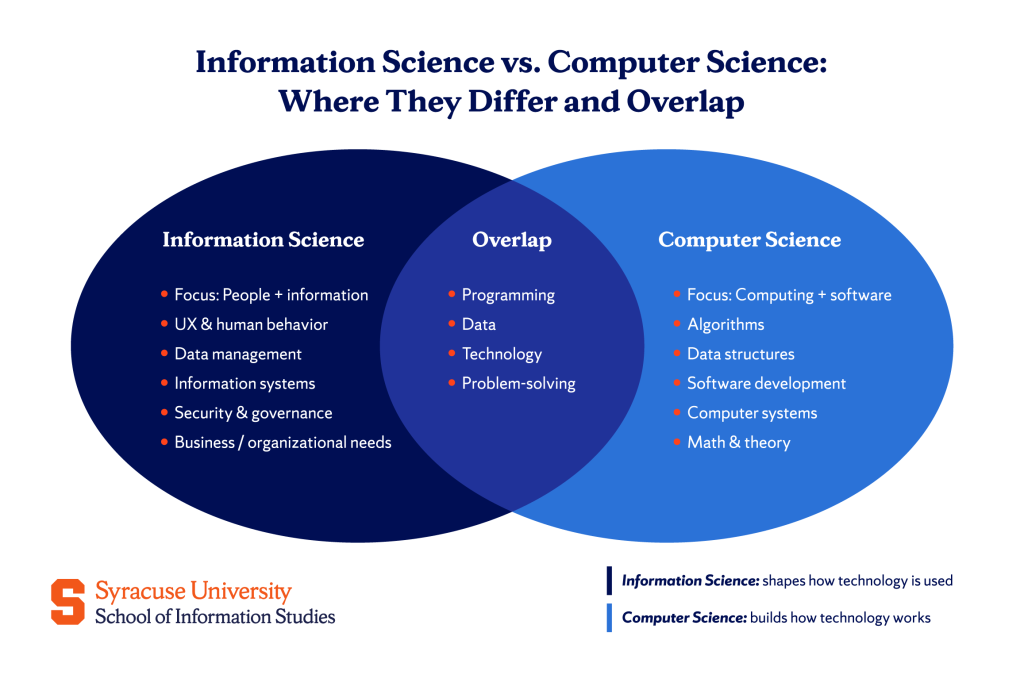
Computer science asks how to make computers and software do something, and do it correctly and efficiently. Information science asks how people and organizations find, organize, protect, and use information, and how technology should be designed so they can. The two overlap in programming and data, but computer science centers on the machine, while information science centers on the people and systems around it.
| Aspect | Information science | Computer science |
|---|---|---|
| Core question | How do people and organizations use information and technology? | How do computers, software, and algorithms work? |
| Focus | People and the information systems they rely on | Computation and software |
| Typical coursework | Databases, data analysis, information systems, UX/design, security, project management | Algorithms, data structures, programming languages, operating systems, discrete math, theory of computation |
| Math load | Moderate: statistics and quantitative reasoning | Heavy: calculus, discrete math, linear algebra, formal proofs |
| Programming depth | Applied: Python, SQL, and scripting for data and systems work | Deep: multiple languages, low-level and theoretical programming |
| Common degree names | Information science, information management and technology, information studies, informatics | Computer science; computer and information science (CIS) at some schools |
| Typical job titles | Data analyst, UX researcher, systems analyst, information security analyst, product or project manager | Software developer, back-end developer, machine learning developer, systems programmer |
| Best fit for | Students who want to shape how technology is used | Students who want to build the technology itself |
What Information Science Studies
Information science examines how information is created, organized, stored, retrieved, protected, and used, along with the ways people and technology interact throughout that process. At its core, information science is a human-centered technology field: a database, a search tool, or an app earns its value by giving people what they need from it.
Coursework typically covers databases and data management, programming for data work in Python and SQL, data analysis, information systems design, user experience, information security, and project management, with communication and business context running through all of it. Syracuse University’s Bachelor’s in Information Management & Technology, for example, includes IST 256 Introduction to Python for the Information Profession and IST 356 Programming Techniques for Data Analytics. Programming is a real part of the major. It’s aimed at working with data and systems rather than at the theory of computation.
What Computer Science Studies
Computer science is the study of computation, meaning algorithms, data structures, programming languages, software design, and the mathematical theory behind how computers process information. Its central questions concern the technology itself: what can be computed, how efficiently, and how to write software that does it correctly.
A typical core moves through introductory and advanced programming, data structures and algorithms, computer organization, operating systems, and theory of computation, followed by electives such as artificial intelligence or computer graphics. Math is the biggest practical difference students notice. A study of 199 computer science degrees at 158 U.S. universities found that 96% required Calculus I, 76% required Calculus II, and all but one required discrete math. Information science programs usually ask for statistics and quantitative reasoning instead.
Information Science vs Information Systems vs Information Technology
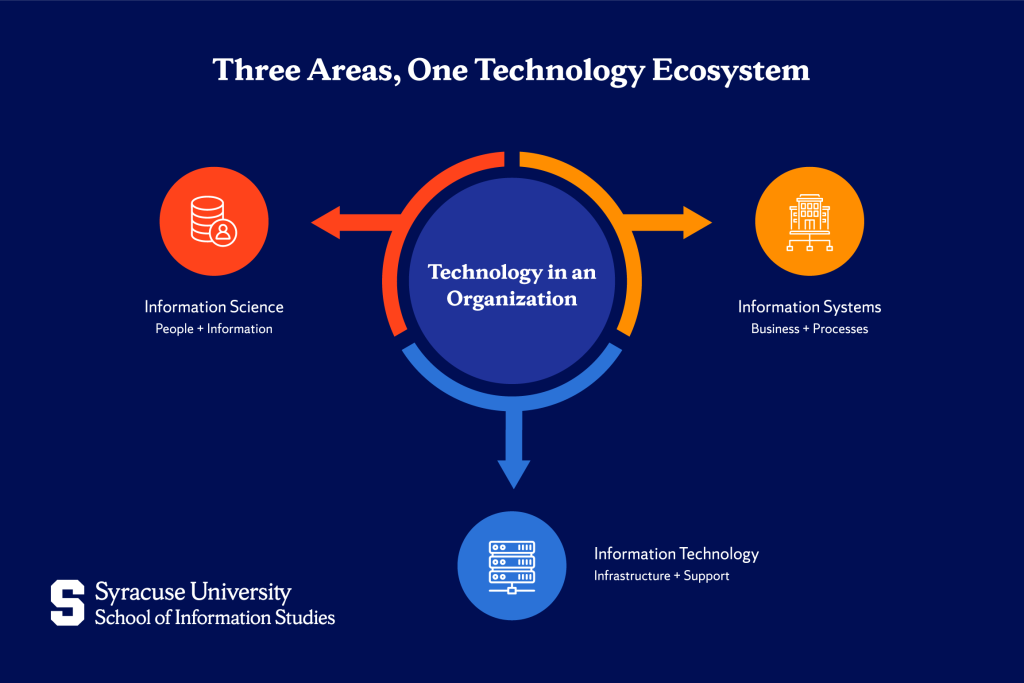
Two other “information” majors often get folded into this comparison. Information science is the broad academic field, covering how people and information interact through data analysis, user experience, information retrieval, and security. Information systems applies technology to business problems inside organizations, while information technology (IT) keeps an organization’s networks and hardware running and supports the people who use them. The iSchool’s bachelor’s degree draws on both information science and information systems, with management skills added, and the information systems vs computer science comparison runs along different lines than this one.
Skills You Build in Each Field
The two majors share a technical foundation, but each builds a different set of core strengths.
Information science skills
- Data management and analysis: organizing and querying data, then reading it closely enough to guide decisions.
- Systems analysis and design: translating what an organization needs into requirements and workable systems.
- User experience and human-centered design: studying how people actually use technology and designing around them.
- Information security and governance: protecting data and deciding who can access it and how.
- Communication and project leadership: working across technical and non-technical teams to deliver a finished solution.
Computer science skills
- Programming fluency: writing in multiple languages and paradigms, including lower-level languages close to the hardware.
- Algorithm design and complexity analysis: choosing the most efficient approach and proving that it is.
- Software architecture and systems programming: understanding how large programs and operating systems are built.
- Mathematical and theoretical reasoning: working comfortably with discrete math, logic, and formal proofs.
- Specialized technical depth: machine learning, graphics, compilers, or distributed systems, depending on electives.
Both majors teach programming and both work with data, so a graduate of either can write code and get hired into technical roles. Computer science goes deeper into how the code and the machine work. Information science goes wider into how the result gets used and whether people can trust it.
Jason Zhou’s path shows how that plays out. He arrived at Syracuse planning to study computer science, then found he wanted to express his creativity through design more than through code. He graduated in 2021 with a Bachelor’s in Information Management & Technology and a human-computer interaction concentration, and the iSchool alum is now a PayPal product designer leading the design of the company’s next-generation ID verification experience.
“This work is critical in today’s digital age, where security and trust are paramount.”
Jason Zhou ’21
Careers and Salaries: Information Science vs Computer Science
Graduates of both majors work in technology, but each degree points toward a different set of job titles, and the spread of information science jobs is notably wide.
Information science career paths
- Data analyst: turns raw data into reports and insights that guide decisions.
- UX researcher or designer: studies how people use products and shapes interfaces around them.
- Systems analyst: connects business needs with technology teams to design and improve the systems an organization runs on.
- Information security analyst: protects an organization’s data and networks from threats.
- Product or project manager: coordinates technical work and carries a product through requirements, testing, and launch.
Computer science career paths
- Software developer: designs and writes the applications and systems people use.
- Back-end or systems developer: builds the servers, databases, and infrastructure behind applications.
- Machine learning developer: builds and trains the models behind AI products.
- Computer and information research scientist: advances the theory and methods of computing, usually with a graduate degree.
- DevOps or cloud developer: automates how software is built, deployed, and scaled.
Software developers, the most common reference point for computer science graduates, earned a median annual wage of $135,980 in May 2025. The closest bachelor’s-level comparisons for information science are computer systems analysts at $105,850 and information security analysts at $129,180. BLS projects all three occupations to grow much faster than the 3% average between 2025 and 2035, led by 21% growth for information security analysts. Computer science medians run higher at the software-developer end, but information science maps to many job titles, so pay depends more on the role you choose than on the degree’s name, and security roles close most of that gap.
Which Should You Choose: Information Science or Computer Science?
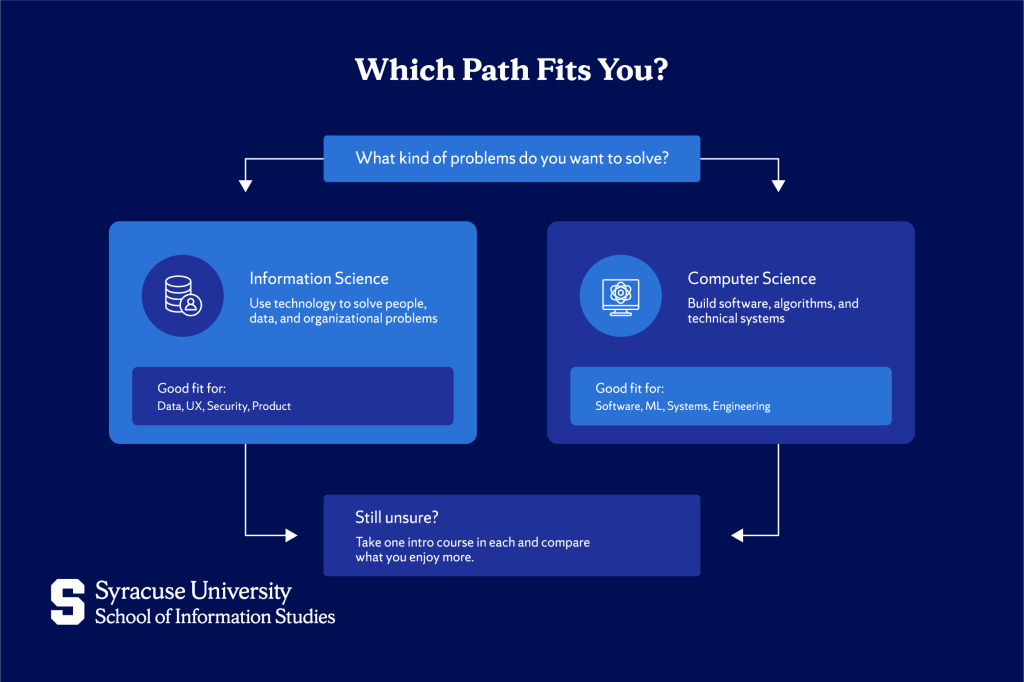
The answer depends on the kind of problems you want to spend your working life on.
Choose information science if…
You like technology but would rather apply it to data and organizational problems than write software all day, and you want room to move between data, UX, security, and product roles. If the calculus-and-proofs sequence is what’s holding you back, choosing information science is a reasonable call about where to put your effort, since statistics and programming stay central. Syracuse’s Bachelor’s in Information Management & Technology is built for this profile, with concentrations including data science, cybersecurity studies, applications of AI, and project management. According to the iSchool career outlook, 91% of the school’s 2025 undergraduates reported a placement.
Choose computer science if…
You want to write software for a living or work on machine learning and systems internals at a deep technical level, and you’re comfortable with a heavy math load or willing to grow into one. It’s the stronger path for pure software roles. Students in college forums often worry the entry-level software market has become crowded, yet BLS still projects 10% growth for software developers through 2035, more than three times the average. Computer science students who want the people-and-systems side can add the Information Management & Technology minor without changing majors.
If you are still undecided
Take one introductory course from each side in your first year, such as an intro programming course and an intro information technologies course, and notice which problems you want to keep working on. Switching between the two majors is common and easiest early, when first-year programming and quantitative courses may count toward either. On a resume, employers hire for the role, so each degree signals the job titles listed above more than a ranking. Students weighing whether information science is a good major in its own right can start with its outcomes and job paths.
Final Reflections on Information Science vs Computer Science
As AI tools take on more routine coding, two kinds of expertise become more valuable. One belongs to people who understand computation well enough to build and improve the models and systems themselves. The other belongs to people who understand data and the people who depend on it well enough to decide how those systems should be used, secured, and governed. Organizations need both, and graduates of the two majors increasingly work side by side on the same products.
At Syracuse University’s iSchool, our Bachelor’s in Information Management & Technology is built for students who want to work at that intersection: technical enough to build with data and systems, and grounded enough in people and organizations to decide what should be built. Students shape the degree through concentrations in areas such as data science, cybersecurity, AI, and cloud computing. If the applied path appeals to you, explore the program’s curriculum and concentrations to see which direction fits the problems you want to work on.
Frequently Asked Questions (FAQs)
Is information science the same as computer science?
No. Computer science focuses on algorithms and how software works, while information science studies how people and organizations use information, through coursework such as databases and user experience design.
Which is better, computer science or information science?
Neither is better overall. Computer science suits students aiming for software developer or research roles, and information science suits students drawn to data analysis, UX, or security work.
Which pays more, information science or computer science?
Computer science has the higher median at the software-developer end, though information security analysts, a common information science path, earn within about $7,000 of software developers’ median pay.
Does information science require coding?
Yes. Information science majors typically learn Python and SQL for working with data, and Syracuse’s program includes dedicated courses in Python and in programming for data analytics.
Is information science easier than computer science?
It’s different rather than easier. Nearly all computer science degrees require calculus and discrete math, while information science leans on statistics and puts more weight on design and communication.
Can I switch from computer science to information science, or the reverse?
Yes, and switching early is easiest. Introductory programming and quantitative courses may count toward either major, and computer science students can add an information management minor instead.