
Key Takeaways
- Information science is a strong major for students who want technology skills tied to real problem-solving, and it is broader and more focused on people and systems than pure computer science.
- The major opens a wide range of careers rather than one job title, including data analyst, UX and UI roles, project management, cybersecurity, systems analysis, and product work, and it is generally treated as a STEM field.
- It suits some students better than others, so it is worth weighing against computer science and information systems based on how much programming depth you actually want.
- Demand for information professionals keeps rising as organizations take on more data and AI tools, along with the security risk that comes with both, which keeps the major’s job outlook strong heading into 2027.
Is information science a good major? For the right student, yes. Information science studies how people use information and technology, and how data gets organized and protected so it can drive real decisions. It’s growing because organizations now run on data and AI tools, and they need people who can manage both without losing track of the humans involved.
Whether it’s a good major for you depends on a few practical things: what kind of work you want to do, where the degree leads, what those jobs pay, and how it compares with computer science in difficulty and focus. If you want the full picture of what information science is before weighing those questions, that’s a useful starting point.
Who Information Science Is a Good Major For
Information science is a good major for a particular kind of student, and naming that profile is more useful than a blanket yes. It tends to fit:
- Students who like technology but would rather apply it to real problems than write software all day
- Students drawn to the people side of technology, meaning how users interact with systems and how teams turn requirements into products
- Students who enjoy working with data, from organizing a messy dataset to turning the analysis into a decision someone acts on
- Career-switchers and undecided students who want a broad technology foundation before choosing a specialty
- Students who want technical skills without the heavy theoretical math and low-level programming load of a computer science degree
It’s a weaker fit for students who want to become deep software developers or spend their careers on algorithms and theory. Those goals are usually better served by computer science, which is the comparison most readers end up making.
Plenty of students find the fit only after they arrive. Parames Chanthasensack ’26 enrolled at Syracuse undecided, took an introductory information technologies course, and transferred into the iSchool to study information management and technology with a concentration in information security. As the undecided student who found a tech path at the iSchool put it:
“The decision I made to transfer has already benefited me.”
— Parames Chanthasensack ’26, Information Management and Technology
Jobs and Career Paths for Information Science Majors
The major’s biggest strength is breadth. Rather than funneling you into a single job, it opens a range of roles where technology and business meet. Common paths include:
- Data analyst: Turns raw data into reports and insights that guide business decisions.
- Systems analyst: Bridges business needs and IT, designing and improving the systems an organization runs on.
- UX or UI designer or researcher: Studies how people use products and shapes interfaces around their behavior.
- Project or product manager: Coordinates technical teams and owns the path from idea to launch.
- Cybersecurity analyst: Protects an organization’s data and systems from threats.
- Database or information architect: Designs how data is structured and stored so the right people can reach it.
- IT consultant: Advises organizations on technology strategy and how to put it in place.
Most of these roles are open to Bachelor’s graduates. Research, faculty, and senior research-scientist tracks are different: they typically call for a doctorate such as the PhD in Information Science and Technology.
Salary and Job Outlook
For typical bachelor’s-level outcomes, computer systems analysts are a close match, and they earn a median annual wage of $105,850. BLS projects employment in that occupation to grow 8 percent from 2025 to 2035, well above the 3 percent average for all occupations. At the research end, computer and information research scientists earned a median of $140,300, though that path usually requires a graduate degree. Because “information science” maps to many job titles rather than one, pay varies widely by role and location, so treat these figures as reference points rather than guarantees.
Information Science vs. Computer Science: Which Major Should You Choose?
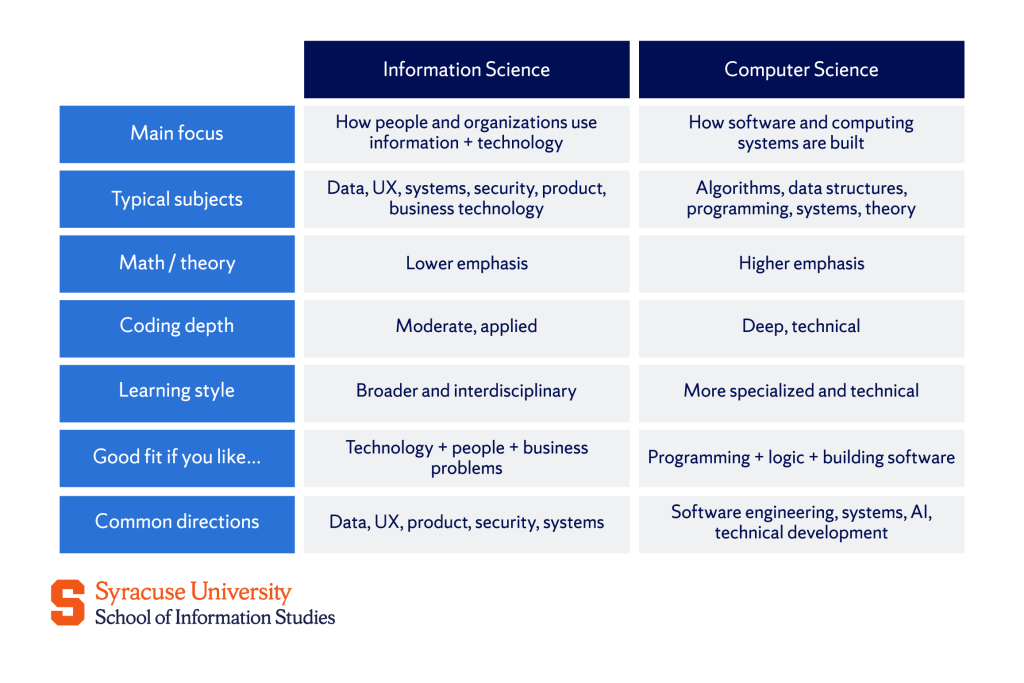
Computer science centers on building software and the theory behind it: algorithms, data structures, low-level programming, and a lot of math. Information science centers on how people and organizations use information and technology to solve problems. That makes it broader and more applied, with less theoretical math.
Computer science suits students who want to write software professionally or work deep in code. Information science suits students who want solid technical skills plus the flexibility to move into data, UX, product, security, or systems roles. Asking which one is harder misses the point, because they’re hard in different ways: computer science goes deeper on math and programming, while information science goes wider across disciplines.
At Syracuse, the Bachelor’s in Information Management & Technology is built around that technology-plus-business blend. Students majoring elsewhere can add the Information Management & Technology minor to build the same skill set alongside their primary field.
Is Information Science a Hard Major, and Is It Worth It?
Information science is moderately challenging, and it asks for real technical skill. Expect coursework in programming and scripting, databases and data management, data analysis, systems design, user experience, information security, and project management. It’s generally less math- and theory-intensive than computer science. For many students, the harder part is the range: you’ll move between a SQL assignment and a stakeholder presentation in the same week, and both need to be good.
The major is worth it if you want flexible, in-demand technology skills and several possible career directions rather than one narrow track. That verdict depends on fit. If you recognize yourself in the profile above, the degree gives you a lot of room to grow, backed by a job outlook that keeps improving. If your real goal is deep software development, computer science will serve you better.
Making the Call on an Information Science Major
The case for this major gets stronger each year. Organizations are adopting AI tools faster than they can govern the data behind them, and privacy and security expectations keep tightening. Every one of those pressures lands on people who understand information, the systems that hold it, and the humans who depend on it.
At Syracuse University’s iSchool, our Bachelor’s in Information Management & Technology is built to develop the technology, data, and problem-solving skills this kind of work requires, and students aiming at research or faculty careers can continue into the PhD in Information Science and Technology. If you’re leaning toward this path, request information from our admissions team and ask about the concentrations that match your interests. A good first conversation is often what turns an undecided interest into a clear direction.
Frequently Asked Questions (FAQs)
Is information science a STEM major?
Usually, computer and information sciences programs, including information science, appear on the Department of Homeland Security’s STEM Designated Degree Program List, which matters for international students seeking STEM OPT extensions.
What courses do information science majors take?
Expect a mix of technical and human-focused classes. At the iSchool, students take courses such as Human-Centered Design and Introduction to Applied Data Science alongside security and database work.
What is the difference between information science and information systems?
Information systems programs, often housed in business schools, focus on running technology inside companies. Information science is broader, covering data and the people who use it in any setting.
Do you need to know how to code for an information science major?
You don’t need prior coding experience to start, but you will learn it. Most programs teach Python and SQL early, since nearly every information role now involves scripting or queries.
Do you need a master’s degree after an information science bachelor’s?
Not for most roles. BLS lists a bachelor’s as the typical entry-level education for computer systems analysts, while a master’s mainly helps for specialized or leadership tracks.
Which industries hire information science graduates?
Finance, consulting, media, and technology firms all hire heavily. Recent iSchool graduates have joined employers such as BNY, Deloitte, IBM, and Warner Bros. Discovery.