
Key Takeaways
- Information systems integrates business processes with technology to solve organizational problems; computer science develops the underlying technology itself through algorithms, software, and theoretical foundations.
- Both information systems and computer science are projected to grow well above the average for all occupations through 2034, with strong BLS-projected demand and median wages above $100,000 for senior roles.
- Computer science typically requires significantly more advanced mathematics; information systems leans on applied statistics and business analytics instead.
Choosing between information systems and computer science can lead students toward different early career options. Both fields sit within a growing technology labor market, with the U.S. Bureau of Labor Statistics projecting computer systems analyst employment to grow 9% from 2024 to 2034, much faster than the average for all occupations. Each offers strong career potential, but they prepare students for different kinds of work.
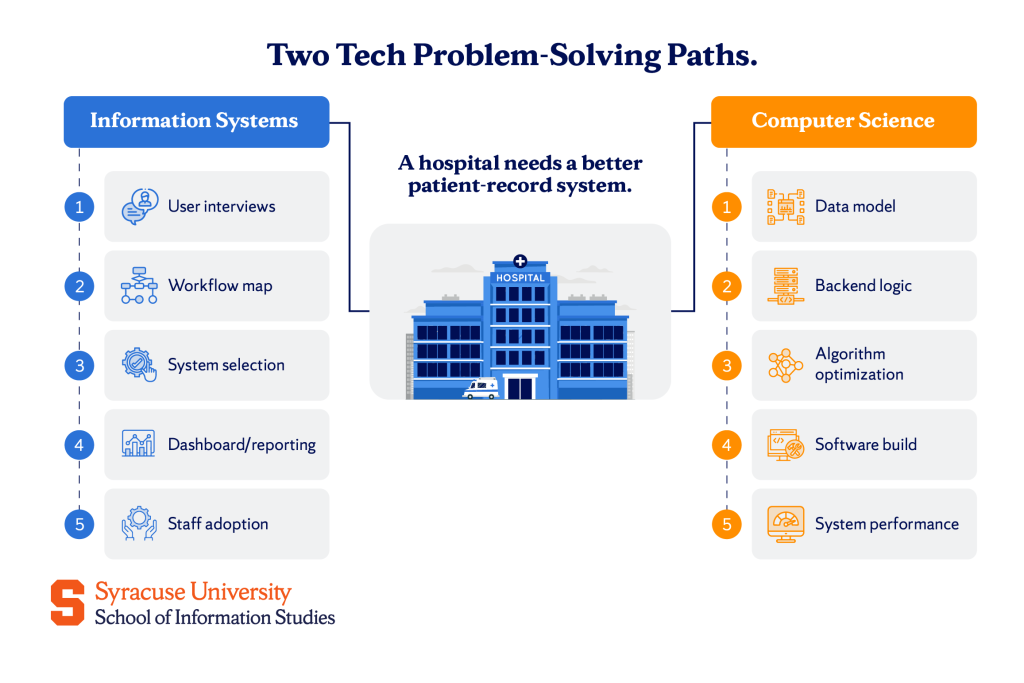
The information systems vs. computer science comparison starts with focus. Information systems uses technology to improve business operations and solve organizational problems. Computer science focuses on building the technology itself, including software, algorithms, systems, and the theoretical foundations behind them. The two areas overlap in tools and technical skills, but they ask different questions: how technology should support an organization versus how the technology should be designed and built.
Key Differences Between Information Systems and Computer Science
Both fields involve software and data, but the differences show up most clearly in focus, skills, daily work, and education.
Focus and objectives
Information systems (IS) professionals ask integration and operational questions of business technology: how does this system fit our process, what’s the ROI of replacing the legacy ERP, which CRM platform supports our sales workflow. The goal is stronger business operations, not the technology by itself.
Computer science (CS) professionals focus more directly on how the technology is built. They work on questions such as which algorithm solves a problem most efficiently, how a system can handle more users, or how complex a technical approach is. The output is built systems and computational advances.
The difference is clear even when both fields look at the same tool. A database might lead an IS graduate to ask whether it supports an audit workflow, while a CS graduate might ask how the query optimizer works. IS optimizes for organizational outcomes; CS optimizes for technical capability.
Required skills and tools
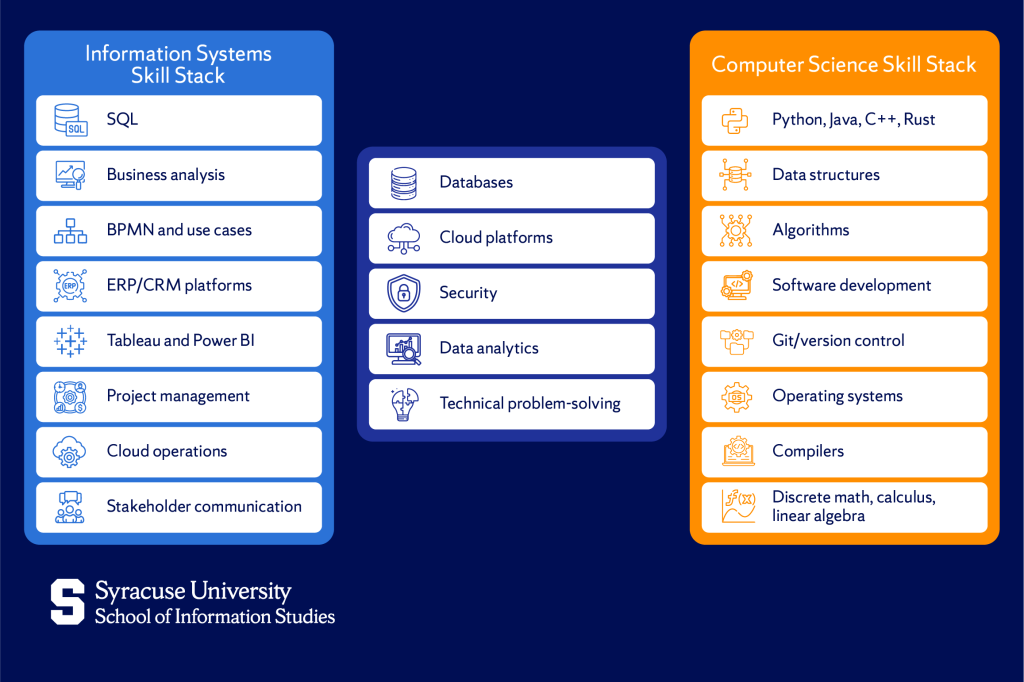
IS professionals work with SQL, business analysis frameworks such as BPMN and use cases, ERP and CRM platforms such as Salesforce, SAP, and Oracle, BI tools such as Tableau and Power BI, project management methods, and cloud platforms at the operations level.
CS professionals work more heavily with programming languages such as Python, Java, C++, and Rust, along with data structures, algorithms, software development practices, version control, compilers, operating systems concepts, and mathematical foundations such as discrete math, calculus, and linear algebra.
The two toolsets overlap in areas such as databases and cloud platforms, but they differ in purpose. IS does not usually require writing production code beyond SQL or light scripting, while CS does not usually center on business requirements documents, workflow mapping, or technology adoption plans.
Daily work and responsibilities
A typical IS day mixes stakeholder meetings, requirements gathering, system configuration or integration work, vendor evaluation, project planning, and reporting on system performance to leadership. The work is heavily collaborative and business-facing; understanding types of information systems and how each fits an organization’s needs is part of the daily judgment IS professionals use.
A typical CS day may include writing and reviewing code, debugging, designing algorithms or system architecture, working with software development teams, and improving the underlying technology over time. The work is heavily technical and tooling-focused.
The contrast can show up within the same organization. An IS graduate at a hospital network might spend the morning configuring a new patient-records integration with several stakeholders, while a CS graduate works on optimizing the query engine that integration depends on. IS work happens at the intersection of business and technology; CS work happens deep inside the technology.
Education paths and credentials
IS is commonly studied through a bachelor’s or master’s program in information systems, information management, or management information systems (MIS). These programs are often housed in an information school, such as Syracuse’s iSchool, or in a business school. The curriculum combines technology coursework with business analysis, organizational behavior, project management, statistics, and applied analytics.
CS is usually studied through a bachelor’s or master’s program in computer science, often housed in a college of computing, school of computing, or related technical division. The curriculum is more math-intensive, with coursework in calculus, linear algebra, discrete math, algorithm theory, programming languages, systems, and theoretical foundations.
The academic structure reflects the difference in focus. IS programs build combined business and technology fluency, while CS programs build deeper technical and mathematical depth.
Salary and Job Outlook Compared
Computer systems analysts earn a BLS median annual wage of around $103,000, while software developers earn approximately $133,000. The difference reflects the heavier coding and technical specialization usually associated with software development roles. It also shows why the IS vs. CS comparison should look beyond salary alone, since the day-to-day work and long-term advancement routes differ.
Both occupations are projected to grow much faster than average from 2024 to 2034: 9% for computer systems analysts and 15% for software developers. Pay also rises at the management level; computer and information systems managers, which includes many senior technology leadership roles, earn a median wage of $170,000+ per year, with the highest 10% earning more than $230,000. This is where IS-oriented careers can become especially competitive, particularly for professionals who move into leadership roles that connect technology strategy with business operations.
Where Information Systems and Computer Science Overlap
Information systems and computer science are different fields, but the line between them is not always clean. Data analytics and business intelligence are one example: IS graduates need stronger modeling skills, while CS graduates may work with business data inside real software systems. This is also where data science and computer science come closer together, especially in roles that combine modeling, software, and applied decision-making.
Security is another shared area. IS work usually centers on governance, compliance, and policy, while CS work is more focused on secure systems, technical defense, and system hardening. A third area is technical product management and architecture, where senior roles can bring business needs and technical decisions into the same job.
That middle ground has created roles such as IT business analyst, technical product manager, security analyst, and ERP architect. These jobs suit people who want business-facing work without leaving technical problems behind. They also reward professionals who understand systems, data, users, and organizational goals, a combination that is harder to find than one narrow skill set.
Which Path Should You Choose?
Choosing between IS and CS depends on the kind of work you want to do. If you are more interested in organizational problems, business systems, and how technology supports teams, IS is likely the better fit. If you are more interested in code, algorithms, systems, and software design, CS may be the stronger direction. IS usually relies more on applied statistics and analytics, while CS requires deeper math, including calculus, linear algebra, and discrete math.
The daily work also differs: IS is more collaborative and business-facing, while CS is more heads-down and technical. Both fields pay well and have strong demand, so neither choice is wrong on salary or job outlook alone.
At Syracuse University’s iSchool, three programs map to the information systems path. The Master’s in Information Systems is the traditional graduate path for students entering or advancing in IS work. The Bachelor’s in Information Management and Technology is the undergraduate option for students building IS skills from the start. The Online Master’s in Information Systems for Executives gives working professionals a flexible option for moving into IS leadership.
Making the Right Choice for Your Career
The choice between IS and CS can affect early career options, but it becomes less fixed over time. At senior levels, the two fields begin to share more responsibility for AI adoption, security, product decisions, and cross-functional technology leadership.
An IS leader may need enough technical judgment to evaluate AI systems or security tradeoffs, while a CS leader may need enough business context to build products people can use and organizations can support. Many professionals build that adjacent knowledge on the job rather than through a second degree. For students entering either field today, the strongest long-term position is depth in one discipline and real literacy in the other.
Frequently Asked Questions (FAQs)
Is information systems easier than computer science?
Computer science is typically more math- and theory-intensive; information systems is more business- and application-focused. “Easier” depends on which thinking style fits you; both fields require sustained effort to do well.
Can a computer science graduate work in information systems?
Yes. Many CS graduates move into IS roles like systems analyst, IT consultant, or technical product manager. The reverse is harder; IS graduates usually need additional CS coursework to compete for software development positions.
Which jobs hire information systems grads vs. computer science grads?
IS grads typically work as business systems analysts, IT project managers, ERP consultants, IT directors, and ultimately CIOs. CS grads typically work as software developers, ML specialists, and research scientists.
Does information systems require less math than computer science?
Generally yes. IS programs require statistics and applied data analytics, while CS programs require calculus, linear algebra, discrete math, and often higher-level math like algorithms theory and computational complexity.
Is information systems a STEM degree?
Most information systems programs in the U.S. are STEM-designated, which qualifies international graduates for the OPT STEM extension and makes the degree eligible for many STEM scholarships (though it’s worth confirming STEM status with each specific program).