
Key Takeaways
- An archivist is a trained professional who preserves, organizes, and provides access to historical records, including physical documents, photographs, audiovisual materials, and born-digital records.
- Most archivists hold a Master of Library and Information Science (MLIS) with an archives concentration, though some enter the field through an MA in history paired with archival training.
- Archivists work at federal agencies, universities, museums, religious institutions, corporations, and historical societies, preserving everything from government records to corporate histories.
More than 40,000 archivists, curators, and museum workers currently preserve the country’s documentary record, and the Bureau of Labor Statistics projects 6% job growth in that group through 2034, faster than average for all occupations. This guide answers what an archivist is, what the job looks like day to day, where these professionals work, what they earn, and how to break into the field, which is part of the broader area of information science.
What Is an Archivist?
An archivist is a trained information professional responsible for preserving, organizing, and providing access to records of enduring value. Archivists work with documentary materials, such as letters, government records, photographs, audiovisual files, and corporate documents, that institutions or individuals have chosen to keep for historical, legal, or cultural reasons. Unlike a records clerk who simply stores files, an archivist decides what’s worth keeping, builds the systems that make it findable decades later, and protects materials so they survive long after the people and events they document are gone.
Archival work is no longer limited to paper. Most archivists spend a substantial part of their week with digital records, including email archives, social media collections, born-digital documents, and electronic government files, using specialized digital-preservation tools to keep that material readable and authentic as software and file formats change. A university archive today might preserve a professor’s email correspondence alongside a 1920s handwritten letter, applying the same core principles of authenticity and context to two very different formats.
While archivists and librarians share an academic credential (MLIS) and sometimes overlap in the same building, the two roles work with different materials and serve different user needs. The profession has grown alongside the volume and complexity of records, and as institutions recognize that digital files require active, ongoing preservation rather than passive storage on a server.
What Archivists Do Day-to-Day
Archivists carry out a defined set of professional processes, regardless of whether the materials are paper or digital.
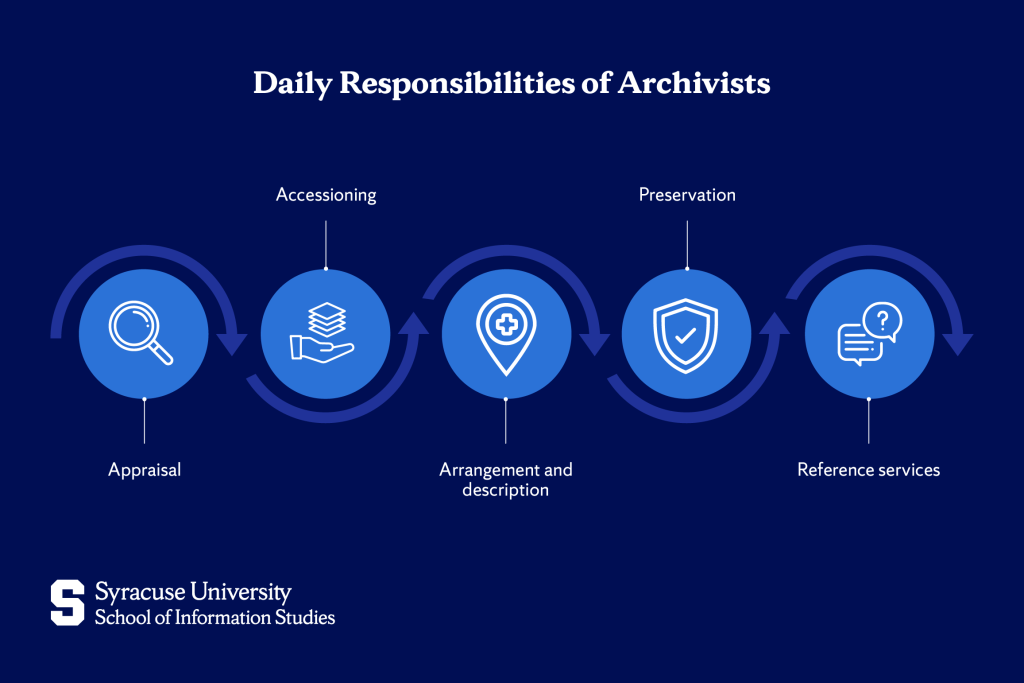
- Appraisal: Deciding which records have lasting historical, legal, or evidentiary value, since most records an organization creates are not meant to be kept forever.
- Accessioning: Formally taking custody of records and adding them to the archive.
- Arrangement and description: Organizing collections and writing finding aids, which are detailed guides that help researchers locate a specific letter, file, or item inside a larger collection.
- Preservation: Protecting materials from damage by controlling temperature and humidity, repairing fragile items, and moving digital files into current formats before older formats become unreadable.
- Reference services: Helping students, journalists, genealogists, and members of the public find the materials they need and understand what they are looking at.
A typical workday often includes several of these tasks. An archivist might spend the morning sorting a new collection, answer researcher questions in the afternoon, and later update records in a digital archive system such as Preservica or ArchivesSpace. Many archivists also help with exhibits, lectures, social media, grant writing, budgets, and donor communication.
The job can look different depending on where an archivist works and how large the institution’s staff is. Federal archivists tend to spend more time on reference and public access; corporate archivists do more selective preservation tied to brand and legal needs; university archivists balance research support with classroom teaching and student supervision. At a small historical society, one archivist may handle nearly everything. At a large institution like the National Archives, the same work is usually divided among specialized teams.
Where Archivists Work
Archivists work across a wide range of institutions.
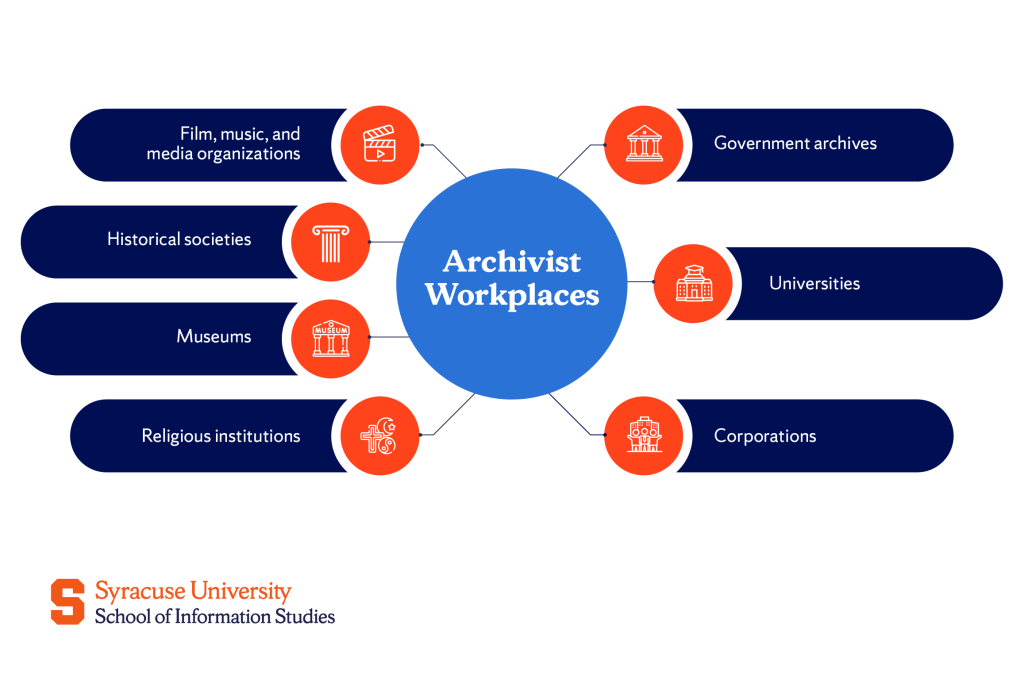
- Federal and government archives: These include the National Archives and Records Administration (NARA), the Library of Congress, presidential libraries, the Smithsonian, military service archives, state archives, city historical societies, and county courthouses. These institutions preserve public records, government documents, and materials with civic or historical value.
- Universities: Many archivists work in special collections, university archives, and rare book libraries. Examples include Yale’s Beinecke Rare Book and Manuscript Library, the University of Texas’s Harry Ransom Center, and Syracuse University Libraries.
- Corporations: Companies such as Coca-Cola, Disney, IBM, and major financial institutions employ archivists to preserve business records, brand history, product files, photographs, advertisements, and audiovisual materials. A corporate archivist might retrieve a 1970s product file for a trademark dispute or find archival footage for an anniversary campaign.
- Religious institutions: Dioceses, denominations, seminaries, and other faith-based organizations preserve church records, theological materials, correspondence, and institutional histories, sometimes dating back centuries.
- Museums: Archivists in museums often work alongside curators to manage documentary collections that support exhibitions, research, and public programming.
- Specialized settings: Archivists also work in historical societies, private foundations, family archives, film studios, music labels, broadcasters, and other organizations with records worth preserving.
At smaller institutions, archivists may share staffing, responsibilities, and physical space with academic librarians or museum staff.
Archivist Salary and Job Outlook
The Bureau of Labor Statistics reports that the median annual wage for archivists is around $61,000, according to its most recent data in the Occupational Outlook Handbook. Employment for these professionals is expected to grow by 6% from 2024 to 2034, driven by the increasing need to organize, preserve, and provide access to digital records.
Salaries can vary significantly depending on the employer. Federal archivists, especially those working at the National Archives and Records Administration (NARA) and presidential libraries, as well as senior corporate archivists, tend to earn above the median wage. Meanwhile, entry-level positions and roles at small historical societies or local archives usually pay less than the median. Specialized positions such as digital archivists, audiovisual archivists, and archives directors can also command higher salaries, especially when institutions require advanced preservation techniques or technical skills. According to BLS data, the highest 10 percent of archivists, curators, and museum workers earn more than $98,000 per year.
How to Become an Archivist
The standard credential for archivists in the United States is the Master of Library and Information Science (MLIS) with an archives concentration, typically from a program accredited by the American Library Association. Most full-time MLIS programs take roughly eighteen months to two years and include dedicated coursework in archival theory, processing methods, digital preservation, and professional ethics. No state license is required to practice as an archivist, unlike some regulated professions, making a graduate degree often the main credential employers look for.
A few paths into the field worth knowing about include:
- MLIS with archives concentration; the most common and flexible route, often paired with a practical portfolio built through processing projects, finding aids, or a digitization initiative.
- MA in history plus an archival certificate; an alternative offered at some schools, combining historical training with hands-on archival methods.
- Certified Archivist (CA) credential; a voluntary credential from the Academy of Certified Archivists, earned through a detailed exam, that signals advanced expertise to employers.
- SAA student membership; a common, low-cost way to start building a professional network in the Society of American Archivists before graduation.
At Syracuse University’s iSchool, students interested in archival careers may choose between two MLIS formats. The on-campus Master’s in Library and Information Science is designed for full-time graduate students who want to study in person with classmates and faculty. The Online Master’s in Library and Information Science offers more flexibility for working professionals who need to study around a full-time job and complete coursework on a schedule that fits their lives. Both programs hold the same accreditation, so the decision usually comes down to format, pace, and learning preference rather than credential strength.
The Evolving Role of the Archivist
For much of the field’s history, archivists worked mainly with physical records, but today, more records are created, stored, and accessed digitally. This means archivists need skills in digital preservation, metadata, and database management alongside traditional archival processing.
AI has not made archivists less necessary; it has made their expertise more important. As institutions use AI to process, describe, and search large digital collections, trained archivists are needed to protect provenance, authenticity, and context. Students entering the field now are stepping into a profession that pairs century-old preservation principles with digital infrastructure work.
Frequently Asked Questions (FAQs)
What’s the difference between an archivist and a curator?
Archivists preserve documentary records like papers, photographs, and digital files, while curators manage object collections such as art and artifacts. The two roles often overlap at small institutions, but credentials differ; curators typically hold museum studies degrees rather than an MLIS.
Can you become an archivist without an MLIS?
Yes, though it’s a less common path. Some archivists hold MA degrees in history combined with archival certificates. However, the MLIS remains the most common and most flexible route into the field.
What is the Certified Archivist (CA) credential?
The Academy of Certified Archivists offers a voluntary CA credential earned through a detailed exam covering archival theory and practice. It isn’t required for employment, but it signals advanced expertise and is recognized by major employers in the field.
Do modern archivists work with digital records?
Yes, digital preservation is now central to the job. Modern archivists manage email archives, born-digital records, social media collections, and electronic documents using tools like Preservica and ArchivesSpace to keep that material accessible and authentic.
Is an archivist a good career to pursue right now?
Yes. The Bureau of Labor Statistics reports a median annual wage of around $61,000 for archivists and projects 6% employment growth from 2024 to 2034. That makes it a stable field, and it may be a strong choice for students who want mission-driven work, enjoy research and organization, and are interested in digital records, preservation, metadata, and long-term access to information.