
Key Takeaways
- The six main types of libraries are public, academic, school, special, national, and digital, each serving a distinct audience with a distinct collection focus and professional role.
- Special libraries, serving corporations, hospitals, law firms, and research institutions, are usually less familiar to the general public.
- Digital libraries are a newer type of library and one of the fastest-growing areas in the field.
- Three of the most widely recognized national libraries are the Library of Congress in the United States, the British Library in the United Kingdom, and the Bibliothèque nationale de France.
The American Library Association estimates there are roughly 125,000 libraries of all kinds in the United States alone, a number that surprises most people who think of libraries only as the building down the street. In reality, the range is much wider than that, from local public branches to national institutions to fully digital collections that can serve millions of users at the same time.
The 6 Types of Libraries and Their Functions
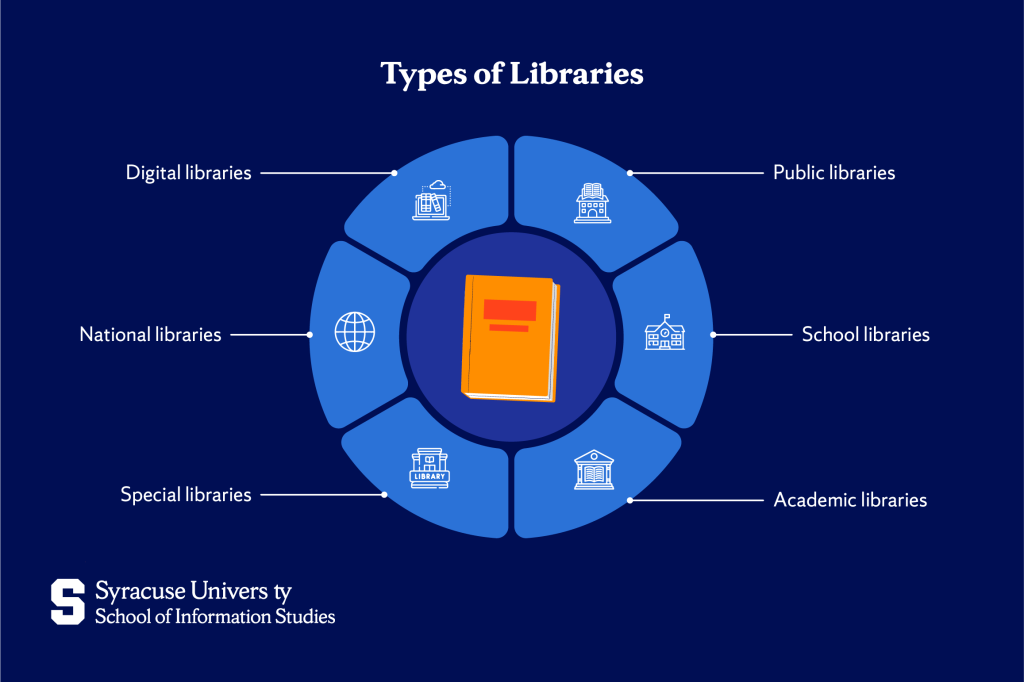
The six library types below are arranged by how familiar they are to people in everyday life. Public libraries come first because they are the type most people know and use, followed by other library settings that may be more specialized.
The American Library Association uses a similar framework as the foundation of professional library classification, typically naming four to five core categories. Digital libraries are included here as a sixth type to reflect how library services have expanded today.
1. Public libraries
A public library is a community-funded institution open to everyone, free at the point of use, serving patrons of every age, background, and reading level without requiring an academic credential or organizational affiliation. They are the most democratic institution in American civic life: no membership fee, no degree required, no reason to visit except curiosity or need.
The audience is genuinely everyone, including young children attending story time, teenagers working on school assignments, adults job-hunting or learning a new language, seniors accessing government services, and community members who simply want a quiet place to read. No other library type serves such a wide demographic range under one roof.
Well-known examples show how large public library systems can be. The New York Public Library system operates 88 branch locations across three boroughs and holds around 50 million items in its research collections. The Chicago Public Library runs 81 locations and serves one of the country’s most active urban library populations. Below those flagship systems, the more typical public library is a single-branch building serving one town or city district, smaller in size but carrying the same mission.
Public librarians handle community programming, reference services, early-literacy work, summer reading initiatives, technology assistance, and navigation support for government services and benefits. Public librarianship is the broadest application of the MLIS (Master of Library and Information Science) credential and one of the most common entry points into the library profession for new graduates.
2. School libraries
A school library, often called a library media center, serves students from kindergarten through twelfth grade, alongside the classroom teachers who collaborate with the librarian on curriculum design. The defining characteristic of this type is that the librarian’s role is fundamentally a teaching role, not just a collection management role.
The primary audience is K-12 students at the school the library serves, along with teachers who rely on the library as a curriculum resource and planning partner. Access is generally limited to the school community.
Examples include the library media centers inside American public high schools and middle schools, the school library programs administered by the New York City Department of Education across more than 1,800 schools, and K–12 library media programs in districts that have invested in dedicated library staff and updated collections. The quality and staffing of school libraries vary widely by district budget and state policy.
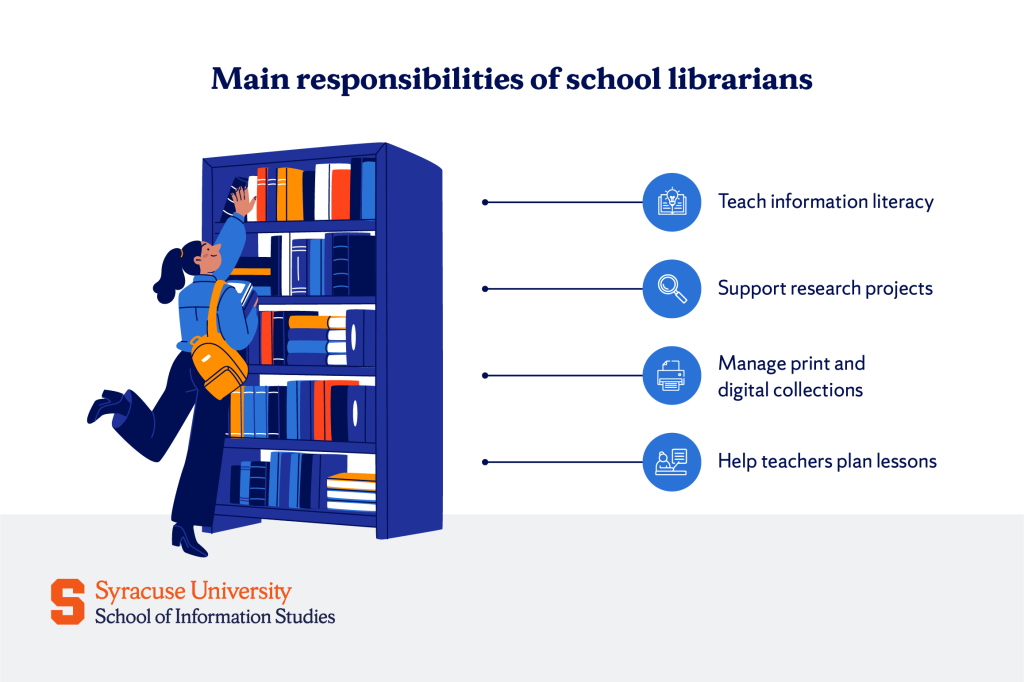
School librarians teach information literacy as a curriculum subject, support classroom research projects, manage print and digital collections aligned with grade-level standards, and collaborate with teachers on lesson design. Unlike most other library types, school librarians typically hold both an MLIS and a state-issued teaching credential, making it one of the more specifically credentialed roles in the profession.
3. Academic libraries
An academic library serves a college or university, with collections built around the institution’s research priorities, courses, and academic programs. Its main users are members of the campus community, including undergraduates, graduate students, faculty, postdoctoral researchers, and, in some cases, affiliated scholars from partner institutions.
These libraries provide access to scholarly books, journals, databases, archives, and other research materials. Access is usually tied to institutional credentials, though some academic libraries also offer community borrowing cards or limited public access.
Named examples include Syracuse University Libraries, the Cornell University Library system with its 20 subject libraries, and Harvard’s Widener Library (one of the largest academic libraries in the world). At a smaller scale, every liberal arts college and community college operates an academic library calibrated to its own curriculum and student population.
Academic librarians typically specialize by subject area, such as a chemistry librarian, a history librarian, a business librarian, and spend significant time on instruction, teaching information literacy as part of academic courses, supporting faculty research and grant work, and managing scholarly communication and open-access publishing programs.
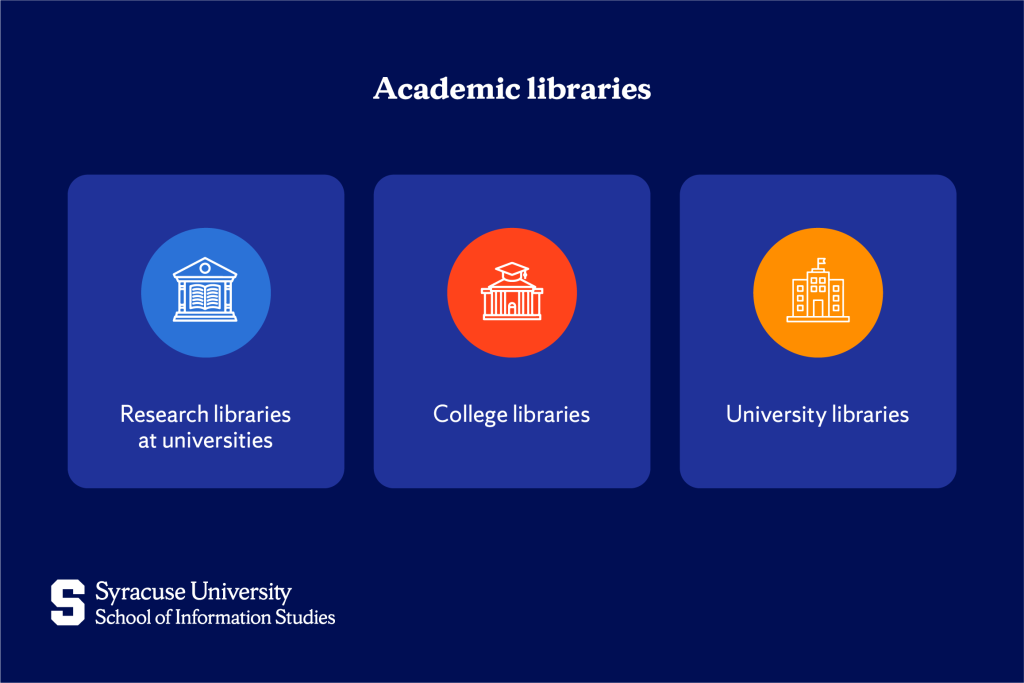
Academic libraries often differ by the size and purpose of the institution they serve: research libraries at major universities, college libraries at smaller institutions with a mostly undergraduate focus, and university libraries serving all schools and programs within a large institution.
4. Special libraries
A special library serves a single organization, profession, or subject area, and is generally closed to the general public. They are usually less familiar to the general public because most people are more likely to use public, school, or academic libraries.
The audience is the employees or members of the host organization. That organization might be a corporation, a hospital, a law firm, a government agency, a museum, a pharmaceutical company, a research institute, a religious institution, or a professional association. What makes it “special” is the narrow, deep focus of both the collection and the librarian’s expertise.
Recognizable examples help show what special libraries do. The law library at a major firm like Wachtell, Lipton, Rosen & Katz serves attorneys who need precision legal research support. The medical library at the Mayo Clinic serves clinicians and researchers in a high-stakes healthcare environment. The art library at the Museum of Modern Art (MoMA) maintains collections that support curatorial and research work unavailable anywhere else. Corporate research libraries at pharmaceutical companies support drug development programs with scientific literature services that directly affect product pipelines.
Special librarians often bring deep subject knowledge to their work. Medical librarians may have additional training in health sciences, while law librarians may hold a JD alongside their MLIS. In many settings, the role also includes competitive intelligence, taxonomy and metadata work, and research data management.
Data librarianship is one growing example of this shift. Syracuse iSchool alumna Heather Owen, who earned an MLIS and a certificate of advanced study in data science, now works as a Data Librarian at the University of Rochester. Her role includes teaching data workshops, helping researchers create data plans, supporting access to data repositories, and advising on how data should be organized, preserved, and shared. Her career shows how MLIS graduates are moving into roles that connect library science with data management.
5. National libraries
A national library holds a legal or constitutional mandate to preserve a country’s published works and serve as a national reference resource. Its distinguishing feature is scope: where every other library type serves a defined local or organizational community, a national library serves an entire country and is typically funded by the national government.
The audience is researchers, government officials, and the public in a research capacity. National libraries are generally not lending libraries in the conventional sense; they exist to preserve and provide access to the national record, not to circulate items for home use.
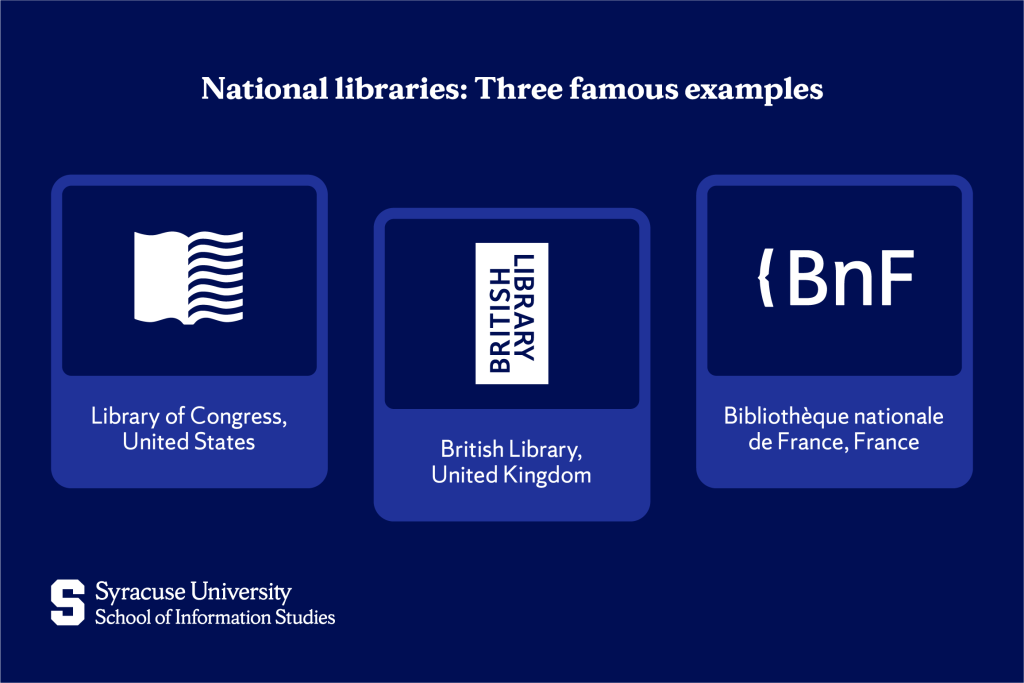
Three of the most widely recognized national libraries are the Library of Congress in the United States, which holds more than 170 million items and serves as the research arm of the U.S. Congress; the British Library in the United Kingdom, which receives a copy of every book published in the UK under legal deposit law; and the Bibliothèque nationale de France, which performs the same function for French publishing and holds one of the world’s most significant manuscript collections.
National library work centers on preservation and conservation, cataloging at scale, specialized collections curation covering rare books, manuscripts, government documents, and born-digital archives, and policy work supporting copyright and information access at the national level. Librarians in national institutions often hold advanced subject credentials alongside their MLIS and work in highly specialized roles that may focus on a single collection type for an entire career.
6. Digital libraries
A digital library exists primarily or entirely online, providing access to collections that may include digitized versions of physical materials, born-digital content, or both. It is the most recent addition to the traditional five-type framework and one of the fastest‑growing areas in library services, as institutions shift collections online and born‑digital content continues to expand.
The audience is anyone with an internet connection, often without geographic or institutional restriction. That open-access orientation distinguishes digital libraries from most other library types, where access is tied to geography, enrollment, or organizational membership.
Well-known digital libraries show how broad this category can be. The Digital Public Library of America (DPLA) aggregates collections from libraries, archives, and museums across the country into a single freely accessible platform. HathiTrust Digital Library holds digitized content from major research libraries and makes public-domain works freely available. The Internet Archive preserves websites, software, and digital media alongside its Wayback Machine. Project Gutenberg focuses specifically on public-domain books in digital format. JSTOR operates as a hybrid academic and digital case, providing digital access to academic journals primarily through institutional subscriptions.
Digital librarians work in digital curation, metadata architecture, copyright and licensing management, and partnerships with academic and public institutions. The same MLIS credential applies, but the work is increasingly focused on web-scale information systems rather than physical collections.
Three subtypes capture the range of digital library work: institutional repositories such as Cornell’s eCommons, which archive the university’s own research output; open-access platforms like DPLA and Project Gutenberg; and digitization projects within larger institutions, such as the Library of Congress’s American Memory project, which has digitized millions of historical photographs, maps, and documents.
Many librarians work across more than one library type over the course of a career, moving from an academic library to a special library role, or from public library work into a digital collections position. For readers ready to think about which type of library they want to work in, the path starts with understanding how to become a librarian and which MLIS concentrations align with each setting.
Bringing the Library Types Together
The six-category framework above remains useful for career planning and professional education, but the boundaries between types are blurring in practice.
Many public libraries now run significant digital collections and partner with academic institutions on research access. Academic libraries are doing community-facing outreach that looks more like public library programming than traditional research support. Special libraries inside technology companies and research-driven corporations have evolved to look more like knowledge management and data teams than the corporate library of a generation ago. The categories describe where librarians tend to specialize; they describe less well where any individual library actually stops and starts.
At Syracuse University’s iSchool, the Master of Library and Information Science prepares librarians for every type of library covered above, with concentrations and elective tracks that let students focus on the setting that fits them best, whether that’s public librarianship, academic research support, data librarianship in a special library, or digital collections work.
For students who need flexibility, the online MLIS program delivers the same curriculum with a schedule designed for working professionals. Explore the program to find the concentration that matches your direction.
Frequently Asked Questions (FAQs)
What are the four classifications of libraries?
Traditional frameworks name four core types (public, academic, school, and special) with national libraries sometimes added as a fifth.
What is the most common type of library?
Public libraries are the most common type by location count, with the American Library Association estimating roughly 9,000 outlets (main libraries and branches) across the United States, many organized into multi‑branch systems.
Which type of library should I work in?
The best fit depends on the audience you want to serve and the subject area you want to specialize in. For example, public librarianship suits those drawn to community programming and broad service, while academic, special, or digital library roles suit those who want deeper subject focus or technical specialization in areas like data curation or research support