
Key Takeaways
- The digital divide describes gaps in who can access, use, and benefit from digital technology.
- Economic factors, geography, education, and age all contribute to technology inequality.
- Digital gaps affect education, employment, healthcare access, and social participation.
Your daughter’s teacher emails an assignment at 8 p.m. Your doctor’s office only schedules appointments online. Your employer expects you to complete training modules from home. The government portal requires digital verification for benefits.
For millions of people, these everyday expectations create impossible barriers. Not everyone has reliable internet, a working device, or the skills to use digital systems confidently.
The modern world runs on digital tools: for learning, working, accessing healthcare, and staying connected. Yet despite this reliance, benefits don’t reach everyone equally. Some communities thrive with high-speed internet and cutting-edge devices, while others struggle with spotty connections and outdated equipment.
This uneven access creates real challenges. Understanding the digital divide, what it is, why it exists, and how it affects daily life, is the first step toward building a more inclusive digital future.
What Is the Digital Divide?
The digital divide refers to the gap between people who have meaningful access to digital technology and those who don’t. It’s not just about owning a smartphone or having an internet connection; it’s about the quality of that access, the skills to use it effectively, and the ability to benefit from digital opportunities.
This divide appears at every level: globally between developed and developing nations, nationally between urban and rural areas, and locally between neighborhoods just miles apart. A family with fiber-optic internet and multiple laptops experiences technology differently from a household sharing one smartphone with unreliable mobile data.
The gap affects specific groups more severely. Low-income communities often can’t afford devices or monthly internet bills. Rural areas lack the infrastructure for high-speed connections. Older adults may have access but lack confidence using digital tools.
According to the Pew Research Center, as of 2025, 4% of U.S. adults don’t use the internet at all, and this rises to 10% among those 65 and older.
Types of Digital Divide
Digital inequality operates on multiple levels. Understanding these distinctions helps explain why simply providing internet access doesn’t solve the problem.
Access divide
The access divide describes disparities in who can connect to the internet and own digital devices. Rural communities face significant infrastructure gaps because installing broadband in sparsely populated areas costs more per household, making it less profitable for internet providers.
Even in areas with available service, cost creates barriers. Households earning less annually are more likely to lack home internet compared to higher-income households. Some families can only afford mobile-only internet plans, which limit what activities are practical. For example, filling out job applications or completing homework becomes frustrating on a small screen with data caps.
Device ownership matters too. When multiple family members need devices simultaneously for school and work, someone gets left out.
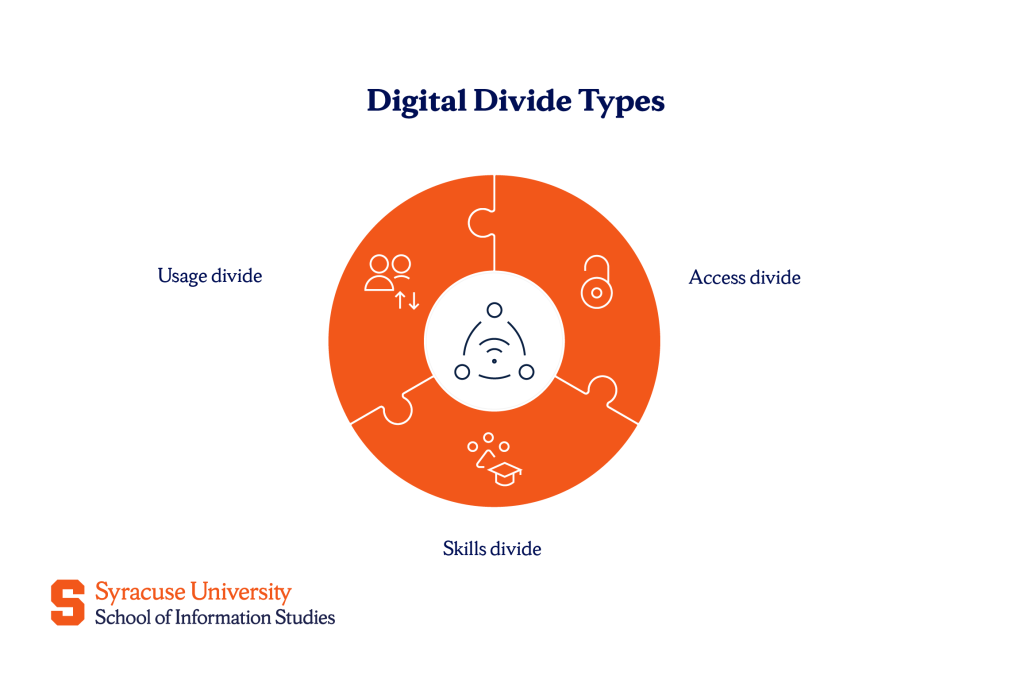
Skills divide
The skills divide refers to differences in digital literacy: the ability to navigate technology effectively, safely, and productively. Having access to the internet means little if you don’t know how to use it or feel intimidated by digital tools.
Digital literacy includes practical skills like using email, searching for information online, recognizing phishing scams, managing privacy settings, and completing online forms. It also encompasses critical evaluation, distinguishing reliable sources from misinformation and protecting personal information.
Many people struggle to feel confident using modern technology. According to AARP research, 64% of adults over 50 feel that technology is not designed with their age group in mind.
Students from well-resourced schools often receive regular technology training, while students in under-resourced districts may have limited exposure beyond basic tasks. This creates workforce readiness gaps that extend long after graduation.
Usage divide
The usage divide describes how people use digital technology differently based on their socioeconomic status and education. Not all internet use creates equal opportunities.
Some people primarily use technology for entertainment, such as streaming videos, gaming, or social media. Others use it for education, career advancement, financial management, and civic participation. Research shows that higher-income users engage in more “capital-enhancing” activities like online courses and job networking, while lower-income users often engage in more passive consumption.
The usage divide also relates to device type. Try writing a resume or navigating complex government forms on a smartphone. It’s technically possible but frustrating, which discourages people from completing important tasks.
Causes of the Digital Divide
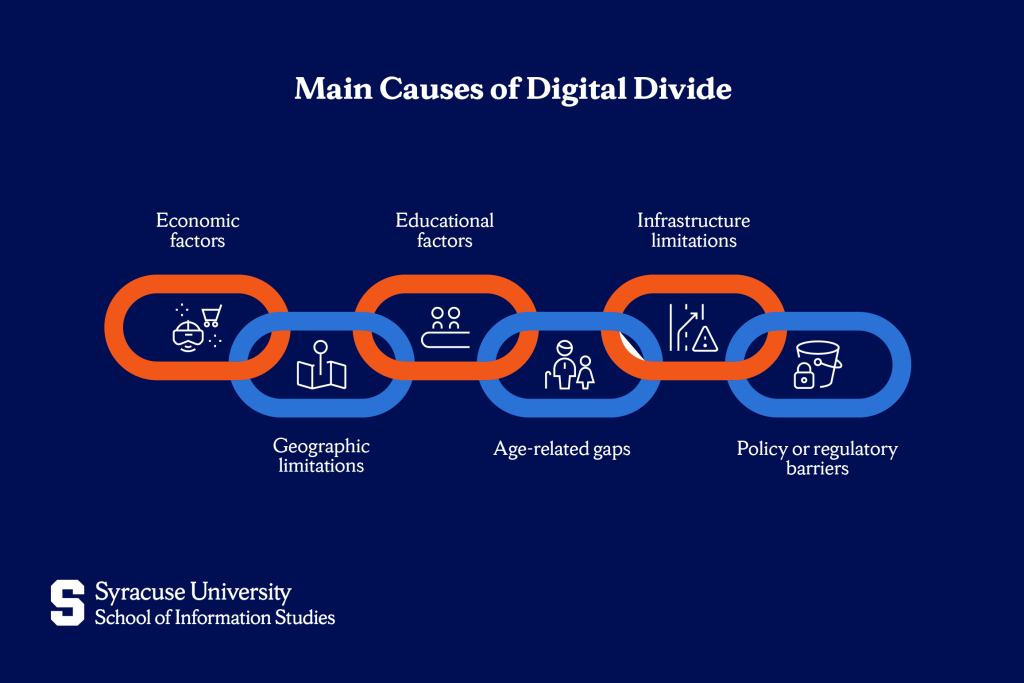
Digital inequality results from multiple overlapping factors:
- Economic factors: A new laptop costs several hundred dollars, and monthly internet bills ranging from $50 to $100 add up to $600 to $1,200 annually. These cumulative costs put consistent digital access out of reach for millions of households.
- Geographic limitations: Recent data confirms that rural Americans are close to 20 times more likely than urban residents to lack access to fixed broadband service.
- Educational factors: Schools in lower-income districts often have outdated equipment and less robust tech curricula. Students graduate without the digital skills their peers from better-resourced schools take for granted.
- Age-related gaps: Older adults often lack confidence using technology and feel excluded from systems that assume digital fluency.
- Infrastructure limitations: Some areas still rely on aging copper telephone lines or satellite connections. Infrastructure upgrades require massive investments that many communities can’t fund independently.
- Policy or regulatory barriers: When digital access isn’t treated as essential infrastructure, investment remains fragmented and uneven.
Understanding digital transformation helps contextualize why these barriers matter. As more systems become digital-first, limited access to technology can quickly turn into fewer opportunities.
Effects of the Digital Divide
The digital divide affects learning, work, healthcare, and participation in society, often making existing gaps even wider.
Education
The digital divide limits students’ ability to complete homework, access online resources, and participate in remote learning. Students without home internet struggle to access learning management systems, submit digital assignments, or conduct online research. The educational impact compounds over time, as students who fall behind often struggle throughout their academic careers.
Employment
Most employers now require online applications. U.S. Census Bureau data shows that higher-wage workers were significantly more likely to work remotely, while lower-wage workers couldn’t. This wage gap often correlates with digital access.
Career training increasingly happens online. Workers without digital access to skill-building courses and certifications can’t stay competitive. The shift toward remote work models further disadvantages people without quality home internet setups.
Healthcare
According to the American Medical Association, approximately 80% of healthcare providers offered telehealth in 2022, but significant disparities exist in who can access these services. Older adults, rural residents, and low-income patients face the greatest barriers.
Healthcare systems increasingly rely on patient portals for appointments, test results, and prescription refills. Patients without digital access must call during business hours, often missing time-sensitive medical information.
Social participation
The National Digital Inclusion Alliance reports that citizens without digital access face significant barriers to accessing public services and engaging with elected representatives. Government services from tax filing to benefit applications have moved online.
Banking has shifted digital, too. People without digital banking access pay more in fees for check cashing and money orders. The shift toward digital civic participation means residents without access have less ability to influence decisions affecting their communities.
Examples of the Digital Divide
The digital divide affects people differently based on where they live, their income, their age, and the technology available to them. The examples below show how limited digital access can create real challenges in everyday life.
- Rural student: A girl lives 45 minutes from her high school in a rural area. Her family can’t afford satellite internet, so she completes all homework at school or the public library. When assignments are posted after hours, Maria falls behind.
- Low-income family: A family shares one smartphone among five people. When both parents need to search for jobs online and two kids have homework, decisions get made about whose needs take priority.
- Older adult: A person is 72 and recently widowed. His doctor’s office switched to an online patient portal. He has a computer but feels overwhelmed creating accounts. He avoids the system and waits weeks for appointments.
- Limited infrastructure: A town of 3,000 residents has one provider offering 10 Mbps maximum speeds. Students struggle with online learning platforms, and local businesses can’t compete because they lack bandwidth for modern systems.
How to Bridge the Digital Divide
Closing the digital divide requires coordinated efforts that address access, skills, and long-term support. Bridging this gap is not about a single solution, but about combining infrastructure development, education, policy action, and cross-sector collaboration to ensure that digital access becomes more equitable and sustainable.
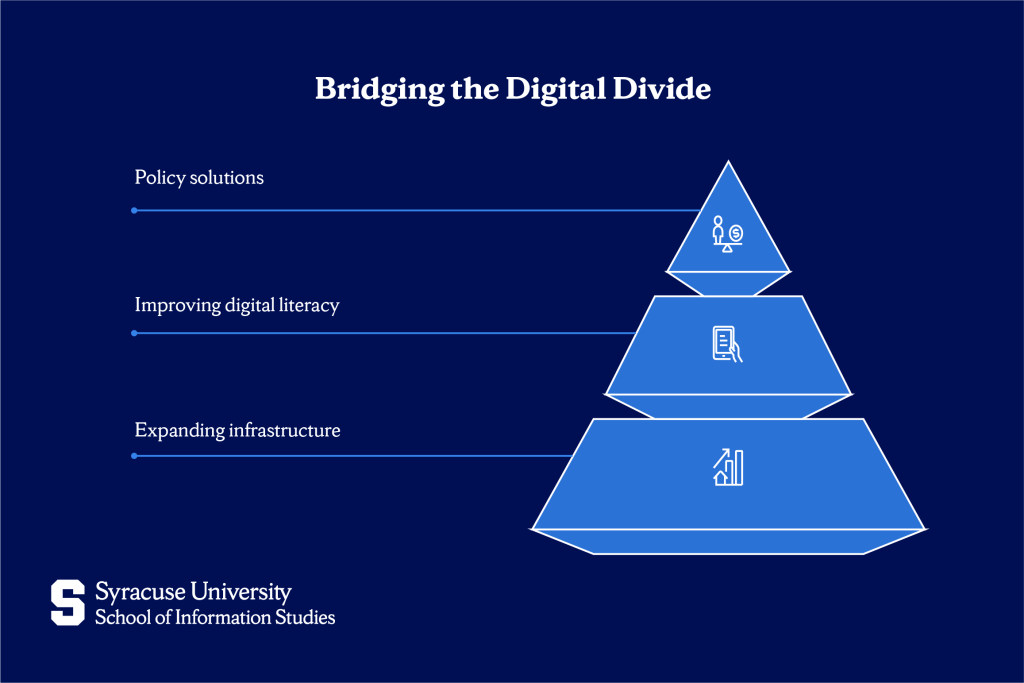
Expanding infrastructure
Infrastructure investment forms the foundation of digital inclusion. Federal and state broadband initiatives now focus on expanding affordable internet access through large-scale infrastructure funding, including nationwide broadband deployment programs and state-managed subsidy efforts. State and local governments also support broadband expansion through public–private partnerships aimed at reaching underserved communities.
At the local level, libraries, schools, and community centers provide essential access by offering free Wi-Fi, computers, and basic technology support. Device donation programs collect used laptops, refurbish them, and distribute them to students and low-income families.
Improving digital literacy
Schools integrate digital skills throughout the curriculum. Libraries offer free digital literacy workshops for adults, covering basics like email, online safety, and job searching. Community organizations target specific populations with tailored training: programs for older adults move at a comfortable pace, while programs for immigrants offer multilingual instruction.
Policy solutions
Federal programs like the Broadband Equity Access and Deployment Program allocate billions to expand broadband in underserved areas. Subsidy programs reduce cost barriers, and school districts receive E-Rate funding for internet access and technology.
Digital inclusion is advanced through education at institutions like Syracuse University’s Innovation, Society, & Technology Bachelor’s Degree program, which prepares students to address technology’s societal impacts.
Support from private and nonprofit sectors
Tech companies donate devices and fund digital literacy programs. Microsoft’s Airband Initiative and Google’s Project Connect work to expand broadband in underserved communities. Nonprofits like EveryoneOn connect families to affordable internet, while PCs for People refurbishes and distributes computers.
Progress is often strongest when different groups work together. Partnerships between schools and local businesses, libraries and internet providers, or nonprofits and government agencies allow resources and expertise to be shared, leading to solutions that no single organization could create on its own.
Moving Toward Digital Equity
Digital equity requires ongoing effort from many groups. Understanding the digital divide shows the size of the problem, but real progress happens when people and institutions take action. This includes schools improving technology access for students, libraries expanding community services, businesses investing in inclusive infrastructure, and governments treating digital access as essential.
Communities that prioritize digital inclusion see clear outcomes, including students completing their education, workers accessing employment, and patients managing their health more effectively. Over time, these individual gains contribute to broader community improvement.
Everyone has a role to play. Educators, voters, volunteers, and professionals all influence how digital access is expanded and supported. For those interested in contributing through education and policy, Syracuse University offers programs that examine technology’s societal impact and prepare students to address complex challenges related to equity and access.
Frequently Asked Questions (FAQs)
What is the main cause of the digital divide?
There’s no single cause; multiple overlapping factors create digital inequality. Economic barriers (cost of devices and service), geographic limitations (lack of rural infrastructure), educational gaps (limited digital literacy), age-related differences, and policy shortcomings all contribute.
How does the digital divide affect students?
Students without reliable internet and devices struggle to complete homework, access online resources, and participate in virtual learning. These gaps create long-term educational disadvantages that affect college readiness and career prospects.
Who is most affected by the digital divide?
Low-income households, rural residents, older adults, people with disabilities, and some racial and ethnic minorities experience the most significant barriers.
How does the digital divide impact daily life?
Digital inequality affects education (completing homework, accessing courses), employment (job applications, remote work), healthcare (telehealth appointments, patient portals), and social participation (staying connected, accessing government services). As more essential services move online, the divide increasingly determines who can participate fully in modern society.