
Key Takeaways
- Human-centered design prioritizes deep empathy and understanding of people’s needs before creating solutions.
- The HCD process includes three phases: Inspiration (discovery), Ideation (design), and Implementation (delivery).
- HCD is the philosophy of putting people first, while design thinking is the structured process for applying that philosophy.
You’ve probably fought with a door that won’t open the way you expect. Or clicked through a checkout process that somehow takes seven steps when two should be enough. Those moments are frustrating for a reason: they happen when solutions are built without really understanding the people who have to use them.
Now think about the products you genuinely enjoy using. The apps that feel intuitive. The services that seem to know what you need before you do. The tools that just work, without explanation. Behind each one is a team that paused to ask a few simple but important questions: “What do people actually need here?” “How do they think?” “What problem are we really trying to solve?”
That’s human-centered design. It isn’t about what’s technically impressive or what looks good in a presentation. It starts with people; their frustrations, their context, their real-world constraints, and builds from there. In this article, you’ll learn what human-centered design is, how it differs from design thinking, the core principles behind it, and the three-phase process teams use to create solutions that actually work in practice.
What Is Human-Centered Design?
Human-centered design (HCD) is a creative approach to problem-solving that prioritizes the needs, behaviors, and contexts of the people you’re designing for. Instead of starting with technology or business goals, HCD begins by deeply understanding the humans who will use what you create.
It’s a philosophy that guides how you think about problems. It focuses on involving users throughout the process of creating something, not just at the end when you’re testing the finished product. You observe how they work, listen to their frustrations, understand their environment, and co-create solutions that fit their lives.
Human-centered design looks at the whole person (their emotions, motivations, cultural context, and community) rather than treating them as a “user” clicking buttons on a screen. While user-centered design focuses primarily on how someone interacts with a specific product or interface, HCD zooms out to consider the broader human experience. It asks not just “Can they use this?” but “Does this actually improve their life?”
Human-Centered Design vs. Design Thinking
People often use “human-centered design” and “design thinking” interchangeably, but they’re not the same thing. Human-centered design is the overarching mindset or philosophy; the commitment to putting people first in everything you create. It’s the “why” behind your work and the “who” you’re serving. HCD is about cultivating empathy, questioning assumptions, and staying focused on human needs even when business pressures push you toward faster or cheaper solutions.
Design thinking is the specific process or toolkit you use to apply that philosophy. It’s the structured approach (empathize, define, ideate, prototype, test) that helps teams move from problem to solution. Design thinking provides the “how”: the workshops, exercises, and methods that translate human insights into actionable solutions.
So, HCD is the compass that keeps you oriented toward people. Design thinking is the map that shows you how to get there. You can practice design thinking without being truly human-centered (just going through the motions), and you can be human-centered without following a formal design thinking process. But together, they create powerful results.
Understanding this relationship matters for anyone working in IT project management or leading innovation efforts. You need both the mindset and the methods to create solutions that resonate.
Core Principles of Human-Centered Design
Human-centered design is guided by a specific set of principles that shape how teams approach problems. While they aren’t rigid rules, they’re mindsets that help you stay focused on creating meaningful solutions.
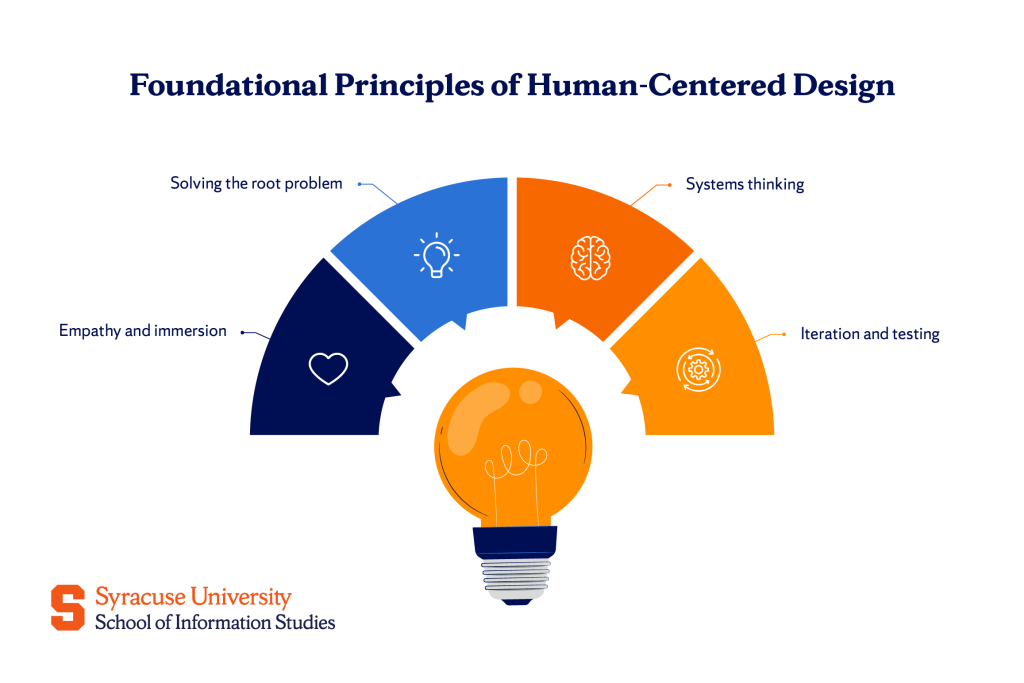
Empathy and immersion
Deep understanding of people (not just data points) is the foundation of HCD. Numbers can tell you what’s happening, but only empathy tells you why. You need to immerse yourself in users’ environments to understand their reality, not just interview them in a conference room.
This means observing how people actually work, not how they say they work. It means spending time in their context, be it a hospital, a classroom, or someone’s home, to see the challenges they face. You’re looking for the unspoken frustrations, the workarounds they’ve created, and the moments where current solutions fail them.
Empathy isn’t sympathy. It’s about setting aside your assumptions and experiencing the world from someone else’s perspective. When you combine qualitative insights with data analytics, you get a complete picture of both behavior patterns and emotional drivers.
Solving the root problem
HCD involves questioning assumptions to ensure you’re solving the right problem, not just a symptom. Too often, teams jump straight to solutions without fully understanding what’s wrong. You might think people need a faster checkout process when what they really need is clearer product information, so they don’t abandon their carts in the first place.
Reframing the problem based on research is essential. After gathering insights, you’ll often discover that the problem statement you started with was incomplete or even wrong. That’s not failure; it’s progress. The willingness to redefine the problem based on what you learn separates human-centered work from assumption-driven design.
This principle asks you to keep asking “why” until you reach the underlying issue. Surface-level solutions might create short-term fixes, but addressing root causes creates lasting change.
Systems thinking
Designers must consider the broader ecosystem (social, cultural, environmental, and economic) in which the solution lives. A product doesn’t exist in a vacuum; it affects and is affected by its surroundings. Understanding how solutions fit within larger information management systems prevents unintended consequences.
For example, designing a mobile health app requires understanding not just the interface, but internet access patterns, cultural attitudes toward technology, privacy concerns, and how information flows between patients and providers. Systems thinking helps you spot potential barriers and leverage existing resources.
This principle also acknowledges that your solution might impact people beyond your primary users. A tool designed for teachers affects students, parents, administrators, and IT staff. Considering these ripple effects leads to more sustainable and equitable solutions.
Iteration and testing
HCD embraces a non-linear approach: continuously testing, failing early, and refining based on feedback. “Perfect” is the enemy of “good” in the early stages; rough prototypes are essential because they help you learn faster. You’re not trying to impress anyone with your first attempt; you’re only trying to discover what works.
This means getting comfortable with failure as a learning tool. Each failed prototype teaches you something valuable about user needs, technical constraints, or implementation challenges. The faster you fail, the faster you learn, and the better your final solution becomes.
Iteration also means staying open to feedback that challenges your ideas. Users might reject solutions you love or gravitate toward features you considered minor. Listening to that feedback and adjusting accordingly is what separates human-centered work from ego-driven design.
The Three Phases of the Human-Centered Design Process
While HCD is fundamentally a mindset, most teams follow a structured workflow to apply it consistently. The framework popularized by IDEO and other design firms breaks the process into three phases that guide teams from problem to solution. These phases aren’t strictly linear, as you’ll often loop back as you learn more.
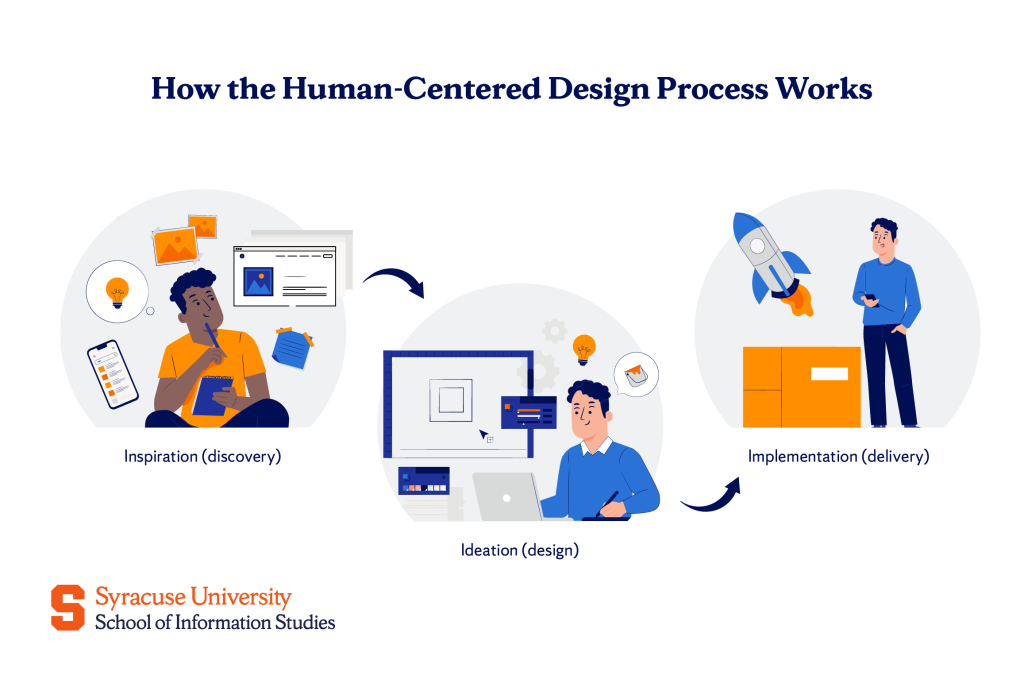
Phase 1: Inspiration (discovery)
This is the research phase where you immerse yourself in the context, observe behaviors, and gather insights. You’re not solving anything yet; you’re just learning everything you can about the people you’re designing for and the challenges they face.
Focus on qualitative research methods like interviews, observation, and ethnographic studies. Watch how people interact with current solutions, listen to their stories, and identify patterns in their experiences. You might shadow nurses during shifts, visit students’ homes to understand homework environments, or observe how elderly users navigate public transportation.
The goal is to build empathy and uncover needs that people might not articulate directly. Often, the most valuable insights come from what people do rather than what they say. You’re also gathering data where relevant, like usage patterns, demographic information, and behavioral metrics that complement your qualitative insights.
By the end of this phase, you should have a clear understanding of who you’re designing for, what problems they face, and why those problems matter. You’ll synthesize your findings into insights that guide the next phase.
Phase 2: Ideation (design)
This is the brainstorming phase where you generate many ideas, synthesize research, and create rough prototypes. You start with divergent thinking, creating as many potential solutions as possible without judgment. Quantity matters more than quality at this stage because unexpected ideas often emerge from wild suggestions.
Then you shift to convergent thinking: evaluating ideas against your insights and making choices about which concepts to prototype. You’re not building finished products yet; you’re creating low-fidelity mockups that let you test core concepts quickly. These might be paper sketches, role-playing scenarios, or simple click-through prototypes.
Data visualization becomes important here as you synthesize research findings and communicate ideas to stakeholders. Visual tools help teams align around insights and make collaborative decisions about which directions to pursue.
The ideation phase is about possibility; exploring multiple paths before committing resources to one solution. You’ll test rough prototypes with real users, gather feedback, and refine concepts based on what you learn.
Phase 3: Implementation (delivery)
This is the execution phase where you bring the solution to life, test with real people, and iterate toward a final launch. The shift from prototype to live product or service requires different skills, as you’re now thinking about scalability, sustainability, and how to measure success.
Testing continues throughout implementation. You might launch a pilot program, gather data on adoption and usage, and make adjustments before a full rollout. This phase also involves planning for digital transformation if your solution requires organizational change or new workflows.
Implementation is where HCD meets reality (budget constraints, technical limitations, stakeholder politics, and timeline pressures). The principles you developed earlier guide trade-off decisions. When you can’t implement everything you envisioned, empathy helps you prioritize features that matter most to users.
The best human-centered teams don’t consider implementation “done” at launch. They continue gathering feedback, measuring impact, and making improvements based on how people actually use what they’ve created.
Why Is Human-Centered Design Important?
HCD delivers measurable results for organizations and meaningful outcomes for communities. Understanding why it matters helps justify the time and resources required to practice it well.
Business value and ROI
Products that truly meet needs are more successful and have higher adoption rates. When you build solutions based on deep user understanding, people actually use them, which means your investment pays off. This can lead to higher customer satisfaction scores and stronger brand loyalty.
Risk reduction is another benefit. By validating ideas early with real humans, organizations avoid spending resources on solutions that no one wants. It’s cheaper to scrap a paper prototype after user testing than to launch a full product that fails in the market. HCD helps teams learn sooner so they avoid expensive mistakes later.
Inclusivity and accessibility
HCD leads to more accessible, inclusive, and sustainable solutions by considering diverse needs from the start. Instead of designing for the “average” user and retrofitting accessibility later, human-centered teams involve people with disabilities, different language speakers, and underrepresented communities throughout the process.
This approach helps bridge the digital divide by ensuring technology serves everyone, not just those with reliable internet or the latest devices. When you design with marginalized communities rather than for them, you create solutions that work in real-world contexts with real constraints.
HCD also gives voice to people often excluded from decision-making. Participatory design methods let community members shape solutions that affect their lives, leading to outcomes that are more equitable and sustainable long-term.
Making Human-Centered Design Work for You
Human-centered design is a way of thinking that transforms how you approach problems. Whether you’re designing digital products, improving services, or addressing social challenges, starting with people ensures your work creates real value.
The shift from assumption-driven design to human-centered design requires humility. It means admitting you don’t have all the answers and that the people you’re serving are the experts in their own lives. It means getting comfortable with ambiguity, iteration, and sometimes scrapping ideas you were excited about because users showed you a different, better path.
If this approach to problem-solving interests you, Syracuse University’s Information, Management & Technology degree helps students build technical and management skills for working with data, systems, and technology. The program includes areas such as cloud computing, cybersecurity, and project management, preparing students for a range of technology-driven careers.
Frequently Asked Questions (FAQs)
Is human-centered design the same as UX?
No, UX (user experience) design focuses specifically on how people interact with products and interfaces, while HCD is a broader philosophy that can be applied to services, policies, and social challenges beyond digital products.
What is the difference between agile and human-centered design?
Agile is a project management methodology focused on iterative development and delivery, while HCD is a problem-solving approach focused on understanding human needs. They’re complementary, as many teams use both together.
What are the 5 steps of Human-Centered Design?
The most common framework includes: Empathize (understand users), Define (frame the problem), Ideate (generate solutions), Prototype (build to test), and Test (gather feedback); though different organizations use variations of this process.
What is a real-world example of human-centered design?
IDEO’s redesign of the shopping cart involved observing how people actually shop, identifying pain points like child safety and theft, and prototyping solutions with real shoppers, resulting in a cart that better met actual needs.