
Key Takeaways
- Human-centered AI focuses on five main principles: human oversight, transparency, fairness, privacy, and outcomes that benefit users and society.
- Human-centered AI is an established area of research and a growing career path, supported by graduate programs, design frameworks, and roles across technology, healthcare, finance, and government.
- As AI systems become more independent, human-centered AI is becoming more than a design idea. Organizations that want trustworthy AI products need people who know how to build, test, and improve systems around human needs.
AI systems can do remarkable things. They can diagnose cancer from medical images, predict equipment failures before they happen, and generate software code from plain-language descriptions. What many of them still can’t do well is account for the people on the receiving end of those decisions. McKinsey’s 2025 State of AI report shows that most organizations are already using AI, but many are still struggling to move from pilots to real enterprise-wide impact. The challenge is not what AI can do, but whether organizations can use it responsibly, explain its outputs, manage its risks, and redesign work around human judgment.
That’s the problem that human-centered AI was built to address. Human-centered AI is a structured approach to designing AI systems that keep human needs, values, judgment, and oversight at the center. It draws directly from human-centered design as its parent discipline and extends those principles into the specific challenges that machine learning and automation introduce.
Human-Centered AI at a Glance
Human-centered AI means designing AI systems to support people, not replace them. It keeps human judgment, oversight, fairness, and transparency at the center, so people can understand how AI decisions are made, question them when needed, and adjust them when they affect real lives.
Human-centered AI is built on a partnership model: each side brings strengths the other lacks.
| What AI does well | What humans do well |
|---|---|
| Process large datasets at speed | Apply judgment in ambiguous contexts |
| Maintain consistent accuracy across millions of decisions | Bring creativity, originality, and imagination |
| Find patterns and correlations humans would miss | Read social, cultural, and emotional context |
| Operate without fatigue or bias from a bad day | Take moral responsibility for outcomes that affect other people |
Core Principles of Human-Centered AI
Human-centered AI is not defined by one universal checklist, but leading institutions tend to focus on the same core principles. Stanford HAI, IBM, the University of Maryland’s Human-Computer Interaction Lab, and the EU AI Act framework all emphasize AI that keeps people, oversight, fairness, transparency, privacy, and social benefit at the center. The five principles below bring those shared ideas together into practical design commitments.
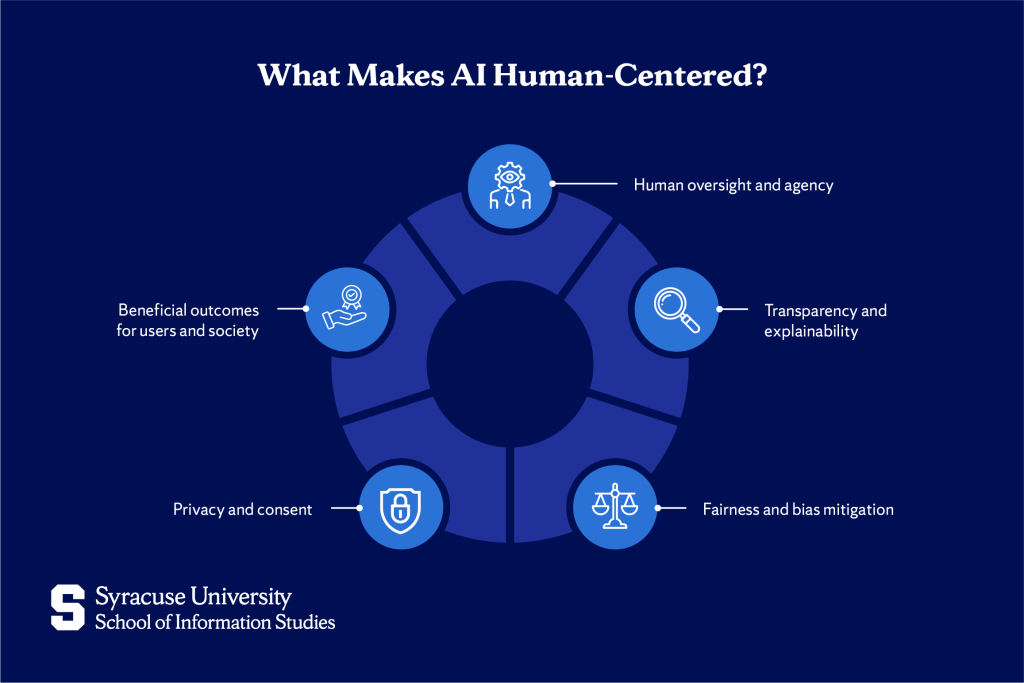
Human oversight and agency
AI systems should not make important decisions without people involved. Humans need to understand the system’s recommendation, question it when something seems wrong, and override it when needed. In practice, this could mean a hiring tool that flags candidates for a recruiter instead of rejecting them automatically, or a clinical AI tool that gives a recommendation while leaving the final decision to the doctor.
Transparency and explainability
People should be able to understand why an AI system made a decision that affects them. If the system is too unclear, it becomes harder to review, question, or correct. This is also reflected in the EU AI Act, which places transparency and human oversight requirements on certain AI systems. In practice, this could mean a loan tool that explains the main reasons for a rejection, or a medical AI tool that shows which parts of an image influenced its recommendation.
Fairness and bias mitigation
AI systems should be checked for fairness before they are used. Models trained on historical data often replicate or amplify historical discrimination, and high overall accuracy can mask severe disparities in subgroup performance. That is why teams need to test how the system works across different demographics, such as in face-recognition tools reviewed for accuracy across skin tones or risk-assessment tools checked for unfair error patterns before deployment.
Privacy and consent
AI systems should respect what people agreed to share, collect only the data needed for the task, and protect the information they hold. This is one reason privacy is central to responsible AI. Many large models have been trained on data that people never expected to be used that way, so teams need clearer rules around consent, storage, and reuse. This can include keeping sensitive data on a user’s device, using privacy-preserving training methods, or clearly explaining how user interactions may be used.
Beneficial outcomes for users and society
AI systems should be judged by whether they help people, not only by whether they increase clicks, time on an app, or other engagement numbers. A system built to maximize engagement can push content that keeps users scrolling even when it does not serve them well. Recommender systems audited for whether they leave users better-informed or just more time-on-app, and productivity AI evaluated on whether it genuinely reduces workload, both illustrate how this principle is applied in practice.
Frameworks for Implementing Human-Centered AI
Principles alone don’t translate into product decisions; they need implementation frameworks that teams can apply to specific questions. Several major industry and academic groups have published practical frameworks for exactly that purpose. No single framework works for every team. The best fit depends on the problem they are trying to solve, such as transparency, fairness, privacy, oversight, or user trust.
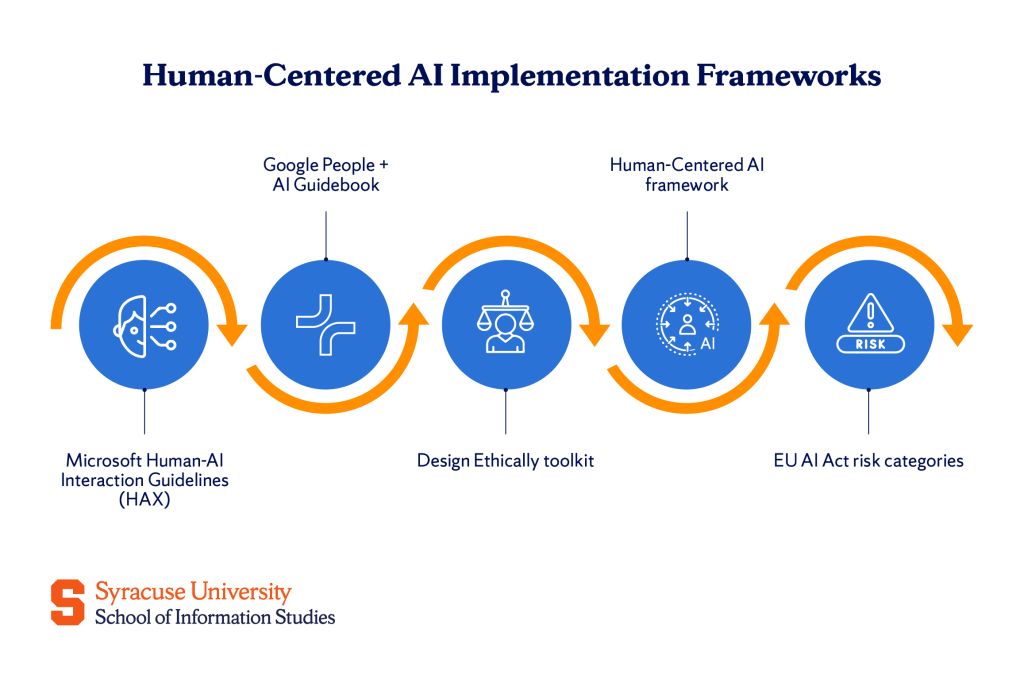
- Microsoft Human-AI Interaction Guidelines (HAX): A set of 18 guidelines for designing how AI systems behave with users, from the first interaction to regular use, errors, and changes over time. Best for product and UX teams designing user-facing AI features and deciding how the system should communicate, recover from mistakes, and support user control.
- Google People + AI Guidebook: A practical guide from Google PAIR with UX and machine learning guidance, design patterns, workshops, and examples for building AI products. Best for teams that want help with user needs, mental models, feedback, explainability, and trust in consumer-facing AI experiences.
- Design Ethically toolkit: A collection of workshop-style exercises and resources created by Kat Zhou to help teams identify ethical risks earlier in the design process. Best for cross-functional teams that want to make ethics part of regular design discussions rather than something reviewed only after launch.
- Human-Centered AI framework: Ben Shneiderman’s research-grounded framework for designing AI systems with both strong human control and useful automation. Best for teams that want an academic foundation for decisions about human-AI collaboration, oversight, trust, and when automation should support rather than replace human judgment.
- EU AI Act risk categories: A risk-based regulatory framework for AI in the European Union. It groups AI systems into four risk levels: unacceptable risk, high risk, limited risk, and minimal or no risk, with stricter obligations for systems that pose greater risks. Best for teams building AI products for European users, especially in regulated areas such as employment, education, finance, healthcare, law enforcement, or public services.
Examples of Human-Centered AI in Practice
Human-centered AI becomes easier to understand when we look at how it appears in real products.
GitHub Copilot and developer oversight
GitHub Copilot is designed as a suggestion engine, not an autonomous code-writer. It generates code completions; the developer accepts, rejects, or modifies each suggestion. The system surfaces uncertainty when relevant and deliberately avoids auto-committing changes: a design boundary that keeps the developer in control of what enters the codebase. That design choice keeps human judgment inside the workflow. The AI may speed up coding, but the developer remains responsible for what enters the codebase.
Clinical decision-support AI in hospitals
Clinical AI tools are often used to surface risks, patterns, or possible next steps for medical teams rather than issue autonomous orders. Epic’s sepsis prediction tools, for example, are used as alerting and screening systems, while imaging AI at institutions such as Mass General Brigham is described as giving clinicians a “second set of eyes” when reviewing radiological studies. In both cases, the AI supports clinical attention, but the clinician still makes the final decision.
This design reflects human-centered AI in practice: the system helps professionals notice what they might miss, while the human expert keeps responsibility for judgment and action. Similar human-AI collaboration dynamics appear in AI in cybersecurity, where analysts use AI-flagged alerts to prioritize investigation rather than automate response.
Accessibility AI: Be My Eyes and Seeing AI
Accessibility tools such as Be My Eyes and Microsoft Seeing AI show human-centered AI in a more direct way. Be My Eyes connects blind and low-vision users with volunteers, companies, and AI for visual assistance, while Seeing AI helps describe visual information through a phone or device.
Such tools are strongest when they are designed around the needs, feedback, privacy, and daily routines of blind and low-vision users. Both applications illustrate the beneficial outcomes and privacy principles in a context where the user’s specific situation, not average-user behavior, drives every design choice.
Recommender systems with engagement guardrails
Some platforms have added features that give users more control over recommendation-driven experiences. YouTube’s “Take a break” reminder lets users pause after a chosen amount of viewing time, while TikTok offers screen time tools and default limits for younger users. Spotify also combines algorithmic recommendations with other forms of curation and user controls. These features reflect the beneficial outcomes principle because they acknowledge that a system should serve users well, not only increase time-on-app.
Still, these additions are partial: they coexist with engagement-based recommendation systems, which is why human-centered methods are stronger when they are built into the product from the beginning.
When Human-Centered AI Goes Missing
The risks of AI often become clearest when human-centered principles are absent. These examples show what can happen when systems are deployed without enough attention to fairness, oversight, transparency, or user wellbeing.
COMPAS recidivism algorithm and fairness failure
ProPublica’s 2016 investigation found that the COMPAS recidivism risk tool produced sharply different error patterns across racial groups. Black defendants who did not reoffend were more likely than white defendants to be labeled higher risk, even though the tool’s overall error rate looked similar across groups. The case became a major example in algorithmic fairness because it showed how aggregate accuracy can hide serious subgroup disparities. It also showed why consequential systems need independent review before their outputs influence legal decisions.
Amazon’s hiring AI and biased training data
Amazon shut down an experimental resume-screening AI in 2018 after discovering it systematically downgraded resumes containing words associated with women, including the names of women’s colleges. The model had been trained on a decade of historical hiring data that itself reflected a male-dominated industry, and it learned to replicate that pattern. As Reuters reported, the bias was caught through internal audit rather than prevented at design time, which is exactly what the oversight and fairness principles are designed to prevent.
Social platform recommender systems and engagement harms
Facebook’s own internal research, leaked in 2021 and reported by the Wall Street Journal’s Facebook Files series, documented that the platform’s engagement-optimized recommender system surfaced harmful content at higher rates than balanced alternatives the company had tested and declined to deploy. The systems were optimized for time-on-app rather than user well-being, a direct failure of the beneficial outcomes principle.
Human-Centered AI vs. Related Approaches
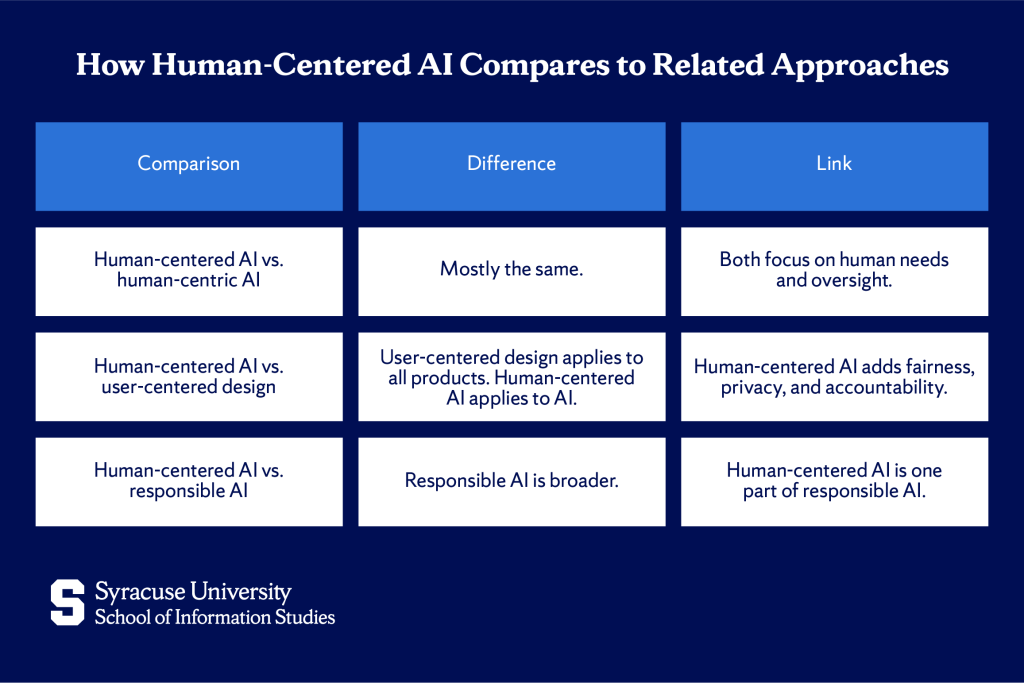
Human-centered AI sits close to several related terms, so the differences can get confusing.
Human-centered AI vs. human-centric AI
The two terms are used interchangeably in most contexts, though their origins differ slightly. “Human-centered” is the more established academic term, while “human-centric” is more common in corporate AI marketing, particularly in European technology policy documents. The functional meaning is largely the same: AI designed around human needs and oversight, and the substantive distinction matters less than what an organization actually does with whichever term it uses.
Human-centered AI vs. user-centered design
User-centered design (UCD) is the broader discipline focused on designing any product or system around its users’ needs, behaviors, and contexts. Human-centered AI applies that thinking to AI systems, where the risks are more complex. An AI system may make predictions, influence decisions, or affect people at scale, so teams also need to think about oversight, explainability, fairness, privacy, and accountability. These concerns are less central in traditional product design because traditional software does not usually learn from data or make uncertain predictions in the same way.
Human-centered AI vs. responsible AI
Responsible AI is the broader category encompassing ethics, governance, accountability, safety, and organizational policy around AI development. Human-centered AI is one component within that broader framework, specifically focused on the design relationship between AI systems and the humans who use them or are affected by their decisions.
The two overlap significantly as fairness, transparency, and oversight appear in both. But responsible AI extends into areas like model governance, risk management, supply chain accountability, and regulatory compliance that human-centered AI doesn’t necessarily address. A team practicing human-centered AI is doing part of what responsible AI requires, not all of it.
Building a Career in Human-Centered AI
The roles that explicitly require human-centered AI competence are still being named and stabilized, but a recognizable set has emerged: AI product designer, AI UX researcher, AI ethics analyst, machine learning specialist with a fairness or interpretability specialization, and AI policy analyst. What these roles share is the explicit responsibility for the human side of AI development: how systems are designed, explained, tested, governed, and used in real settings.
Programs that prepare graduates for human-centered AI roles combine technical AI literacy with design, ethics, and social-science training. iSchool’s Master’s in Applied Human-Centered AI is designed specifically for this intersection, preparing graduates for roles that require the technical depth to evaluate AI systems and the design and ethics fluency to improve them. For undergraduates, the Integrative Artificial Intelligence Bachelor’s Degree offers a broader entry point by combining AI training with an applied minor, helping students learn how to use AI within a specific field. The Applications of AI Minor provides a smaller, structured introduction to AI principles, applications, and responsible design before students commit to a full AI degree or graduate program.
The Bottom Line
The gap between what AI systems can do and how thoughtfully they’re designed is the central challenge of the next AI decade. Models will keep getting more capable, but the hard part is building AI that people can actually trust, understand, and meaningfully participate in, as systems become more autonomous and their decisions carry more weight.
Human-centered AI is the field that takes that challenge seriously as a design problem. The organizations and professionals who build with human-centered methods will be the ones whose AI products users actually adopt, regulators find acceptable, and society is better for having.
Frequently Asked Questions (FAQs)
Is generative AI like ChatGPT human-centered?
Partly. Modern large language models include some human-centered features, such as human feedback during training, safety filters, and content moderation. But they still fall short in important areas. Their training data can be hard to inspect, consent is often unclear, and users usually have limited control over how the system makes or changes its decisions.
Is human-centered AI just marketing?
Sometimes, yes. Human-centered AI can sound like marketing when a company uses the term without changing how its products are designed. The real test is whether users can understand, question, or override AI outputs, and whether teams use practical frameworks like Microsoft HAX or Google PAIR when making design decisions. Without those, the label is decorative.
Is human-centered AI required by law?
In some jurisdictions, yes. The EU AI Act mandates risk assessments and transparency obligations for high-risk AI systems, with enforcement phasing in through 2026, while several US states and federal procurement rules require algorithmic transparency, though no unified federal mandate currently exists.
How do you actually measure whether an AI system is human-centered?
You measure it through testing and review, not by the label alone. Teams can use tools such as Microsoft HAX checklists, EU AI Act assessments, ethics workshops, fairness testing across demographic groups, and user research with the people affected by the system. Without that kind of evidence, a claim that an AI system is “human-centered” is hard to prove.