
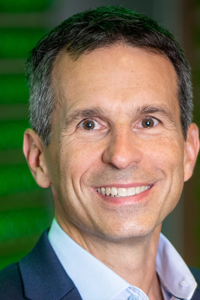
 As artificial intelligence reshapes how businesses operate and people work, Frank Iannella sees enormous opportunity—but also a need to think differently about what it means to build a career in technology.
Iannella, chief information officer and senior vice president of digital technology at Heineken, joined the Infoversity podcast to discuss AI, digital transformation and the skills students will need to lead in a rapidly changing industry.
Iannella’s own career took an unexpected path. He studied science at Syracuse University and initially considered medical school before a job in a pharmaceutical lab introduced him to software and technology. That discovery ultimately led to a career spanning more than two decades at PepsiCo and, today, a technology leadership role at Heineken.
At Heineken, Iannella says the focus on AI isn’t simply about adopting the newest technology. The company has approached generative AI by starting with business problems and asking where the technology can make a meaningful difference. Early experiments with internal chatbots have expanded into applications across supply chain, inventory management, marketing, legal, HR and other areas.
That experimentation also comes with caution. Iannella discusses the importance of strong data governance, security, ethics and clear policies around how employees and vendors use AI. For organizations, he argues, embracing AI responsibly requires understanding not only what the technology can do, but whether the organization is prepared to use it well.
But perhaps the biggest change Iannella sees is in the people using technology. Generative AI and natural-language interfaces are making capabilities once reserved for highly technical specialists accessible to a much broader group of people. As those barriers fall, the ability to understand problems, ask good questions and connect technology to real business needs becomes increasingly valuable.
For students preparing for careers in this environment, Iannella’s advice is to seek out experiences: build things, work across disciplines, learn how organizations operate and develop the ability to work with people. The traditional path through an IT career is changing quickly, he says, but those broader skills will remain important regardless of where the technology goes next.
That lesson extends all the way to the executive suite. Despite serving as a CIO, Iannella says he spends surprisingly little of his time focused specifically on technology. Much of his job is about people—developing talent, navigating organizational change, working with other leaders and understanding the business.
“It’s a people business,” he says. “It’s a people role.”
Listen to the full episode of Infoversity to hear Iannella discuss the changing nature of technology careers, responsible AI, digital transformation and how students can prepare to lead through whatever comes next.