
Key Takeaways
- Data science majors enjoy strong job demand, with competitive salaries averaging $122,000 per year for data scientists.
- Data science requires rigorous study in mathematics, statistics, and programming, but the skills you gain are highly transferable.
- AI is automating routine tasks, making critical thinking and communication skills more valuable than ever.
- Success requires hands-on experience through projects, internships, and portfolio building.
If you’re thinking about majoring in data science, you’re likely asking yourself a big question: Is it worth it? The answer is yes, with one important consideration. The field is moving fast, and thriving as a data scientist in 2025 requires far more than coding ability alone.
Data science combines statistics, programming, and business strategy to help organizations make smarter decisions. It’s a field where you’ll work with real data to solve real problems, like predicting customer behavior, improving healthcare outcomes, or building recommendation systems.
This article gives you an honest look at what to expect from a data science major: the career opportunities, the challenges, the skills you’ll build, and how to know if it’s the right fit for you.
Why Data Science Remains a Top-Tier Major
Despite rapid changes in technology, data science continues to be one of the most valuable majors you can pursue. The combination of strong job prospects, competitive salaries, and transferable skills makes it an attractive option for students interested in tech careers.
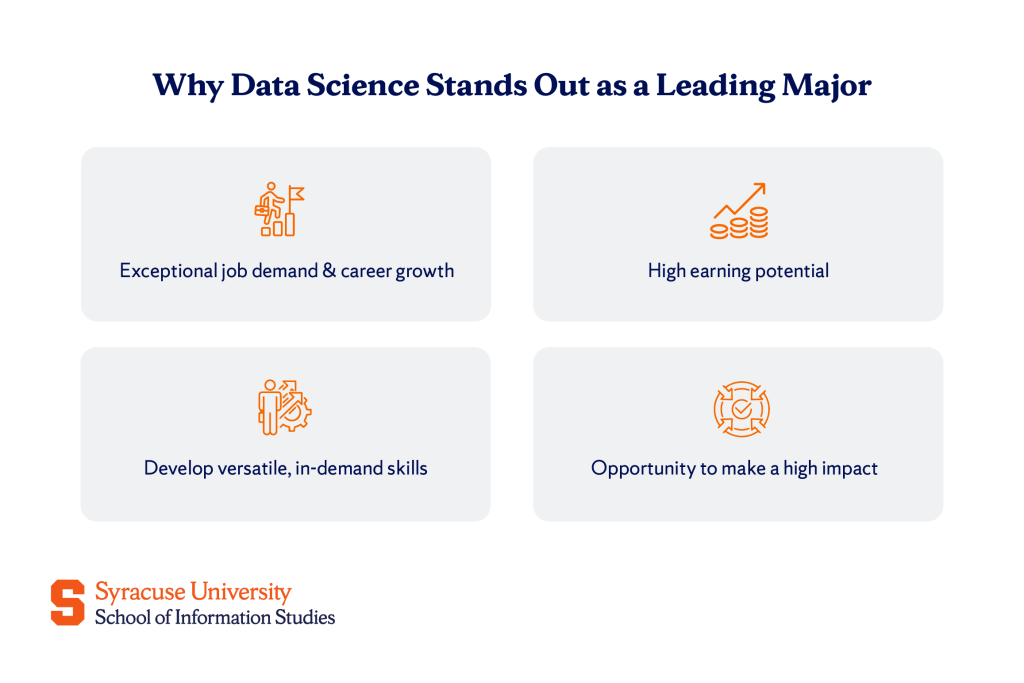
Exceptional job demand & career growth
The demand for data scientists continues to rise across industries. According to the U.S. Bureau of Labor Statistics, employment of data scientists is projected to grow 34% from 2024 to 2034, much faster than the average for all occupations. Companies in healthcare, finance, retail, technology, and government all need professionals who can make sense of massive datasets.
As organizations pour resources into data infrastructure, they need experts who can transform information into actionable insights. Whether your interest lies in forecasting market behavior, advancing patient care, or developing smarter products, data science skills create powerful career opportunities.
High earning potential
Data scientists earn an average salary of $122,000 per year, and mid-career professionals with more years of experience often earn well into six figures.
Compare this to data analysts, who earn an average of $82,000 annually, a competitive salary, but data science’s more advanced skill set commands higher compensation. The investment in your education pays off quickly, especially when you consider the trajectory of salary growth as you gain experience.
Develop versatile, in-demand skills
A data science major equips you with far more than coding ability. You’ll develop:
- Analytical thinking: Breaking down complex problems into clear, workable components.
- Technical proficiency: Working with Python, R, SQL, and machine learning libraries.
- Statistical reasoning: Understanding probability, hypothesis testing, and experimental design.
- Problem-solving: Finding creative solutions to ambiguous business challenges.
- Communication: Translating technical findings into actionable insights.
These skills transfer across industries. If you decide tech isn’t for you, the analytical and problem-solving abilities you’ve built will serve you in consulting, finance, healthcare, or even entrepreneurship.
Opportunity to make a high impact
Data scientists influence decisions that directly impact people’s lives. You might help a hospital reduce readmission rates, assist a nonprofit in allocating resources more effectively, or help a company create products that better serve its customers.
“In my classes, whether it’s ‘Data in Society’ or ‘Intro to Networks & Cloud,’ I find myself constantly challenged and intrigued,” shares Gabriel Davila-Campos, an iSchool student.
“It’s not just about learning the theories; it’s about seeing how these concepts come alive in the real world.”
This sense of purpose, knowing your work creates tangible value, is what keeps many data scientists engaged in the field long-term.
Potential Challenges of a Data Science Major
Before committing to data science, you should understand the real challenges you’ll face. The academic rigor, competitive job market, and evolving nature of the field require dedication and adaptability.
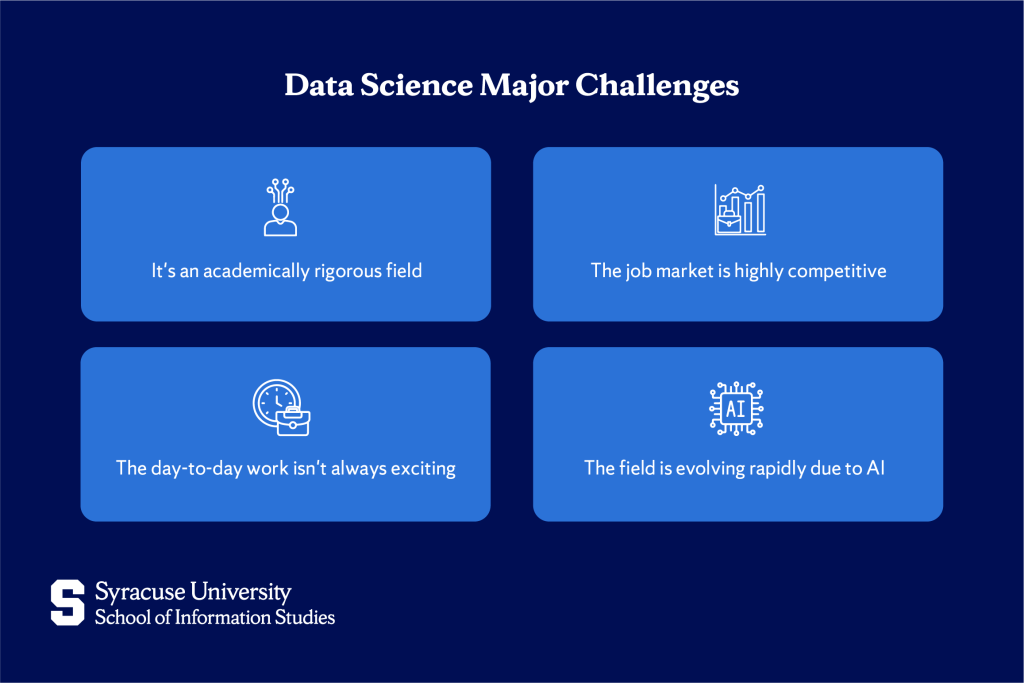
It’s an academically rigorous field
Data science requires strong foundations in mathematics, specifically linear algebra, calculus, and probability theory. If you struggled with high school math, you’ll need to invest extra time building these skills.
The programming learning curve is steep. You’ll start with Python or R basics, but quickly move into more complex topics like object-oriented programming, algorithm optimization, and working with messy, real-world datasets. Expect to spend significant time debugging code and troubleshooting errors.
That said, the challenges of the field should not deter you if your interest is genuine. Many accomplished data scientists were not math prodigies; they advanced by committing to the work and seeking guidance when necessary.
The job market is highly competitive
A degree alone will not guarantee a position in data science. Entry-level roles attract thousands of applicants, and employers prioritize candidates who can demonstrate practical, applied skills.
To stand out, you need to:
- Complete personal projects that showcase your abilities.
- Build a portfolio on GitHub with clean, well-documented code.
- Pursue internships or research opportunities during school.
- Network with professionals in the field.
- Stay current with industry trends and tools.
The day-to-day work isn’t always exciting
Movies often portray data science as a series of constant breakthroughs and dramatic “aha!” moments. The reality is more grounded. Research indicates that data scientists spend up to 80% of their time on data cleaning and preparation, transforming messy datasets into usable formats.
Much of the work involves:
- Fixing inconsistent data formats
- Dealing with missing values
- Creating dashboards and reports
- Documenting your code and processes
- Explaining findings to non-technical stakeholders
The more visible modeling and algorithm development does occur, but it typically represents a smaller share of the role than many expect. For those who enjoy problem-solving and creating structure from complexity, this work is highly rewarding. For individuals drawn only to the most high-profile aspects of the field, however, the day-to-day reality may feel less engaging.
The field is evolving rapidly due to AI
AI tools are changing the daily work of data scientists. Routine tasks like basic data visualization, simple statistical analysis, and even some predictive modeling can now be automated or assisted by AI.
This evolution does not diminish the role of data scientists; on the contrary, AI in data science elevates the importance of higher-order skills. As Jeffrey Saltz, associate professor and program director at Syracuse University’s iSchool, explains:
“The continuing enhancement of courses helps to ensure that the iSchool’s program is robust and comprehensive and can evolve as the field evolves.”
What matters most are the capabilities that AI cannot easily replicate: advanced problem-solving, strategic thinking, domain knowledge, and the ability to communicate insights with clarity. The real value lies in knowing which questions to ask, how to interpret results in context, and how to translate those findings into meaningful decisions.
Essential Skills You Gain (Beyond Just Coding)
While programming skills gained through a data science degree are crucial, the most valuable abilities are those that help you think strategically, solve complex problems, and communicate effectively.
Core technical skills
A data science major provides a strong technical foundation. You’ll work with:
- Programming languages: Python and R for data analysis, with SQL for database queries.
- Machine learning libraries: scikit-learn, TensorFlow, and PyTorch for building predictive models.
- Data visualization tools: Tableau, Power BI, matplotlib, and seaborn for creating compelling charts.
- Big data technologies: Spark, Hadoop, and cloud platforms like AWS or Azure.
- Version control: Git and GitHub for code management and collaboration.
Critical thinking & strategic problem-solving
The most valuable skill you’ll develop, and the one AI cannot easily replace, is the ability to think critically and strategically. Data science is not simply about running algorithms; it’s about identifying which problems matter, how to approach them, and how to evaluate results.
You’ll learn how to:
- Ask the right questions before diving into analysis.
- Recognize when a problem requires data science versus simpler solutions.
- Identify biases and limitations in your data and models.
- Anticipate how your analysis will be applied in practice.
- Challenge assumptions and validate results rigorously.
As Jeffrey Saltz notes:
“The iSchool has been a pioneer in AI and data science education, and we were one of the first universities to offer an Applied Data Science program.”
This pioneering approach emphasizes not just tools, but also the mindset that makes data scientists effective.
Communication and data storytelling
You can build the most sophisticated model in the world, but if you can’t explain what it means to non-technical stakeholders, it’s useless. That’s why communication is a core competency for every data scientist.
Key abilities include:
- Translating technical results into clear business insights.
- Designing visualizations that tell a compelling story.
- Presenting recommendations confidently to executives.
- Writing documentation that is accessible and useful.
- Collaborating effectively with cross-functional teams.
Strong communicators advance more quickly because they can bridge the gap between technical teams and business decision-makers. Developing these skills alongside your technical expertise is critical for long-term success.
Common Career Paths After Graduation
Career opportunities for data science graduates include a wide range of roles. Typical paths include:
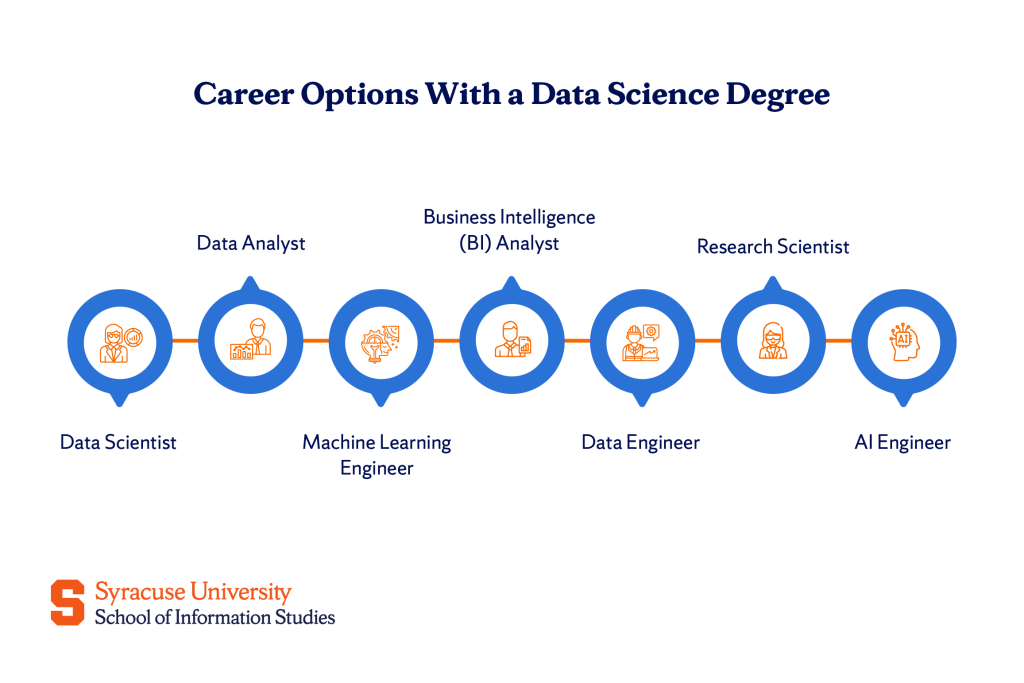
- Data scientist: Build predictive models, conduct experiments, and provide strategic insights. You’ll work with large datasets to answer business questions and drive decision-making.
Average annual salary: $122,000. - Data analyst: Focus on descriptive analytics, creating reports, and building dashboards. This role is less programming-intensive and more about understanding business metrics.
Average annual salary: $82,000. - Machine learning engineer: Develop and deploy machine learning models in production environments. It requires strong software engineering skills alongside data science knowledge.
Average annual salary: $128,000. - Business intelligence (BI) analyst: Create data warehouses, design reporting systems, and help organizations monitor key performance indicators.
Average annual salary: $99,000. - Data engineer: Build and maintain the infrastructure that enables large-scale data operations, including pipelines, databases, and platforms.
Average salary: $129,000. - Research scientist: Conduct advanced research in academia or industry, creating new algorithms and advancing the discipline.
Average annual salary: $130,000. - AI engineer: Design and implement AI systems, often working closely with machine learning engineers and data scientists.
Average annual salary: $106,000.
Many graduates begin as data analysts or junior data scientists and advance into specialized or senior positions as they gain experience. The field offers structured career progression as well as flexibility to shift focus as interests and expertise evolve.
Data Science vs. Similar Majors
Many students weigh their options between data science, computer science, and statistics. These areas overlap, but each focuses on different skills and leads to distinct career trajectories.
Data science vs. computer science
Computer science is broader and focuses on building software systems, algorithms, and applications. Coursework typically covers operating systems, networking, databases, and software engineering principles. It is an excellent choice for students seeking flexibility to work across diverse areas of technology, including web development, systems programming, cybersecurity, and even data science.
Data science is more specialized, concentrating specifically on analyzing data to extract insights. You’ll study statistics, machine learning, and data visualization more deeply, but you’ll have less exposure to pure software development.
Choose computer science if you want broader career options in tech, enjoy building applications and systems, or are still exploring your interests.
Choose data science if you’re specifically interested in working with data, enjoy statistics and analytics, and want to focus on insights and decision-making rather than software development.
Data science vs. statistics
Statistics provides the theoretical foundation for data science. It’s more mathematically rigorous and focuses on probability theory, experimental design, and inference. If you major in statistics, you’ll spend more time proving theorems and understanding the math behind techniques.
Data science is more practical and computational. You’ll still use statistical methods, but the focus is on applying them to real-world problems. Expect more coding, data cleaning, and working with large datasets to find actionable insights.
Choose statistics if you enjoy mathematics, want a strong theoretical foundation, or plan to pursue research or graduate studies in statistics.
Choose data science if you prefer hands-on work that blends statistics, programming, and real-world problem-solving.
Is a Data Science Major the Right Choice for You?
Before committing to data science, take a moment to reflect on a few key questions:
- Do you enjoy solving complex puzzles and problems? Data science is fundamentally about breaking down ambiguous challenges and finding solutions.
- Are you comfortable with advanced mathematics? You’ll need to master calculus, linear algebra, and probability. If these feel daunting, consider whether you’re ready to build that foundation.
- Are you interested in learning to code? Programming is non-negotiable. You don’t need to start as an expert, but an interest in learning is important.
- Do you have a natural curiosity for finding patterns? Great data scientists are genuinely interested in understanding “why” and “how”; they ask questions constantly.
- Can you handle ambiguity? Real-world problems are messy. You’ll often work with incomplete information and need to make judgment calls.
- Are you able to explain your insights clearly? Technical skills matter, but communicating your findings effectively is just as crucial.
If you answered yes to most of these questions, data science could be an excellent fit. If not, you could explore related areas such as information systems, business analytics, or computer science.
The Bottom Line
Data science is an excellent choice for those ready to build a blend of technical, analytical, and communication skills. The field is demanding and competitive, but also highly rewarding for those who enjoy solving real-world problems through data.
Success in data science depends on a solid academic background, hands-on experience, a well-developed portfolio, and a commitment to continuous learning as technology advances. Programs that evolve with industry trends help students stay adaptable and ready for the future.
Syracuse University’s iSchool offers several options to help you build these skills, including the Applied Data Science Bachelor’s Degree, the Master of Applied Data Science, and the Certificate of Advanced Study (CAS) in Data Science. Each program is designed to help you meet the demands of this constantly evolving field and build the expertise needed to succeed.
Frequently Asked Questions (FAQs)
Is data science hard to study?
Yes, data science is academically challenging, requiring strong foundations in mathematics, statistics, and programming. However, with consistent effort and the right support system, most motivated students can succeed.
Which is better, CS or DS?
Computer science offers broader career options across all of tech, while data science is more specialized for analytics and insights work. Choose CS for flexibility, DS if you’re specifically interested in data-driven problem-solving.
Will AI replace data scientists?
No. AI will automate routine tasks, but it can’t replace the strategic thinking, domain expertise, and communication skills that skilled data scientists bring. The role is evolving, not disappearing.
Is a data science degree better than a bootcamp?
A degree provides deeper theoretical knowledge, broader skills, and greater credibility with employers. Bootcamps offer faster entry but may lack depth. For long-term career growth, a degree from a reputable program like Syracuse University’s iSchool offers a better foundation and more opportunities.