
Key Takeaways
- The core skills you need to get started in data science include Python, statistics, data cleaning, and machine learning basics.
- Building a portfolio of hands-on projects is the most effective way to become job-ready for data science.
- Structured data science degree programs accelerate learning and add formal credentials.
- Career paths in data science span from data analyst to AI specialist, with strong salary potential across industries.
You want to learn data science, but every time you look up where to begin, you end up staring at endless lists of tools, courses, bootcamps, and opinions that don’t quite agree with each other, and it gets overwhelming.
If that feels familiar, here’s the reassuring part: how to learn data science is a question with a clear, structured answer. Data science is one of the fastest-growing fields right now, with the U.S. Bureau of Labor Statistics projecting 34% growth through 2034, much faster than most professions. The median annual salary for data scientists is over $100,000, which explains why so many people are exploring the field.
This guide lays out a practical, step-by-step roadmap, from complete beginner to job-ready. Whether you’re learning independently or thinking about enrolling in a formal program, you’ll see which skills to build, in what order, and what kind of timeline makes sense in the real world.
What Is Data Science and Why Does It Matter?
At its core, data science includes extracting meaningful insights from raw data to inform decisions. But a solid definition of data science covers four interconnected disciplines: statistics, programming, machine learning, and domain knowledge.
Here’s how those four pillars show up in real life:
- Healthcare (predicting patient readmission rates to improve hospital planning).
- Finance (detecting fraudulent transactions in real time using anomaly detection models).
- E-commerce (personalizing product recommendations based on browsing and purchase history).
- Tech (optimizing app performance by analyzing user behavior patterns).
What makes data science exciting is the impact: solving real problems, in virtually every industry, using skills you can start building today.
What Skills Are Required in Data Science?
Before you map out a learning path, it helps to know what you’re building toward. The data science skills that employers care most about fall into five areas:
- Programming: Python is the industry standard for data science. SQL is essential for working with databases.
- Statistics and probability: Understanding distributions, hypothesis testing, and statistical significance separates analysts from guessers.
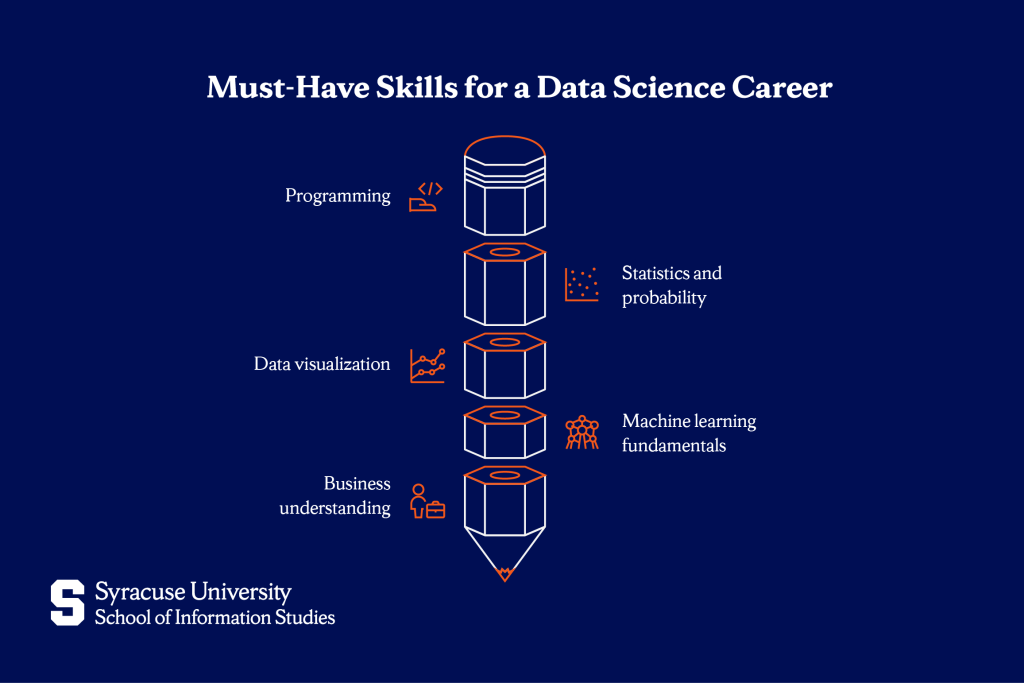
- Data visualization: Turning raw numbers into clear charts and dashboards using tools like Tableau or Matplotlib.
- Machine learning fundamentals: Knowing when and how to apply algorithms like regression, decision trees, and clustering.
- Business understanding: The ability to translate a business problem into a data question and communicate your findings to non-technical stakeholders.
You don’t need to master all of these at once. The roadmap below builds them in the right order.
Step-By-Step Roadmap on How to Learn Data Science
This path works whether you’re starting from zero or coming in with some technical background. Work through each step before moving on, as the skills stack on each other.
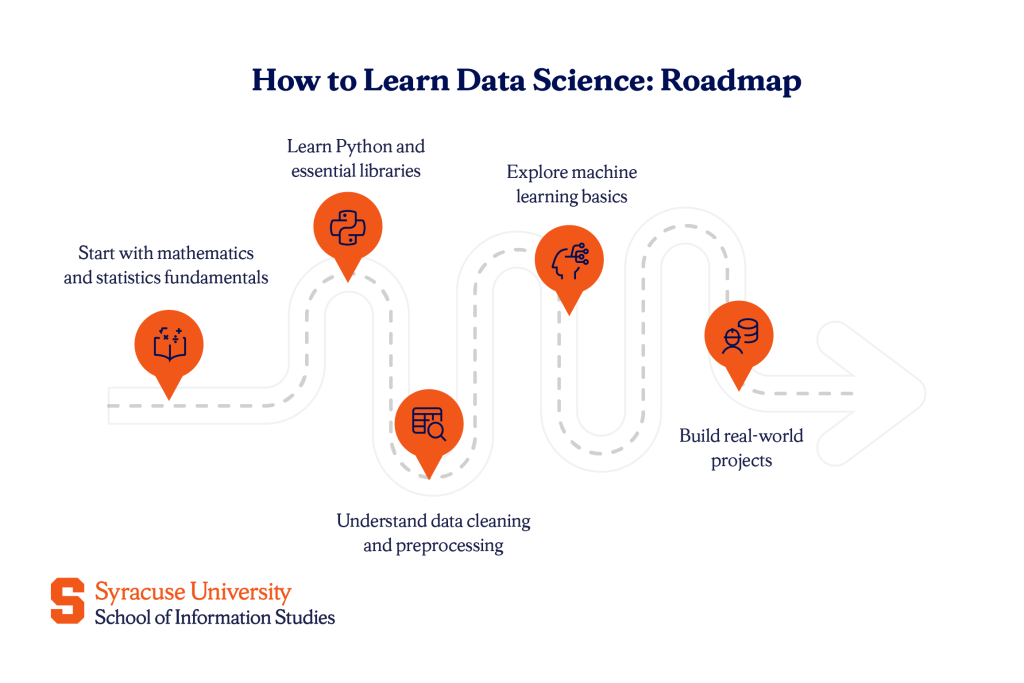
Step 1: Start with mathematics and statistics fundamentals
Most beginners skip this step. Don’t. A working understanding of the following will make everything that comes later much easier:
- Probability and conditional probability
- Descriptive statistics (mean, median, standard deviation)
- Hypothesis testing and p-values
- Linear algebra basics (vectors and matrices)
Step 2: Learn Python and essential libraries
Python is beginner-friendly, widely used in industry, and supported by a massive ecosystem of data science libraries. Start here:
- NumPy: numerical computing with arrays and matrices.
- Pandas: data manipulation and analysis (the workhorse of real-world data science).
- Matplotlib/Seaborn: data visualization for quick exploratory analysis.
- Scikit-learn: your first machine learning library, with clean, consistent syntax.
Don’t just watch tutorials. Code along with every lesson, then try to break and fix things on your own. Passive watching won’t build the muscle memory you need.
Step 3: Understand data cleaning and preprocessing
This is where most beginners get surprised. In real-world data science, most of a data scientist’s time is spent cleaning and preparing data, not running models. You’ll need to get comfortable with:
- Handling missing values (when to drop vs. impute)
- Identifying and removing outliers
- Data transformation and normalization
- Feature engineering: creating new variables that improve model performance
Step 4: Explore machine learning basics
Once your foundations are solid, it’s time to build and evaluate models. Start with the core concepts before moving into deep learning or neural networks:
- Supervised learning: the model learns from labeled data. Think spam filters or price prediction.
- Unsupervised learning: the model finds patterns in unlabeled data (e.g., customer segmentation).
- Regression: predicting continuous values (e.g., house prices).
- Classification: predicting categories (e.g., churn vs. no churn).
- Clustering: grouping similar data points (e.g., market segmentation).
Step 5: Build real-world projects
A portfolio of projects is often what gets you hired. Start with beginner-friendly projects that cover the full data science pipeline:
- Sales forecasting using historical transaction data
- Customer churn prediction for a subscription business
- A movie recommendation system using collaborative filtering
- An interactive data visualization dashboard built in Tableau or Plotly
Document every project clearly on GitHub. Explain your process, the data, the methods, and what you found. Employers want to see your thinking, not just your code.
How a Degree in Data Science Can Help You Learn Effectively
Self-learning is absolutely possible, but it requires significant discipline, and it’s easy to hit plateaus or skip important fundamentals. A structured academic program changes that equation.
Syracuse University iSchool’s Applied Data Science Bachelor’s Degree is built for students who want a rigorous, career-aligned path with real guidance along the way. Here’s what a formal program provides that self-study often doesn’t:
- Curriculum depth and sequencing: Courses are designed to build on each other, so you don’t skip foundational material or learn things out of order.
- Hands-on projects and capstone work: You’ll apply your skills to real problems (not just toy datasets) with faculty guidance.
- Mentorship and career support: Access to advisors, faculty who consult for industry, and a strong alumni network.
- Formal credentials: A degree signals to employers that you’ve completed a verified, comprehensive curriculum.
The iSchool’s approach combines technical skills with human-centered thinking, preparing graduates not just to build models, but to communicate findings and lead data-informed decisions.
Best Resources to Learn Data Science
Data science is one of the most accessible fields to learn today, thanks to the range of high-quality resources available online.
Free platforms for beginners
If you’re starting from scratch, free platforms allow you to build foundational skills without financial commitment while exploring whether the field truly interests you.
- Kaggle Learn: short, project-based courses in Python, SQL, and machine learning.
- Google’s ML Crash Course: a fast introduction to machine learning concepts.
- Khan Academy: the clearest free resource for brushing up on foundational math and statistics.
- StatQuest with Josh Starmer (YouTube): a clear and easy-to-follow resource for learning statistics and machine learning basics.
- CS50’s Introduction to Python (edX): Harvard’s free intro course, one of the best starting points for Python.
Paid certifications and bootcamps
Paid programs make the most sense when you want structured accountability, a certificate for your resume, or access to a learning community. Strong options include:
- IBM Data Science Professional Certificate (Coursera): nine courses covering the full pipeline, with a recognizable credential at the end.
- Google Advanced Data Analytics Certificate: a well-regarded credential focused on real-world application.
- DataCamp: subscription-based, project-heavy, and ideal for learning at your own pace.
However, if you’re serious about a career transition or building deep expertise, a formal degree program will outpace any certificate in terms of depth, recognition, and career outcomes.
How Long Does It Take to Learn Data Science?
The timeline to learn data science varies depending on your starting point, study intensity, and long-term goals.
Self-learning timeline
Your self-learning timeline depends on how many hours you put in each week and what you already know. A realistic framework looks like this:
- 0–3 months: math fundamentals, Python basics, and your first data cleaning projects.
- 3–6 months: machine learning fundamentals, portfolio projects, and working with real datasets.
- 6–12 months: advanced techniques, specialized tracks, and refining projects to interview-ready standards.
Studying 10–15 hours per week, most people reach an entry-level, job-ready stage in about 9–12 months. Prior experience in math or programming shortens that timeline significantly.
Degree program timeline
A bachelor’s degree program typically runs two to four years, depending on your prior credits and enrollment pace. What you gain is a guided learning environment where the curriculum is sequenced deliberately, projects are mentored, and you’re building a professional network alongside your technical skills.
For graduate-level study, a master’s program typically takes one to two years. Syracuse University’s Master’s in Data Science can be completed in as little as one year. In both cases, the degree removes a major self-learning burden: figuring out what to study next and whether you’re learning it well enough.
It’s also worth thinking about the types of data you’ll work with in your target industry, as structured programs often incorporate that industry context directly into coursework.
Common Mistakes Beginners Should Avoid
Progress in data science depends less on raw intelligence and more on consistent habits and practical application. As most beginners hit the same obstacles, here’s what to watch for:
- Tutorial overload: Watching course after course without building anything. After each lesson, apply what you learned by building something small, even a simple script or mini-project.
- Skipping statistics: Jumping straight to machine learning without understanding foundational concepts leads to shallow knowledge. This gap often becomes obvious in interviews when you’re asked to explain why a model behaves the way it does.
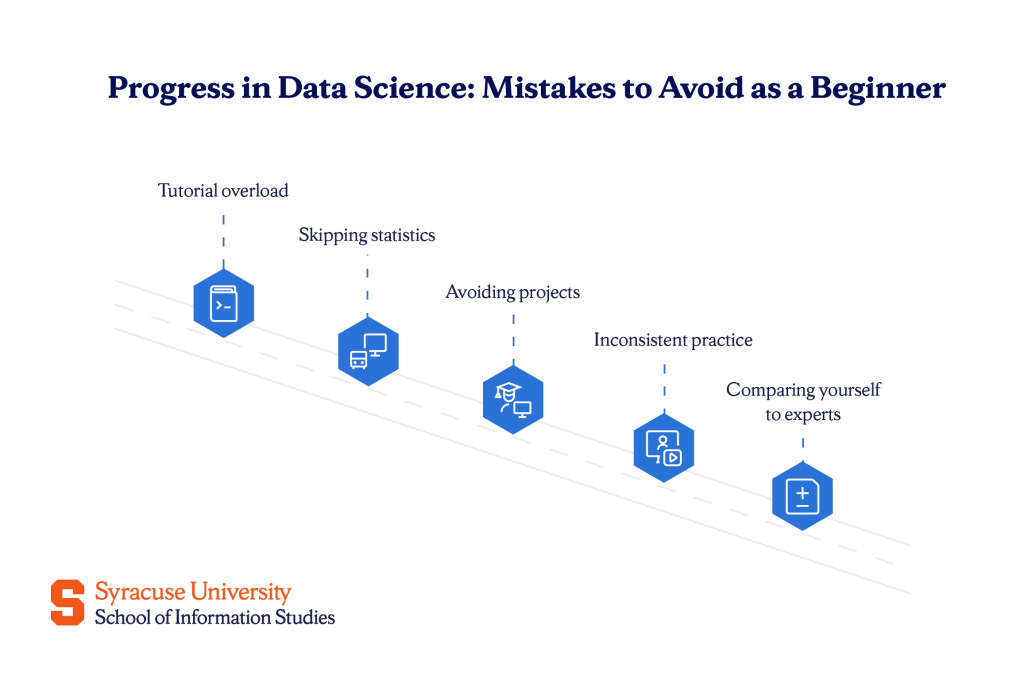
- Avoiding projects: Projects feel intimidating until you start one. Start with a topic or dataset that genuinely interests you, which makes the process more engaging and easier to sustain.
- Inconsistent practice: Coding for four hours on one weekend and then stopping for two weeks slows retention and growth. Even 30 focused minutes a day builds stronger momentum than irregular marathon sessions.
- Comparing yourself to experts: The professionals showcasing advanced models and complex pipelines have spent years refining their skills. Measure your progress against where you were last month, not where someone else is today.
Career Paths After Learning Data Science
One of the most compelling things about building data science skills is the variety of roles they open up:
- Data analyst: Interprets data to answer business questions and present insights through reports and dashboards.
- Data scientist: Builds predictive models and uses statistical methods to extract deeper insight from complex datasets.
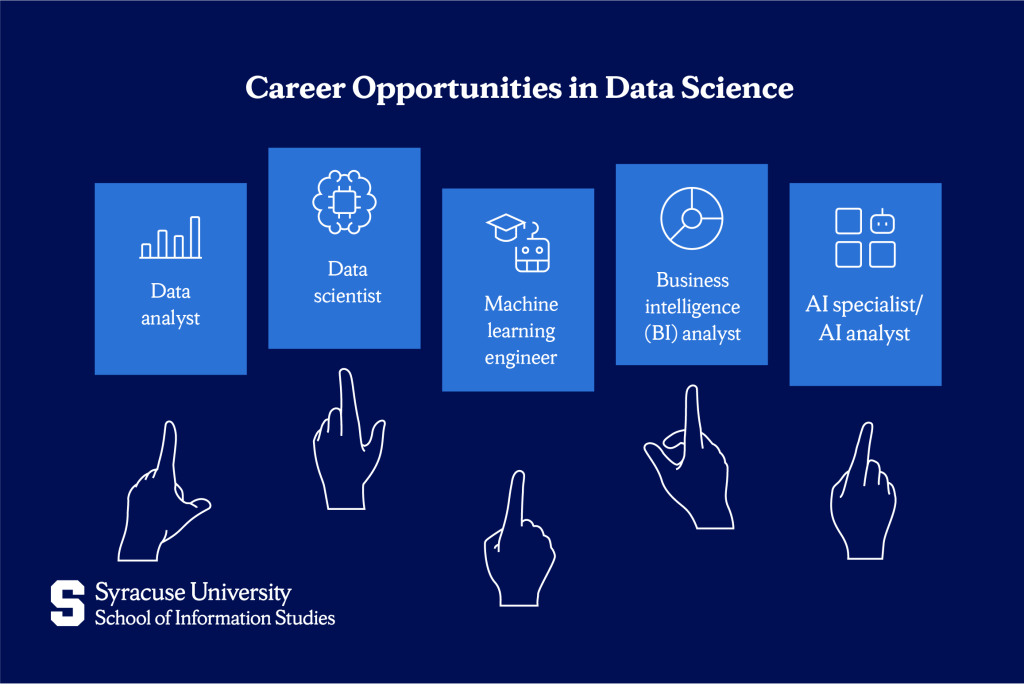
- Machine learning engineer: Develops and deploys ML models at scale, with a heavier focus on software engineering.
- Business intelligence (BI) analyst: Uses data tools to support strategic decisions, often working closely with executive teams.
- AI Specialist / AI Analyst: Focuses on applied artificial intelligence, including generative AI, across product and operations.
Syracuse iSchool alumni work at organizations including Amazon, Disney, EY, and city governments across the United States; a testament to how broadly these skills transfer.
Wrapping Up Your Path to Data Science
Learning data science is a process, and the roadmap is clear: build your math and stats foundation, learn Python, get comfortable with messy data, explore machine learning, and build projects that prove what you can do.
Whether you go the self-learning route or enroll in a structured degree program, consistency matters more than speed. The field is growing fast, the career outcomes are strong, and the skills you build are transferable across virtually every industry.
If you’re ready to take a structured, career-focused path, explore what the Syracuse iSchool’s Applied Data Science Bachelor’s Degree has to offer. You’ll work on real problems, learn from faculty who consult for industry leaders, and graduate with a portfolio and a credential that stand out.
Request information about the Applied Data Science program today and see how you can begin this fall.
Frequently Asked Questions (FAQs)
Is data science hard for beginners?
Data science has a learning curve, but it’s not out of reach. The main difficulty for beginners is the large amount of material and uncertainty about where to begin. Following a clear roadmap, starting with math and Python before moving into machine learning, makes the process much easier to manage.
Do I need advanced math to learn data science?
No, you do not need advanced mathematics to get started in data science. A solid understanding of basic algebra, probability, and statistics is enough at the beginner level. As you progress into more advanced machine learning or specialized roles, deeper knowledge of linear algebra and calculus can become helpful, but it is not required on day one.
Is AI replacing data scientists?
AI tools are changing how data scientists work (automating routine tasks like data cleaning and basic model tuning), but they’re not replacing the role. Data science requires judgment: framing the right questions, selecting appropriate methods, interpreting results in context, and communicating findings to non-technical stakeholders. Those skills aren’t being automated. If anything, the rise of AI is increasing demand for people who understand both the data and the tools driving it.
Can I learn data science without a degree?
Yes, many working data scientists are self-taught or transitioned from unrelated fields. A degree isn’t a strict requirement, especially for analyst-level roles. That said, a formal program provides structured learning, mentorship, and a recognized credential that can meaningfully accelerate your path to employment. If a full degree isn’t the right fit right now, stackable certificates or a part-time program can be a strong middle ground.