
Key Takeaways
- Most professional statistician roles require a master’s degree in statistics, biostatistics, or applied mathematics, making the field a longer credentialing path than data analyst or data scientist roles.
- The U.S. Bureau of Labor Statistics reports a median annual wage surpassing $100,000 for statisticians, with the highest 10% earning more than $170,000.
- Becoming a statistician follows five stages: earning a bachelor’s degree, building foundational technical skills, completing a master’s degree, gaining applied experience, and developing domain specialization.
The Bureau of Labor Statistics (BLS) projects statistician employment to grow much faster than average through 2034, with demand expanding across healthcare, government, and technology as organizations rely more heavily on rigorous statistical analysis to support decisions. Understanding how to become a statistician and what the role involves can help students and career changers see whether this analytical, high-demand profession fits their skills and goals. The process usually includes five practical steps, from building the right academic foundation to gaining experience and preparing for advanced roles.
How to Become a Statistician in 5 Steps
Becoming a statistician is a structured path through education, technical skill development, and applied experience, typically taking six to eight years from the start of a bachelor’s degree to qualifying for a full statistician role.
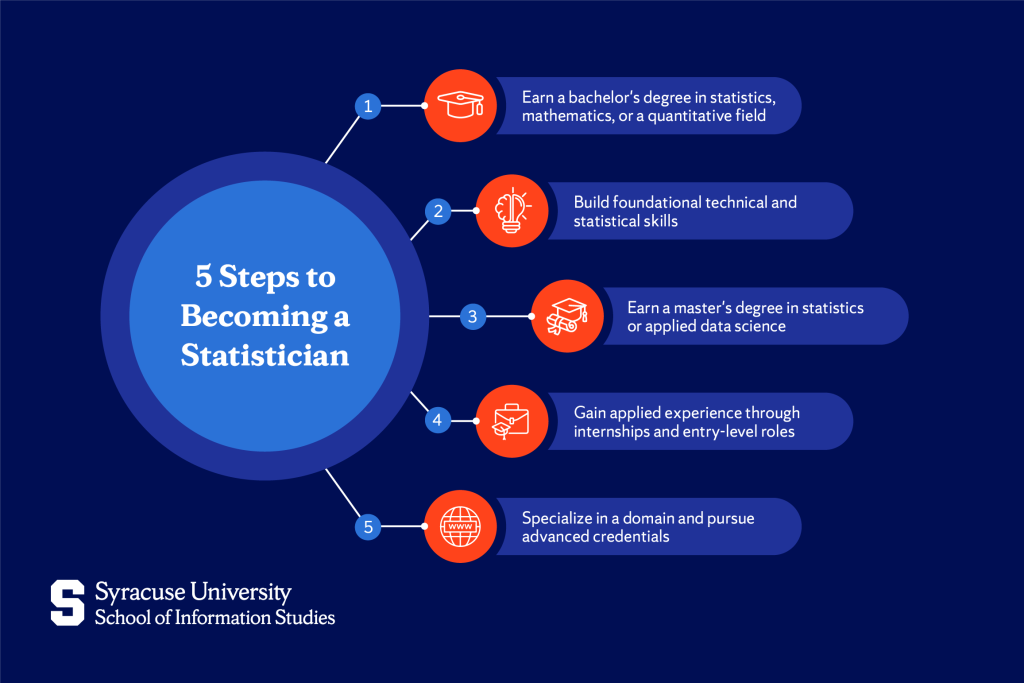
Step 1: Earn a bachelor’s degree in statistics, mathematics, or a quantitative field
A four-year degree in statistics, mathematics, applied math, biostatistics, economics, computer science, or another quantitative field is usually the starting point. It gives you the math and software background that graduate statistics courses expect, including calculus, linear algebra, probability, and statistical tools. Without that foundation, advanced coursework becomes much harder to handle.
Choose a quantitative major and prioritize coursework in calculus through multivariable calculus, linear algebra, probability theory, mathematical statistics, and at least one programming language (R or Python). Building an undergraduate research portfolio by working with a faculty member on an applied project gives you something concrete to show graduate programs and employers alike. The iSchool’s Bachelor’s in Applied Data Science is one direct-fit undergraduate path, combining statistical training with applied data analysis work from the start.
Step 2: Build foundational technical and statistical skills
Alongside your degree, start building the practical skills statisticians use with real data. This means learning how to clean datasets, write code, run statistical analyses, interpret results, and explain what those results mean. Coursework gives you the foundation, but projects help you turn that knowledge into something you can use in a job or graduate program.
Focus on R, Python, and SQL, since these are common tools for statistical work, data analysis, and database use. Practice core methods such as regression analysis, hypothesis testing, experimental design, and statistical modeling through applied projects. Completing at least two end-to-end projects with public datasets, such as Kaggle datasets or government open data, gives you concrete evidence of practical capability when you start applying to graduate programs or jobs.
Step 3: Earn a master’s degree in statistics or applied data science
A master’s degree is the standard credential for most professional statistician roles. The BLS notes that statisticians typically need at least a master’s degree in mathematics or statistics, though related graduate programs in biostatistics, applied statistics, or applied data science can also prepare students for statistics-focused roles. At this level, students study more advanced methods, including multivariate analysis, Bayesian statistics, time-series analysis, experimental design, and applied machine learning.
Apply to graduate programs aligned with your career direction. For example, biostatistics is a strong fit for healthcare, public health, and pharmaceutical work; applied statistics works well for industry and research roles; and applied data science can be useful for students interested in statistics-heavy roles in technology or analytics. The iSchool’s Master’s in Applied Data Science is one relevant graduate option because it combines statistical methods, data management, and applied analysis.
Step 4: Gain applied experience through internships and entry-level roles
Applied experience is where statistical training starts to become professional judgment. Coursework teaches the methods, but internships and entry-level roles teach you how to choose the right method for a real problem, work with messy data, and explain findings to people who may not have a statistics background.
Look for internships or early roles that involve statistical analysis, research design, data cleaning, reporting, or modeling. Common starting points include research assistant roles, junior statistician positions, data analyst roles with statistical responsibilities, and research-focused positions in government, healthcare, pharmaceuticals, technology, or public policy.
Consider organizations like the Census Bureau, BLS, CDC, FDA, major pharmaceutical companies such as Pfizer, Merck, or Novartis, or tech firms with dedicated research teams. Federal agencies in particular value statistical credentials highly and often hire directly from internship pipelines. For many students, this stage begins during the master’s program and continues for the first one to three years after graduation.
Step 5: Specialize in a domain and pursue advanced credentials
As you gain experience, start narrowing your focus around a specific field or type of statistical work. Statisticians may specialize in areas such as biostatistics, financial statistics, environmental statistics, sports analytics, government statistics, or psychometrics. Specialization matters because each field has its own data types, regulations, research questions, and reporting standards. Over time, that domain knowledge is what helps you move from entry-level work into more advanced roles.
Choose a specialty based on the work you enjoyed most during internships, projects, or early career roles. Some statisticians also pursue credentials that fit their field, such as Society of Actuaries credentials for insurance-adjacent work, SAS Certified Statistical Business Analyst for pharma and corporate settings, or ASA accreditation through the American Statistical Association for broader professional recognition. A Ph.D. is worth considering for academic research, senior research leadership, or highly specialized government and pharmaceutical roles.
Essential Skills for Statisticians
Statisticians need fluency in R and Python as primary analytical languages, SQL for database work, and at least one specialized tool depending on industry: SAS for biostatistics and pharma, Stata for academic econometrics, and MATLAB for simulation and applied modeling.
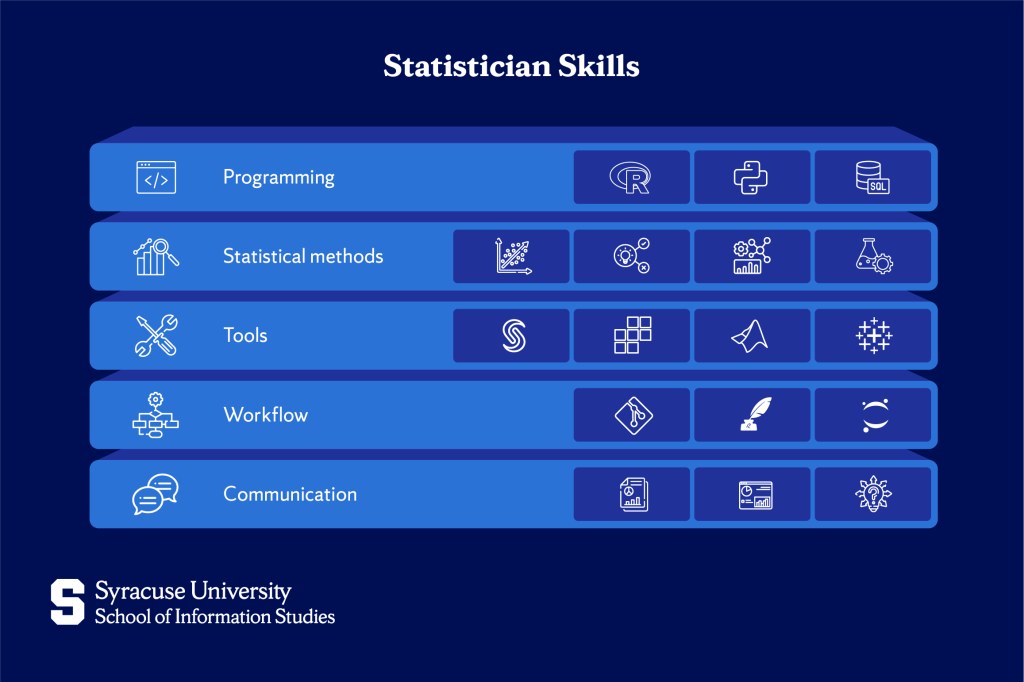
Statistical methods competence spans regression analysis, hypothesis testing, experimental design, multivariate methods, time-series analysis, and Bayesian inference. Data visualization skills using ggplot2, matplotlib, or Tableau, along with the ability to write reproducible analytical code in R Markdown or Jupyter notebooks with version control through Git, are now expected at every career level, not just senior ones.
Technical skills may help you get hired, but communication skills often influence how far you advance. Statisticians spend a lot of time explaining results to people outside the field, such as physicians reviewing clinical trial findings, executives assessing a market study, or policymakers evaluating a program’s impact. Being able to translate statistical findings into business, research, or policy language, write clear reports, and create visualizations that non-experts can understand is one of the most valuable skills in the field.
Statistician Salary and Job Outlook
The U.S. Bureau of Labor Statistics reports a median annual wage of approximately $103,000 for statisticians as of the most recent release. Employment in the occupation is projected to grow 8% from 2024 to 2034, much faster than the average for all occupations.
Pay varies by industry and specialization; BLS wage data show that the highest 10% of statisticians earned more than $170,000, while adjacent quantitative roles such as actuaries and computer and information research scientists also show high upper-end pay. To compare this career with a broader analytics track, see our overview of data analytics salaries.
Where Statisticians Work
Statisticians work across federal agencies, including the Census Bureau, Bureau of Labor Statistics, CDC, FDA, USDA, and the Department of Veterans Affairs; the federal government remains one of the largest employers of professional statisticians in the country. In healthcare, biostatisticians at pharmaceutical companies such as Pfizer, Merck, Novartis, and Eli Lilly, alongside academic medical centers like Mayo Clinic and Johns Hopkins, and contract research organizations, design and analyze clinical trials that determine which treatments reach patients.
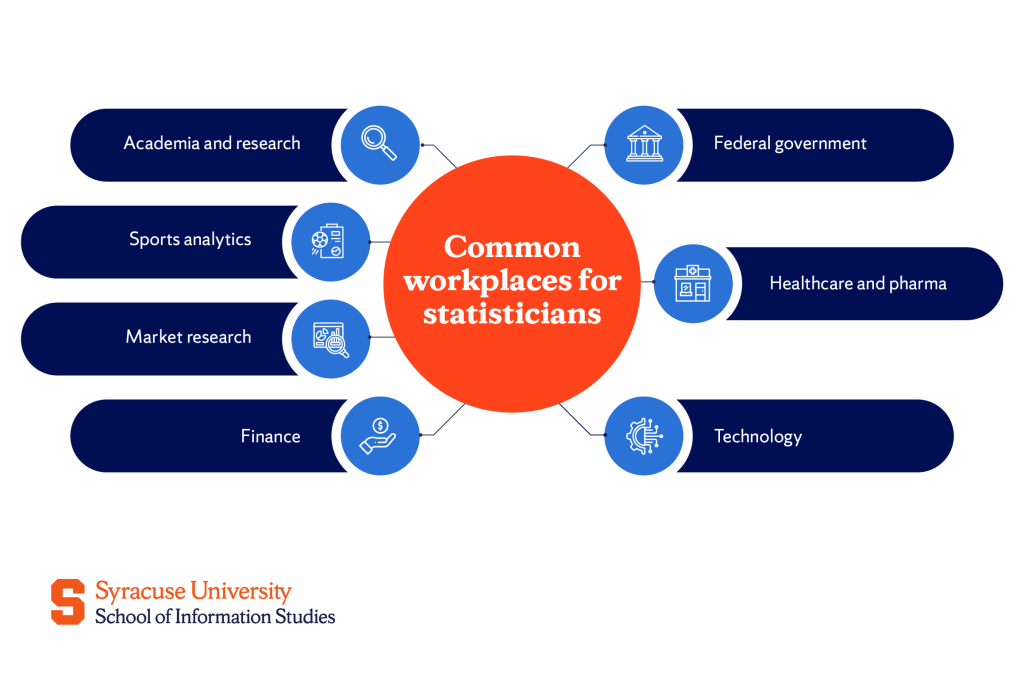
Industry roles include statisticians at technology companies running large-scale experimentation platforms (Meta, Google, Netflix, and Microsoft), financial statisticians at banks and hedge funds, market research statisticians at consultancies, and sports analytics statisticians at professional teams and broadcasters. Academia and research employ statisticians at universities, national laboratories like Sandia and Los Alamos, and non-profit research institutes.
Students weighing statistics against a faster-entry quantitative career can also review how to become a data analyst, which explains a shorter route into professional data roles with different long-term options for specialization and pay.
Building a Career as a Statistician
Statistician careers reward patience, depth, and the ability to keep learning as data problems become more complex. The credential path is often longer than the route into data analyst or data scientist roles, but senior statisticians can build more stable, specialized careers, especially when they develop strong domain expertise.
As AI tools automate more routine analytical work, that depth becomes even more important. Machine learning has not reduced the need for statisticians; it has increased demand for professionals who can evaluate model assumptions, interpret uncertainty, and audit statistical claims. Students entering the field now are preparing for a job market that treats statistical training as foundational across industries.
Frequently Asked Questions (FAQs)
How long does it take to become a statistician?
Most paths take six to eight years: four for a bachelor’s degree, then two for a master’s, plus one to three years of applied experience. Some industry roles are reachable with a bachelor’s plus several years of applied work, but most professional statistician titles require a master’s.
Can I become a statistician without a master’s degree?
It’s possible but uncommon for roles formally titled “statistician.” BLS data shows most professional statistician positions require a master’s degree, and bachelor’s-only candidates typically enter as data analysts or research assistants and grow into statistician roles after additional training.
What programming languages do statisticians use most?
R and Python are the dominant languages. R remains the gold standard for academic and biostatistics work, while Python is increasingly preferred in industry, tech, and finance roles. SQL is also essential for working with structured data in most professional settings.
What’s the difference between a statistician and an actuary?
Statisticians design and analyze data across many fields, including research, government, healthcare, and technology, while actuaries specialize in evaluating financial risk specifically for the insurance and pension industries, following their own credentialing path through Society of Actuaries exams rather than a statistician’s master’s degree pathway.
Is being a statistician a good career in 2026?
Yes. BLS projects statistician roles to grow much faster than average through 2033, with median wages surpassing $100,000 per year, and the field is expanding as more organizations make data-driven decisions, while AI’s growth has increased rather than reduced demand for statistical expertise.