
Key Takeaways
- A statistician is a trained expert who uses mathematical and statistical methods to collect, analyze, and interpret data.
- Statisticians work across healthcare, government, finance, technology, and scientific research, making the role one of the most versatile in the data profession.
- Most entry-level statistician roles require at least a bachelor’s degree in statistics, mathematics, applied data science, or a related field, with a master’s degree preferred for many industry positions.
The American Statistical Association (ASA) defines statistics as “the science of learning from data and of measuring, controlling, and communicating uncertainty.” The definition points to something fundamental about how information is understood in modern society. From public health research and financial markets to manufacturing systems and scientific experiments, large amounts of data are constantly produced. Statistics provides the methods used to examine that information carefully and then draw conclusions that can help in decision-making.
The professionals trained to carry out this work are known as statisticians.
What Is a Statistician?
A statistician is a professional trained in statistical science whose work focuses on developing reliable methods for collecting data and evaluating what that data reveals. The role focuses on determining how information should be gathered and how results should be interpreted so that conclusions are supported by evidence.
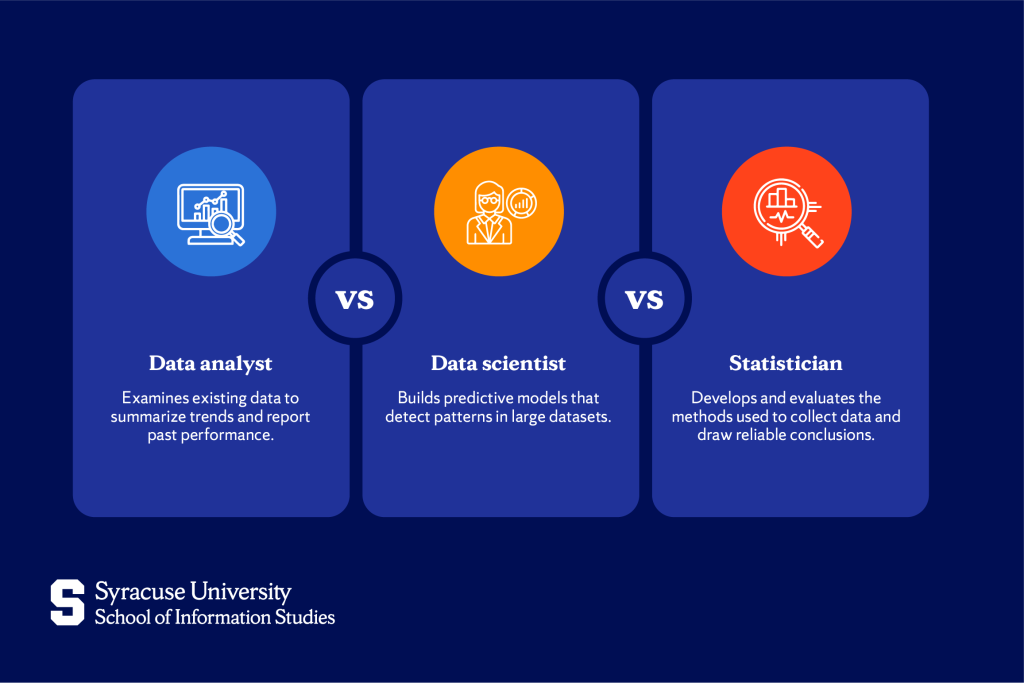
Statisticians often work in environments that also include data analysts and data scientists. All three roles examine data to support research, operations, or strategic decisions, which is why they are sometimes grouped together within data-related professions.
Their responsibilities, however, differ in emphasis. Data analysts typically work with existing datasets to summarize trends and prepare reports that help organizations understand past activity. Data scientists often build predictive models and machine learning systems that identify patterns in large datasets. Statisticians focus on the underlying methods used to generate reliable results. Their expertise lies in research design, probability theory, and statistical inference, which guide how data should be collected and how conclusions should be evaluated.
What Does a Statistician Do?
The work of a statistician begins with planning how information will be gathered and continues to the interpretation of results and communication of findings. Each stage involves a different set of tasks and requires careful attention to how data is produced and evaluated.
Designing surveys and experiments
Before data collection begins, statisticians determine how the information will be gathered. This includes clarifying the research question and deciding how participants or observations should be selected so the results reflect the population being studied.
These decisions strongly influence the reliability of the final results. When the design of a study is flawed, even large datasets can lead to misleading conclusions. By carefully structuring how data is collected, statisticians reduce bias and ensure that the information analyzed later can support meaningful findings.
Collecting and preparing data
Once a study is underway, data may come from surveys, controlled experiments, administrative databases, or observational records. In many cases, the information arrives in raw form as scattered entries, inconsistent records, or files generated by different systems. Statisticians then review the data to identify errors and incomplete records, making corrections where possible so the dataset reflects the information accurately.
Next, they organize the data into structured tables or statistical datasets that can be analyzed with specialized software. This preparation stage often requires considerable time because the accuracy of later conclusions depends heavily on the quality of the dataset.
Analyzing data using statistical methods
After the dataset has been prepared, statisticians apply statistical methods to evaluate patterns in the data. These methods may include regression analysis to examine relationships between variables, probability models to estimate uncertainty, hypothesis testing to assess whether observed results are statistically meaningful, and classification or clustering techniques that group similar observations within a dataset.
The objective at this stage is to describe what the data shows while also assessing how reliable the observed patterns are. Statisticians examine whether the results could have appeared by chance and estimate the level of confidence that can be placed in the conclusions drawn from the available evidence.
Interpreting results and advising decision-makers
Statistical findings must be interpreted in light of how the study was designed and how the data was collected. These factors influence what the results actually represent. A survey with a small or unrepresentative sample, for example, may produce results that cannot be generalized to a larger population.
Statisticians also examine measures such as confidence intervals, which indicate the range within which a true value is likely to fall based on the available data. A narrow interval suggests a more precise estimate, while a wider interval reflects greater uncertainty. By evaluating these measures, statisticians determine how strongly the results support a particular conclusion.
Organizations often rely on these interpretations when making decisions. Researchers use them to evaluate scientific findings, businesses apply them when assessing operational outcomes, and policymakers examine them when reviewing program effectiveness. In each case, the statistician helps explain what the results indicate and what limitations should be considered before those findings influence decisions.
Presenting findings clearly
The final stage of a statistician’s work involves communicating results in a form that others can understand. Reports, visualizations, presentations, and written briefs help translate technical findings into explanations that different audiences can follow.
Clear communication allows statistical analysis to inform decisions. When results are explained carefully, decision-makers can use the evidence to guide planning and evaluate outcomes based on the information revealed by the data.
What Skills Does a Statistician Need?
Statisticians rely on a combination of technical expertise and practical judgment when working with data. Among the most important skills for professionals in this role are:
Strong knowledge of math and probability
Statistical work is grounded in probability theory and statistical inference. These areas provide the tools used to reason about uncertainty and evaluate patterns within data. Statisticians work with probability distributions such as the normal, binomial, and Poisson distributions, which describe how values are expected to appear within a dataset.
This mathematical foundation allows statisticians to draw conclusions from sample data and evaluate how well those conclusions represent a larger population. A strong understanding of these principles ensures that statistical methods are applied appropriately and that results are interpreted accurately.
Technical and software skills
Modern statistical work relies heavily on specialized software and programming tools. Languages such as R and Python are widely used for statistical analysis and data modeling. SAS remains common in areas such as pharmaceutical research and government studies, while SQL allows statisticians to retrieve information from structured databases.
Visualization tools also play an important role. Libraries such as ggplot2 in R or matplotlib in Python allow statisticians to present patterns in data through charts and graphical summaries that help others interpret the results.
Developing proficiency with these tools requires hands-on practice. Research projects, internships, and applied coursework often provide opportunities to work with real datasets and strengthen technical skills.
Critical thinking and problem-solving
Statistical analysis begins long before software is used. Statisticians evaluate whether a research question is clearly defined and whether the chosen method suits the available data. This step requires careful reasoning about how a study is designed and what assumptions underlie the analysis.
Problem-solving in statistics often involves identifying limitations within a dataset or recognizing when a method may produce misleading conclusions. By evaluating these factors early, statisticians help ensure that the analysis reflects the evidence accurately.
Communication and ethical responsibility
Statistical findings often influence decisions that affect organizations, communities, and public policy. For this reason, statisticians must communicate results in a clear and responsible manner.
Ethical judgment also plays an important role. Data used in statistical analysis may include sensitive information such as medical records, financial data, or demographic information. Statisticians are expected to handle this information carefully and present results in ways that accurately reflect what the data supports.
Where Do Statisticians Work?
Statisticians work across many sectors where organizations rely on data to guide decisions. Their expertise is applied in environments that require careful analysis and reliable conclusions drawn from complex datasets.
Common workplaces include:
- Government and public sector: National statistical agencies, central banks, regulatory institutions, and public health departments use statistical analysis to produce economic reports, population statistics, and health surveillance data.
- Business and finance: Companies apply statistical methods to market research, consumer behavior analysis, financial risk assessment, demand forecasting, and pricing strategy.
- Healthcare and scientific research: Pharmaceutical companies, hospitals, and research institutions rely on statisticians to design clinical trials and evaluate the effectiveness of medical treatments.
- Technology and data-driven companies: Technology firms employ statisticians to analyze product usage, conduct A/B testing, and support data-driven development of digital services.
How Do You Become a Statistician?
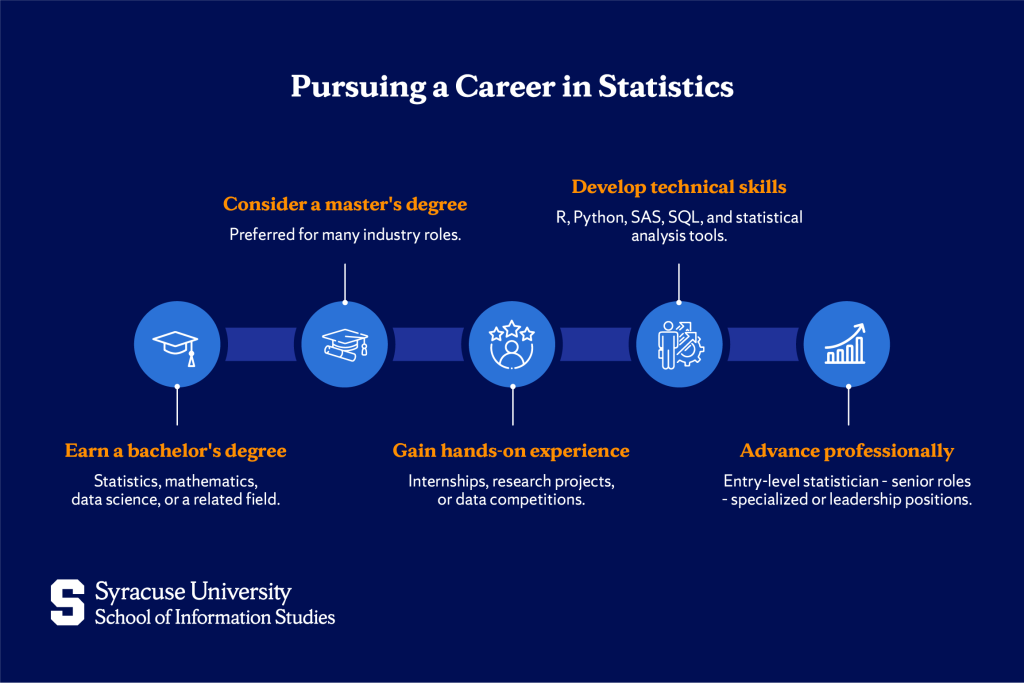
Becoming a statistician typically involves a combination of formal education and practical experience working with real datasets. The field relies on strong quantitative training; however, employers also expect candidates to demonstrate how those skills translate into applied analysis. The path therefore develops through academic preparation, hands-on data work, and gradual professional specialization.
Education requirements
Most statistician roles require at a minimum a bachelor’s degree in statistics, mathematics, data science, or a closely related quantitative field. Many industry roles prefer a master’s degree because advanced statistical work often involves more complex modeling techniques and deeper training in statistical theory. Fields such as biostatistics and economic research commonly expect this additional preparation. Doctoral degrees are typically required for academic research careers and some senior positions in government or pharmaceutical research.
Because the profession relies heavily on both theoretical knowledge and applied analysis, students often benefit from programs that combine mathematical foundations with practical experience working with data. The Applied Data Science bachelor’s degree at Syracuse University’s iSchool provides training in various areas, including statistical analysis, alongside hands-on experience using analytical tools and working with real datasets. This type of preparation helps students build the quantitative and analytical skills that many data-focused careers, including statistical roles, require.
Gaining practical experience
Academic training provides the theoretical base, while practical experience demonstrates the ability to apply those concepts. Students often develop this experience through several avenues:
- Internships: Working with research institutions, government agencies, or companies that maintain data teams.
- Research assistant roles: Supporting faculty projects that involve survey design, data analysis, or experimental studies.
- Capstone or thesis projects: Conducting full statistical analyses on real datasets from data collection through interpretation.
- Data competitions: Simulating applied statistical problem-solving.
Career growth opportunities
Statisticians often progress through several stages as their expertise develops:
- Entry-level statistician: Assisting with data preparation and conducting standard analyses under supervision.
- Statistician or senior statistician: Leading analytical work for projects and advising on appropriate statistical methods.
- Biostatistician or quantitative researcher: Specialized roles that apply advanced statistical techniques within fields such as healthcare or finance.
- Principal statistician or director of analytics: Positions focused on research leadership, team management, and strategic analytical guidance.
Statisticians who expand their expertise in statistical modeling may also move into roles that intersect with data science and machine learning.
Is Being a Statistician a Good Career?
For people who are interested in solving complex problems and working with evidence, statistics offers a career built around discovery. Each project involves a different dataset, a different research question, and a new analytical challenge. This constant variation appeals to individuals who prefer work that requires careful reasoning and thoughtful interpretation rather than routine tasks.
In addition to intellectual engagement, becoming a statistician is a good career choice for its financial compensation and job outlook. The U.S. Bureau of Labor Statistics projects employment for mathematicians and statisticians to increase by 8% from 2024 to 2034, reflecting the expanding role of data in business, healthcare, government, and technology. Median annual wages for statisticians are reported at $103,300, with higher earnings common in specialized or senior roles.
Bringing It All Together
As the amount of data produced across industries continues to grow, the need for professionals who can interpret that information with care and precision becomes increasingly important.
For those interested in developing these capabilities, the path begins with strong preparation in quantitative reasoning and applied data analysis. The Applied Data Science bachelor’s degree at Syracuse University’s iSchool offers an opportunity to build those foundations through training in statistical methods, data analysis, and the analytical tools used across modern data-driven professions.
FAQ’s
Is a statistician the same as a data scientist?
Not exactly. Statisticians focus more heavily on probability theory, research design, and the mathematical foundations used to evaluate conclusions. Data scientists often focus on predictive modeling and machine learning systems that analyze large datasets. The roles share many tools and methods, which is why they sometimes overlap in practice.
What industries hire statisticians?
Statisticians work across many sectors that rely on data-driven decisions. Major employers include government agencies, healthcare and pharmaceutical organizations, financial institutions, technology companies, and academic research institutions.
How long does it take to become a statistician?
A bachelor’s degree typically takes four years to complete. Many industry roles prefer a master’s degree, which usually requires one to two additional years of study. Doctoral programs for research-oriented careers often take four to six years beyond the bachelor’s degree.
Do statisticians need programming skills?
Yes. Many statistician roles require familiarity with programming tools used for data analysis. Common examples include R, Python, or SAS, along with SQL for working with databases and data visualization tools that help communicate analytical results