
Key Takeaways
- AI works by finding statistical patterns in large amounts of data rather than following rules a programmer wrote by hand, which is why it can answer questions it was never explicitly given the answer to.
- Every modern AI system runs through the same five-stage loop: collect data, train a model, represent what it learned in a neural network, run inference on new inputs, and improve through feedback.
- When a chatbot answers a question, it isn’t searching the web in real time; it’s predicting the most likely next words based on patterns learned during training, which is also why it can be confidently wrong.
- AI is powerful but narrow, and its real value comes from pairing it with human judgment, the core idea behind human-centered AI.
You probably used AI several times today without thinking about it: unlocking your phone with your face, getting a show recommended on Netflix, asking a chatbot to draft an email, or having your bank flag an unusual charge. Millions of people rely on these tools daily, yet very few could explain what’s happening underneath, which is why “how does AI work?” ranks among the most searched technology questions online.
The short answer is that AI learns patterns from huge amounts of data instead of following rules a person wrote by hand. And nearly every modern AI system, from a spam filter to ChatGPT, follows the same five-step loop to get there.
What Is AI, Really?
Artificial intelligence is software that performs tasks we normally associate with human thinking, like recognizing a face in a photo or understanding a spoken question. What sets it apart from ordinary software is how it gets there. Traditional programs follow explicit instructions a programmer writes step by step, while AI learns patterns from examples, so it can handle inputs no one anticipated.
A spam filter shows the difference clearly. An older filter might block any email containing “free money,” a rule someone typed in by hand, and spammers simply changed their wording. An AI filter instead studies millions of emails people have marked as spam and learns what spam tends to look like, including variations nobody wrote a rule for.
How AI Works, Step by Step
AI models are built once through training, then run over and over on new inputs, and after improved as feedback flows back in to start the cycle again.
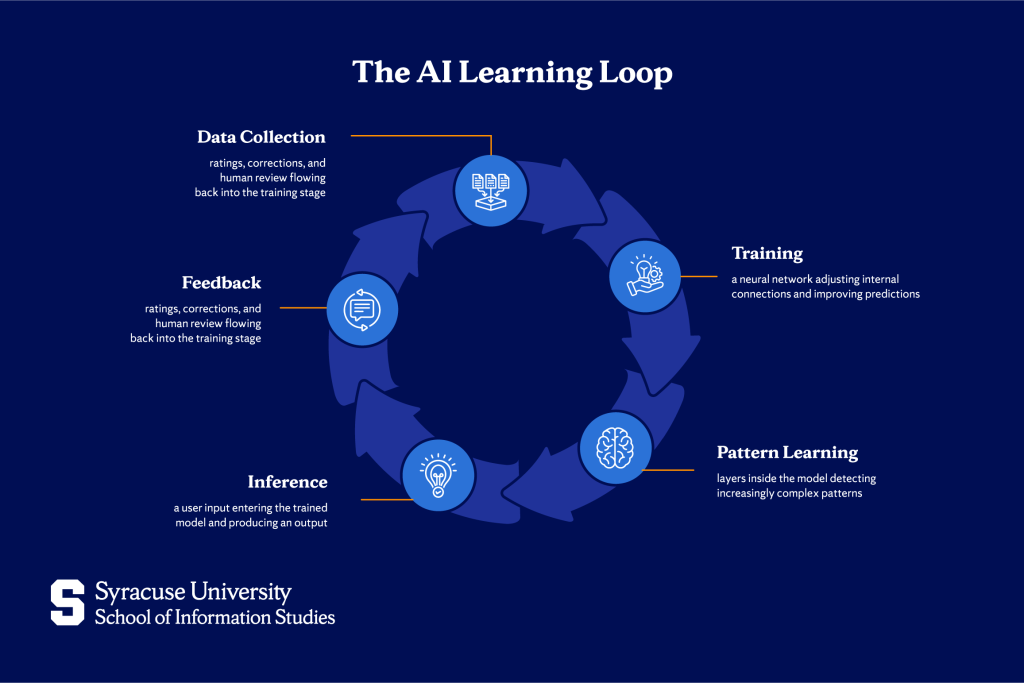
Step 1: Collecting and preparing data
AI is only as good as the data it learns from. Since it learns by example, the first step is gathering large collections of labeled examples: photos tagged “cat,” emails marked “spam,” medical scans annotated by radiologists, or text drawn from books and websites. The scale can be enormous. Meta’s Llama 3 language models were trained on more than 15 trillion tokens, or word fragments, from publicly available sources, roughly seven times the data used for the previous version. Preparing that data means cleaning out duplicates and errors, because messy or skewed data at this stage creates problems that surface much later.
Step 2: Training the model
Training is where learning actually happens, and it works like guided trial and error. The model makes a guess, checks it against the correct answer, measures how far off it was, and nudges its internal settings, called parameters, so it will be a little less wrong next time. That cycle repeats billions of times. The model isn’t memorizing answers. It’s tuning millions or billions of numbers until they capture the patterns in the data, much as you learn to ride a bike through countless small corrections rather than by reading instructions.
Step 3: Neural networks and how AI represents patterns
So what is a trained model physically made of? Most modern AI uses a neural network: layers of simple connected units loosely inspired by neurons in the brain. Each connection carries a weight, a number that strengthens or weakens during training, and together those weights hold everything the model has learned. “Deep” learning simply means the network has many layers. In an image model, early layers might detect edges and corners while later layers combine them into shapes and, eventually, “a face.”
Step 4: Inference: putting the trained model to work
Once training is finished, the model gets put to work through inference: it receives a new input it has never seen and produces an output, such as translating a sentence or flagging a suspicious credit card transaction. Training and inference are very different jobs. Training happens once (or occasionally) and can take weeks of computing time, while inference runs every time someone uses the tool and takes seconds. When you type a prompt into a chatbot, inference is what’s running.
Step 5: Feedback and improvement
Models get better through feedback. Some comes from users, like thumbs-up and thumbs-down ratings or corrected predictions. Some comes from paid human reviewers who compare responses side by side and rank which is more helpful, a process called reinforcement learning from human feedback, or RLHF, which is a large part of how chatbots are tuned to be useful and polite. The scale here is significant too: Meta reported that fine-tuning for Llama 3 used over 10 million human-annotated examples. All of that feedback becomes new training data, and the loop starts again.
A Real Example: What Happens When You Ask a Chatbot a Question
Suppose you ask a chatbot, “Can you summarize this error message and tell me what might be causing it?” The example below shows the basic process an large language model (LLM) uses to generate a response:
- The model works from your prompt and the context available to it: Unless the system also gives it access to tools such as web search, technical documentation, or code execution, it does not independently look up the answer.
- Your prompt is broken into tokens: The model processes those tokens and generates the response one token at a time, based on the probability of what should come next in that context.
- Its answer draws on patterns learned during training: Because the model has been exposed to large amounts of text, including technical documentation and examples of similar problems, it can recognize familiar patterns and generate a relevant response.
- The response can still be wrong: The model may misunderstand the context, miss important details, or produce an explanation that sounds plausible but does not apply to the specific situation.
This same basic process underlies many other LLM tasks, including answering questions, summarizing documents, drafting text, and generating code.
Types of AI You’ll Hear About
The terms below show up constantly in news coverage and job listings. Here’s where each one fits:
| Term | What it means in one line |
|---|---|
| Machine learning (ML) | The broad approach behind modern AI: systems that learn patterns from data instead of being hand-coded. |
| Deep learning | Machine learning that uses many-layered neural networks; it powers image recognition and language models. |
| Generative AI | Models that produce new content, including text, images, code, and audio, by predicting likely outputs (ChatGPT, DALL-E). |
| Narrow (weak) AI | AI built to do one kind of task well. Every AI system in use today is narrow AI. |
| General (strong) AI | Hypothetical AI with human-level flexibility across any task. It doesn’t exist yet. |
Everything people call “AI” today is narrow AI, and generative AI is the particular kind that burst into public use after late 2022. Machine learning is the engine inside almost all of it.
What AI Can’t Do (Yet)
Understanding the limits matters as much as understanding the mechanics:
- It doesn’t truly understand meaning: A model predicts plausible patterns, with no grasp of what the words refer to and no awareness of whether its output is true.
- It hallucinates: Because it predicts likely text, it can produce confident, fluent answers that are simply wrong, a known limitation researchers haven’t solved.
- It inherits bias: A model trained on skewed data reproduces that skew and can amplify it, which is why auditing training data carefully makes such a difference.
- It depends entirely on its data: It struggles with situations unlike anything in its training and has no genuine common sense to fall back on.
These gaps explain why the most reliable AI systems keep a person in the loop to check, correct, and decide.
Why Understanding How AI Works Matters
AI has moved from a specialist tool into everyday work, hiring, healthcare, and education, so a working mental model of it has become basic literacy, much as understanding the internet did a generation ago. The people who get the most from AI, and run into the fewest unpleasant surprises, are the ones who know both what it does well and where it breaks down.
At Syracuse University’s iSchool, our Master’s in Applied Human-Centered AI is built on the idea that the most valuable AI work pairs technical fluency with human judgment and ethical design. Undergraduates can begin with the Integrative Artificial Intelligence Bachelor’s Degree or add the Applications of AI Minor to another major, and the Master’s in Applied Data Science suits those drawn to the data side. If you’d like to take the next step, request information from our admissions team. Next time an AI tool gives you an answer, try tracing it back through the five steps. It’s the quickest way to start judging when that answer deserves your trust.
Frequently Asked Questions (FAQs)
Why does AI give different answers to the same question?
Chatbots don’t always choose the single most probable next word. A setting called temperature adds controlled randomness, so the same prompt can branch in slightly different directions each time.
Does AI learn from my conversations?
Not during the chat itself, because a model’s weights don’t change mid-conversation. Some providers may use chats to train future versions depending on your settings, which privacy controls usually let you switch off.
Are AI detectors reliable?
Not very. OpenAI discontinued its own AI text classifier in July 2023 after it correctly identified only 26% of AI-written text and mislabeled human writing as AI 9% of the time.
Can AI be creative, or does it just copy?
It recombines patterns learned from vast amounts of data into new output, which can be genuinely novel in form. Models can occasionally reproduce memorized passages from training data word for word, though.
How much energy does AI use?
A lot, and it’s growing. The International Energy Agency projects data center electricity use roughly doubling from 485 TWh in 2025 to 950 TWh in 2030, with AI-focused facilities growing fastest.
Do you need to know how to code to work with AI?
Not to use it well, since clear prompting and subject knowledge go a long way. Building or customizing AI systems, however, usually requires Python and a grounding in statistics.