
Key Takeaways
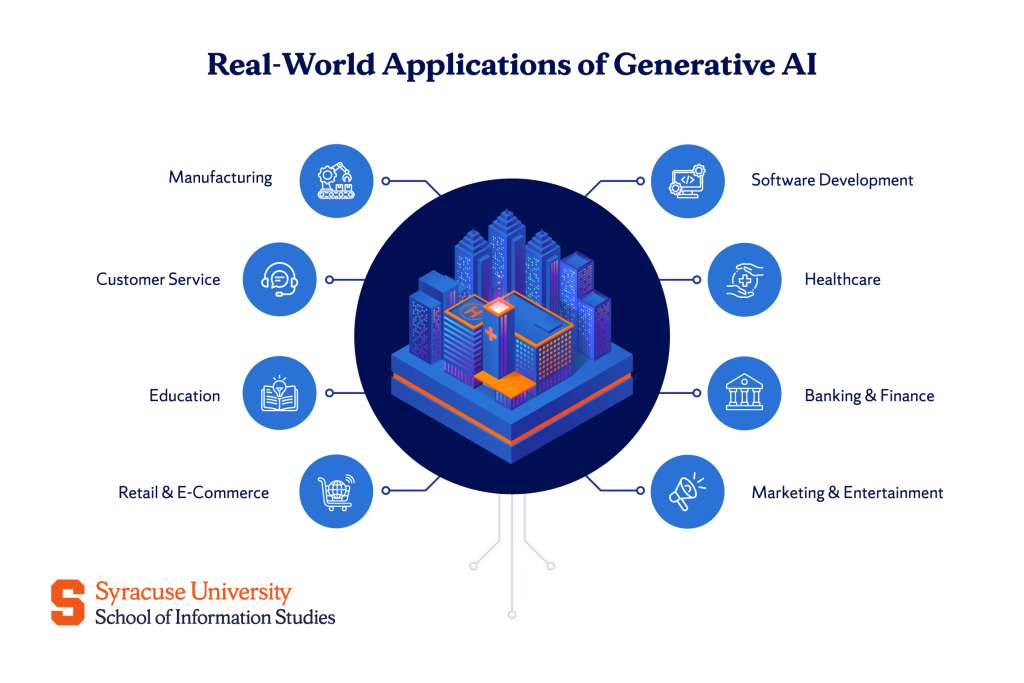
- Generative AI is in daily production use across at least eight industries, including software, healthcare, banking, retail, and education.
- Each industry gives generative AI a different core job, such as drafting clinical notes in hospitals or writing code on software teams.
- MIT-associated research from 2025 found that approximately 95% of enterprise generative AI pilots in its study produced no measurable financial return, highlighting the difficulties organizations face when putting AI into practice.
- Agentic AI, where models plan and complete multistep tasks, is the next stage, and it raises the bar for human oversight.
Generative AI is becoming part of everyday work in industries ranging from healthcare to software development. Businesses use it to draft documents, develop code, and help employees find information. According to Stanford University’s 2026 AI Index Report, 79% of surveyed organizations reported using generative AI in at least one business function in 2025, up from 71% in 2024.
However, wider adoption doesn’t necessarily mean that every application produces measurable results. The 2025 GenAI Divide report found that most enterprise generative AI pilots in its study had yet to demonstrate a financial return.
Looking at how different industries use the technology offers a clearer understanding of its practical applications, the benefits organizations are seeing, and the limitations they still face.
What Counts as Generative AI
Generative AI is a class of models that create new content, such as:
- Text: ChatGPT, Claude, Gemini, and Microsoft Copilot draft, summarize, translate, and answer questions.
- Image and video: Midjourney, Adobe Firefly, Google Veo, and Runway turn written prompts into visuals.
- Audio and voice: ElevenLabs synthesizes speech, and Suno composes songs from a text description.
- Code: GitHub Copilot and Cursor write and explain software.
The examples below are grouped by who uses these tools and what they use them for.
Generative AI Examples by Industry
Generative AI is used differently across industries, depending on the work involved and the problems organizations are trying to solve. The following examples show how businesses and institutions are applying the technology in practice.
1. Software Development
Software developers use generative AI to write code, identify errors, and speed up repetitive programming tasks. These tools can suggest individual lines of code or generate larger sections based on instructions, allowing developers to spend more time on complex problems.
Several tools support different parts of the development process:
- GitHub Copilot: Suggests code, generates functions, and helps developers write unit tests within their coding environments.
- Cursor: An AI-powered code editor that helps developers understand existing code and make changes across multiple files.
- Amazon Q Developer: Assists with coding and includes capabilities for upgrading legacy Java applications to newer versions.
- Tabnine: Provides AI-assisted code completion and generation, with options for organizations that need greater control over their development environments.
Limitations: AI-generated code may contain logical errors or security vulnerabilities, even when it appears to work correctly. Developers still need to review and test the output before using it in production.
2. Healthcare and Life Sciences
Healthcare organizations use generative AI to reduce administrative work and support medical research. One of its most established applications is clinical documentation, where AI systems turn conversations between clinicians and patients into draft medical notes.
Microsoft’s Dragon Copilot and Abridge are examples of tools designed for this purpose. Microsoft’s ambient documentation technology reportedly assisted with more than 3 million patient conversations across 600 healthcare organizations in a single month.
Generative AI is also being used in drug discovery. Insilico Medicine applied AI to identify a drug target and develop rentosertib, an experimental treatment for idiopathic pulmonary fibrosis. The drug’s phase 2a clinical trial results were published in Nature Medicine in June 2025.
Other examples include Google’s Med-Gemini research models, developed for medical applications, and AlphaFold 3, which uses a diffusion-based approach to predict molecular structures.
Limitations: Inaccurate AI-generated medical information can create serious patient-safety risks. Clinicians must verify documentation before it becomes part of a patient’s medical record, and organizations must protect sensitive health information in accordance with applicable privacy requirements.
3. Banking and Financial Services
Financial institutions use generative AI to help employees find information and work with large volumes of documents. These applications are particularly useful in areas such as financial research, where professionals need to retrieve relevant information quickly.
Morgan Stanley developed its AI @ Morgan Stanley Assistant with OpenAI to help financial advisors search the firm’s internal research and knowledge resources. According to OpenAI, more than 98% of Morgan Stanley’s advisor teams use the assistant.
Other applications include:
- AI @ Morgan Stanley Debrief: Helps financial advisors summarize client meetings and prepare follow-up documentation.
- JPMorgan LLM Suite: Provides employees with access to approved generative AI capabilities for tasks such as summarization and document analysis.
- BloombergGPT: A finance-focused language model developed to support natural language processing tasks involving financial information.
Limitations: Using AI in financial services raises concerns about data security, accuracy, and accountability. These risks become particularly serious when AI agents can access financial accounts and perform tasks on users’ behalf. In October 2026, CBS News reported that some banks had identified AI agents appearing to take actions customers had not specifically authorized. Such cases highlight the need for strict access controls and clear limits on what AI systems can do. Financial institutions must also verify AI-generated information and maintain human oversight, particularly for financial advice and regulated decisions.
4. Marketing, Media, and Entertainment
Generative AI allows marketing and creative teams to produce written and visual content more quickly. Businesses use it to develop advertising materials, experiment with creative concepts, and adapt content for different audiences.
Several tools have become common in creative workflows:
- Adobe Firefly: Generates and edits images and other creative assets for design and marketing projects.
- Midjourney: Creates images from text descriptions, allowing teams to explore visual concepts.
- Runway: Offers AI-powered video generation and editing tools.
- ElevenLabs: Generates synthetic speech for uses such as narration and multilingual audio content.
Large brands are also experimenting with AI-generated advertising. Coca-Cola used generative AI for its 2024 “Holidays Are Coming” campaign and returned to the approach in 2025, despite criticism of the creative results.
Limitations: Generative AI raises questions about copyright, consent, and the use of creative work in model training. Businesses also need to assess the quality of AI-generated content and be transparent about its use where appropriate.
5. Retail and E-Commerce
Retailers use generative AI to help customers find products and to support the work involved in managing online stores. Applications include conversational shopping assistants and automatically generated product descriptions.
Amazon’s AI shopping assistant Rufus was used by more than 300 million customers in 2025, according to the company. In May 2026, Amazon combined Rufus with Alexa+ into Alexa for Shopping, which helps customers compare products and find information before making purchases.
Other tools support retailers behind the scenes:
- Shopify Magic: Helps merchants generate product descriptions and other store content.
- Shopify Sidekick: Allows merchants to ask questions about their store and receive AI-assisted support with business tasks.
- Google Vertex AI Search for Commerce: Helps retailers improve product discovery through AI-powered search and recommendations.
Limitations: AI-generated product descriptions can contain inaccurate details, while shopping assistants may provide unsuitable recommendations. Retailers need to check the information presented to customers and assess whether AI recommendations are improving the shopping experience.
6. Education and Training
Generative AI is being used to support student learning and reduce the time teachers spend preparing educational materials. AI tutors can provide explanations and practice activities, while teacher-facing tools help develop lesson plans and classroom resources.
Khan Academy’s Khanmigo is one example. Built using OpenAI technology, it guides students through problems using questions and hints. Khanmigo for Teachers also helps educators prepare learning materials and is available free to teachers in 49 English-speaking countries through a partnership with Microsoft.
Other educational applications include:
- Duolingo Max: Uses generative AI for interactive language practice, including simulated conversations.
- Google LearnLM: A family of AI models and capabilities designed to support educational applications.
- ChatGPT Edu: Provides universities with access to ChatGPT in an institutional environment for teaching, studying, and administrative work.
Limitations: AI tutors can provide incorrect explanations, and students may become overly dependent on generated answers. Adoption also varies. Khan Academy reported that approximately 15% of students with access to Khanmigo were using it, illustrating the challenges of integrating AI tools into everyday learning.
7. Customer Service and Operations
Businesses use generative AI to answer routine customer questions and help support teams retrieve information more quickly. AI assistants can handle common requests, allowing human employees to focus on problems that require additional attention.
Klarna introduced an OpenAI-powered customer service assistant in 2024, initially reporting that it handled work equivalent to 700 full-time agents. The company later acknowledged concerns about service quality and placed greater emphasis on maintaining access to human support. AI remains central to its operations, with Klarna reporting that its assistant handled 80% of customer service chats in 2025.
Businesses can also use platforms such as:
- Intercom Fin: An AI customer service agent that answers questions using a company’s support knowledge.
- Salesforce Agentforce: Allows organizations to create AI agents that respond to requests and carry out supported business processes.
- Zendesk AI Agents: Help customer service teams automate responses and manage support requests.
- OpenAI Agents SDK: A developer toolkit for building AI agents that use connected tools to perform tasks.
Limitations: AI assistants may struggle with unusual requests or situations requiring greater judgment. Businesses need clear procedures for transferring conversations to employees and checking that automated responses meet their service standards.
8. Manufacturing and Industrial Design
Manufacturers use AI to support product development and improve production processes. One application is generating synthetic training data, which allows companies to create artificial examples of defects or operating conditions that may be difficult to capture in real factories.
For example, NVIDIA’s Omniverse Replicator generates synthetic images that can be used to train computer vision systems. Electronics manufacturer Delta Electronics has used the technology to produce labeled training data for automated inspection, reducing the time required to prepare images for its AI models.
Related tools serve different purposes:
- NVIDIA Omniverse: Provides tools for developing digital replicas of physical environments and generating synthetic data.
- NVIDIA Isaac Sim: Simulates robots and industrial environments to support testing and AI training.
- Autodesk Fusion: Includes generative design tools that produce design alternatives based on design constraints.
- Siemens NX: Supports product design and manufacturing workflows, including AI-assisted design capabilities.
It’s important to distinguish these applications. Generative design tools such as Autodesk Fusion may use optimization and simulation methods that differ from generative AI. Synthetic data workflows can also combine simulation with generative models.
Limitations: AI-generated designs and simulated results still require real-world validation. Manufacturers must test whether proposed solutions meet technical specifications and relevant safety standards before using them in production.
How to Tell a Strong Generative AI Deployment From a Weak One
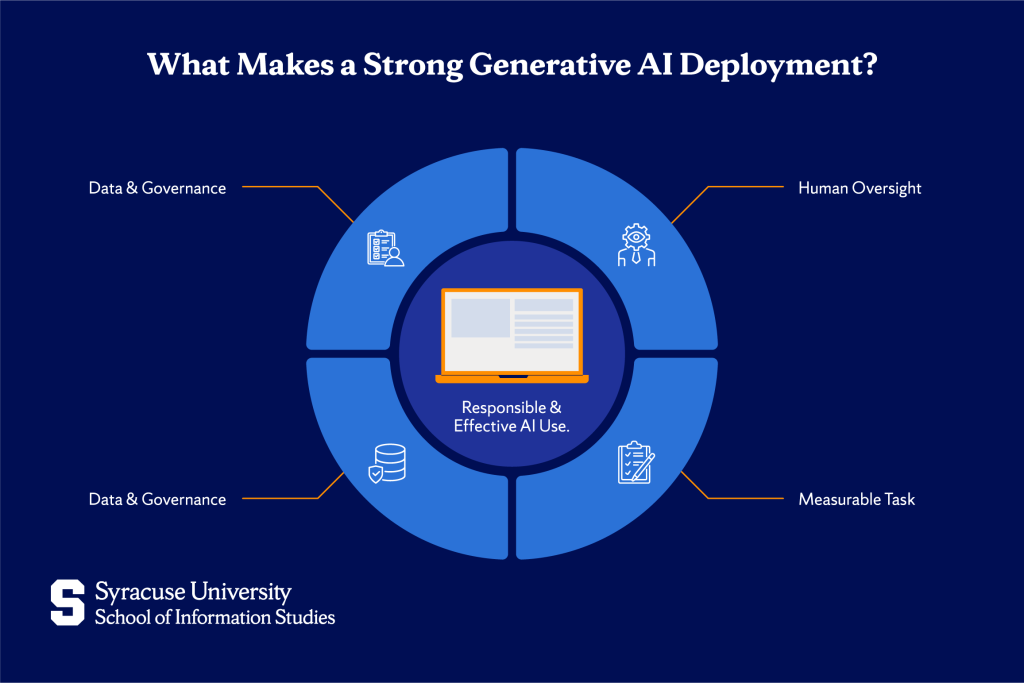 The examples across these industries show that implementing generative AI involves more than selecting a tool. Organizations need to consider how it fits into existing work, how its performance will be measured, and what happens when the output is inaccurate.
These considerations are particularly important in fields such as healthcare and finance, where mistakes can have serious consequences. The following criteria help assess how effectively an organization has implemented generative AI:
- Appropriate human oversight: The level of review should reflect the risks involved. Clinical documentation and financial advice require greater scrutiny than routine content drafting or internal knowledge searches.
- A narrow, measurable task: Working examples target one job with a clear metric, such as minutes saved per note, instead of a broad mandate to “add AI.”
- Grounded data and governance: Answers drawn from a trusted source, such as a research library or a codebase, beat open-ended generation, and regulated industries add data rules on top.
- Clear accountability: Organizations need policies for handling inaccurate outputs and protecting sensitive information. Where AI creates content that imitates a person’s work or likeness, consent and disclosure may also be necessary.
Where Generative AI Examples Are Heading: From Content to Action
The next wave of examples takes actions instead of only producing content. Agentic AI systems chain reasoning and tool use to finish multistep tasks, such as building and testing a software feature or resolving a support case end to end. An agent that acts is harder to supervise than a model that drafts, and Gartner expects more than 40% of agentic AI projects to be canceled by the end of 2027 because of rising costs and weak risk controls.
At Syracuse University’s iSchool, students can develop the technical knowledge and practical judgment needed to work with generative AI. Our Master’s in Applied Human-Centered AI includes courses in building generative AI applications, large language models, and responsible AI, with hands-on projects that help students apply these concepts.
Undergraduate students can explore AI through the Applications of AI Minor. The new B.S. in Integrative Artificial Intelligence is scheduled to begin in Fall 2027 and combines technical AI training with an applied minor. Our Master’s in Applied Data Science offers another option for students interested in working with data and machine learning.
If you’re interested in developing practical AI skills while learning to evaluate how the technology affects people and organizations, explore our Master’s in Applied Human-Centered AI.
Frequently Asked Questions (FAQs)
What is the difference between AI and generative AI?
AI covers any system that performs tasks like classifying or predicting. Generative AI is the subset that creates new content: a fraud score is AI, and a drafted customer email is generative AI.
Is ChatGPT generative AI?
Yes. OpenAI’s ChatGPT, launched in November 2022, uses large language models to generate text and code from prompts, and it brought generative AI into mainstream use.
What industries use generative AI the most?
Software, healthcare, banking, and retail show the most visible production use, with GitHub Copilot in code editors and ambient note-takers in hospitals.
What is the difference between generative AI and agentic AI?
Generative AI creates content such as text, images, and code. Agentic AI builds on these capabilities by using models and connected tools to complete multistep tasks. For example, an AI shopping assistant may help customers compare products, while an agentic system may also complete a purchase with the customer’s authorization.
Do most companies succeed with generative AI?
Results vary considerably. The 2025 GenAI Divide report found that approximately 95% of enterprise generative AI pilots in its study produced no measurable financial return. However, this finding doesn’t mean that generative AI is ineffective across businesses. Its value depends on how organizations use the technology and measure results.