
Key Takeaways
- The best AI tools for academic research fall into four workflow stages: finding sources, reading and summarizing papers, analyzing data, and writing and citing.
- Tools built on scholarly databases search academic corpora instead of the open web, so their citations hold up far better than a general chatbot’s.
- ChatGPT, Claude, and Gemini are strong for brainstorming and explaining concepts, but they can invent citations. Every claim and source needs a check against the original paper.
- Responsible use isn’t optional: check your institution’s AI policy, disclose or acknowledge AI use where required, and never paste confidential or participant data into a tool.
Using AI for academic work can raise immediate concerns about plagiarism and academic misconduct. Those concerns are valid. Relying on AI to produce analysis or original ideas and presenting them as your own may violate an institution’s academic integrity policies.
Ethical use, however, looks different. AI can support the research process without replacing the researcher. It may help reduce the time spent searching for information, identify useful keywords, organize early findings, or point researchers toward sources they may have missed.
Using AI tools for academic research responsibly requires knowing which systems are reliable, where their limitations lie, and which tasks are appropriate to delegate. Researchers must also verify any information AI provides and follow their school’s rules on disclosure, citation, and acceptable use.
Best AI Tools for Academic Research
A promising research question can quickly turn into dozens of browser tabs and a folder full of unread PDFs. Instead of handing the project over to one chatbot, the solution is to use specific AI tools that help the work move along. Some systems are built to uncover literature. Others help researchers understand material or revise work they have already written. Each has a limited role, and the researcher remains responsible for source quality and final conclusions.
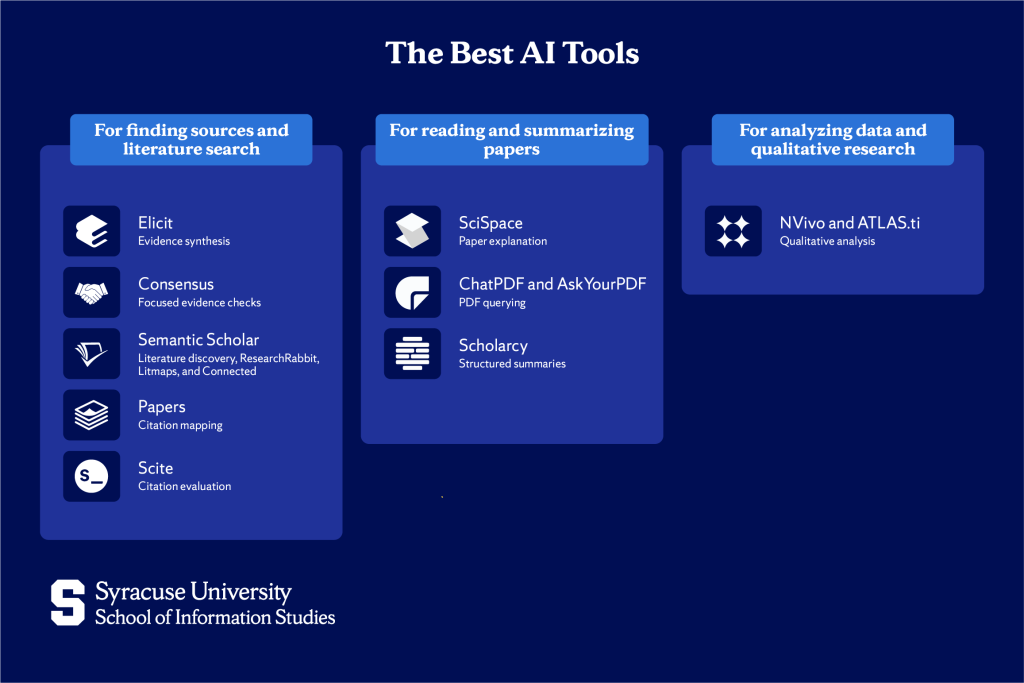
For finding sources and literature search
Traditional keyword searches can miss a useful paper when its authors describe the same idea but using a different vernacular. Some research tools address that problem through semantic search, while others follow citation relationships from papers you already trust.
These tools can broaden a literature search, but no single platform covers every relevant publication. Use them alongside your library databases or a broader scholarly search engine.
Elicit
Elicit is strongest when the task extends beyond finding papers and into evidence synthesis. Its systematic review workflow supports the search and screening stages. It can also extract data and produce materials aligned with PRISMA 2020.
Findings are organized in structured tables, with extractions linked to supporting passages in the source. This makes Elicit useful for reducing repetitive work during evidence reviews, but every extraction should still be checked against the original paper.
Consensus
Consensus is designed to answer focused questions using material drawn from a large academic research database. Its generated responses are linked to papers, making it useful for getting an initial sense of where the evidence stands.
Use Consensus to become familiar with a topic or check whether research supports a specific claim. It can also help identify papers for closer reading. It should not serve as the only search method behind a literature review.
Semantic Scholar
Semantic Scholar is a free research search engine that uses AI to identify relevant scientific literature. It works well for building a broad reading list and following citation links between papers.
Researchers can save papers to a library and receive recommendations based on their interests. The platform also provides alerts for newly published work or new citations. Do not assume that its results cover every database available through your institution.
ResearchRabbit, Litmaps, and Connected Papers
These tools make the citation network visible once you have at least one reliable paper to use as a starting point.
ResearchRabbit builds recommendations around collections created by the user. Its suggestions adapt as more papers are added. Litmaps uses references and citations to create visual literature maps, with monitoring features for newly published work. Connected Papers creates a similarity graph around an origin paper by examining shared references and co-citation patterns.
They are particularly useful when terminology differs across research communities or when you want to explore work related to your initial reading list.
Scite
Scite is most useful after a paper has entered your working reading list. Its Smart Citations show the context in which later papers cite a study. Citation statements may also be classified as supporting or contrasting with the original research.
The platform provides retraction information as well. It cannot decide whether a study is trustworthy, but it gives researchers more evidence to examine before relying on that study.
For reading and summarizing papers
Finding a relevant paper is only the beginning. The next challenge is deciding whether it deserves a full read and understanding difficult sections without losing the author’s argument.
PDF assistants can speed up this first review. However, a generated summary cannot replace the paper itself. Check the surrounding text before quoting a finding or including it in your analysis.
SciSpace
SciSpace is well suited to papers with dense technical content. Its Chat with PDF feature can explain equations and tables, while follow-up questions allow users to examine a difficult section more closely.
This makes it useful when one part of a paper is blocking your understanding. Any explanation you plan to rely on should still be compared with the relevant page in the document.
ChatPDF and AskYourPDF
ChatPDF and AskYourPDF let users upload a document and ask questions about its contents. They work well for a first-pass read, such as locating where a concept appears or requesting a simpler explanation of one section.
They are less useful for deciding whether an author’s reasoning is convincing. Before uploading unpublished or confidential work, review the platform’s data policy and your institution’s rules.
Scholarcy
Scholarcy turns a paper into a structured summary that highlights its main points. It is useful when you have a large reading queue and need to decide which papers require closer attention.
Use the summary to become familiar with the paper. Return to the complete text before citing its findings or describing the author’s conclusions.
For analyzing data and qualitative research
AI can reduce repetitive work during analysis, but it cannot select the right methodology or defend an interpretation. The tools in this category are primarily designed for qualitative projects, where coding decisions must remain open to researcher review.
Any AI-generated code should be assessed against the research question and the underlying data.
NVivo and ATLAS.ti
NVivo and ATLAS.ti place AI assistance inside established qualitative analysis environments. NVivo’s AI Assistant can summarize source material and suggest child codes based on work the researcher has already completed.
ATLAS.ti offers automated coding as well as a guided option that uses the research question to direct the analysis. The generated codes remain available for review. These platforms are better suited to interview transcripts or open-ended responses than a general chatbot because the analysis stays connected to the wider research project.
AI may accelerate the initial coding process, but the researcher must decide which suggestions to keep and how they should be refined.
For academic writing and citations
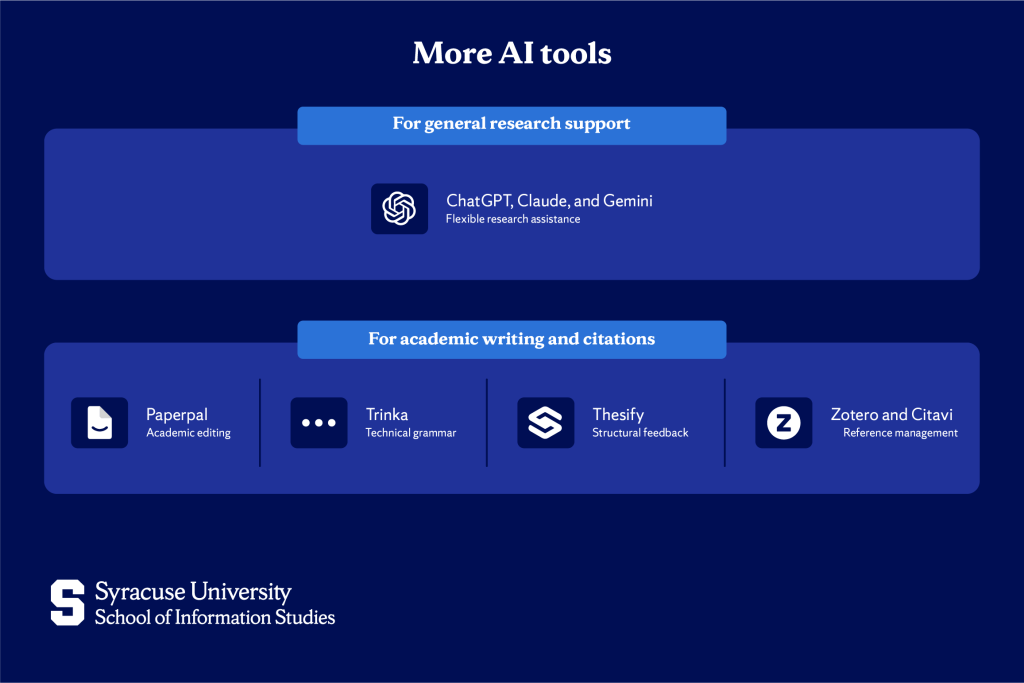
Once the research is underway, AI can help improve how the work is presented. The ethical boundary is clear: use these systems to review your own writing, not to manufacture ideas or analysis that you submit as original work.
Citation tools can also reduce clerical work. They do not remove the researcher’s responsibility to confirm that each reference is accurate.
Paperpal
Paperpal is designed around scholarly writing and journal submission. It offers language suggestions suited to academic material, along with checks intended to prepare manuscripts for review.
Its research features can search a large corpus and help users work with references. Paperpal is most useful when the argument and evidence are already yours, and the goal is to improve clarity or prepare the manuscript for submission.
Trinka
Trinka focuses on grammar and style for academic or technical writing. Its suggestions are tuned to formal conventions, making it more appropriate for manuscripts and technical reports than a general grammar checker.
Use it to improve language without allowing suggested changes to alter the meaning of a claim.
Thesify
Thesify acts more like a reviewer than a text generator. It evaluates the strength of a thesis and how well the supporting evidence aligns with it. The tool can also identify problems involving structure or clarity.
This makes it useful later in the revision process, when you need feedback on the paper you have written rather than new text to submit.
Citation managers (Zotero, Citavi)
Zotero and Citavi are reference managers rather than substitutes for research judgment. Zotero is a free, open-source tool for collecting sources and producing citations directly within common word processors.
Citavi combines reference management with knowledge organization. Its current platform also includes AI-assisted features. Both tools can save substantial time, but imported metadata may still contain errors. Check author names and publication information before submitting the reference list.
General AI assistants: ChatGPT, Claude, and Gemini
General AI assistants are useful for clarifying a research question or testing an outline. They can also explain an unfamiliar concept while you read. However, an ordinary chat response should not be treated as a literature review or source list.
Their dedicated research modes can search the web and produce reports with citations. A cited report is easier to audit than an ungrounded answer, but the researcher still needs to open each source and confirm that it supports the associated claim. Never copy a reference directly into academic work without verifying it.
How to Choose the Right AI Tool for Your Research
The tools listed above are among the most useful options for academic research, but they are not the only ones available. Before adopting another tool, make sure to evaluate it in terms of:
- Source base: Does the tool search scholarly databases or rely mainly on the open web? Tools grounded in academic databases are generally more dependable for locating research, although every source still needs to be verified.
- Transparency: Does the tool show where its information comes from? You should be able to open the cited source and confirm that it supports the claim being made.
- Workflow fit: Does the tool address a clear need at a particular stage of your project? A focused tool that improves one part of the process is often more useful than a general platform with features you may not need.
- Cost: Does the free plan provide enough access for meaningful use, or are essential features restricted to a paid subscription? Consider how often you will use the tool before paying for an upgrade.
Using AI Tools Responsibly and Ethically in Research
Responsible AI use begins with understanding the rules that apply to your work. Universities, departments, and individual instructors may set different expectations, so a tool permitted in one course may be restricted in another. Check the relevant policy before using AI and disclose its role when required.
Privacy is crucial, especially when research involves sensitive material. Do not upload confidential data or unpublished work until you have reviewed the tool’s privacy terms and understand how submitted information may be stored or reused. Research involving human participants or institutional review board approval should generally remain within tools authorized by the institution.
AI output also requires close review. A system may reproduce bias from its training data or present uncertain information with confidence. Researchers remain responsible for checking claims, interpreting the evidence, and ensuring that the final work reflects their own reasoning.
Final Thoughts on Choosing AI Tools for Academic Research
Over time, using AI tools for academic research can also raise broader questions about how these systems work, why different types of AI produce different results, and how their use should be governed.
Students who want to move beyond using AI and begin designing or evaluating it need both technical knowledge and an understanding of its effects on people. Syracuse University’s Bachelor’s in Integrative Artificial Intelligence combines coursework in programming and mathematics with the study of AI ethics, governance, and human interaction. Students also complete an applied minor in an area such as business, communications, policy, or analytics. A senior capstone provides an opportunity to develop and assess an AI solution within that chosen field.
Join Syracuse University’s School of Information Studies to prepare for work that connects AI systems with responsible real-world application and see how you can build the skills to design, understand, and shape responsible AI.
Frequently Asked Questions (FAQs)
Is it cheating or plagiarism to use AI tools for academic research?
It depends on how you use them. Using AI to find sources, organize references, or get formative feedback on a draft is treated very differently from submitting AI-generated text as your own writing. Your institution’s academic integrity policy is the deciding authority here, so check it before you assume either way.
Do I need to cite or acknowledge AI tools in my paper?
Many institutions ask you to acknowledge AI use rather than formally “cite” it, since AI isn’t an author and can’t take responsibility for what it produces. Where an acknowledgment goes, and how detailed it needs to be, depends on your citation style and your institution’s guidance, so confirm the specifics before you submit.
Can AI research tools access paywalled or subscription-only journals?
Mostly no. Most AI research tools index open or licensed metadata and abstracts, and they often can’t reach the full text behind a publisher’s paywall. Your library’s subscription databases remain essential for complete access to those sources.
How can I tell if an AI tool’s citations are real and not hallucinated?
Search the cited title or DOI in Google Scholar or your library catalog, confirm the authors and publication year match, and read the original source to make sure it actually supports the claim. Tools that link directly to the source sentence make this check faster and more reliable.
Can AI tools replace a full systematic literature review?
No. AI can speed up screening and synthesis, but it can’t guarantee comprehensive recall of every relevant study. A defensible systematic review still depends on documented database searches and human judgment at every stage.