
Key Takeaways
- AI ethics is the set of values an AI system should uphold, and AI governance is the set of policies and people that make sure it does.
- Six principles appear across nearly every major framework: fairness, transparency, accountability, privacy, safety, and human oversight.
- These principles now carry legal weight, with the EU AI Act’s bans on unacceptable-risk AI applying since February 2025 and its high-risk rules scheduled for December 2027.
- Human-centered AI is the design approach that turns these principles into daily practice, and programs such as the iSchool’s Master’s in Applied Human-Centered AI teach it from the first project.
When the EU AI Act entered into force on August 1, 2024, it became the world’s first broad law governing artificial intelligence. Its bans on manipulative and unacceptable-risk systems took effect in February 2025, and a 2026 amendment set December 2027 as the date for its high-risk rules covering uses like hiring and credit scoring. AI ethics and governance moved from conference panels into compliance plans.
The two terms describe related jobs. AI ethics is the set of values an AI system should uphold, while AI governance is the set of policies and roles that make sure it actually does. Both rest on a short list of shared principles, and the definitions come first.
What Are AI Ethics and Governance?
People often use the two terms interchangeably, but they describe different layers of the same work. One decides what responsible AI should look like, and the other makes sure it happens.
AI ethics defined
AI ethics is the branch of applied ethics that asks how AI systems should be designed, trained, deployed, and used so they respect human rights and treat people fairly. It draws on philosophy, law, social science, and computer science alike. The most widely endorsed statement of these values is UNESCO’s Recommendation on the Ethics of AI, adopted by all 193 member states in November 2021 as the first global standard on the subject.
AI governance defined
AI governance is the set of policies, processes, roles, and tools an organization or government uses to keep AI systems in line with the law and with its own ethical standards. In practice, governance assigns ownership to a review board or a named model owner, and it sets checkpoints such as approval before deployment and monitoring afterward. If ethics is the destination, governance is the road rules and inspections that get you there.
How the two work together
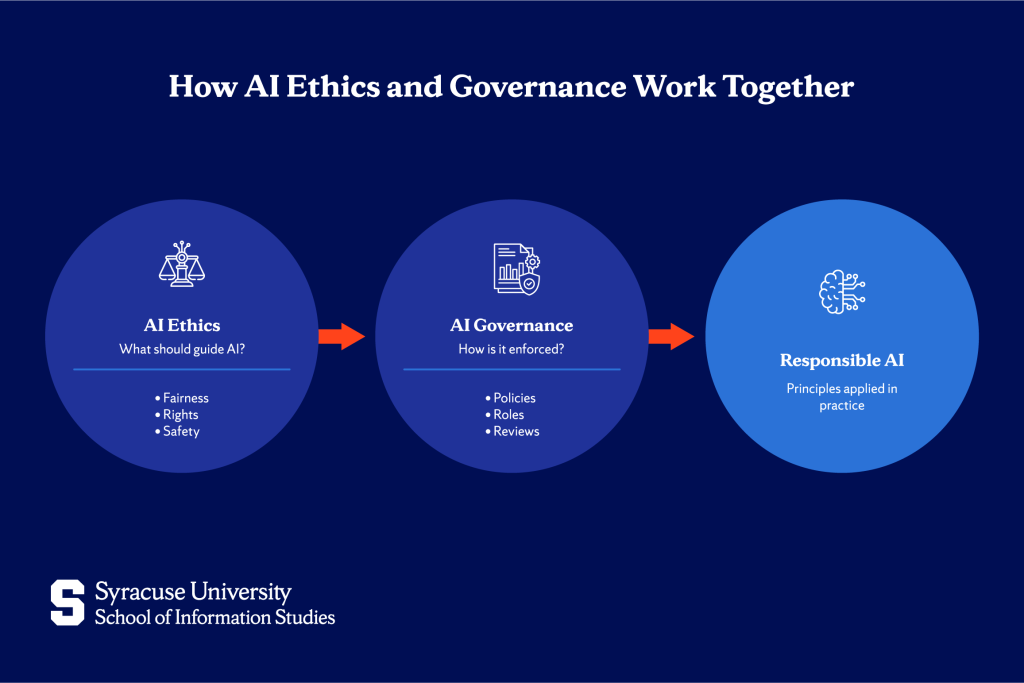
Each depends on the other. Ethics without governance produces principles posters that change nothing, and governance without ethics produces compliance checklists that miss real harm. That’s why every major framework pairs a short list of values with concrete processes to enforce them. The values themselves are remarkably consistent across frameworks, which makes it possible to treat them as one set of six.
Readers who want the mechanics behind these systems can start with how AI works before going further.
The 6 Key Principles of AI Ethics and Governance
No single official list exists. The OECD AI Principles name five values-based principles, and the EU’s Ethics Guidelines for Trustworthy AI list seven requirements. Line those up against the NIST AI Risk Management Framework, UNESCO’s Recommendation, and the EU AI Act, and the same six themes appear in every one.
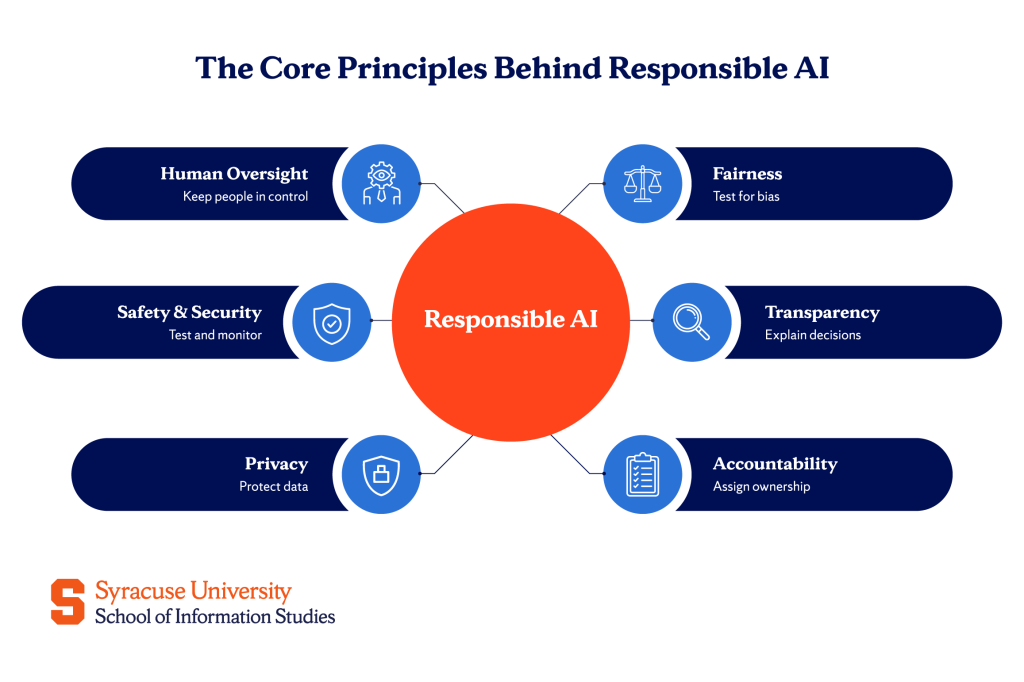
1. Fairness and non-discrimination
AI systems should avoid producing systematically worse outcomes for people because of race, gender, age, disability, or other protected traits. Because models learn from historical data, bias is the default until someone measures and corrects it. In 2018, Amazon abandoned an internal recruiting model after it learned to downgrade résumés that included the word “women’s,” according to Reuters. Governance answers with bias testing across demographic groups before launch and on a schedule afterward. New York City’s Local Law 144 has required independent bias audits of automated hiring tools since July 2023.
2. Transparency and explainability
People should know when they’re dealing with AI and what data it uses. For consequential decisions, they should also be able to learn why it produced a given result. Transparency is disclosure (that AI is involved and how it was built), while explainability is the ability to give an understandable reason for a specific output. In February 2024, a Canadian tribunal held Air Canada liable after its website chatbot gave a customer wrong bereavement-fare information, rejecting the airline’s argument that the chatbot was responsible for its own words. Governance responds with documentation standards such as model cards and datasheets, and the EU AI Act requires that users be told when they’re interacting with an AI system.
3. Accountability
A named person or organization must answer for what an AI system does, with a clear route for people to seek redress when it causes harm. “The algorithm decided” can never be the final word. In the Netherlands, a risk-scoring algorithm used by the tax authority wrongly flagged tens of thousands of families for childcare-benefits fraud, with families holding dual nationality disproportionately targeted, according to Amnesty International’s 2021 report. The scandal contributed to the entire Dutch cabinet resigning in January 2021. Governance assigns model ownership and builds appeal channels, and the EU AI Act spells out separate duties for the “providers” who build high-risk systems and the “deployers” who use them.
4. Privacy and data protection
AI systems should collect only the personal data they need, with a lawful basis and meaningful consent, and protect it from misuse. That includes a newer risk: models can memorize training data and repeat it back. Clearview AI built its facial recognition database by scraping billions of face images from the web, and in September 2024 the Dutch data protection authority fined the company €30.5 million. Governance relies on data protection impact assessments, which GDPR requires for high-risk processing, and on privacy-by-design reviews before a model is trained.
5. Safety, security, and reliability
AI systems should perform as intended under real conditions and resist manipulation, failing safely when something goes wrong. Reliability asks whether a system works consistently. Security asks whether someone can make it misbehave on purpose. In June 2023, two New York lawyers were sanctioned in Mata v. Avianca after filing a brief that cited six court cases ChatGPT had invented. Governance sets performance thresholds a system must meet before deployment and uses red-teaming to probe for adversarial inputs. Once the system is live, ongoing monitoring catches problems that testing missed. “Safe” and “secure and resilient” are two of the seven trustworthiness characteristics in the NIST AI Risk Management Framework.
6. Human oversight and agency
People should stay meaningfully in control of AI-driven decisions and be able to question or override them, especially when rights, health, money, or liberty are at stake. This principle is the one that puts the other five into daily use, and it sits at the center of human-centered AI. Article 14 of the EU AI Act requires high-risk systems to be designed so people can oversee them effectively, including the ability to intervene or stop the system. (The “30% rule” that circulates online, where AI handles roughly 70% of a task and people keep the final 30% of judgment and sign-off, is an informal rule of thumb and appears in no standard.) Governance builds in human checkpoints and gives the people supervising the system the training to use them.
Each of these principles is only as real as the process that enforces it. A fairness commitment with no audit attached is a statement of intent, and governance supplies the rest.
The importance of responsible AI came through clearly for one iSchool data science student after a Data Science Day session on the topic:
“As a data scientist, we should be careful and know about potential harmful impact from our work.”
Choijamts Bataa ’23
How AI Governance Puts the Principles Into Practice
Governance works on three levels at once: international principles, national and regional law, and the practices inside individual organizations. The frameworks below sit at different levels, and most organizations draw on more than one.
| Framework | Issued by / year | Type | What to know |
|---|---|---|---|
| OECD AI Principles | OECD, 2019 (updated 2024) | Intergovernmental principles, voluntary | The first intergovernmental AI principles, with 47 adherents, and the basis for the G20’s AI principles |
| UNESCO Recommendation on the Ethics of AI | UNESCO, November 2021 | Global standard, voluntary | Adopted by all 193 member states; the broadest shared statement of AI values |
| NIST AI RMF 1.0 | U.S. National Institute of Standards and Technology, January 2023 | Voluntary framework | Organizes governance into four functions (Govern, Map, Measure, Manage) and names seven trustworthiness characteristics |
| EU AI Act | European Union, in force August 2024 | Binding law, phased | Risk-tiered rules: unacceptable-risk uses banned, high-risk systems under strict requirements, limited-risk systems with transparency duties, and minimal-risk systems largely untouched |
| ISO/IEC 42001 | ISO/IEC, December 2023 | Certifiable management-system standard | The first auditable standard for an AI management system, comparable to ISO 27001 for information security |
Inside a company or public agency, governance usually starts with an AI review board whose members come from legal, data, product, and ethics or compliance teams. That group keeps an inventory of every model in use and its risk level, requires an impact assessment before anything high-risk launches, and schedules bias and performance audits afterward. Each model gets documentation and a named owner, and incidents follow a reporting path that ends with a specific person. Much of the day-to-day work is unglamorous, such as reviewing vendors’ AI tools and rewriting usage policies as regulations change. Large software vendors now sell AI governance platforms that automate inventory and monitoring, which shows how mainstream the practice has become.
Why AI Ethics and Governance Matter Now
Public trust is thin. In a June 2025 survey, Pew Research Center found that 50% of U.S. adults are more concerned than excited about the growing use of AI in daily life, while only 10% are more excited than concerned. The legal stakes are also concrete: the EU AI Act allows fines of up to €35 million or 7% of global annual turnover, whichever is higher, for prohibited AI practices. For most organizations, governance is now a business and legal requirement as much as an ethical one.
The field is real, and it’s growing. Responsible AI work exists today under titles such as AI governance analyst, responsible AI lead, AI policy analyst, and AI risk manager, usually inside legal, risk, product, or data teams. The IAPP’s 2025 AI Governance Profession Report found that 77% of surveyed organizations are working on AI governance, and the association launched its AI Governance Professional (AIGP) certification in 2024 in response to demand. Entry is easiest for people who bring a background in data, law, policy, or product and add formal study of responsible AI, since few postings hire for “AI ethics” alone.
Building a Foundation in Human-Centered AI
The question has moved from whether AI should have rules to who knows how to apply them. Organizations need people who can read a bias audit and explain a model’s limits to a decision-maker who has never trained one. At Syracuse University’s iSchool, the Critical AI Research and Education (CAIRE) Lab studies who benefits from AI systems and who bears their harms. Whatever role you’re aiming for, the most useful preparation is learning to put human judgment into the design from the start, which is what responsible AI means in practice.
Our Master’s in Applied Human-Centered AI is built on that idea. The 31-credit program can be completed in one calendar year, and its required core includes IST 692 Responsible AI, where students learn to find and correct bias in AI systems and work through AI regulation, along with IST 736 Large Language Models in Information Contexts, which emphasizes responsible deployment. Syracuse undergraduates can begin with the Applications of AI Minor. If you want to be the person in the room who can turn these six principles into working practice, explore the program’s curriculum and see how its courses map to the role you have in mind.
Frequently Asked Questions (FAQs)
What is an AI impact assessment?
It’s a structured review, completed before launch, of who a system could affect and how. ISO/IEC 42001 includes AI system impact assessments, and GDPR requires a data protection impact assessment for high-risk processing.
How do small companies handle AI governance without a dedicated team?
Most assign one accountable owner and adopt a voluntary framework such as the NIST AI RMF. Under the EU AI Act, fines for small and medium-sized businesses are capped at the lower of the two penalty amounts.
Do open-source AI models fall under the same governance rules?
Partly. The EU AI Act exempts many free and open-source AI systems from its obligations, but the exemption ends once a system is used for high-risk purposes or prohibited practices.