
Key Takeaways
- Information science jobs form a category of distinct roles across data, security, user experience, information management, and research, rather than a single job title.
- The most common entry points today are data analyst, information security analyst, UX researcher, and systems analyst.
- A bachelor’s degree such as Information Management & Technology opens most of these roles, while a PhD is reserved for the research and faculty track.
- The Bureau of Labor Statistics projects computer and information technology occupations to grow faster than average through 2035, and the hiring spreads across health care, finance, government, and libraries as well as tech companies.
The U.S. Bureau of Labor Statistics expects about 280,000 openings a year in computer and information technology occupations between 2025 and 2035. A large share of those openings are information science jobs, even when the posting never uses that phrase.
Information science covers a group of roles that sit where people and technology meet around data. People in these jobs analyze data and protect it, design how people interact with it, organize it so it can be found, and study how it gets used. Computer science builds the systems, IT keeps them running, and information science decides what those systems hold and how people work with them. For the fuller definition, start with what information science is.
What Counts as an Information Science Job?
Information science jobs focus on how information is collected, organized, secured, analyzed, and used by people. The work centers on the information itself and the people who depend on it, while other specialists build and maintain the underlying hardware and software.
Take a hospital’s patient records. A software developer writes the records application, and a systems administrator keeps it running day and night. An information science graduate designs the data model behind it, sets the rules for which staff can see which records, and shapes the workflow clinicians follow on screen. All three jobs are technical. The information science role is the one accountable for whether the information is accurate and safe to use.
Core Information Science Jobs and What They Do
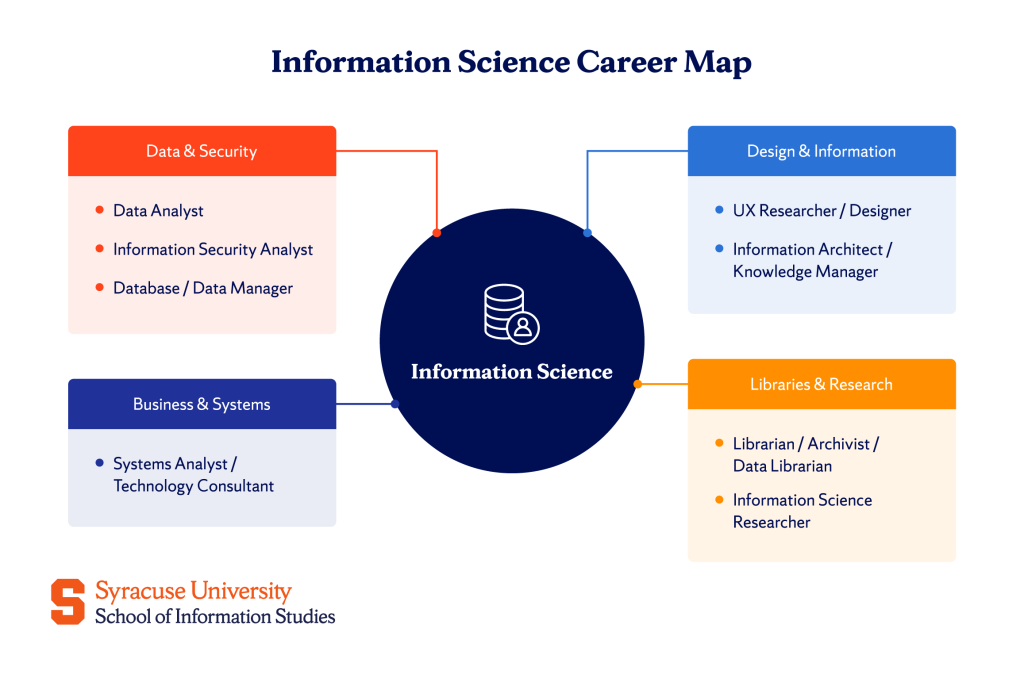
The roles below run roughly in order of how often information science graduates enter them, starting with data and security, moving through design, information management, and consulting, and ending with research. Treat the order as a loose guide, since the right fit depends on your interests and background.
1. Data analyst
Data analysts clean datasets, build dashboards, and explain what happened and why to the people making decisions. They usually sit inside marketing, operations, finance, or product teams.
- SQL and Excel or Google Sheets
- Tableau or Power BI
- Python or R for analysis
- Descriptive statistics
The closest BLS category, data scientists, earned a median wage of $120,230 in May 2025, though entry-level analyst pay starts lower. It’s the most realistic first job straight from a bachelor’s.
2. Information security analyst
Security analysts protect an organization’s data and networks. They watch for breaches, scan for vulnerabilities, set access policies, and lead the response when something goes wrong. Most work in a security operations or IT risk team alongside network administrators and compliance staff.
- Network fundamentals
- SIEM platforms such as Splunk or Microsoft Sentinel
- Vulnerability scanners such as Nessus
- Frameworks such as NIST CSF and ISO 27001, plus an entry certification like CompTIA Security+
Information security analysts earned a median of $129,180 in May 2025, and BLS projects 21% growth through 2035, seven times the 3% average.
3. UX researcher or UX designer
UX professionals study how people actually use digital products and shape the structure and screens so those products make sense. Researchers run interviews and usability tests, and designers turn the findings into wireframes and prototypes. Both sit on product teams with product managers and developers.
- User research methods such as usability testing and card sorting
- Figma
- Information architecture
- Accessibility standards (WCAG)
The closest BLS match, web and digital interface designers, earned a median of $104,000 in May 2025, with 6% projected growth. One iSchool alum working in UX is now a senior UX designer at Synchrony, where she works with cross-functional teams to find and fix the problems users run into.
4. Information architect or knowledge manager
Information architects organize an organization’s information so people can find it and trust it. They build taxonomies, metadata schemes, intranets, and knowledge bases. It’s the role most directly descended from classical information science, usually based in content or operations teams at large organizations.
- Taxonomy and metadata design
- Content management systems such as SharePoint, Confluence, or Drupal
- Search configuration
- Records and retention policy
BLS has no dedicated code for this role. Payscale reports an average base salary of about $135,000 for information architects, drawn from a small sample. Competition is lighter than in the data and security tracks.
5. Database administrator or data manager
Database administrators keep an organization’s databases accurate and available, with access locked down. They manage performance, backups, access controls, and data quality, working with analysts who use the data and with compliance staff on governance.
- SQL and relational databases such as PostgreSQL, Oracle, or SQL Server
- Cloud data platforms such as Snowflake or Azure SQL
- Backup and recovery
- Data governance frameworks
Database administrators and architects earned a combined median of $126,760 in May 2025. BLS projects flat employment for administrators but 9% growth for architects, which is why many people in this role move toward data architecture or governance leadership.
6. Systems analyst or technology consultant
Systems analysts translate what a business needs into what its systems should do. They gather requirements, map processes, compare software options, and manage implementations, often as the bridge between executives and technical teams. Many work at consulting firms, which makes this the most common consulting entry point for information science graduates.
- Requirements gathering and process mapping (BPMN)
- Agile and Scrum
- Enterprise platforms such as Salesforce, SAP, or ServiceNow
- Stakeholder communication
Computer systems analysts earned a median of $105,850 in May 2025, with 8% projected growth. One iSchool graduate now consults for Deloitte Digital in New York, helping clients put their customer data to use.
7. Librarian, archivist, or data librarian
This is the library and information science side of the field, covering public, academic, school, and special libraries, plus the growing data librarian specialty in universities. Data librarians help researchers manage and preserve their datasets, and these jobs extend to hospitals, law firms, museums, and government agencies.
- Cataloging and metadata standards such as MARC and Dublin Core
- Research data management
- Digital preservation
- Reference and instruction
Librarians and library media specialists earned a median of $68,270 in May 2025, with 3% projected growth, and most positions require an ALA-accredited master’s. Pay runs lower than in the data and security roles.
8. Information science researcher or faculty member
Researchers study how people, information, and technology interact, in areas such as human-computer interaction, information behavior, misinformation, and AI and society. They work in university iSchools, industry research labs, think tanks, and government research agencies, and this is the one track on the list that typically requires a doctorate. The iSchool’s PhD in Information Science and Technology is the structured route in.
- Qualitative and quantitative research design
- Statistics
- Scholarly and grant writing
- A defined research specialization
Computer and information research scientists earned a median of $140,300 in May 2025, with 22% projected growth, while faculty pay varies by institution and rank.
Other roles worth knowing
- Health information manager: governs patient records, coding, and HIPAA compliance in hospitals and health systems, often with the RHIA credential.
- GIS analyst: builds and analyzes spatial data for planning, utilities, environmental agencies, and public safety.
- Product manager: decides what a data-driven product should do and why, a common next step after a few years in analyst or UX roles.
- Data governance or AI governance specialist: the newest cluster, growing as privacy laws and the EU AI Act take effect, with job titles still settling.
- Business intelligence developer: a close cousin of the data analyst who builds the reporting layer that others use.
Ellee Chen, the UX alum mentioned above, described how she found her direction:
“It wasn’t until my summer internship that I stumbled upon a field that sparked a passion I hadn’t anticipated.”
Yuhong “Ellee” Chen ’18
Skills Information Science Jobs Require
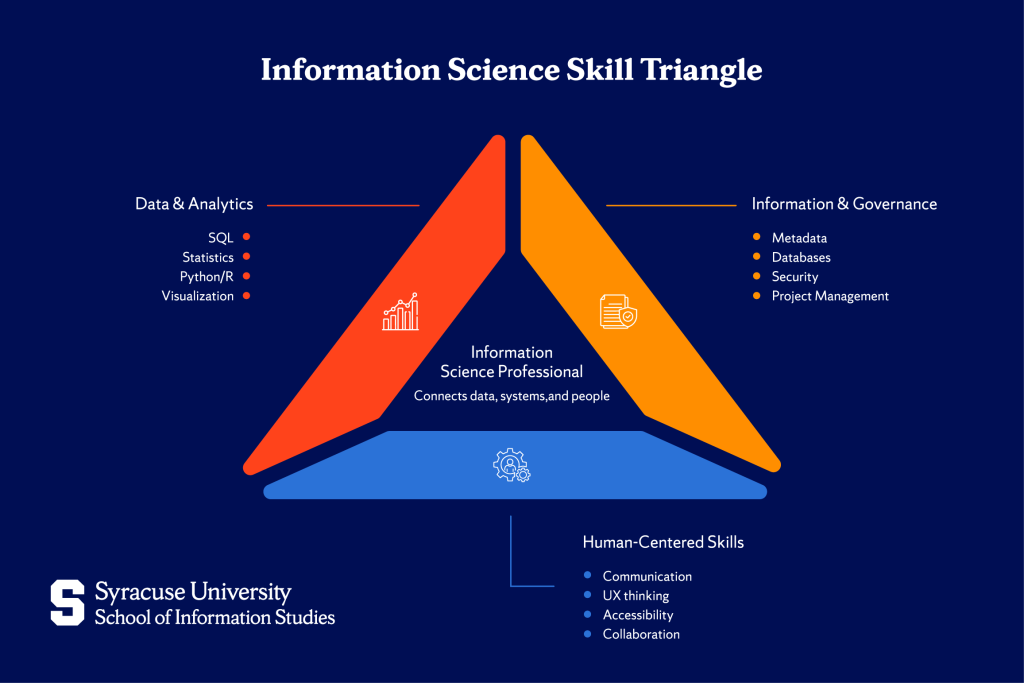
The roles above share a common core in handling data and communicating about it, though they differ in depth. Some of these skills come from coursework, while others build through projects and internships.
Data and analytics skills:
- SQL and spreadsheet fluency: expected in nearly every role on the list.
- Statistics and data literacy: enough to sanity-check a dashboard or a vendor’s claim.
- A scripting language: Python or R for analysis and automation, an advantage in most roles.
- Visualization: Tableau or Power BI, plus the judgment to pick the right chart for the audience.
Information organization, security, and governance skills:
- Information architecture and metadata: structuring, labeling, and classifying information so it can be found and reused.
- Database literacy: knowing how data is stored and moved, even if you never administer a database.
- Security and privacy fundamentals: access control and laws such as HIPAA, GDPR, and FERPA, which every role on the list touches.
- Project management: requirements and Agile basics, since most information science work arrives as projects.
Human-centered and communication skills:
What separates strong information science professionals is how they work with people. They translate technical findings for decision-makers who need a clear recommendation, design with real users in mind (including accessibility), and write documentation that the next person can follow. They also work across data, IT, security, legal, and business teams on the same project. That human-centered focus runs through how the iSchool teaches.
Where Information Science Jobs Are: Career Options by Industry
Information science hiring reaches well beyond technology companies. Every organization now collects, protects, and acts on data, so the same roles appear in hospitals, banks, government agencies, and universities. BLS data on where information security analysts work shows the pattern: 22% are in computer systems design, but 17% work in finance and insurance, and the rest are spread across other industries.
| Industry | Typical information science roles | What the work looks like |
|---|---|---|
| Health care | Health information manager, data analyst, security analyst, UX researcher | Patient-record governance, clinical analytics, HIPAA compliance, patient portal usability |
| Finance and insurance | Data analyst, database administrator, security analyst, systems analyst | Risk and fraud analytics, regulatory reporting, core-system modernization, customer data management |
| Technology and software | UX researcher/designer, product manager, information architect, data analyst | Product research, content and search architecture, growth analytics, experimentation |
| Government and public sector | Records manager, GIS analyst, security analyst, systems analyst | Public records and FOIA, geospatial planning, digital service design, cybersecurity |
| Education, libraries, and research | Librarian, data librarian, archivist, researcher/faculty | Research data management, digital collections, instruction, scholarly research |
| Consulting and professional services | Technology consultant, systems analyst, knowledge manager, information architect | Client implementations, process redesign, knowledge systems, data strategy |
The industry you choose often shapes your day-to-day work more than your job title does, and internships are the most reliable way to test one before committing. The iSchool career outlook shows where recent graduates have landed.
Education Paths Into Information Science Jobs
Most of the roles above, including data analyst, security analyst, UX, systems analyst, database administrator, and information architect, are open with a bachelor’s degree, and many postings ask for a degree in information science, information management, or a related field. Syracuse’s Bachelor’s in Information Management & Technology covers programming and data analytics, cybersecurity, networks and cloud computing, and project management, with concentrations that let students specialize. Students in another major can add these skills through the Information Management & Technology minor.
A master’s is required for most librarian roles and is often preferred for senior information management, security leadership, and advanced data positions.
The research track runs through a doctorate. The iSchool’s PhD in Information Science and Technology is a fully funded, residential program of four to five years, where doctoral students research topics such as AI, machine learning, human-computer interaction, and data privacy with faculty. Graduates go on to roles such as university professor, research scientist, data scientist, and policy advisor. Readers still deciding on the degree itself can weigh whether information science is a good major for their goals.
Salary and Job Outlook for Information Science Jobs
Computer and information technology occupations earned a median annual wage of $109,470 in May 2025, more than double the $50,980 median for all occupations. BLS projects the group to grow faster than average from 2025 to 2035. Across the roles in this article, pay ranges from about $68,000 for librarians to around $140,000 for database architects and research scientists. Competition for entry-level roles has grown, and the projections show where routine work is thinning: BLS expects no growth for database administrators, while information security analysts and data scientists are projected to grow far faster than average.
How to Choose the Right Information Science Job for You
The right first target depends on where you’re starting.
If you’re a student or complete beginner
Build the foundation first: SQL, spreadsheets, and enough statistics to read data critically. Then target data analyst or entry-level security roles, since they have the clearest entry paths and the widest spread across industries. A degree such as the Bachelor’s in Information Management & Technology gives that foundation structure, and internships show you which track you like.
If you’re a professional changing careers
Start from the information science role closest to your current work. People from design or communications often move toward UX, operations and administrative staff toward systems analysis, IT support toward security, and teachers or publishers toward librarianship or knowledge management. A targeted credential plus a portfolio of real projects usually works better than trying to learn the whole stack at once. Your existing domain knowledge is an advantage, so aim for roles that combine information science with the field you already know.
If you’re drawn to research or teaching
Plan for a doctorate, such as a PhD in Information Science and Technology. It’s a longer path with a narrower job market, and in exchange you get to shape how the field thinks about information, technology, and society. Working as a research assistant or in a faculty lab during your bachelor’s or master’s is the clearest test of whether the track fits you.
Final Reflections on Information Science Careers
Worry about job-market saturation is reasonable, especially for entry-level roles. Still, as AI systems take on more routine technical work, the questions that stay hard are information science questions: which data an organization should trust, how to protect it, who gets access, and how people will actually use the result. The growth in governance, privacy, and human-centered roles is the field’s response, and it gives information science work staying power in an AI-heavy labor market.
At Syracuse University’s iSchool, our Bachelor’s in Information Management & Technology is designed to build the data, security, design, and management skills these roles call for from the first semester. For students drawn to research, the PhD in Information Science and Technology offers a funded path into faculty and lab careers. If one of the roles on this list sounds like you, explore the bachelor’s curriculum and its concentrations to see which path leads there.
Frequently Asked Questions (FAQs)
Is information science a good career choice?
For many people, yes. BLS projects 21% growth for information security analysts and 35% for data scientists between 2025 and 2035, against a 3% average across all occupations.
Do you need a PhD for information science jobs?
Only for research and faculty roles. Analyst and UX jobs typically require a bachelor’s, while most librarian positions call for an ALA-accredited master’s degree.
Can I work remotely in an information science job?
Often, especially in data analysis and UX research, where hybrid schedules are common. Security analysts may face on-call duties, since BLS notes they sometimes work outside normal business hours during emergencies.
Can I get an information science job without a technical background?
Yes. Many programs start at the introductory level, such as Syracuse’s IST 256 Introduction to Python for the Information Profession, and career changers can build on domain experience.
How long does it take to land a first information science job after graduation?
It varies, but internships shorten the search considerably. Syracuse’s iSchool reported that 91% of its 2025 undergraduates had secured a placement.