
Key Takeaways
- Learning large language models is a staged path that starts with Python and machine learning fundamentals before you touch transformers.
- The transformer architecture, and specifically the attention mechanism, is the single concept that explains how modern LLMs actually work.
- Most learners reach practical fluency by building on existing models, starting with prompting, moving to retrieval-augmented generation, and adding fine-tuning only where it earns its place, rather than by training a model from scratch.
- A motivated learner who already has coding basics can reach working competence in roughly three to six months, while genuine depth takes considerably longer.
ChatGPT reached an estimated 100 million monthly users about two months after its November 2022 launch, which UBS analysts called the fastest growth of any consumer app on record. Less than four years later, large language models sit inside email clients, code editors, search engines, and customer service chats, which leaves anyone heading into technology with a practical question: how do you learn how these systems work, beyond typing prompts into one?
Working out how to learn large language models is less intimidating once you see it as a sequence. You don’t need to train a model from scratch to become competent. You need a foundation in Python and basic machine learning, then a solid grasp of how transformers work, and then hands-on practice building on top of existing models, first through prompting, then retrieval, and eventually fine-tuning.
How to Learn Large Language Models: A Step-by-Step Path
The steps move from understanding how LLMs work to progressively more hands-on ways of building with them. Each step is useful on its own, so you’ll be able to build real things long before you reach the last one. Step 1 assumes some Python and basic machine learning; if you need to backfill those first, the prerequisites section further down covers exactly what’s required.
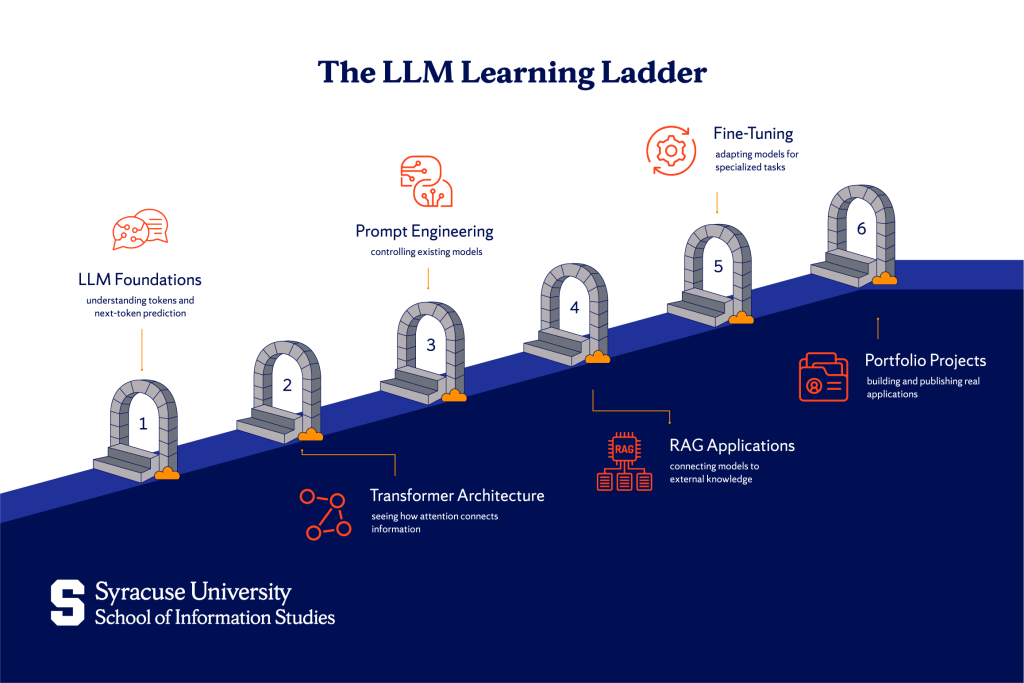
Step 1: Learn what an LLM is and how it generates text
Start with the core mental model before writing any code. An LLM is a model trained on enormous amounts of text to predict the next token, a word or word fragment, and that one mechanism repeated at scale produces fluent language. Tokens and next-token prediction are the two ideas to internalize first, since nearly everything else builds on them.
Step 2: Learn the transformer architecture and attention
This is the step worth slowing down for. The transformer architecture, introduced in the 2017 paper “Attention Is All You Need,” is the design behind every major LLM today, and its self-attention mechanism deserves real study time. At a high level, attention lets the model weigh which earlier words in a passage matter most when predicting the next one, so “it” in a long sentence gets connected to the right noun several clauses back. You don’t need to follow every equation to understand this. A good way in is to read the original paper alongside a visual explainer video, or to work through an annotated walkthrough that pairs each section of the paper with runnable code.
Step 3: Master prompting and prompt design
Prompting is the first applied layer and the fastest route to useful output, because you can build working tools with an existing model like GPT, Claude, Gemini, or an open model long before you fine-tune anything. Practice zero-shot and few-shot prompting, chain-of-thought reasoning, system prompts, and requests for structured output such as JSON. Treat prompt design as a real skill rather than a bag of tricks. What you learn carries over to every model you’ll use.
Step 4: Build with retrieval-augmented generation (RAG)
RAG is the second applied layer and the pattern behind most LLM applications in production today. It connects a model to an outside knowledge source, such as your organization’s documents or a database, so it answers from current, specific information instead of relying only on what it absorbed during training. You’ll work with embeddings and a vector database, usually tied together with a framework such as LangChain or LlamaIndex. RAG is what turns a general chatbot into a tool grounded in a real organization’s data, which is why employers ask for it so often.
Step 5: Learn fine-tuning, and when you do not need it
Fine-tuning is the third and most advanced applied layer: adapting a pre-trained model to a specific task or style using your own data. Most learners and most projects don’t need it. Prompting and RAG solve the majority of problems, and fine-tuning earns its place mainly for narrow, repeated tasks where those two fall short. When you do reach for it, parameter-efficient methods such as LoRA and QLoRA let you adapt a model on modest hardware, which means you can learn this layer without the compute budget of a major lab. You almost certainly won’t need to train a model from scratch, and that assumption is one of the most common reasons beginners stall before they start.
Step 6: Build projects and a portfolio
You learn LLMs by building, and watching another hour of tutorials won’t substitute for that. A sensible progression starts with a prompt-based tool, moves to a RAG app that answers questions over a set of documents, adds an evaluation script that measures how often that app gets answers right, and ends with a small fine-tuned model. Publish each one on GitHub. A visible portfolio tells employers far more than any certificate.
SaiKumarReddy Pochireddygari G’24 followed this build-first approach. He joined a research lab as an assistant in his first semester of the iSchool’s applied data science master’s program, and he now works as a senior machine learning professional at ADP, building GenAI Ops and LLM Ops platforms from the ground up.
“The exposure and learning have been unprecedented.”
— SaiKumarReddy Pochireddygari G’24, Senior Machine Learning Professional, ADP
What You Need Before You Start: Prerequisites
LLMs sit on top of general machine learning, so learners who skip the foundations tend to hit a wall around the transformer step. The good news is that the bar is lower than most beginners fear. You need working competence, not a doctorate.
Programming foundations (Python)
Python is the language of LLM work. Before you start, get comfortable with functions and data structures, and with installing and using libraries. You’ll meet NumPy and pandas early for handling data, and PyTorch for anything involving model code. The goal is enough Python to read and run model code, which is a much smaller target than becoming a software developer.
Math and statistics (how much you actually need)
This is the question beginners worry about most, and the honest answer is reassuring. To use and apply LLMs, you need conceptual familiarity with linear algebra (vectors and matrices) and probability, plus an intuitive sense of how gradient descent nudges a model toward better answers. You don’t need to derive proofs. Deep math becomes necessary only if you want to research or design new architectures, which is a different goal from applying the models that already exist.
Core machine learning concepts
Before LLMs make sense, you should be able to explain what a neural network is, the difference between training and inference, what “parameters” and “weights” refer to, and how supervised learning works. A single introductory machine learning course covers all of this.
Essential Skills for Working With LLMs
LLM competence blends technical skill with judgment. Knowing how to build something is half of it. Knowing what works, what fails, and what’s responsible to put in front of users is the other half.
- Python and core libraries: Reading and writing code with PyTorch and Hugging Face Transformers well enough to run and adapt existing model code.
- Prompt design: Reliably getting useful, structured output from any model, using few-shot examples and chain-of-thought where they help.
- Data handling and embeddings: Preparing text so it can be converted into embeddings that a vector database can search quickly.
- Model evaluation: Judging whether output is accurate and grounded in its sources, since LLMs produce fluent answers that can still be wrong.
- Responsible-AI judgment: Recognizing bias and privacy risks before an LLM application reaches real users.
Evaluation and responsible-AI judgment are what separate someone who can demo an LLM from someone trusted to ship one, and they’re the skills self-taught learners most often underweight.
Best Resources to Learn LLMs
There’s no shortage of free material on LLMs. The hard part is knowing what to work through and in what order, which is exactly the problem a structured program solves. The resources below run from formal study to self-directed options you can combine with it.
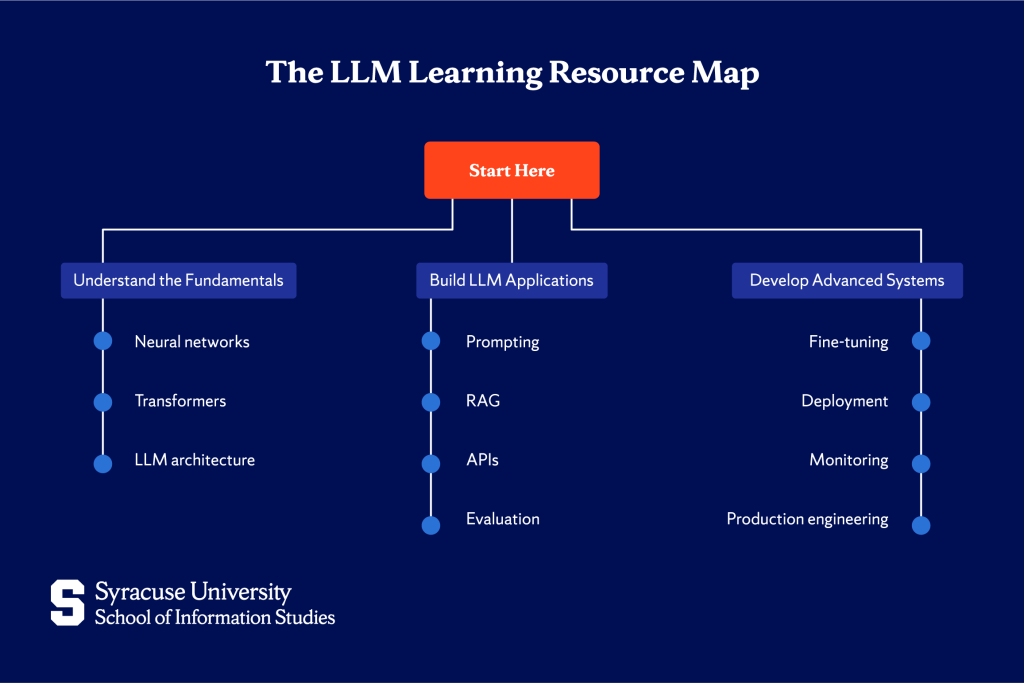
Degree programs and structured study
A program adds the pieces self-study rarely delivers on its own: the mathematical and machine learning theory underneath the applied layers, rigorous evaluation practice, grounding in responsible AI, faculty feedback on real projects, and a professional network. Self-taught learners most often skip exactly the parts that separate building a demo from shipping something people rely on.
At Syracuse’s iSchool, the Master’s in Applied Human-Centered AI builds hands-on skill with generative AI models alongside the judgment to use them responsibly, and undergraduates can start with the Integrative Artificial Intelligence Bachelor’s Degree. Learners coming from a data background often look at the Master’s in Applied Data Science, while students in other majors can add an AI focus through the Applications of AI Minor. Any program works best alongside the self-directed practice below.
Free courses and hands-on training
- Hugging Face LLM Course and documentation: the standard hands-on starting point for building with open models.
- Andrej Karpathy’s “Neural Networks: Zero to Hero” and “Let’s build GPT” videos: best if you want to learn LLMs by building a small one yourself.
- 3Blue1Brown’s neural network and transformer videos: best for an intuitive visual grasp of attention.
- DeepLearning.AI short courses on prompting, RAG, and fine-tuning: short, applied, and free to audit.
- Google Cloud’s “Introduction to Large Language Models” and Microsoft’s “Generative AI for Beginners”: concise primers for absolute beginners.
Books and reference reading
Sebastian Raschka’s Build a Large Language Model (From Scratch) is one of the strongest choices for understanding what happens inside an LLM, taking readers through embeddings, attention, model architecture, pretraining, and fine-tuning in Python and PyTorch. Hands-On Large Language Models by Jay Alammar and Maarten Grootendorst takes a more visual and application-focused approach, covering pretrained models, embeddings, fine-tuning, and other techniques used when working with LLMs.
For people moving toward production work, Chip Huyen’s AI Engineering focuses on building applications with foundation models, including evaluation, system design, and the decisions involved in taking AI applications beyond a prototype. LLM Engineer’s Handbook by Paul Iusztin and Maxime Labonne goes further into end-to-end LLM systems, with material on RAG, training pipelines, deployment, monitoring, and evaluation.
Natural Language Processing with Transformers by Lewis Tunstall, Leandro von Werra, and Thomas Wolf is an earlier reference, but it remains useful for understanding transformer-based NLP and the Hugging Face ecosystem that much of today’s LLM tooling grew from.
Communities and practice
Books provide structure, while communities become especially useful once you start building and run into specific problems. r/LearnMachineLearning is useful for broader machine learning questions, r/LLMDevs focuses more closely on developing LLM applications, and r/LocalLLaMA has active discussions around open-weight models, local inference, hardware, quantization, and new model releases.
The Hugging Face forums are particularly useful when a question involves models, datasets, fine-tuning, or the Hugging Face libraries themselves. Kaggle adds a different kind of practice through datasets, notebooks, and competitions where you can compare your approach with work from other practitioners.
These communities are most useful once the question is specific. Sharing the relevant code, error message, model, and what you have already tried usually produces much better help than asking a broad question about why something is not working.
How Long Does It Take to Learn LLMs?
If you already have Python and basic machine learning, you can reach working competence, meaning you can build prompt-based and RAG applications, in roughly three to six months of consistent part-time study. Starting from zero programming adds several months for those foundations first. Competence at applying LLMs is measured in months, while deep expertise in training and research is measured in years. The field also changes quickly, so learning LLMs is ongoing work rather than a finish line.
Why LLM Skills Are Worth Building Now
Just a few years ago, working with language models was a specialist niche. Today it’s a broadly useful literacy across software, data, product, and research roles, and the applied layers have lowered the barrier so far that meaningful work no longer requires training a model at all. The people who stand out are the ones who understand what’s happening underneath and can tell when a model’s answer deserves trust.
At Syracuse University’s iSchool, our Master’s in Applied Human-Centered AI is designed to build that technical fluency together with the evaluation and responsible-AI judgment that working with large language models demands, and the Master’s in Applied Data Science offers a closely related route for learners who lean toward data. If you’re ready to take a structured step, the Applied Human-Centered AI application checklist shows what you’ll need. Whatever route you take, the best next move is the same: pick a model, build something small this week, and let the questions it raises tell you what to learn next.
Frequently Asked Questions (FAQs)
Should I start with an open model or a commercial API?
Start with a commercial API such as OpenAI’s or Anthropic’s for the quickest results. Move to an open model like Llama or Mistral through Hugging Face once you want to inspect and adjust what’s underneath.
Do I need a powerful GPU to learn LLMs?
No. Prompting and RAG run on an ordinary laptop that calls an API, and free Google Colab notebooks offer enough GPU time for small LoRA fine-tuning experiments.
How much does it cost to practice with LLMs?
Very little at first. API providers charge per token, so small practice projects often cost a few dollars a month, and open models on Hugging Face are free to download.
Are LLM certifications worth getting?
They can add structure and a résumé line, particularly cloud-vendor credentials. On their own, though, they rarely carry as much weight with employers as a degree or demonstrated project work.
What jobs can you get with LLM skills?
Common targets include machine learning specialist, AI specialist, NLP specialist, and applied scientist. The same skills are increasingly useful in data analyst and product manager roles as well.
What is the difference between an LLM and an AI agent?
An LLM generates text in response to a prompt. An AI agent wraps an LLM in a loop that lets it plan and call tools such as search or code execution, then act on the results over several steps.
Do you need a master’s degree after an information science bachelor’s?
Not for most roles. BLS lists a bachelor’s as the typical entry-level education for computer systems analysts, while a master’s mainly helps for specialized or leadership tracks.
Which industries hire information science graduates?
Finance, consulting, media, and technology firms all hire heavily. Recent iSchool graduates have joined employers such as BNY, Deloitte, IBM, and Warner Bros. Discovery.