
Key Takeaways
- Artificial intelligence jobs include a category of distinct roles spanning data, research, product, and ethics or governance work, each with its own skills and pay band.
- Most AI roles still expect a bachelor’s degree in AI, computer science, data science, or a related field, and a specialized master’s increasingly sets senior and research candidates apart.
- AI governance, human-centered AI, and “AI plus domain” hybrid roles are among the fastest-growing categories in the field, a sign that AI is reshaping work more than it’s eliminating it.
Fear that AI will take people’s jobs has become common, but the reality is more complicated. AI may reduce the need for some tasks; however, at the same time, it is also changing existing work and contributing to the growth of new roles.
This makes artificial intelligence jobs a fascinating area to consider. As the field develops and its use expands across industries, employers need people who understand both the technology and how it should be applied.
Core Artificial Intelligence Jobs and What They Do
The roles below move from the technical work behind AI systems into research, product management, governance, and more specialized applications. The order is not a ranking. The strongest fit depends on your experience, interests, and the type of problems you want to solve.
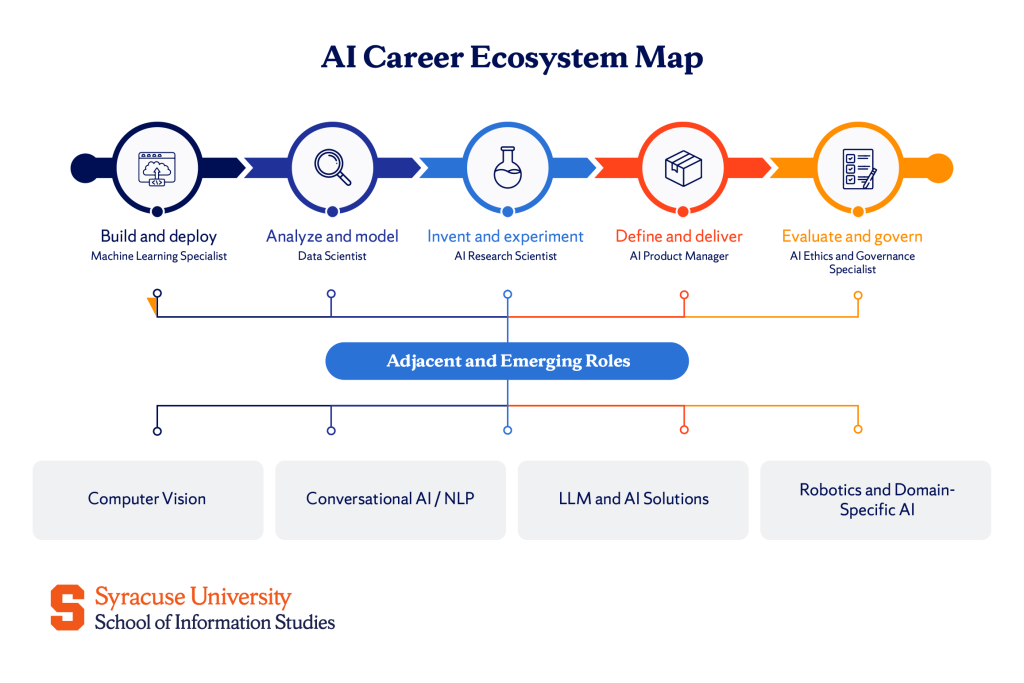
1. Machine learning specialist
A machine learning specialist builds the systems used to train, deploy, monitor, and update machine learning models. The role sits between data science and software development, with a strong focus on making models reliable enough for real-world use.
Key tools and skills for this role include:
- Python, PyTorch, or TensorFlow
- scikit-learn and feature-development pipelines
- Model deployment and serving
- MLOps tools such as MLflow, Docker, and Kubernetes
2. Data scientist
A data scientist analyzes data, designs experiments, and builds predictive models to answer business questions. The boundary between data science and machine learning varies by employer, but data scientists generally focus more on analysis and model development, while machine learning professionals focus more on deployment, scale, and reliability.
Key tools and skills for this role include:
- Python or R, plus SQL
- Statistics and experimental design
- Data visualization
- Core machine learning libraries
3. AI research scientist
An AI research scientist develops and tests new algorithms, model architectures, and training methods. These professionals often work in corporate or university research labs, where they run experiments and may publish their findings before other teams adapt them for practical use.
Key tools and skills for this role include:
- Linear algebra, probability, and optimization
- Research and experimental methods
- PyTorch or JAX
- A strong publication or research record
4. AI or machine learning product manager
An AI product manager decides which problems an AI product should address and how its success will be measured. The role connects data teams with designers, business leaders, and users, translating product needs into realistic technical requirements. It generally requires technical literacy rather than daily model development.
Key tools and skills for this role include:
- AI product strategy
- Enough machine learning knowledge to assess feasibility
- Experimentation and performance metrics
- Model and large language model evaluation
5. AI ethics and governance specialist
An AI ethics and governance specialist helps an organization develop and use AI responsibly. The work may include assessing bias and other risks, setting internal policies, documenting how models were developed, and checking that systems meet privacy and regulatory requirements before and after deployment.
Key tools and skills for this role include:
- Responsible AI and risk-management frameworks
- Bias and fairness assessments
- Data privacy and regulatory knowledge
- Model documentation and audit procedures
The role is particularly relevant to people with experience in policy, law, risk, social science, or human-centered design. Syracuse University’s M.S. in Applied Human-Centered AI helps students build on that background through coursework in responsible AI, regulation, bias assessment, human-AI interaction, and practical AI development, preparing them to evaluate how AI systems affect both organizations and the people who use them.
6. Adjacent and emerging AI roles
Many AI careers focus on a particular type of data, system, or industry rather than the entire development process:
- Computer vision specialist: Develops systems that interpret images and video for areas such as medical imaging, robotics, and autonomous vehicles.
- Natural language processing or conversational AI specialist: Creates systems that process language, generate text, and communicate with users.
- Large language model or AI solutions specialist: Adapts generative AI models for particular products, organizations, or information systems. Prompt design and model evaluation may form part of this work.
- Robotics and domain-specific AI specialist: Combines AI expertise with knowledge of areas such as healthcare, finance, manufacturing, or marketing.
These categories often overlap. Syracuse iSchool alumnus Keisuke Inoue, for example, built his career in conversational AI and now leads the design, research, and implementation of an AI recruitment chatbot and related automation tools. His work combines data science, natural language processing, product development, and an understanding of how people communicate with technology.
His experience also illustrates a broader point about AI careers: professionals are not always confined to one job category. A single position may draw on research, product knowledge, and human-centered design, depending on the system being developed and the people expected to use it.
Skills and Qualifications for AI Jobs
AI roles draw on many of the same technical and analytical skills, but the required depth varies. For example, developers and researchers need stronger programming and mathematics, while product and governance professionals combine technical literacy with business, policy, or subject-area expertise. Formal education provides the foundation, but projects and professional experience demonstrate how well someone can apply it.
Some of the core technical skills many AI jobs require include:
- Programming: Python is the main language used across AI roles, supported by SQL for data work and, depending on the position, R, C++, or Java.
- Machine learning and deep learning: Technical roles require an understanding of core algorithms and frameworks such as PyTorch, TensorFlow, and scikit-learn.
- Mathematics and statistics: Linear algebra, probability, statistics, and optimization are particularly important for model development and research.
- Data infrastructure and MLOps: AI specialists may work with data pipelines, AWS, Azure, or Google Cloud, along with deployment tools such as Docker, Kubernetes, and MLflow.
- Generative AI and large language models: Many AI roles now involve some understanding of LLMs, model evaluation, prompt design, retrieval methods, or fine-tuning. The level of expertise depends on the position.
In addition to the technical skills, many roles also require the following soft skills:
- Communication: Explaining models, results, and limitations to technical and non-technical audiences.
- Critical thinking: Evaluating data quality, model performance, and the assumptions behind an AI system.
- Collaboration: Working across data, product, legal, compliance, and subject-area teams.
- Ethical judgment: Recognizing issues involving bias, privacy, transparency, and the wider impact of AI.
- Adaptability: Keeping pace with changing tools, methods, and expectations without losing sight of the problem being solved.
Education and credentials
Requirements when it comes to education and credentials can vary by employer and role. Generally, a bachelor’s degree is the typical entry-level education for data scientists and software developers, while computer and information research scientists typically need at least a master’s degree. Graduate education is therefore more important for research and highly specialized positions than for every AI job.
Syracuse University’s iSchool offers several ways to build this preparation. At the undergraduate level, the B.S. in Integrative Artificial Intelligence combines programming, mathematics, and AI systems with ethics, governance, and human-centered design. Students from other majors can add the Applications of AI Minor, which introduces AI tools and applications while examining their ethical and social effects.
Then, the M.S. in Applied Data Science focuses on data collection, management, analytics, machine learning, and communicating results, while the M.S. in Applied Human-Centered Artificial Intelligence combines technical AI training with ethics, hands-on projects, and portfolio development.
How to Break Into AI
Breaking into AI does not require everyone to start in the same place. The most practical approach depends on your current experience, the work that interests you, and the technical demands of your target role.
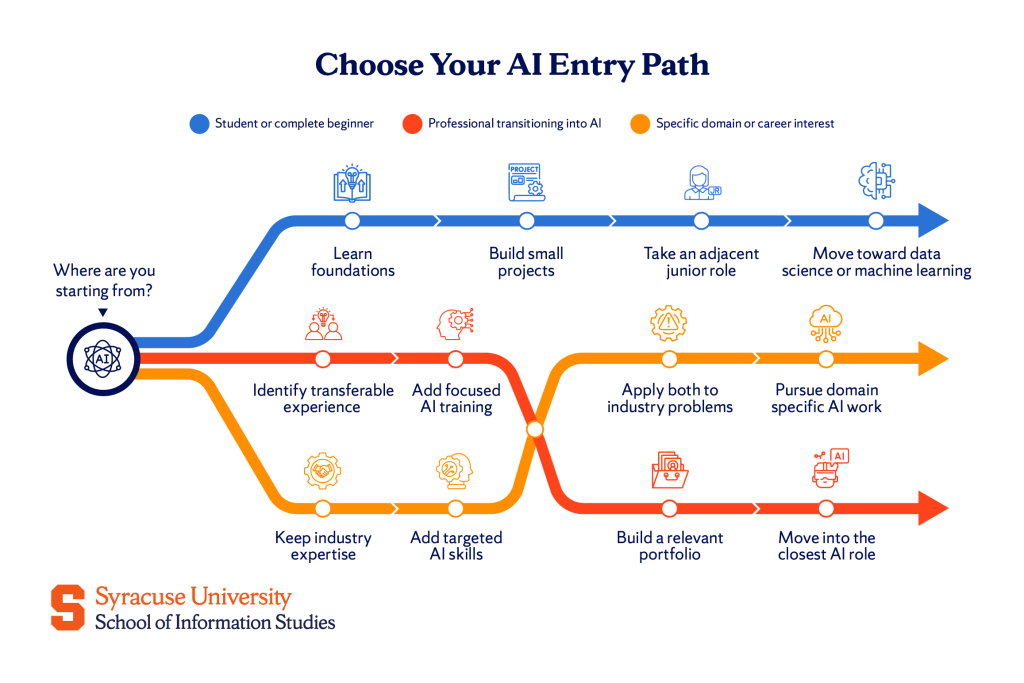
If you’re a student or complete beginner
Start with Python, SQL, statistics, and the basic principles of machine learning. Use small projects to show that you can clean data, train a model, evaluate its performance, and explain the results.
Data scientists and machine learning specialists are not always true entry-level positions. Internships and junior roles in analytics, software development, AI implementation, or technical support may provide a more practical first step toward them.
If you’re a professional transitioning into AI
Begin with the role closest to your existing experience. Software developers may move into machine learning, analysts into data science, product professionals into AI product management, and people working in policy, law, or risk into AI governance.
A focused master’s degree or certificate, supported by a portfolio of relevant projects, is usually more practical than trying to learn every part of the AI stack. Career changers may also be well suited to AI product, governance, implementation, or domain-specific positions because these roles value the experience they already have.
If you have a specific domain or interest
Choose a role based on the work you want to do. Developing new algorithms points toward AI research, building production systems toward machine learning, and using data to answer business questions toward data science. AI governance focuses on fairness, policy, and risk, while AI product management determines which systems should be built and how their success should be measured.
Professionals with experience in healthcare, finance, marketing, manufacturing, or another specialized area may not need to leave that field behind. Combining existing subject knowledge with AI skills can prepare them for roles that require both technical understanding and familiarity with the problems an organization is trying to solve.
Salary and Job Outlook for AI Careers
The World Economic Forum’s Future of Jobs Report 2025, based on a survey of more than 1,000 global employers, found that 86 percent expect AI and information-processing technologies to transform their businesses by 2030. This change is expected to affect hiring across many occupations, not only positions with AI in their titles.
The job outlook varies by occupation. According to a Bureau of Labor Statistics (BLS) analysis, the increasing use of AI and other information technologies is expected to support strong growth across several computer and mathematical occupations. Employment of data scientists is projected to grow 33.5 percent from 2024 to 2034, while employment of computer and information research scientists is projected to grow 19.7 percent. Software developer employment is projected to grow 15.8 percent, adding approximately 267,700 jobs, the largest numerical increase among the technology occupations included in the analysis.
Salaries also differ considerably by role, employer, industry, location, seniority, and years of experience. As one benchmark, the BLS reports that computer and information research scientists, a broad category that includes some advanced AI research work, earn a median annual wage of $140,910. Earnings ranged from less than $80,670 for the lowest-paid 10 percent to more than $232,120 for the highest-paid 10 percent, illustrating how widely compensation can vary within a single occupational category.
The Future of AI Jobs
AI is changing how work is performed across industries. Some routine clerical and administrative tasks may decline, while demand is growing for people who can apply AI within technical, business, policy, and specialized industry settings. The strongest preparation combines AI knowledge with judgment, ethical awareness, and expertise in a particular field.
Syracuse University’s iSchool offers several ways to build that combination. The M.S. in Applied Human-Centered Artificial Intelligence focuses on the technical and human impact of AI, while the M.S. in Applied Data Science, available on campus and online, provides deeper preparation in data and modeling. Explore the programs to find the option that best supports your career goals.
Frequently Asked Questions (FAQs)
What artificial intelligence job should I pursue first?
For most beginners, data scientist or junior machine learning specialist offers the clearest entry path, built on a Python, statistics, and machine learning foundation. Career changers often start from the role closest to their current stack.
Do you need a degree to work in AI?
Most AI roles expect at least a bachelor’s degree in computer science, data science, or a related field, and a specialized master’s increasingly differentiates candidates for senior and research positions.
Will AI replace these jobs?
AI is automating tasks more than eliminating whole AI careers. It’s also creating new categories like AI governance and human-centered AI, and WEF surveys point to strong demand for AI-related skills through 2030.