
Key Takeaways
- Data science for business turns company data into information that supports specific decisions.
- Companies use data science to understand past performance, predict outcomes, recommend actions, and automate repeatable decisions.
- Data science projects follow six phases: business understanding, data understanding, data preparation, modeling, evaluation, and deployment.
- Business data science requires technical expertise and the ability to connect the analysis to a practical business need.
Wavestone’s 2024 survey of Fortune 1000 data leaders found that investment in data and analytics remains a priority, with generative AI increasing the pressure to use that information more effectively. Yet the phrase “data science for business” is still often reduced to dashboards and spreadsheet reporting.
Data science for business goes further. It is the end-to-end process of turning raw company data into evidence that supports action, improves performance, reduces risk, and identifies new opportunities. Its value lies not in the report itself, but in the decision the analysis helps an organization make.
What Data Science for Business Actually Means
Data science for business means using company data to solve a specific business problem. It may help an organization predict demand, identify unusual transactions, understand customer behavior, or decide where resources should be directed. The goal is to produce information that supports a useful decision.
The term is related to business intelligence and data analytics, but they are not identical. Business intelligence generally tracks performance through reports, dashboards, and key metrics. Data analytics examines the data more closely to explain patterns or assess possible outcomes. Data science often uses statistical methods, programming, and machine learning to build models that predict results or support decisions that need to be repeated at scale.
The boundaries between these areas vary by organization. What distinguishes data science is its emphasis on using data to develop a solution that can inform future action, rather than only reporting what has already happened.
Four Ways Companies Use Data Science
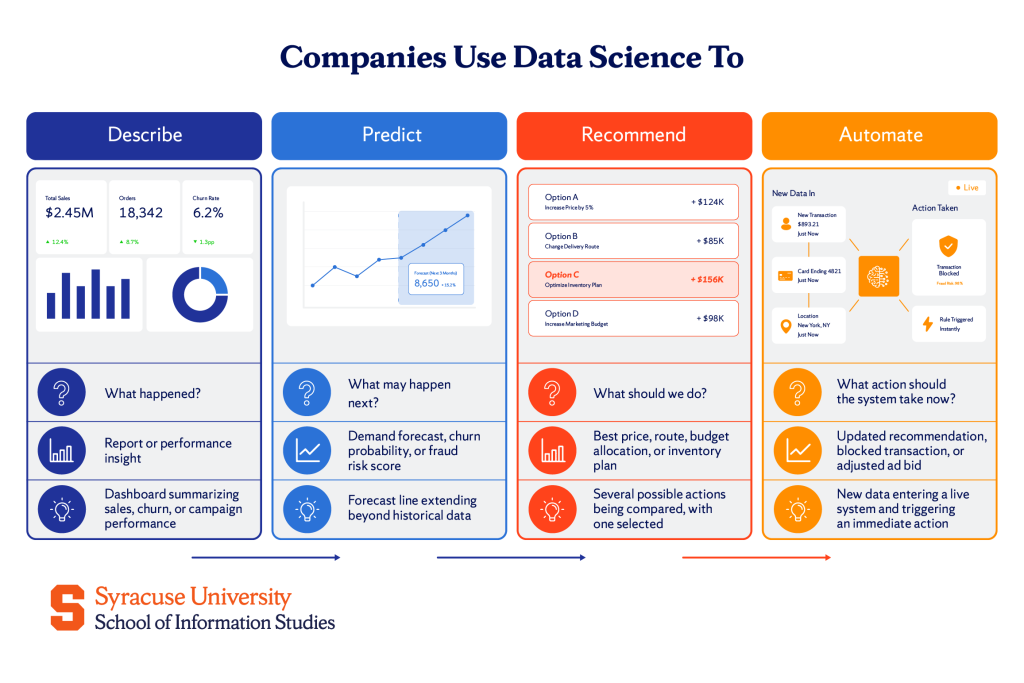
Companies use data science at different levels, depending on the question they need to answer and how they plan to use the result. Some applications help teams understand past performance, while others support future decisions or carry them out automatically. Most organizations use a combination of these approaches.
1. Describing what happened
Companies begin by bringing historical data together to show what has already occurred. Sales reports, customer churn dashboards, and marketing performance metrics help teams track results and identify changes that require attention.
This work is often associated with business intelligence. It provides a reliable view of performance, but it does not explain what will happen next or tell a company how to respond.
2. Predicting what may happen
Predictive data science uses patterns in past data to estimate a future outcome. A company might forecast demand, identify customers who are likely to cancel, or assess the probability that a transaction is fraudulent.
These predictions allow businesses to respond before the outcome occurs. A retailer may adjust inventory ahead of a rise in demand, while a customer service team may contact someone who appears likely to leave.
3. Recommending the best course of action
Some models are designed to compare possible actions and identify the one most likely to produce the desired result. This may involve setting a price, choosing a delivery route, allocating a marketing budget, or deciding how much stock to send to each location.
The distinction is important. A prediction estimates what is likely to happen, while a recommendation helps the business decide what to do in response.
4. Automating decisions
Data science may also be built into a system that makes or carries out decisions as new data arrives. Recommendation engines update the content shown to each user, fraud systems review transactions in real time, and advertising platforms adjust bids automatically.
At this level, the model becomes part of the company’s daily operations rather than an analysis that someone reviews separately. Automated systems still require monitoring, particularly when their decisions affect finances, access to services, or other high-stakes outcomes.
Data Science in Action: How Companies Use Data Across Industries
The four capabilities listed above can take different forms depending on the industry and the decision that is being made:
| Industry | Signature data science use case | Capability rung | Concrete detail to include |
|---|---|---|---|
| Retail & e-commerce | Product recommendations and personalization | Automated | Customer activity informs product suggestions, while sales patterns help retailers decide how much inventory to order and where to place it. |
| Banking & finance | Fraud detection and credit risk scoring | Predictive / automated | Models score transactions or applications so institutions can identify higher-risk activity and decide when additional review is needed. |
| Insurance | Risk pricing and telematics | Predictive | Customer, claims, and telematics data help insurers estimate risk, set premiums, and prioritize claims for review. |
| Healthcare | Readmission and early-warning prediction | Predictive | Models identify patients who may face a greater risk of readmission or another adverse outcome so care teams can respond earlier. |
| Logistics & supply chain | Demand forecasting and route optimization | Prescriptive | Forecasts guide inventory planning, while optimization models recommend routes that reduce delays and operating costs. |
| Marketing & SaaS | Churn prediction and next-best-offer | Predictive / prescriptive | Models identify customers who may cancel and help teams select an appropriate retention offer or intervention. |
| Manufacturing | Predictive maintenance | Predictive | Sensor and equipment data flag components likely to fail so teams can schedule repairs before an unplanned shutdown. |
Recommendation systems show how several of these capabilities work together. Netflix uses specialized machine learning models to personalize features such as “Continue Watching” and “Today’s Top Picks for You.” Amazon has also developed recommendation methods that identify relationships between products based partly on customer viewing and purchasing patterns. In both cases, the model predicts relevance and automatically changes what each customer sees.
Fraud detection applies a similar process to a higher-risk decision. Visa’s systems analyze transaction details and generate risk scores within milliseconds, allowing a payment provider to approve a purchase, request verification, or decline it. The model must detect suspicious behavior without creating too many false alerts that prevent legitimate customers from completing purchases.
The model alone does not determine whether a data science project creates value. Projects often underperform when they begin without a defined business problem, lack ownership from the team expected to use the result, or never become part of the company’s daily systems. A successful project therefore begins with a decision the business needs to improve and includes a clear way to measure the outcome.
How a Data Science Project Actually Works
The workflow behind these examples follows a lifecycle popularized by the CRISP-DM (Cross-Industry Standard Process for Data Mining) framework. It organizes the work into six phases:
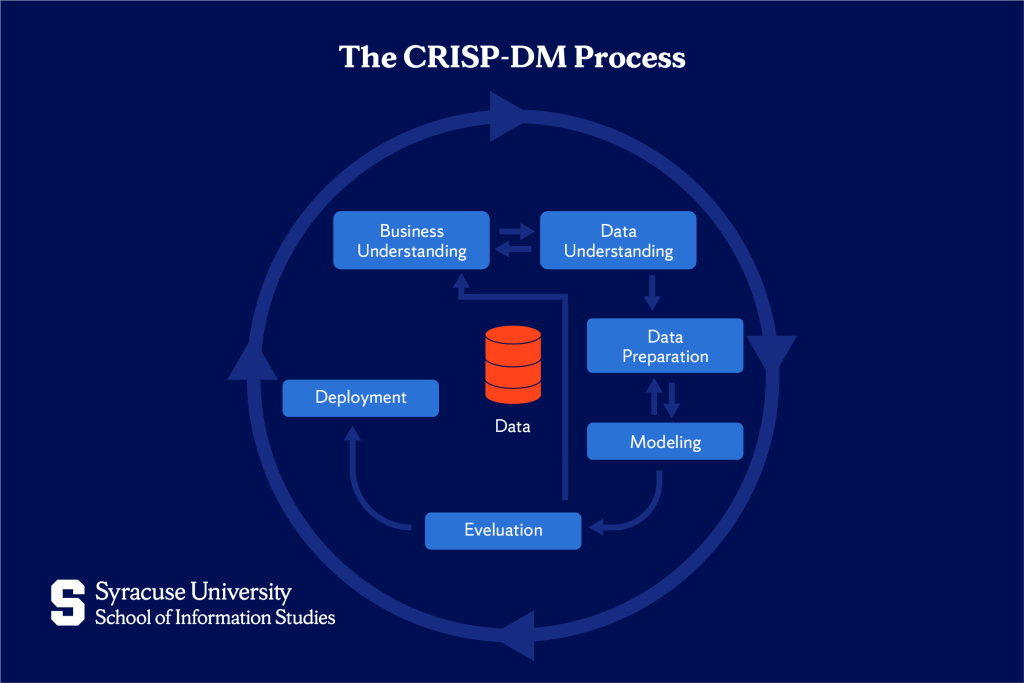
- Business understanding: The business problem, project goals, and measures of success.
- Data understanding: The available data, including its sources, quality, patterns, and limitations.
- Data preparation: The cleaning, combining, and transformation required to make the data suitable for analysis.
- Modeling: The selection, development, and comparison of statistical or machine learning models.
- Evaluation: The assessment of whether the results are accurate and relevant to the original business objective.
- Deployment: The introduction of the analysis or model into a business process, product, or decision-making system.
The Skills and Roles Behind Business Data Science
Business data science rarely depends on one person working alone. A successful project requires people who can prepare the data, develop the analysis, connect the findings to business priorities, and support the results after they are put into use.
The roles may differ by company, but they share one purpose: making sure the technical work leads to a decision the business can act on.
The core roles
Data science teams usually include or work closely with a variety of roles. The core ones include:
- Data scientist: builds predictive and prescriptive models and frames ambiguous problems as data problems in the first place.
- Data analyst: answers defined business questions with existing data, working closest to the business stakeholder and often serving as the entry point into the field.
- Data specialist: builds and maintains the pipelines and infrastructure that make the data usable and the models deployable.
- Analytics or data product manager: owns the link between a model and the business decision it’s meant to serve.
The skill that actually drives value: business translation
Technical skills like Python, SQL, statistics, and machine learning are necessary but not sufficient. Someone still has to turn a commercial problem into a question that data can answer, then explain the result in terms the business can use.
This is “business translation”. It means understanding the company’s goal, choosing a measure that reflects it, and connecting the analysis to a specific decision. A churn model, for example, has limited value unless the team knows which customers to contact, when to intervene, and how success will be measured.
Business translation also works in the other direction. Data professionals must explain uncertainty, limitations, and trade-offs without relying on technical language. This helps decision-makers understand what the model supports, where caution is needed, and what action is realistic.
The strongest data science professionals therefore do more than build accurate models. They make sure the work addresses a real need and reaches the people responsible for acting on it.
Final Reflections on Data Science for Business
A decade ago, the competitive advantage belonged to whoever collected the most data. That advantage has largely evaporated. Nearly every company has data now, so the edge belongs to organizations that can reliably turn it into trustworthy, deployed decisions, and to the professionals who can pair technical depth with business judgment. That combination, not raw technical skill alone, is the scarce resource today.
At Syracuse University’s iSchool, our Master’s in Applied Data Science is built to develop exactly this combination: the statistical and machine-learning skills companies need, alongside the business framing that turns models into decisions. Working professionals often choose the online Master’s in Applied Data Science for its flexibility, while undergraduates can start with the Bachelor’s in Applied Data Science or add data skills to another major through the Data Science Minor. For students who want the business-plus-data combination built directly into their degree, the iSchool-Whitman dual degree pairs data science with a business education from the ground up. Explore the program that fits where you want to take this next.
Frequently Asked Questions (FAQs)
Is data science a good career for business?
Yes. Demand spans nearly every sector, and the highest-paid roles combine technical skill with business judgment, since the most common reason projects fail is weak business framing, not weak modeling.
What is the difference between data science, analytics, and business intelligence?
Business intelligence reports what happened, analytics explains why and what’s likely next, and data science builds the predictive and automated systems that recommend or make the next decision at scale.
Do I need a degree to work in data science for business?
Not always, but a structured program shortens the path. Degrees like the iSchool’s Master’s in Applied Data Science build the statistics, machine learning, and business-translation skills employers screen for together.