
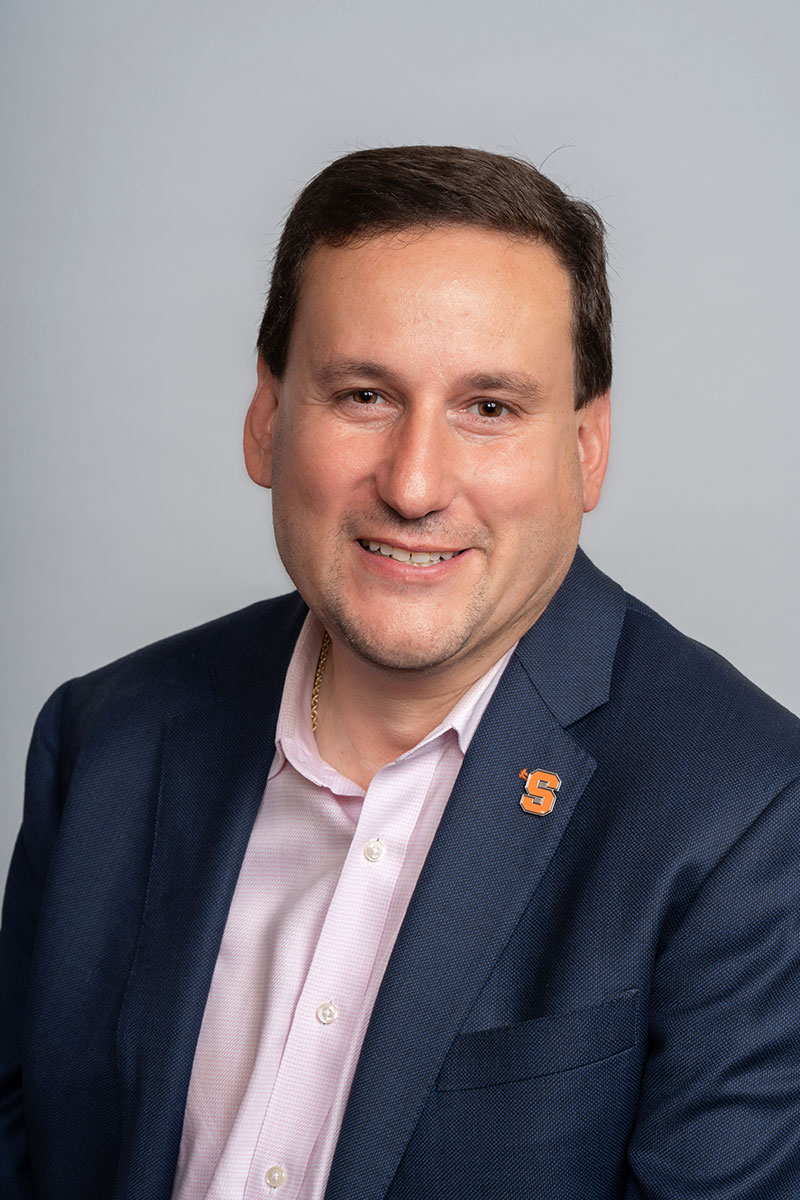
 As Syracuse University’s first Senior Vice President for Digital Transformation and Chief Digital Officer, Jeff Rubin ’95, G’98 spends much of his time thinking about the future. Whether it’s artificial intelligence, connected campus technology, or new approaches to teaching and learning, his focus isn’t simply adopting new tools. It’s reimagining how technology can improve the way a university operates, supports students, and prepares graduates for an AI-driven world.
Rubin joined the Infoversity podcast to discuss the path that led him from the iSchool to leading one of Syracuse University’s most ambitious strategic initiatives. While his career has spanned entrepreneurship, software development, and executive leadership, he credits the iSchool with giving him the foundation to adapt alongside technology as it evolved.
“I finally knew what I wanted to do,” Rubin said of his time as a graduate student, when the internet was just beginning to reshape society. That curiosity ultimately launched a career built around anticipating what’s next.
After earning his bachelor’s and master’s degrees from the iSchool, Rubin founded Sidearm Sports, a software company that revolutionized digital platforms for collegiate athletics. What began as a solution for Syracuse Athletics grew into an industry-leading SaaS platform serving more than 1,700 colleges and universities, including more than 95 percent of NCAA Division I athletic programs. After selling the company in 2014, he remained in executive leadership before returning to Syracuse University in a new role focused on shaping its digital future.
Today, Rubin sees digital transformation as much more than implementing new technology. Instead, he describes it as rethinking how every part of the university can work together more intelligently.
“We have so much data that we’re collecting here at the university,” he explained. “Digital transformation is really reimagining how we think about and engage with our constituents around all aspects of the university.”
That vision touches nearly every corner of campus, from student services and financial aid to campus safety, teaching, research, and operations. While Syracuse has invested heavily in transforming its physical campus, Rubin believes the next opportunity lies in creating an equally exceptional digital experience.
A major piece of that strategy centers on artificial intelligence, but Rubin is quick to point out that AI is only one part of a much larger ecosystem.
“Artificial intelligence only works as well as the data that feeds it,” he said.
For Rubin, connectivity, data, and AI form a three-part foundation. Syracuse has already established itself as one of the nation’s most connected campuses through investments in advanced wireless infrastructure. The next step is bringing together data that has traditionally existed in separate systems and using it responsibly to create more personalized, efficient experiences for students, faculty, and staff.
Perhaps nowhere does Rubin see greater potential than inside the classroom.
For generations, higher education has followed a familiar model: professors lecture, students take notes, and learning is measured through exams, papers, or projects. Rubin believes AI creates an opportunity to rethink that approach by making learning more interactive and personalized.
Rather than delivering the same experience to every student, he envisions AI-powered simulations that adapt in real time based on each learner’s understanding. Students could begin applying concepts immediately through realistic scenarios while AI adjusts the level of difficulty, helping every student reach the same learning outcomes through individualized pathways.
“What if we could rethink the way I teach?” Rubin asked, describing a future where students move seamlessly between instruction, simulation, and hands-on application during class.
That philosophy also influenced Syracuse University’s decision to provide AI tools to faculty, staff, and students, encouraging the campus community to explore how generative AI can enhance teaching, learning, and productivity while ensuring equitable access across the university.
Rubin believes those experiences are becoming increasingly important because AI is rapidly becoming a foundational workplace skill.
“We’ve had requirements around math and writing,” he said. “The world is different.”
Rather than treating AI as a specialized topic reserved for technology majors, he sees it as a literacy that will touch every profession. Whether students pursue careers in business, healthcare, communications, government, or engineering, understanding how to work effectively with AI will become just as essential as understanding information technology is today.
That philosophy aligns closely with the iSchool’s expanding AI programs, including its master’s degree and new undergraduate offerings focused on helping students apply AI strategically across industries rather than simply build the technology itself. Rubin believes that combination of technical understanding and real-world application plays directly to the iSchool’s longstanding strengths.
“Nothing screams information like artificial intelligence,” he said.
As AI capabilities continue to evolve, Rubin emphasizes that innovation must be balanced with responsibility. Building trustworthy AI requires strong governance, thoughtful data management, and collaboration across disciplines. Syracuse is developing new frameworks that bring together faculty and staff from across the university to guide decisions around privacy, accessibility, ethics, and responsible AI implementation.
At the same time, he acknowledges that emerging technologies introduce new cybersecurity challenges, from increasingly sophisticated phishing attempts to AI-generated social engineering attacks. Staying ahead requires both stronger technology and greater awareness among the people using it.
Looking ahead, Rubin imagines a campus where technology works seamlessly in the background to improve everyday experiences. He points to possibilities such as AI-enhanced safety systems, smarter infrastructure, and connected technologies that respond more quickly to student needs. While the tools themselves will continue to change, the larger goal remains the same: use technology thoughtfully to make the university more responsive, more connected, and better equipped for the future.
That entrepreneurial mindset continues to shape his leadership today. Rather than viewing information technology solely as a support function, Rubin wants it to serve as a strategic partner that helps every unit across the university solve problems, innovate, and prepare for what’s next.
“We need to lead the university into the future through IT,” he said.
For Rubin, digital transformation isn’t defined by any single technology. It’s about building a culture that embraces change, encourages collaboration, and uses innovation to create better experiences for students, faculty, and the broader university community. As AI and emerging technologies continue to reshape higher education, his vision is clear: the future belongs to institutions willing to rethink what’s possible.