
Key Takeaways
- Python is the most-used language on GitHub overall, largely because of growth in machine learning and data science projects.
- Beginners should start with Python, then add a second language based on domain: C++ or Rust for performance-critical work, R for statistical modeling, JavaScript for web-deployed AI, or Scala for distributed data pipelines.
- Rust and Mojo are the two languages signaling where the field is heading in 2026: Rust for memory-safe AI infrastructure, Mojo for Python-compatible code that compiles to native machine speed.
According to the 2025 Stack Overflow Developer Survey, 84% of developers reported using or planning to use AI tools in their work, a number that would have seemed implausible five years ago. For anyone entering the field now, that statistic raises an immediate practical question: which language do you actually need to learn?
The answer depends on what kind of AI work you want to do. Python is the main language in the field and is used in much of the machine learning code found on GitHub. But AI work does not happen in Python alone. Different tasks may call for different languages.
AI research, production systems, browser-based tools, robotics, statistics, and symbolic reasoning each have different needs. That is why there is no single best language for every situation. The top AI programming languages each have their own use, and the right choice depends on the kind of projects you want to build.
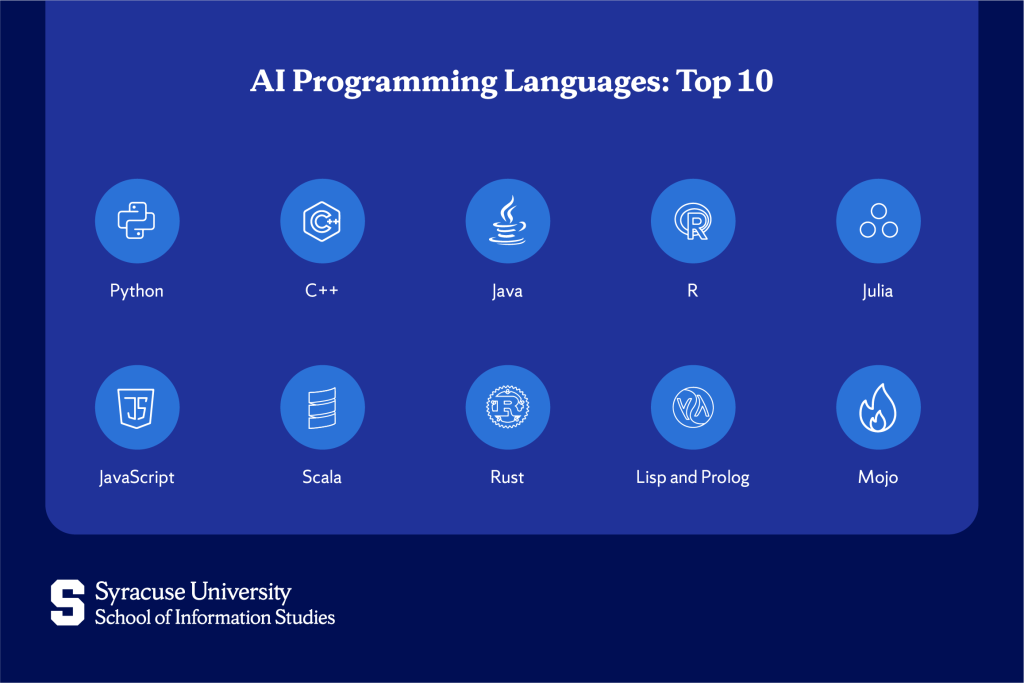
Top 10 AI Programming Languages
Python and C++ take the top two spots because they are used so heavily across AI research, machine learning, and performance-heavy systems. After those two, the ranking is less fixed. As different AI tasks need different languages, the best choice depends on what you want to build, where the system will run, and how much speed, flexibility, or integration the project needs.
1. Python
Python is a high-level, interpreted programming language that has become the default language for AI research, prototyping, and most production machine learning work. According to the 2024 GitHub Octoverse report, Python is the most-used language on GitHub overall, largely because of growth in machine learning and data science projects. Its position is also strengthened by the tools around it. Major AI frameworks usually support Python first, many AI courses teach with Python, and most AI teams expect developers to know it well.
Best AI use cases: machine learning model training, deep learning research, natural language processing, computer vision, and large language model fine-tuning.
Notable frameworks and libraries:
- TensorFlow
- PyTorch
- scikit-learn
- Keras
- Hugging Face Transformers
- LangChain
Limitation: Python’s Global Interpreter Lock (GIL) restricts true parallel processing, and its interpreted nature makes it slow for performance-critical inference, which is why production AI systems typically pair Python with C++ or Rust for the performance-sensitive components.
2. C++
C++ is a programming language used when AI systems need to run very fast and use memory carefully. In projects where speed is critical, such as real-time AI, robotics, or autonomous vehicles, teams may use C++ when Python is too slow. It gives developers more control over how the system runs, which makes it useful for performance-heavy AI work.
Best AI use cases: real-time AI inference engines, autonomous vehicle systems, robotics control loops, low-latency trading models, and game AI.
Notable frameworks and libraries:
- TensorFlow C++ backend
- PyTorch C++ frontend (libtorch)
- Caffe
- ONNX Runtime
- TensorRT
- OpenCV
Limitation: steep learning curve and slow development speed compared to Python. C++ is rarely the first language a team reaches for when building an AI feature, but often the language a system gets rewritten in once performance becomes the bottleneck. Rust is a modern alternative with comparable speed and memory safety guarantees.
3. Java
Java is a statically typed, JVM-based language and the practical choice when large enterprises need to add AI capabilities to existing systems without abandoning a decade of existing infrastructure. Where C++ serves raw performance, and Python serves research, Java’s strength is the enormous install base of corporate Java applications that need AI features layered in.
Best AI use cases: AI-powered fraud detection in banking systems, recommendation engines in large e-commerce platforms, document processing in legal and insurance workflows, and on-device machine learning in Android applications.
Notable frameworks and libraries:
- Deeplearning4j (DL4J)
- Weka
- Apache OpenNLP
- MOA
- Tribuo
Limitation: a smaller AI library ecosystem than Python, and significantly less common in cutting-edge research. Java AI work tends to follow the research field rather than lead it, and teams building new AI systems from scratch rarely choose Java as their primary AI language today.
4. R
R is a statistical computing language designed specifically for data analysis and is the language of choice when statistical rigor matters as much as predictive accuracy. Where Python treats statistics as one tool among many, R was built from the ground up around statistical methodology. It is often used for hypothesis testing, formal analysis, and models where interpretation matters.
Best AI use cases: bioinformatics and clinical research AI, financial econometrics, academic statistics-heavy research, and AI models requiring formal statistical inference alongside prediction.
Notable frameworks and libraries:
- caret
- mlr3
- randomForest
- xgboost (R interface)
- tidymodels
Limitation: less suited to production deployment than Python. R is powerful in the modeling and research phase, but teams often move to Python or another language when a model needs to be packaged and served at scale.
5. Julia
Julia is a high-performance, dynamically typed language that combines Python-like expressiveness with execution speeds approaching C. It was built specifically for scientific computing and numerical analysis, making it the rare case of a language that doesn’t force a choice between ergonomics and performance.
Best AI use cases: scientific simulations with embedded machine learning (climate modeling, computational biology), differential equation solving combined with neural networks, high-performance numerical research where Python is too slow but C++ development time is too costly.
Notable frameworks and libraries:
- Flux.jl
- MLJ.jl
- Knet.jl
- ScikitLearn.jl
- DifferentialEquations.jl
Limitation: a much smaller ecosystem and community than Python. Fewer pre-built libraries, less tutorial content, fewer job listings, and a harder hiring market for Julia-trained developers. Julia is excellent for the right problem; finding that problem in a job posting is harder than finding a Python role.
6. JavaScript
JavaScript runs directly in every web browser without plugins or server round-trips, making it the default choice for AI that needs to execute client-side. It can work inside the website itself, which can make the experience faster and reduce the need to send data back to a backend system.
Best AI use cases: real-time browser-based AI features (face filters, gesture recognition, live sentiment analysis), interactive AI demos and educational tools, Node.js-based AI APIs, on-device AI in progressive web applications.
Notable frameworks and libraries:
- TensorFlow.js
- Brain.js
- ONNX Runtime Web
- ml5.js
- LangChain.js
Limitation: browser execution constraints mean JavaScript is used almost exclusively for running pre-trained models rather than training them. Model size, memory limits, and compute constraints make in-browser training impractical for anything beyond simple demos or beginner practice projects.
7. Scala
Scala is a programming language that runs on the Java Virtual Machine, which means it can work well with Java-based systems and big data tools. In AI, Scala is most useful when teams need to process very large datasets across many machines. It is often used with tools such as Apache Spark, where the work is too large for one computer to handle. While Java is often used to add AI features to existing business systems, Scala is more common in large-scale data processing and machine learning pipelines.
Best AI use cases: large-scale recommendation engines (the architecture powering platforms similar to Netflix or LinkedIn), fraud detection pipelines processing billions of transactions, streaming AI on real-time data feeds, and ETL pipelines feeding production ML models.
Notable frameworks and libraries:
- Apache Spark MLlib
- ScalNet
- Breeze
- Smile
Limitation: steep learning curve, a smaller AI-specific library ecosystem than Python, and increasing competition from Python combined with PySpark for the same distributed workloads, making Scala less necessary for groups that want large-scale data processing without learning a new language.
8. Rust
Rust is a systems programming language used when AI infrastructure needs to be fast and safe. It is newer in AI than languages like Python, C++, or Java, but it is becoming more relevant for the systems that support AI tools.
Rust is often compared with C++ because both can deliver strong performance. The difference is that Rust is designed to prevent many common memory-related errors, such as buffer overflows and use-after-free bugs, making it useful for AI systems where speed matters, but where teams also want code that is easier to maintain and review.
Best AI use cases: AI inference servers and edge runtimes, WebAssembly-based AI deployment, performance-critical components inside larger Python-based AI systems, and tooling for large language model serving.
Notable frameworks and libraries:
- Candle
- Burn
- tch-rs (PyTorch Rust bindings)
- Linfa
Limitation: a smaller AI ecosystem than C++ or Python, a steeper learning curve than any other language on this list, and rarely used for AI research.
9. Lisp and Prolog
Lisp and Prolog are both linked to symbolic AI, a part of AI that focuses on logic, rules, and structured knowledge instead of pattern-finding from large datasets. They are grouped together because they serve a similar purpose: helping systems reason through information that follows clear rules.
Lisp is the original AI language of the 1960s–80s, still used in symbolic reasoning research and expert systems. Modern dialects include Common Lisp and Clojure. Prolog is a logic programming language built for knowledge representation, expert systems, and computational linguistics; narrow in scope but irreplaceable in the domains it serves.
Best AI use cases: expert systems in legal and medical domains, knowledge graphs and ontologies, computational linguistics research, formal verification of AI systems, and neuro-symbolic AI research combining neural networks with rule-based reasoning.
Limitation: neither language is a practical first choice for someone entering AI today. The job market for Lisp and Prolog developers is small, and most AI problems in production are solved with statistical approaches rather than symbolic ones. But for the specific problems symbolic AI handles well (problems that require explainable, verifiable reasoning), neural networks are not the answer, and these languages remain the right tool.
10. Mojo
Mojo is a programming language designed from the ground up for AI workloads, built by Modular and released in 2023. It combines Python-compatible syntax with native compilation to machine code, targeting exactly the weakness that makes Python unsuitable for performance-critical AI: slow execution speed. It represents the clearest signal that the AI language landscape is still evolving.
Best AI use cases: performance-critical AI components that would otherwise require a rewrite in C++ or Rust, AI deployments on heterogeneous hardware spanning GPU, TPU, and CPU targets, workloads where Python’s ergonomics matter but its runtime speed does not.
Notable frameworks and libraries:
- MAX Engine (Modular’s inference platform, built for Mojo)
- Python interoperability layer (Mojo can import and run Python libraries directly)
Limitation: as of 2026, Mojo remains an emerging language with a small ecosystem, no established hiring market, and limited production adoption outside early-adopter organizations. It is not yet a viable primary choice for most AI teams, but it is the language to track for anyone planning an AI career past 2027.
How to Choose the Right AI Programming Language for You
Choosing an AI programming language is easier when you start with your goal. A beginner who wants to learn machine learning needs a different starting point than someone building AI features for a website, working with large datasets, or improving the speed of a production system.
If you’re a complete beginner
Start with Python. It is the easiest entry point into AI because it has a large learning community, plenty of beginner-friendly tutorials, and strong coverage across AI courses, bootcamps, and university programs. Many modern AI learning paths, including fast.ai, DeepLearning.AI, and university curricula, use Python as the starting language.
For students who want a structured AI program, Syracuse University’s iSchool offers the Integrative Artificial Intelligence Bachelor’s Degree, which helps build AI literacy through technical, ethical, and human-centered coursework, and the Applied Human-Centered Artificial Intelligence Master’s Degree, designed to prepare students to work with advanced AI technologies through hands-on projects, applied portfolio work, and responsible AI practice.
If you’re already a developer transitioning into AI
Start with the AI language closest to the tools you already use. This makes the move into AI easier because you are learning machine learning concepts without also having to relearn programming from the ground up.
- Java developers: Deeplearning4j and Weka provide a path into AI without leaving the JVM.
- JavaScript or TypeScript developers: TensorFlow.js and LangChain.js let you build and deploy AI features inside web applications you already know how to ship.
- C++ developers: libtorch (the C++ PyTorch interface) and ONNX Runtime put you directly into production AI inference work.
Most developers transitioning into AI also pick up Python within their first six months, regardless of starting language, because so much AI research, documentation, and tooling is built around it.
If you have a specific AI domain in mind
Match the language to the domain:
- Statistical or research-grade modeling → R
- Browser-based or on-device AI → JavaScript
- Distributed AI on large-scale data → Scala
- Real-time inference, robotics, autonomous systems → C++ or Rust
- Symbolic AI, knowledge representation, expert systems → Lisp or Prolog
- Scientific computing with embedded ML → Julia
- Performance-critical AI infrastructure, 2026 and beyond → Mojo (alongside Python)
AI Career Outlook for Programmers
AI skills now carry value across many software roles, not only positions with “AI” in the title. As more companies add AI features to products, internal tools, customer platforms, and data systems, employers increasingly look for candidates who understand AI frameworks, model behavior, and responsible design.
The U.S. Bureau of Labor Statistics reports a median annual wage of $133,000 for software developers, with employment projected to grow 15% from 2024 to 2034, far faster than the average for all occupations. AI-focused roles, including machine learning specialist, AI research specialist, ML platform specialist, and applied AI developer, often pay above the general software developer baseline, especially when the role requires strong programming skills, framework fluency, and experience building AI systems.
In response to sustained employer demand for AI-ready graduates, Syracuse University’s iSchool recently launched its Master’s in Applied Human-Centered AI, a graduate program designed for the language fluency, framework depth, and responsible design skills that AI roles now require.
The Bottom Line
Five years ago, the answer to “which AI language should I learn?” was usually simple: Python. Today, the right answer depends on whether the work is research, production, deployment to the browser, symbolic reasoning, or performance-critical infrastructure that can’t afford Python’s runtime overhead. The rise of Rust for memory-safe AI systems and Mojo for faster Python-style development shows how much the field is expanding.
For anyone entering AI today, the goal is not to replace Python. It is to understand where Python fits, where its limits appear, and which other languages become useful as projects become more specialized.
At Syracuse University’s iSchool, the Master’s in Applied Human-Centered AI is designed to build fluency in the languages, frameworks, and responsible design principles that modern AI work requires across research, production, and deployment contexts. The Master of Applied Data Science offers a complementary path for students whose AI interests are grounded in data systems, predictive modeling, and applied analytics. Explore both programs to find the track that fits where you want to take your career.
Frequently Asked Questions (FAQs)
What is the best programming language for AI?
Python is the strongest general-purpose choice, as it powers the majority of AI research and most production ML systems. However, the best language for a specific AI task depends on context: C++ for real-time inference, JavaScript for browser deployment, R for statistical modeling, and Scala for distributed data pipelines.
Which programming language is used in ChatGPT?
ChatGPT and the underlying GPT models were trained and developed primarily using Python, with PyTorch as the core deep learning framework; the production infrastructure serving the model at scale also relies on lower-level systems code, likely including C++ and CUDA for GPU-level optimization.
Is Python the only language for AI?
No. While Python dominates AI research and prototyping, production AI systems commonly incorporate C++ for performance-critical inference, Rust for memory-safe infrastructure, JavaScript for browser-based AI, and Scala for distributed data workloads.
What AI programming language should I learn first?
Python at the beginner level, since it has the largest community, the most learning resources, and the broadest adoption across AI frameworks and courses. Then, add a second language based on the specific AI domain you want to work in.
Is becoming an AI programmer worth it?
Yes, especially from a salary and job outlook perspective. Software developers earn a high median salary, and employment is projected to grow much faster than average. AI skills can add even more value because many companies now need people who can build, improve, and work with AI-powered systems.