
Key Takeaways
- Each neural network architecture is built for specific data types and tasks.
- CNNs excel at image and spatial data; RNNs and LSTMs handle sequential and time-series data best.
- Transformers have become the dominant architecture for natural language processing tasks.
- GANs generate realistic synthetic data, while autoencoders are used for compression and anomaly detection.
- Choosing the wrong architecture, even with good data, leads to poor results. Understanding each type helps you make better decisions.
Not all neural networks work in the same way. Some are built to recognize faces in a crowd. Others predict the next word you’ll type or generate images that never existed. The types of neural networks available today span a wide range of architectures, depending on the kind of problem they are meant to solve. For anyone starting out in machine learning or trying to deepen their understanding of AI systems, these differences and where they work best is one of the most useful things you can learn.
Main Types of Neural Networks
Each neural network architecture is built with a different type of data in mind. Some work best with structured, tabular inputs. Others are designed for images or sequences like text. Knowing what each type is built to handle can be the difference between a model that performs well and one that falls short.
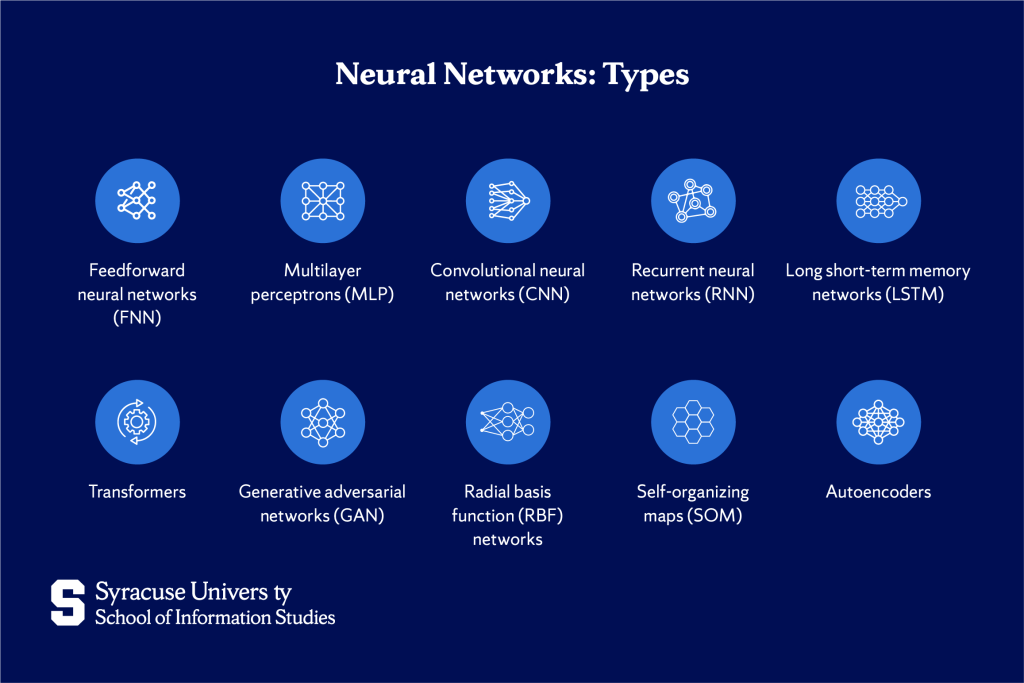
Feedforward neural networks (FNN)
The feedforward neural network is the simplest architecture: data moves in one direction only, from input to output, with no loops or memory. Each input is multiplied by a weight, summed, and passed through an activation function to produce an output.
FNNs work well for straightforward classification tasks like predicting whether an email is spam or estimating a numerical value, but they can’t handle sequential or time-dependent data. If your inputs don’t have any meaningful order, an FNN is a reasonable starting point.
Multilayer perceptrons (MLP)
An MLP is an FNN with multiple hidden layers between input and output, which allows it to learn more complex, non-linear patterns. Training uses backpropagation, a process that adjusts weights by working backward through the network based on prediction errors.
MLPs are flexible and general-purpose, making them useful for tasks like customer churn prediction or fraud detection. Their main weakness is that they don’t naturally account for spatial structure (as in images) or temporal order (as in sequences).
Convolutional neural networks (CNN)
CNNs are built for spatial data, particularly images. They use convolutional layers (filters that slide across input data to detect features like edges, textures, and shapes) followed by pooling layers that reduce dimensionality. This structure lets CNNs automatically learn increasingly abstract features from raw pixels without manual feature design.
Real-world applications include facial recognition, medical image analysis, and object detection in self-driving vehicles. CNNs require large datasets and significant compute, but for image tasks, they remain the standard choice.
Recurrent neural networks (RNN)
RNNs are designed for sequential data. Unlike FNNs, they feed the output of one step back as input to the next, giving the network a form of short-term memory. This makes them naturally suited to tasks like next-word prediction, speech recognition, and time-series forecasting.
The significant drawback is the vanishing gradient problem. As a sequence gets longer, the model starts to “forget” earlier information, making it hard to learn connections between things that are far apart. This is why models like LSTMs were later developed to help keep important information over longer sequences.
Long short-term memory networks (LSTM)
LSTMs are a type of RNN designed to handle the vanishing gradient problem. They use a system of gates (input, forget, and output) to manage information as it moves through the network. One gate decides what new information to store, another decides what to forget, and a third controls what gets passed forward.
This setup allows LSTMs to keep important context over much longer sequences, which makes them useful for tasks like language translation, voice assistants, and text summarization. The downside is that they are more complex, so they take longer to train and use more memory than standard RNNs.
Transformers
Transformers changed the trajectory of deep learning when they were introduced in 2017. Instead of processing sequences step by step, they use self-attention, a mechanism that weighs the relevance of every word in a sequence relative to every other word simultaneously. This allows parallel processing, which makes them far faster to train than RNNs at scale.
Transformers power most modern large language models, including the systems behind chatbots and machine translation tools. Their main drawback is how much data and computing power they require, which makes training them from scratch impractical for most individuals.
Generative adversarial networks (GAN)
GANs consist of two networks trained in opposition: a generator that produces synthetic data and a discriminator that tries to tell real from fake. Over time, this competition pushes the generator to produce increasingly realistic outputs.
GANs are behind AI-generated images, deepfake video, and synthetic training data creation. They’re powerful but notoriously difficult to train. Common problems include training instability and mode collapse, where the generator produces only a narrow range of outputs.
Radial basis function (RBF) networks
RBF networks classify inputs based on their distance from learned reference points, rather than using traditional weighted sums. The hidden layer applies a radial basis function to measure how close each input is to those reference points.
They tend to train quickly and work well for tasks like function approximation, interpolation, and pattern classification, particularly when the data forms clear clusters. Their main limitation is scalability, since performance can drop with very large or high-dimensional datasets.
Self-organizing maps (SOM)
SOMs are an unsupervised learning method used to turn high-dimensional data into a simpler, usually two-dimensional grid. The key idea is that points that are similar in the original data stay close to each other on the map, so the structure of the data is preserved.
This makes SOMs useful for visualizing complex datasets and spotting natural groupings. They are often used in customer segmentation and exploratory data analysis. While they are less common in modern deep learning workflows, they remain valuable for interpretability and visualization tasks where understanding structure matters more than prediction accuracy.
Autoencoders
Autoencoders learn to compress data into a smaller representation and then rebuild it. The first part, called the encoder, reduces the input into a lower-dimensional form. The second part, the decoder, tries to reconstruct the original data from that compressed version. What the model captures in that middle step is a simplified but meaningful representation of the input.
Autoencoders are used for image denoising, anomaly detection, and dimensionality reduction. Variations like variational autoencoders (VAEs) extend the concept into generative modeling. The main risk is that a poorly constrained autoencoder simply memorizes inputs without learning anything useful.
Comparing Types of Neural Networks
With ten architectures on the table, the practical question becomes: how do they stack up against each other, and which one fits your problem? A direct comparison across a few key dimensions makes that decision easier.
Strengths and weaknesses
CNNs deliver high accuracy on image tasks but demand large labeled datasets and significant GPU resources. RNNs are lightweight and intuitive for short sequences but degrade on longer ones. LSTMs fix that problem but add training complexity. Transformers outperform both on language tasks at scale, yet are data-hungry and expensive to run. GANs produce impressive generative outputs but are unstable to train. Autoencoders and SOMs are excellent unsupervised tools, but rarely match supervised architectures on raw predictive accuracy.
| Architecture | Best For |
|---|---|
| FNN / MLP | Tabular data, classification, regression |
| CNN | Images, video, spatial data |
| RNN | Short sequences, time-series |
| LSTM | Long sequences, language, speech |
| Transformer | Natural language processing, large language models, translation |
| GAN | Image generation, synthetic data |
| RBF Network | Function approximation, small-scale classification |
| SOM | Clustering, visualization |
| Autoencoder | Compression, anomaly detection, denoising |
How to Choose the Right Neural Network
Picking an architecture isn’t about choosing the most sophisticated option. It’s about matching the model to your data, your problem, and your resources.
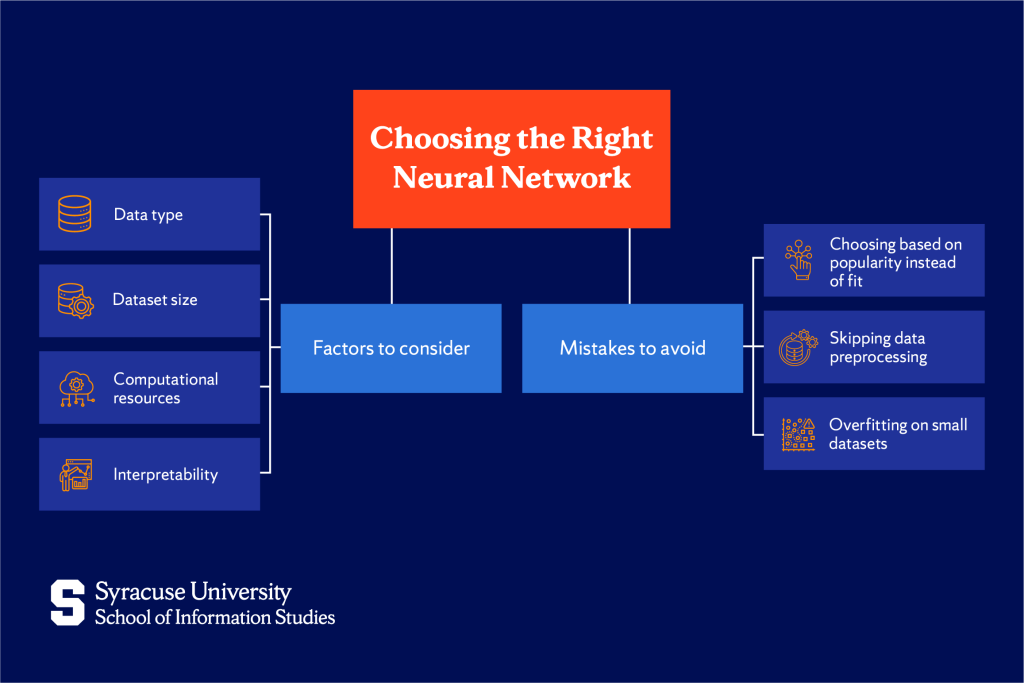
Factors to consider
Making a choice starts with understanding the limits and needs of your problem. A few practical factors will quickly narrow down what will actually work.
- Data type: The kind of data you’re working with is often the clearest starting point. Image data usually points toward CNNs, while text or time-based sequences are better handled by LSTMs or Transformers. Structured, tabular data tends to work well with simpler models like MLPs.
- Dataset size: Some architectures need far more data than others to perform well. Transformers, for example, typically require very large datasets to learn effectively, while models like RBF networks can still perform well with smaller amounts of data. Choosing a model that matches your data volume helps avoid underperformance.
- Computational resources: The hardware you have available can limit what is practical. Complex models often require GPUs and long training times, while simpler architectures can run efficiently on standard machines. If resources are limited, a lighter model may be the better choice.
- Interpretability: In some cases, it’s important to understand and explain how a model makes decisions. Simpler models are generally easier to interpret, which can matter in fields like healthcare or finance. More complex architectures may offer higher performance, but they can be harder to explain to non-technical stakeholders.
Common mistakes to avoid
Avoiding common mistakes can save time and prevent models from underperforming, even when the architecture itself is sound.
- Choosing based on popularity instead of fit: It’s easy to reach for well-known models like Transformers, even when they are not the best match for the problem. In many cases, a simpler model such as an MLP can deliver similar results with less data and faster training. The focus should always be on what fits the task, not what is most widely used.
- Skipping data preprocessing: No architecture can compensate for poor-quality data. If the dataset is unclean, incomplete, or unbalanced, the model will struggle regardless of how advanced it is. Taking the time to prepare and validate your data is a necessary step.
- Overfitting on small datasets: Deep networks are especially prone to overfitting when trained on limited data. The model may perform well on training data but fail to generalize to new inputs. Techniques like dropout, regularization, and early stopping can help, but they require careful monitoring of validation performance during training.
The Bottom Line
The different types of neural networks aren’t competing alternatives. They’re specialized tools, each developed to address a specific kind of challenge in AI. Understanding what each architecture is built for puts you in a much stronger position than simply knowing how to run one. As AI systems grow more capable and more embedded in everyday applications, this kind of architectural literacy is increasingly valuable.
If you want to build a foundation that prepares you to work with these systems professionally, Syracuse University’s iSchool offers two strong options. The Integrative Artificial Intelligence Bachelor’s Degree focuses on programming, mathematics, AI systems, ethics, governance, human-centered design, and applying AI in another field through a required minor. The Applied Human-Centered Artificial Intelligence Master’s Degree helps graduate students develop stronger skills in applied AI projects, deep learning, natural language processing, responsible AI, human-AI interaction, and portfolio development for professional practice.
Frequently Asked Questions (FAQs)
What are the most common types of neural networks?
The most widely used architectures are feedforward neural networks, CNNs, RNNs, LSTMs, and Transformers. CNNs dominate image-related tasks, while Transformers have become the standard for natural language processing. For general-purpose prediction on structured data, MLPs remain a practical and reliable choice.
Which neural network is best for image processing?
Convolutional neural networks (CNNs) are the standard choice for image processing. Their convolutional layers are specifically designed to detect spatial features like edges and shapes, and they do so efficiently by sharing parameters across the input. For most image classification, detection, or segmentation tasks, a CNN will outperform other architectures.
What is the difference between CNN and RNN?
CNNs are designed for spatial data; they process inputs as grids and detect local patterns using filters. RNNs are designed for sequential data; they process inputs one step at a time and use feedback loops to retain information across steps. CNNs work best for images; RNNs work best for text, speech, or time-series data where order matters.
Are neural networks hard to learn?
The concepts behind neural networks are accessible with a solid foundation in math and programming, particularly linear algebra, calculus, and Python. The bigger challenge is building intuition for how different architectures behave, which comes with practice. Many people start with FNNs and MLPs before moving into CNNs and sequence models, building complexity gradually rather than all at once.