
Key Takeaways
- Librarians are service-oriented professionals who help communities access published and continuously updated information resources.
- Archivists are preservation specialists who safeguard and organize unique primary sources such as records, manuscripts, and historical documents.
- The difference between an archivist and a librarian lies mainly in the type of materials they manage and the professional frameworks used to organize and preserve them.
- Both careers typically require a graduate degree in library and information science or a closely related field.
Libraries and archives often appear side by side in conversations about information management. The two professions share a commitment to preserving knowledge and maintaining organized systems that make information accessible. At first glance, the distinction can seem subtle, which is why the comparison between archivist vs librarian frequently raises questions for students considering careers in this field.
What Does a Librarian Do?
A librarian manages collections of published materials and helps people find and use information. These collections include books, academic journals, digital databases, multimedia resources, and other materials that are regularly updated or replaced. The role centers on access and guidance, which means librarians spend a large portion of their time working directly with students, researchers, or members of the public.
Daily work for librarians often includes:
- Helping people with research questions, guiding them toward reliable sources and relevant materials.
- Teaching information literacy, which involves showing students or community members how to evaluate sources and identify misinformation.
- Organizing community programs, such as reading groups, workshops, or educational events.
- Maintaining the collection, including removing outdated or damaged materials so the catalogue stays accurate and useful.
- Managing digital resources, such as online journals, databases, and electronic books.
Librarians often specialize depending on where they work:
- Public librarians serve local communities in city or regional libraries.
- Academic librarians support research and teaching at universities and colleges.
- School librarians work in primary or secondary schools and often collaborate with teachers.
- Special librarians manage information collections within organizations such as hospitals, law firms, corporations, or government agencies.
What Does an Archivist Do?
An archivist works with historical records that are unique and irreplaceable. Unlike librarians, who manage collections of published materials, archivists preserve original documents and primary sources. These might include letters, institutional records, photographs, manuscripts, audio recordings, film footage, or digital files created by organizations and individuals.
Two core principles guide archival work:
- Provenance: Records remain grouped according to the person or organization that created them so their historical context stays intact.
- Original order: Archivists preserve the arrangement in which records were originally organized because that structure often contains important information.
Typical responsibilities for archivists include:
- Evaluating records to determine which materials should be preserved for long-term historical value.
- Preserving collections by controlling environmental conditions and coordinating digitization projects.
- Creating finding aids, detailed descriptions that help researchers locate specific documents within large collections.
- Processing new collections by organizing and cataloging materials after they are acquired.
Archivists may also focus on specific areas of work. Some manage digital archives containing electronic records. Others preserve the historical documents of companies, museums, universities, or government institutions.
Education and Certification Paths
Both professions usually require graduate-level education, and the academic routes often overlap. Many professionals begin with a program in library and information science, which provides training that applies to both fields.
Librarian Requirements
Most librarians hold a Master of Library and Information Science (MLIS) from a program accredited by the American Library Association (ALA). These programs focus on how information is organized, accessed, and used.
Coursework typically covers research methods, cataloging systems, collection development, digital information tools, and user services.
School librarians may need additional credentials depending on the country or state where they work. In many cases, this includes a teaching license or education certification.
The Master of Library and Information Science program at the Syracuse University School of Information Studies prepares students for this role through a 36-credit curriculum that combines core training in information organization, reference services, and library leadership with flexible electives. The program can be completed in about one to two years and is available both on campus and online.
Archivist Requirements
Archivists commonly hold a master’s degree in archival science, history, or library and information science with an archival concentration. Many employers also recognize the Certified Archivist (CA) credential issued by the Academy of Certified Archivists. This certification requires professional experience and passing a standardized examination.
Students pursuing the MLIS at Syracuse University do have the option to choose professional pathways such as archives and special collections, digital curation, user services and community engagement, or digital information systems. This structure allows graduates to prepare for traditional library roles while developing expertise in emerging information environments, including archival work.
Essential Skills and Personality Traits
Discussions about archivists and librarians often start with the same stereotype: the quiet professional working alone among shelves and documents. The image appears in popular culture so often that it has become shorthand for both careers. In reality, it only captures a small part of the work.
Both librarians and archivists rely on strong organizational thinking, research skills, and careful attention to information systems. Yet the daily responsibilities attached to each role call for different strengths. Looking at the professional skill profiles helps clarify where the two paths begin to diverge.
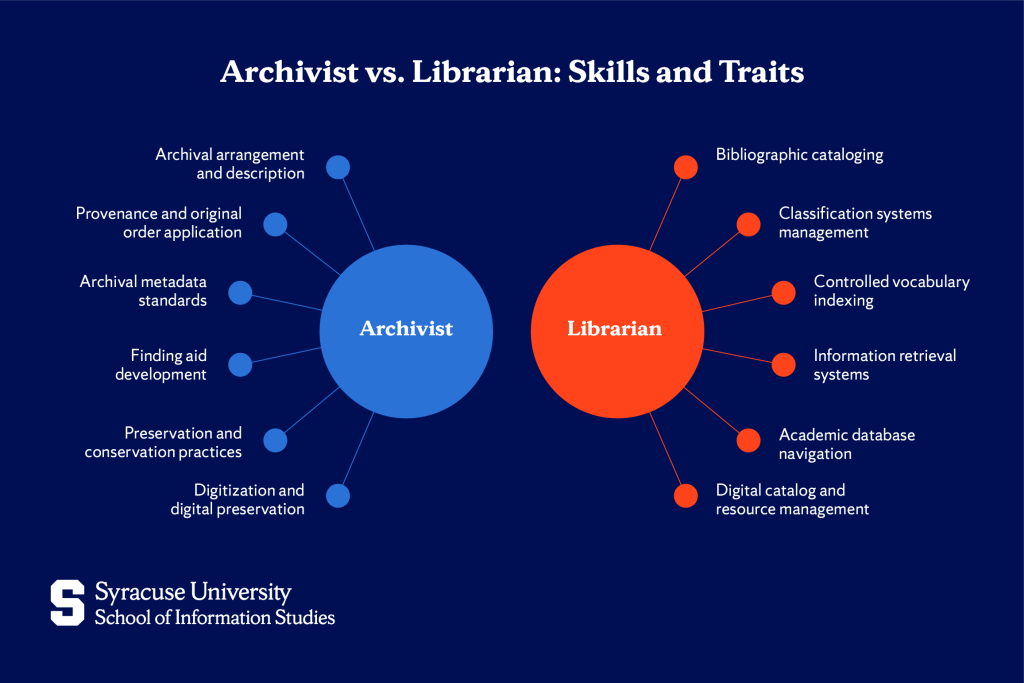
The Librarian profile
Librarians develop strong capabilities in information organization and retrieval systems. Their training centers on describing and indexing published materials so they can be discovered quickly across large collections.
A key professional skill is bibliographic cataloging, which requires proficiency with metadata frameworks such as MARC records and Resource Description and Access (RDA). Librarians must also work with controlled vocabularies, including Library of Congress Subject Headings, to ensure materials are indexed consistently across library networks.
Another defining capability is classification system management. Librarians organize collections using systems such as the Dewey Decimal Classification or the Library of Congress Classification, which requires the ability to interpret subjects, assign appropriate call numbers, and structure collections for efficient browsing and discovery.
Modern librarianship also demands strong information system literacy. Professionals must understand how search platforms, academic databases, and digital catalogs function, allowing them to optimize discoverability and maintain reliable access to electronic resources.
The Archivist profile
Archivists develop expertise in archival description, preservation frameworks, and record structure analysis. Their professional capabilities focus on maintaining the context and integrity of unique historical records.
One central skill is archival arrangement and description, which requires applying the principles of provenance and original order. These concepts guide how records are structured and documented so that their historical context remains intact.
Archivists also work with archival metadata standards. This includes proficiency with Describing Archives: A Content Standard (DACS) and digital encoding systems such as Encoded Archival Description (EAD), which allow archival collections to be documented and searched in online systems.
Another important capability is preservation literacy. Archivists must understand environmental control, conservation practices, and digitization standards used to stabilize fragile materials and maintain long-term accessibility for research.
Work Environment, Salary, and Job Outlook
The working atmosphere in these professions differs noticeably, even though both revolve around managing and preserving information.
Librarians often work in environments that function as active public spaces. The pace tends to be dynamic, with steady foot traffic, scheduled programming, and frequent interaction with students, researchers, or community members. Workdays may include assisting users, supporting group activities, or managing busy service desks during peak hours. Because these environments remain open to accommodate public access, schedules can include evenings, weekends, or holiday hours depending on the institution.
Archivists typically operate in quieter and more controlled environments designed to protect historical records. Many archival spaces are climate-regulated to preserve fragile materials, which often means low lighting and limited exposure to outside conditions. The pace of work is generally slower and more research-oriented. Extended periods of focused analysis or documentation are common, and walk-in interactions tend to be less frequent than in library settings.
Work schedules also differ slightly. Librarians frequently work evenings or weekends to support public access and programming. School librarians often follow academic calendars, which can include summer breaks. Archivists working in government agencies or corporate archives generally follow standard business hours, though museum-related positions may involve occasional evening or weekend work.
Differences appear in compensation patterns as well. According to the U.S. Bureau of Labor Statistics, the median annual wage for librarians and library media specialists is $64,320. Archivists fall within the broader category of archivists, curators, and museum workers. The median annual wage for archivists specifically is estimated to be $61,570, while the overall category reported a median of $57,100.
Employment projections show modest but steady demand for both fields. The U.S. Bureau of Labor Statistics projects employment for librarians and library media specialists to grow 2 percent from 2024 to 2034, which is slower than the average across all occupations. Even so, about 13,500 openings are expected each year, largely due to retirements and workforce turnover.
Employment for archivists, curators, and museum workers is projected to grow 6 percent from 2024 to 2034, slightly faster than the average for all occupations. On average, about 4,800 openings are expected annually in this broader category over the same period.
Conclusion: Making Your Choice
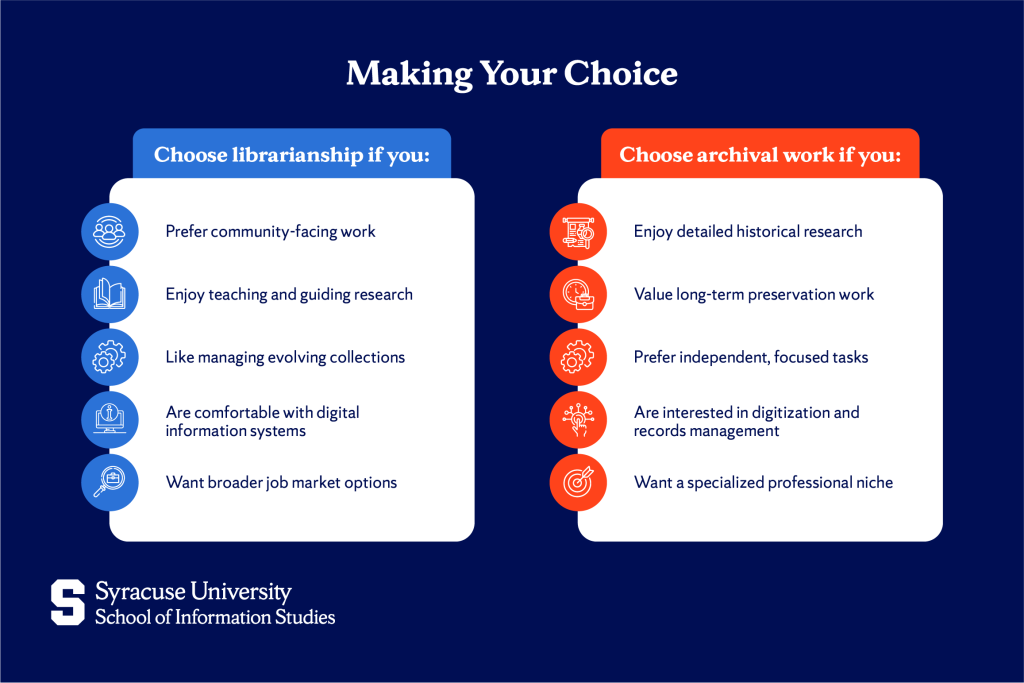
Both careers offer meaningful, intellectually rich work in the information professions. The right choice comes down to how you want to spend your days and what kind of problems you want to solve. Librarianship suits those drawn to working with people, teaching research skills, and managing active information collections, while archival work appeals to those who prefer careful, methodical work preserving and documenting unique historical records over long periods of time.
Either way, a strong graduate program is required to set the foundation. The MLIS program at the Syracuse University School of Information Studies prepares students with the core competencies needed across the information profession, making it a strong option for those considering careers in either librarianship or archival work.
Frequently Asked Questions
Can you be an archivist with a library degree?
Yes. An MLIS with an archival concentration is one of the most common paths into the profession, especially when paired with internship experience and the Certified Archivist credential.
Do archivists make more than librarians?
Generally, no. The BLS reports a median salary of $64,320 for librarians, compared with $61,570 for archivists, though senior archivists in government or corporate roles can earn comparable or higher pay.
Is it hard to get a job as an archivist?
The field is competitive. There are roughly 4,800 projected openings per year, so candidates benefit from specialized digital skills, internship experience, and professional certification.