
Key Takeaways
- The best data science projects are the ones you can complete, explain, and present clearly.
- Data science projects should be chosen based on skill level, available data, and career relevance.
- Beginner data science projects should focus on clean workflows; intermediate projects on better decision-making; advanced projects on originality and real-world constraints.
- Use-case categories, like predictive modeling, NLP, recommendation systems, time series, and analytics, help you match data science projects to actual job functions.
You likely already understand the importance of including data science projects in your portfolio. The more difficult task is identifying which projects are worth your time and effort. This piece presents a structured selection of data science project ideas, organized by skill level and practical use case, so you can choose work that aligns with your current abilities while contributing to a strong, credible portfolio.
The focus remains consistent throughout: projects that support meaningful learning and demonstrate your ability to apply concepts in a practical context.
Why Data Science Projects Matter
Projects are how you close the gap between knowing concepts and showing you can use them. Employers assessing candidates for data science roles look for more than formal qualifications. They expect clear evidence that you can define a problem, analyze it using data, and produce meaningful outcomes. That’s what a well-executed project does.
Projects also support the development of practical skills that structured learning often does not fully address. This includes working with incomplete or inconsistent data, making informed decisions when results are unclear, and explaining findings to individuals who were not involved in the analysis process. These capabilities tend to become visible during interviews and remain essential in professional settings.
What Makes a Data Science Project Worth Building
Not every project justifies the time and effort it requires. Strong projects tend to share several defining characteristics, regardless of experience level.
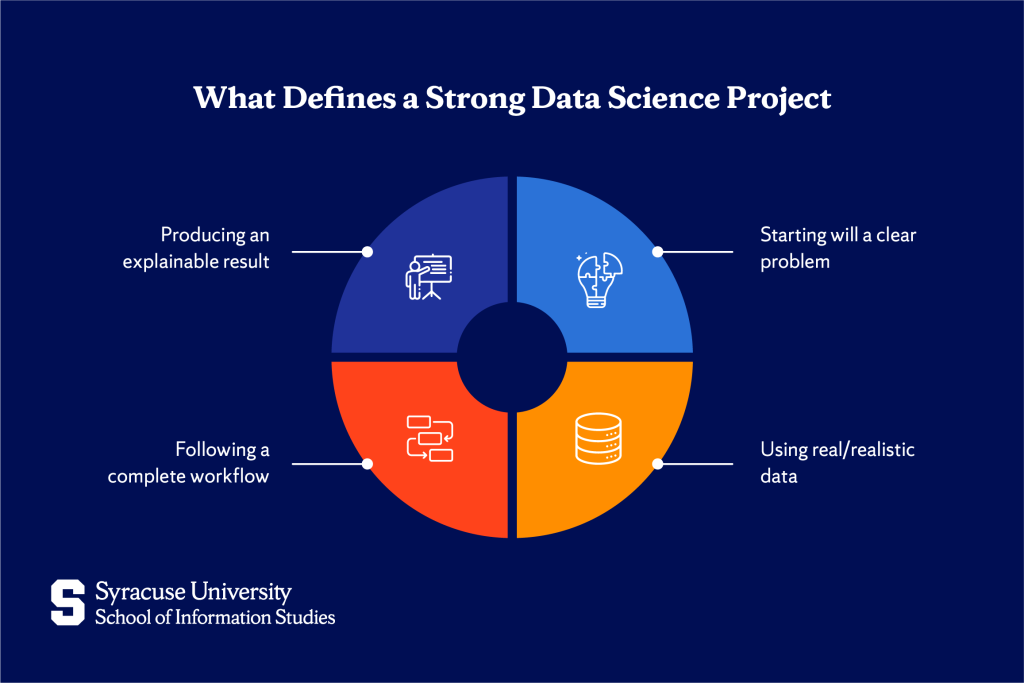
- They start with a clear problem: Broad or loosely defined goals often lead to unclear outcomes. A focused question, such as identifying which product categories contribute most to repeat purchases, creates direction and makes the results easier to interpret and communicate.
- They use real or realistic data: While simplified datasets are useful for learning, portfolio projects benefit from data that reflects real conditions, including missing values, inconsistent formats, and unclear variables. Addressing these issues is part of the analytical process and strengthens the credibility of the work.
- They follow a complete workflow: A complete workflow is essential. A project that presents only a final model or output remains incomplete. Strong work demonstrates the full process, including data sourcing, preparation, exploration, analysis or modeling, evaluation, and a well-defined conclusion. This end-to-end structure reflects how data problems are approached in practice.
- They produce an explainable result: If the findings cannot be communicated in straightforward terms, the project is not yet suitable for a portfolio. Clarity allows others to understand both the outcome and its relevance, which is a critical expectation in professional contexts.
How to Choose the Right Data Science Project
Before you pick a project idea, it is useful to consider a few practical questions. What’s your current skill level? How much time can you realistically commit? What tools are you already comfortable with, and which ones are you willing to learn as you go?
Aligning the scope of a project with your skill level is critical. Projects that are too complex often remain unfinished, which limits their value. In contrast, a smaller project that is completed with clear reasoning and careful execution provides stronger evidence of ability. It is also helpful to understand the demands of tasks such as data wrangling before committing to projects that involve extensive cleaning and transformation, as these stages can require significant time and attention.
Interest in the subject area should also be taken into account. Projects built around topics that hold your attention are more likely to be completed and refined. When the domain feels disconnected from your interests, maintaining consistency becomes more difficult, which can affect both the quality and completion of the work.
Beginner Data Science Projects
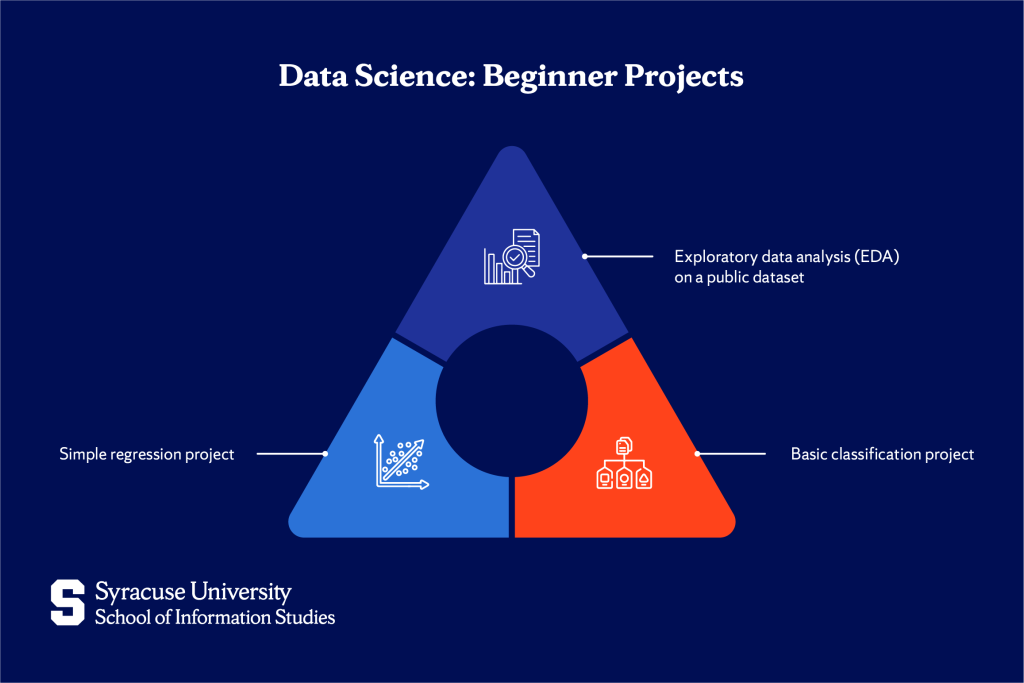
Beginner projects should prioritize one objective: completing a full and coherent workflow without unnecessary complexity. The aim is not to produce an advanced model, but to demonstrate the ability to move from raw data to a meaningful insight or prediction, with clear reasoning at each stage.
Good starting points include:
- Exploratory data analysis (EDA) on a public dataset: Pick a dataset from Kaggle or the UCI Machine Learning Repository and document what you find: distributions, missing values, outliers, and relationships between variables. This process forms the basis of data analysis and supports effective data visualization, yet it is often underdeveloped in early portfolios.
- Basic classification project: Build a model that predicts a binary outcome, such as whether an email is spam or not, whether a customer is retained or lost, or whether an application is approved or denied. Models such as logistic regression or decision trees are appropriate at this stage, provided the evaluation is handled correctly using a separate test set, and the results are clearly interpreted.
- Simple regression project: Predict a continuous value like housing prices or energy consumption using publicly available data. Focus on feature selection, model evaluation, and interpretation over tuning.
The scope should remain focused throughout. A project that answers a single, well-defined question with clarity is more effective than one that attempts multiple objectives and lacks consistency.
Intermediate Data Science Projects
Intermediate projects place greater emphasis on decision-making rather than added complexity. At this level, you should be making deliberate choices about feature development, evaluation metrics, and how to frame results for a business context.
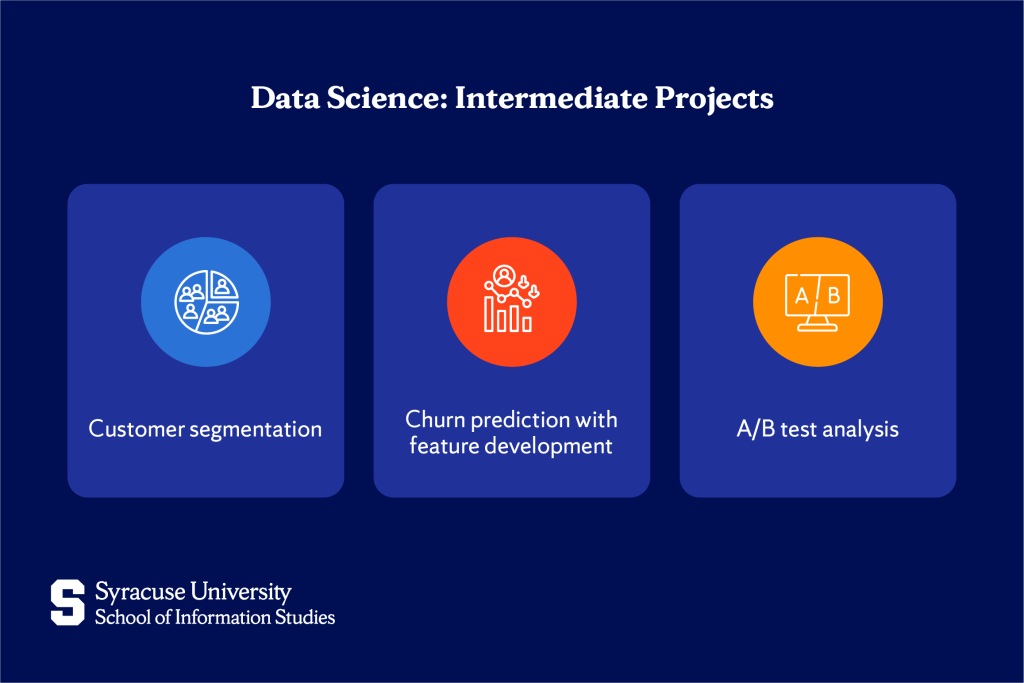
Strong intermediate project directions include:
- Customer segmentation: Use clustering to group customers by behavior or attributes, then describe what each segment means and how a business might act on it. The insight matters more than the algorithm.
- Churn prediction with feature development: Move beyond raw variables to construct features that better capture underlying patterns, address class imbalance carefully, and choose evaluation metrics that reflect the practical cost of incorrect predictions.
- A/B test analysis: Take a dataset from a real or simulated experiment and work through the statistical analysis properly, including determining whether observed differences are statistically significant and how those findings should be interpreted.
At this level, statistical modeling becomes more central. The ability to justify methodological choices and explain why a particular approach was selected distinguishes intermediate work from earlier stages.
Advanced Data Science Projects
Advanced projects are defined by originality, practical constraints, and an awareness of how models function outside controlled environments. At this stage, the focus moves from building a model to evaluating whether it performs reliably in real conditions.
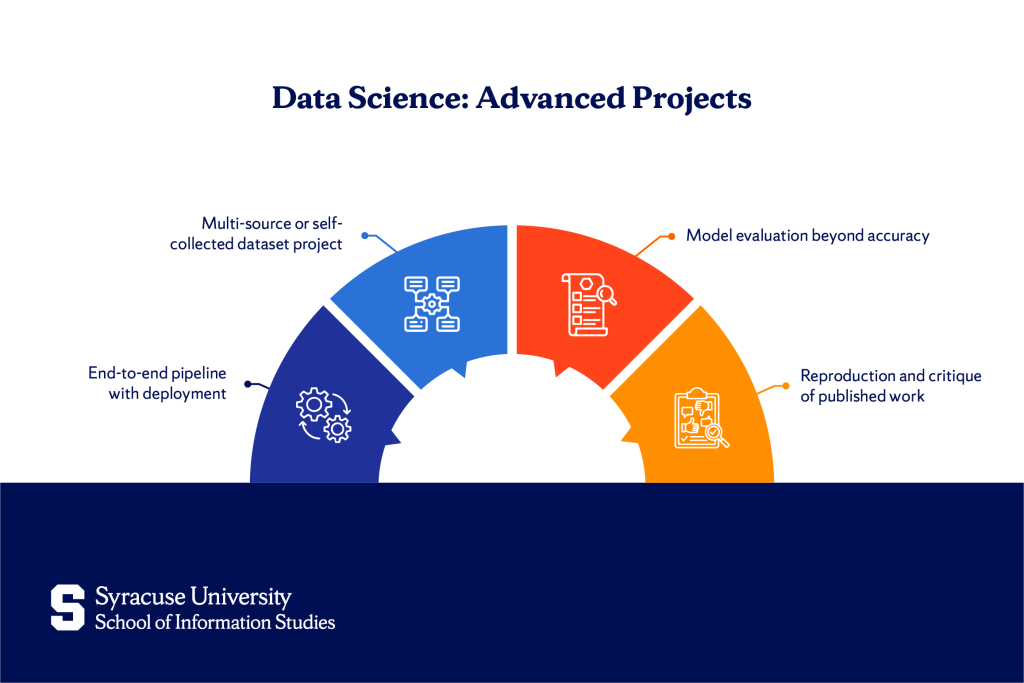
These projects often involve large, complex, or combined datasets that require careful preprocessing decisions. Evaluation also becomes more rigorous. Accuracy alone is not sufficient; considerations such as fairness, robustness, and performance across different groups become relevant. They also account for how a model would behave outside the notebook, including how it responds to changes in data and how its outputs can be explained to non-technical stakeholders.
Project ideas at this level might include end-to-end pipelines that go from raw data ingestion to a shareable output or basic deployment, original datasets you collect or combine yourself, or projects that reproduce and critique findings from published research. A deeper understanding of machine learning, including its limitations, supports more thoughtful project design and evaluation.
It is important to maintain a defined scope. A project that is clearly structured, thoroughly executed, and carefully evaluated provides stronger evidence of ability than one that attempts too much without achieving depth.
Data Science Project Types by Use Case
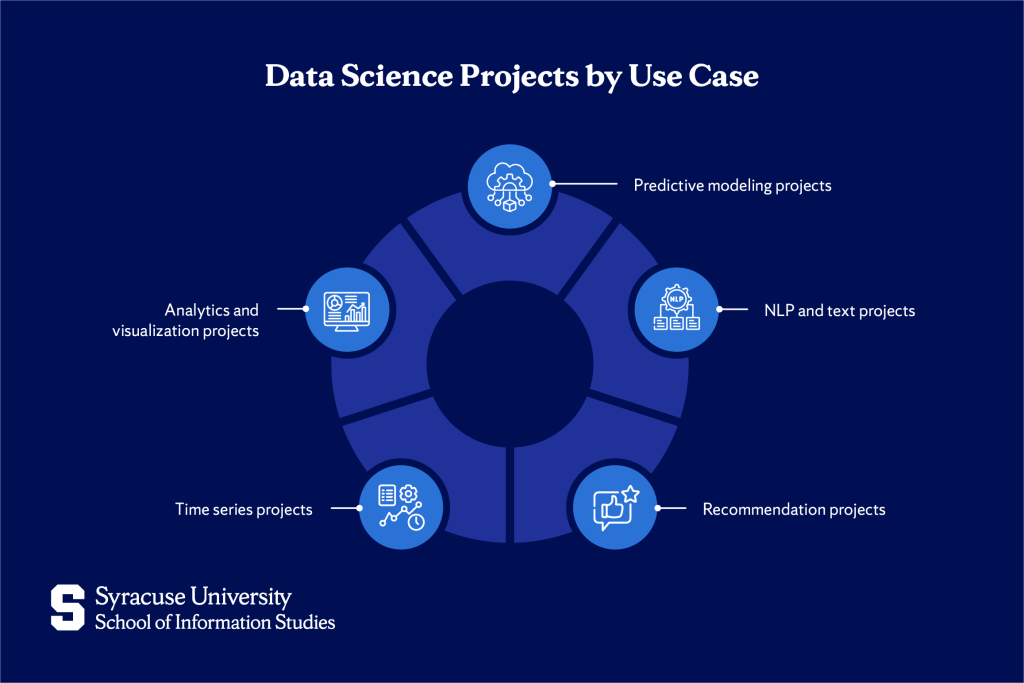
Skill level determines the appropriate level of challenge, while use case provides direction. These categories align with actual job functions, so selecting a use case that matches your career goals increases the relevance of your work to recruiters in that area.
Predictive modeling projects
Classification and regression problems form the core of applied data science. Churn prediction, fraud detection, credit scoring, and demand forecasting all fall here. The strength of a predictive analytics project lies in how well you frame the business problem, choose your evaluation criteria, and communicate the model’s performance (both its strengths and its limitations).
NLP and text projects
Sentiment analysis, topic modeling, text classification, and named entity extraction are all strong portfolio projects because they show you can work with unstructured data. The challenge with NLP projects is evaluation: metrics like accuracy can be misleading, so demonstrating that you understand precision, recall, and domain-specific context strengthens the credibility of the work.
Recommendation projects
Recommendation systems show up in e-commerce, streaming, hiring, and content platforms. Building a basic collaborative filtering or content-based recommender, and being able to explain the trade-offs between approaches, demonstrates applied thinking that’s directly relevant to product and platform roles.
Time series projects
Forecasting energy demand, predicting website traffic, and modeling seasonal sales patterns all depend on handling time-based data correctly. The quality of a time series project is largely determined by its validation approach. Models should be trained on historical data and tested on future observations, rather than using randomly shuffled splits that ignore the sequence of time.
Analytics and visualization projects
Not every strong data science project involves a machine learning model. An analytics-focused project that works with a complex dataset, addresses a clearly defined business question, and presents results in a format suitable for stakeholders demonstrates skills that are highly valued, particularly in analyst and business intelligence roles. Effective data visualization can strengthen a project significantly, often providing more value than a model that is not clearly explained.
How to Turn a Project Into a Portfolio Asset
Completing a project is only the first stage. Preparing it for a portfolio requires additional refinement, and this step has a direct impact on how the work is received.
The repository should be clear and functional. Code needs to be organized, properly documented, and reproducible. Anyone who accesses the project should be able to run it without resolving missing dependencies or guessing what your variables mean. A well-structured README is essential, outlining the problem, the approach taken, and the main findings.
Decisions should also be explicitly documented. Why did you choose that model? Why did you drop those features? Showing your reasoning is as important as showing your results. It’s what separates a portfolio project from a homework assignment.
The presentation of results should begin with the main outcome and its relevance. A concise statement of what was found and why it matters ensures that the key message is immediately clear, which is important given how quickly hiring managers review project work.
Common Mistakes to Avoid
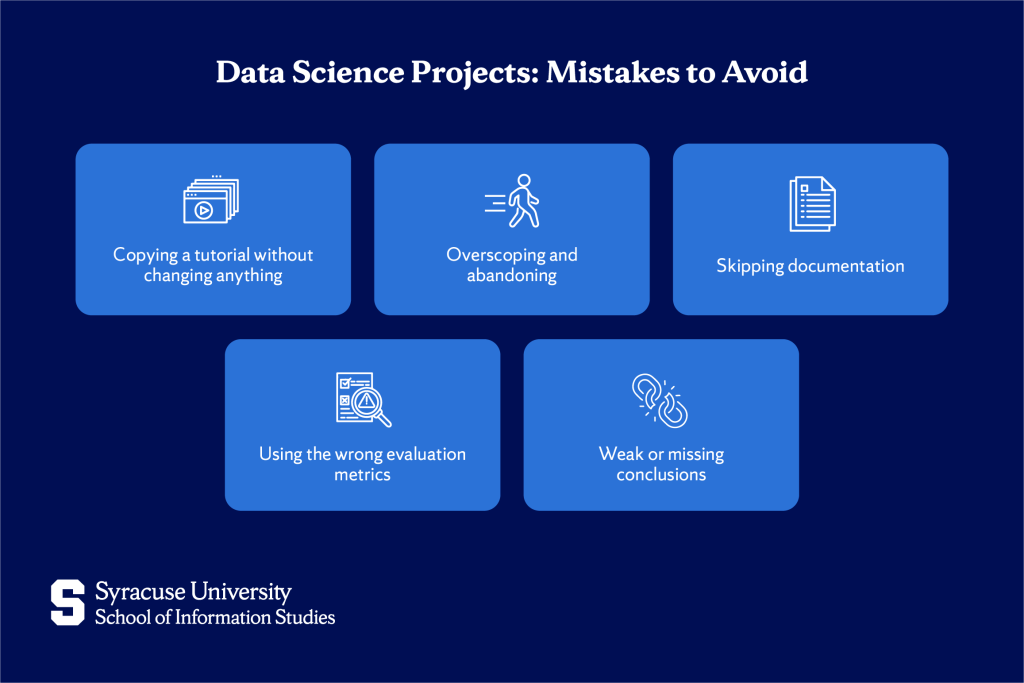
Several recurring issues can reduce the impact of otherwise solid projects.
- Copying a tutorial without changing anything: Well-known examples, such as datasets hosted on Kaggle, are widely used, and reviewers are familiar with standard approaches. If you use a common dataset, you need a differentiated angle: a different question, a deeper analysis, or a meaningful extension.
- Overscoping and abandoning: An unfinished project with ambitious goals is worth less than a finished project with modest ones. Establishing realistic boundaries at the outset supports better outcomes.
- Skipping documentation: A notebook full of code with no explanations signals that you can execute instructions but may not fully understand what you built. Write for the person reviewing your work, ensuring that each step and decision is understandable.
- Using the wrong evaluation metrics: For example, reporting accuracy in an imbalanced classification problem without addressing the imbalance indicates a lack of critical assessment. Metrics should be selected and interpreted in relation to the specific problem.
- Weak or missing conclusions: Every project should end with a clear statement of what you found, an acknowledgment of limitations, and an indication of potential next steps. If the work concludes without interpretation, it remains incomplete.
The Bottom Line
Strong data science projects are not defined by model complexity. Their value lies in the quality of the question, the integrity of the analysis, and the clarity with which the results are explained. This combination of rigor and clear communication is what employers look for when reviewing portfolios.
Pick a project that matches your current level, finish it completely, and document it well. Then do the next one. That progression, more than any single impressive idea, is what builds a portfolio worth showing.
If you want a more structured approach, programs such as the Applied Data Science Bachelor’s Degree or the Master of Applied Data Science at Syracuse University’s iSchool provide project-based learning alongside training that reflects industry expectations.
Frequently Asked Questions (FAQs)
Where can I find unique datasets for my projects?
Beyond Kaggle and UCI, try Google Dataset Search, data.gov, the World Bank Open Data portal, or APIs from platforms like the Census Bureau, Twitter, or Spotify. Less-used sources tend to produce more differentiated projects.
How long should a portfolio project take to complete?
A focused beginner project can be completed within one to two weeks, while intermediate and advanced projects often require three to six weeks. Defining a clear and limited scope from the outset is one of the most effective ways to sustain progress and develop practical data science skills through project work.
Should I use Python or R for my data science portfolio?
Python is the safer default for most job markets, particularly in tech and product roles. R is still valued in research, academia, and certain analytics-heavy industries. If you’re targeting a specific role, look at the job postings you want and match your tool choice to what they list.
Is it okay to use AI tools like ChatGPT to write my project code?
Using AI tools to assist with code is increasingly common and generally acceptable, but you need to understand everything in your project. If you can’t explain a line of code in an interview, don’t include it. Use AI tools to move faster, not to skip understanding.