
Key Takeaways
- A data scientist spends 60–80% of the time collecting, cleaning, and preparing data.
- EDA helps data scientists figure out which questions are worth answering and which models could work.
- Data scientists prototype models and generate insights; ML engineers take those prototypes and turn them into scalable, production-grade systems.
- The traditional route to becoming a data scientist begins with a bachelor’s degree in computer science, statistics, mathematics, or a related field. Alternative paths include bootcamps, online certifications, and self-study.
You’ve probably heard people call data scientists “AI wizards” or even “the most in-demand job of the 21st century.” But what does a data scientist actually do between their morning coffee and end-of-day stand-up?
The truth is messier and more interesting than the hype suggests. “Data scientist” has become a broad title that means different things depending on the company, the industry, and how advanced their data use is. What you see in a job posting often doesn’t match what happens day to day.
What’s behind the title might surprise you, and it’s worth taking a closer look.
After gathering these insights, the analyst presents their findings using charts or reports, ensuring the information is easy for others to understand. This enables decision-makers to quickly see which products are worth focusing on and which might need adjustments. The data analyst’s role is crucial because it helps the company identify successful strategies and areas for improvement.
One of the most commonly used tools by data analysts is Excel because it is great for smaller datasets and has features like charts and graphs that make it easier to see patterns and understand the data. When the data gets larger or more complex, SQL may be used. If the analysts decide to conduct a more advanced analysis, Python and R can also be quite useful for statistical and predictive modeling.
In all cases, tools like Google Analytics help track how websites are performing and analyze user behavior, while Hadoop is used for processing huge datasets, especially when handling large amounts of data, also known as big data.
Once they have the results, data analysts can use tools like Tableau and Power BI to present them in a more interactive and easy-to-understand way, even for other teams not necessarily familiar with data analysis.
Why Is “Data Scientist” Such a Confusing Title?
If you’ve looked at job boards recently, you’ve probably noticed that “data scientist” can mean anything from Excel-heavy analyst work to advanced machine learning research.
The confusion stems from three main factors:
- Company maturity. A data scientist at a startup might wear multiple hats, building dashboards, writing SQL queries, and occasionally training a model. At a tech giant like Amazon, the same title could mean working only on deep learning for recommendation systems while other teams manage infrastructure.
- Industry context. In finance, the focus might be on risk modeling and regulatory reports. In e-commerce, it’s product recommendations and conversion funnels. In healthcare, it’s handling sensitive patient data and clinical trials. Same title, completely different workday.
- HR job postings. Descriptions often list every possible skill and responsibility to cast a wide net. You’ll see requirements like “expert in Python, R, SQL, Spark, TensorFlow, and cloud platforms”, but the actual role might focus on just two or three of those tools.
The takeaway: two “data scientist” jobs can look nothing alike. Knowing how to read between the lines makes all the difference.
What a Data Scientist Actually Does
The popular image of data science often emphasizes flashy technology and abstract algorithms. In practice, the work is far more grounded and often more compelling. Here’s what the day-to-day role looks like, based on the experiences of professionals in the field.
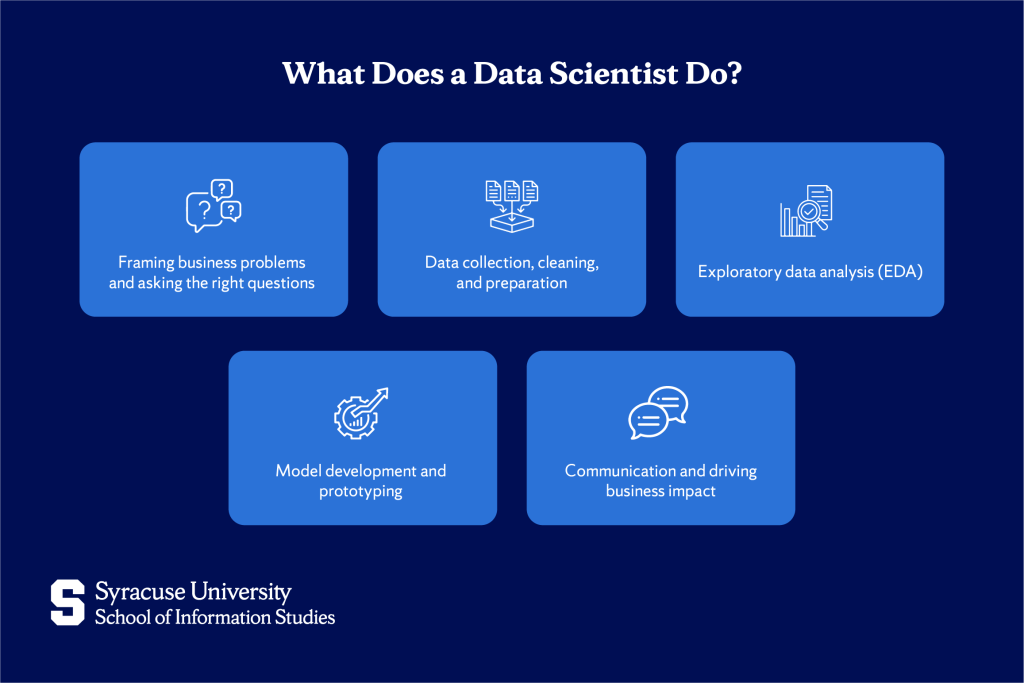
Framing business problems and asking the right questions
Before touching any data, you need to understand what problem you’re solving. A stakeholder might say, “We’re losing customers”—but that’s not a data question yet.
Does “losing customers” mean higher churn, fewer repeat purchases, or a drop in engagement? By collaborating with product managers, marketers, or executives, you’ll define success metrics and scope out what’s realistic with the data on hand.
This problem-framing phase determines whether your analysis drives real business impact or ends up as a forgotten slide deck.
Data collection, cleaning, and preparation
Here’s the part nobody talks about in data science bootcamp ads: you’ll spend 60–80% of your time on this step.
Real-world data is messy. Fields are misspelled. Timestamps are wrong. Customer IDs don’t match across systems. Before you can analyze anything, you need to:
- Write SQL queries to pull data from multiple databases
- Build ETL pipelines that automatically extract, transform, and load data
- Handle missing values—decide whether to fill, drop, or flag them
- Standardize formats so dates, currencies, and categories align
This isn’t glamorous work, but it’s non-negotiable. A model is only as good as the data feeding it. Get this wrong, and everything downstream is compromised.
Exploratory data analysis (EDA)
This is your detective phase. You’re looking for patterns, anomalies, and stories hidden in the numbers.
During EDA, you might:
- Identify trends and correlations using statistical tests
- Create visualizations (histograms, scatter plots, heatmaps) to spot relationships
- Build dashboards in tools like Tableau or Power BI so stakeholders can explore data themselves
EDA helps you figure out which questions are worth answering and which models could work. It’s both art and science: statistical rigor plus the instinct to notice when something doesn’t look right.
Model development and prototyping
This is the part most outsiders imagine, but it often takes less time than expected, especially in analytics-heavy roles.
When you do build models, the process looks like this:
- Choose the right algorithm based on your problem (regression, classification, clustering, etc.)
- Train the model using historical data
- Test performance on data the model hasn’t seen before
- Iterate and refine to improve accuracy
Common tools include Python libraries like Scikit-learn, TensorFlow, or PyTorch. But here’s the reality check: many data scientists spend more time validating and tweaking models than creating them from scratch.
And if you’re in a smaller company or analytics-focused role, you might build models only occasionally, spending more time on reporting and descriptive analysis instead.
Syracuse University’s Applied Data Science Bachelor’s Degree prepares students for this balance, combining hands-on projects with consulting opportunities at global companies to mirror real-world workflows.
Communication and driving business impact
Data only matters if people act on it. That means translating complexity into clarity.
Expect to:
- Build presentations that tell a story, not just show charts
- Write reports highlighting key takeaways and recommendations
- Explain trade-offs (e.g., “This model is 85% accurate, but it takes longer to run”)
- Answer executive questions quickly and confidently in meetings
Your insights have value only when they influence decisions. That’s why communication is as critical as coding, and why so many job descriptions emphasize “storytelling” skills.
Mia Perry ’24, a Syracuse iSchool alumna and now consultant at CohnReznick, describes it this way:
“Pivoting to an iSchool education opened new pathways for success. In my new role, I bridge creativity and technical expertise to deliver impactful solutions.”
The Essential Data Scientist Skillset
If you’re considering a career in data science, you need the right mix of technical expertise and business skills.
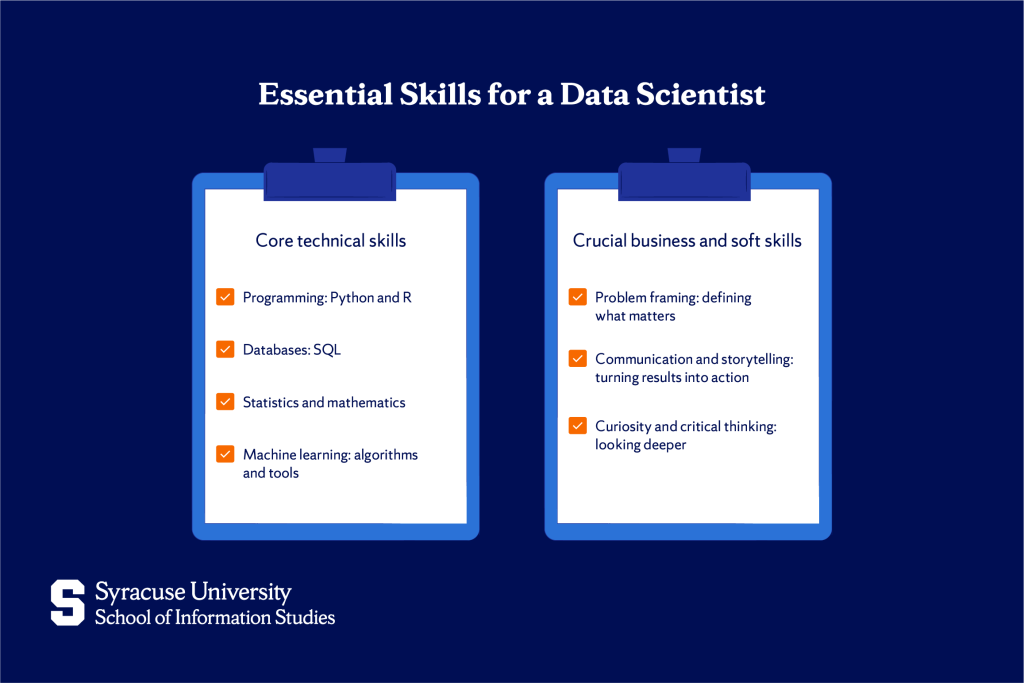
Core technical skills
Success in data science starts with a strong technical foundation. These are the tools and concepts you’ll rely on every day:
- Programming: Python and R
Python dominates the field thanks to its versatility and powerful libraries like Pandas, NumPy, and Scikit-learn. R still has a strong presence in academic and research settings, especially for statistical modeling. - Databases: SQL is indispensable
SQL is part of daily life for data scientists, used to query databases, join tables, and extract relevant data. - Statistics and mathematics: the foundation of analysis
A solid grasp of probability, hypothesis testing, regression, and basic calculus is essential. These concepts are the backbone of both model building and result interpretation. - Machine learning: algorithms and tools
Familiarity with standard algorithms, such as linear regression, decision trees, and neural networks, paired with libraries like Scikit-learn or TensorFlow, equips you to build predictive models effectively.
Crucial business and soft skills
Technical knowledge only takes you so far. To make a lasting impact, you also need the ability to frame problems, communicate results, and think critically:
- Problem framing: defining what matters
Strong technical ability won’t help if you’re solving the wrong problem. Always ask: What decision will this analysis support? and How does it serve company goals? - Communication and storytelling: turning results into action
Executives don’t care about algorithms; they care about outcomes. Clear communication and strong storytelling ensure insights translate into business impact. - Curiosity and critical thinking: looking deeper
Asking Why is this happening? or What else could explain this? prevents flawed conclusions and drives better decisions.
At Syracuse University, the Master of Applied Data Science program develops both technical expertise and these crucial business skills. Through consulting projects, internships, and global experience requirements, students gain the perspective needed to succeed in fast-moving, cross-functional teams.
Data Scientist vs. Other Data Roles
Here’s a quick breakdown of the differences between a data scientist, a data analyst, and a machine learning engineer:
| Role | Primary Focus | Key Responsibilities |
|---|---|---|
| Data Scientist | Prediction and insight generation | Build models, analyze trends, communicate findings to stakeholders |
| Data Analyst | Describing what happened | Create reports, dashboards, and visualizations; answer specific business questions |
| Machine Learning Engineer | Building production-ready ML systems | Deploy models, optimize performance, handle scalability and infrastructure |
| Data Engineer | Infrastructure and data pipelines | Build ETL systems, manage databases, ensure data quality and availability |
Datast: Data analysts focus on what happened (descriptive analysis), while data scientists focus on what will happen (predictive modeling).
Data scientist vs. machine learning engineer: Data scientists prototype models and generate insights; ML engineers take those prototypes and turn them into scalable, production-grade systems.
Data scientist vs. data engineer: Data engineers build the pipelines and infrastructure that data scientists use. Think of engineers as the architects who lay the foundation, while scientists are the analysts who work on top of it.
In many organizations, these roles overlap, especially at startups, where “data scientist” might mean doing all of the above.
How to Become a Data Scientist and Grow
If you’re considering data science as a profession, here is a structured guide to building the knowledge and experience required.
Laying the foundation (education & knowledge)
The traditional route begins with a bachelor’s degree in computer science, statistics, mathematics, or a related field. Many professionals also pursue a master’s degree to deepen their expertise.
Alternative paths include bootcamps, online certifications, and self-study. However, you’ll need to prove your skills through projects, not just credentials.
Syracuse’s Certificate of Advanced Study (CAS) in Data Science offers a flexible option for professionals looking to upskill without committing to a full degree.
Building a practical project portfolio
Employers want proof of ability, not just coursework. A strong portfolio should highlight:
- Data cleaning and EDA on messy, real-world datasets (sources like Kaggle or data.gov are good starting points)
- Predictive modeling with clear business applications (e.g., churn prediction or sentiment analysis)
- Visualization skills using tools like Tableau, Matplotlib, or Plotly
- Code quality with well-documented GitHub repositories
Your portfolio should tell a story: “Here’s the problem, here’s how I approached it, and here’s the impact of the solution.”
Landing your first role and advancing
Many data scientists begin as analysts, honing SQL, Excel, and reporting skills before moving into modeling-focused roles.
Titles can be misleading. A “data scientist” at a startup might spend most of their time building dashboards, while a “senior analyst” at a large firm could be running complex machine learning models. Read descriptions closely and ask targeted questions during interviews.
Growth paths vary but may include senior data scientist, machine learning engineer, analytics manager, or specialized roles in fields such as healthcare, finance, or marketing.
The Bottom Line
Data science is fundamentally about solving real problems: working with messy data, identifying meaningful patterns, and presenting results in ways that inform decisions.
Although the job title can mean different things across industries, the essential skills remain consistent: strong problem-solving, technical fluency, and the ability to connect data with business outcomes. Whether you’re starting as an analyst or already comfortable with Python, the priority is building practical skills that deliver measurable value.
For those interested in pursuing this path, Syracuse University’s iSchool data science programs offer a strong foundation. With hands-on projects, global learning opportunities, and a collaborative community, they prepare students for careers where the impact of their work is clear and lasting.
Frequently Asked Questions (FAQs)
Is being a data scientist a difficult job?
Data science has a steep learning curve, especially if you’re new to programming or statistics. But it’s manageable with structured learning and hands-on practice; starting in an analyst role helps ease the transition.
What is the salary of a data scientist?
According to the U.S. Bureau of Labor Statistics, the median salary for data scientists exceeds $100,000 annually, with significant variation based on experience, location, and industry.