
Key Takeaways
- A machine learning scientist researches and designs the algorithms and models that shape how artificial intelligence (AI) systems learn.
- Machine learning scientists focus on researching and improving models, while machine learning developers typically concentrate on implementing and maintaining them in production. Responsibilities may overlap depending on the organization.
- Most roles expect at least a master’s degree, and a PhD is common for research scientist positions at large AI labs.
- The U.S. Bureau of Labor Statistics (BLS) reports a $140,300 median annual wage for computer and information research scientists, the closest occupation it tracks, with 22% job growth projected through 2035.
Machine learning picks the next video in your feed, flags suspicious charges on your card, makes sense of voice commands, and powers the large language models behind chatbots. Someone has to research and design those models, and nearly all notable ones now come from industry: over 90% in 2025.
A machine learning scientist works at the research end of this field. In this role, you’d design new algorithms and run the experiments that show whether they help a model learn faster or more accurately. Machine learning (ML) developers then turn those methods into products and keep them running. Because the job centers on original research, most employers look for graduate-level training and a strong research foundation.
If you’re weighing this path, here’s what the work involves, which skills and degrees employers expect, what it pays, and how people usually get there.
What a Machine Learning Scientist Does Day to Day
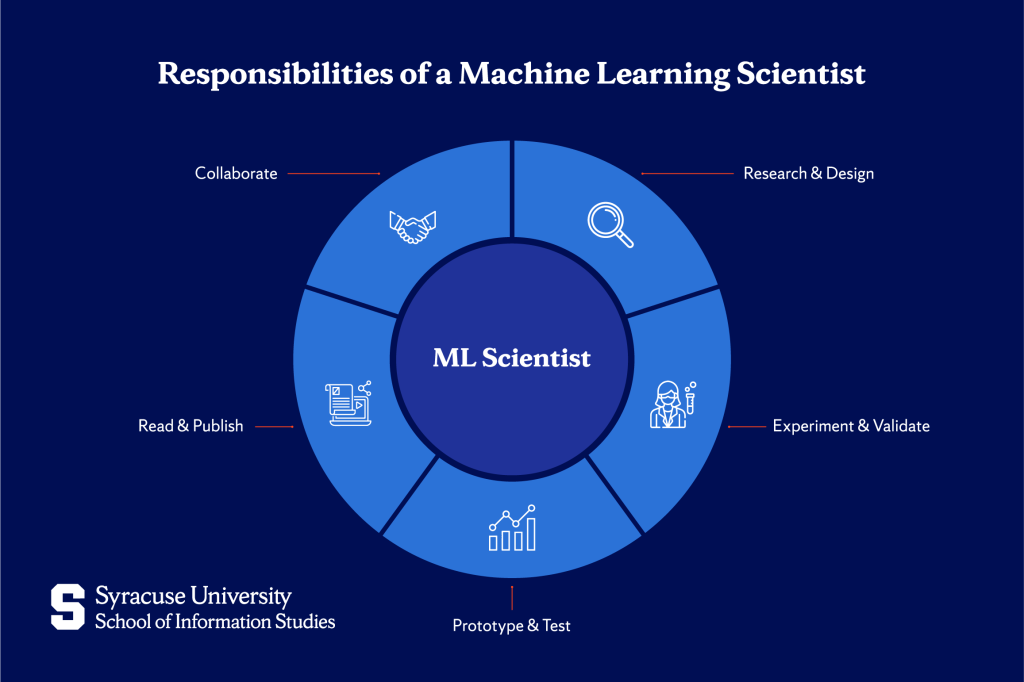
Most of a machine learning scientist’s time goes to research: designing models and testing whether new ideas make them better. Maintaining production systems usually falls to development teams. The work tends to cluster into five areas.
Research and design new models and algorithms
This is the defining part of the job. You take a business or scientific problem, such as spotting fraudulent payments or reading medical scans, and frame it as something a model can learn. Then you adapt an existing method or invent a new one, like a different model architecture or training technique.
Run experiments and validate results
Testing fills much of the week. You design controlled experiments, build datasets, train candidate models, and measure each one against a strong baseline. Progress usually comes from many rounds of small changes and reruns.
Develop and test prototypes
Once a method performs well in testing, machine learning scientists may develop a prototype to evaluate how it works with realistic data. They often collaborate with machine learning specialists or developers to integrate successful approaches into production systems, although some scientists contribute directly to implementation.
Read, publish, and stay current
Reading new papers is a regular part of the job because methods change quickly. At research-heavy organizations, you may also publish findings at conferences or file patents. Publishing is the part of the work that most often separates scientists from developers.
Collaborate across teams
You’ll work with data scientists, ML developers, product managers, and domain experts so a model solves the right problem. A fraud analyst or a radiologist, for example, can tell you which errors would cost the most in practice.
The balance varies by employer: at large tech labs the role resembles academic research, while mid-size companies usually mix research with hands-on building.
Skills and Qualifications of a Machine Learning Scientist
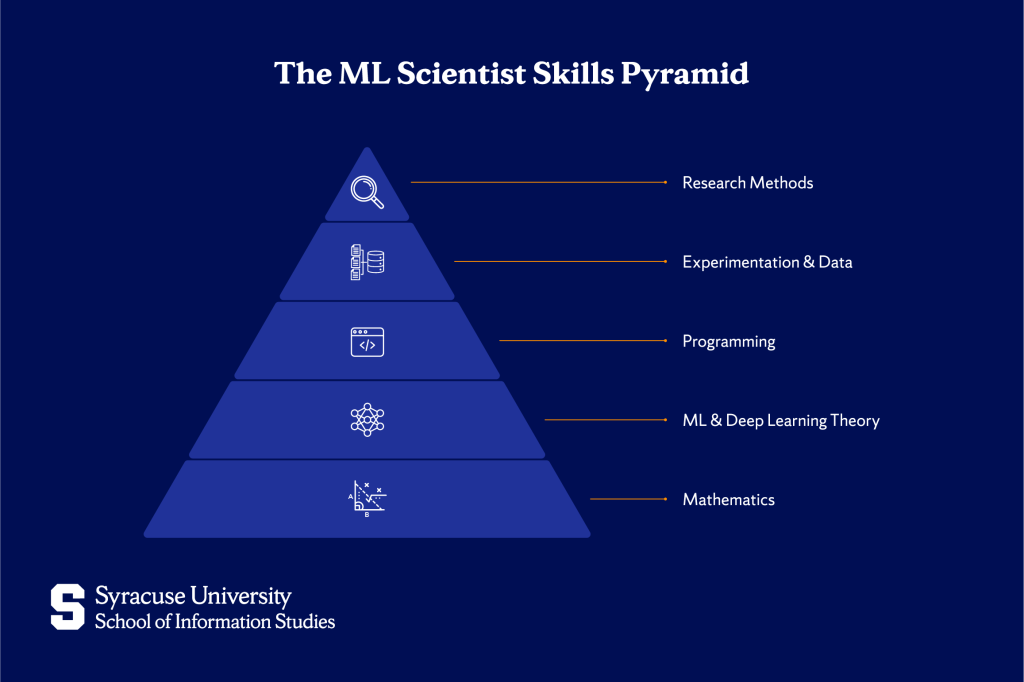
This role calls for two kinds of depth. You need the math and theory to explain why a model behaves as it does, plus the hands-on skill to build and test one. Research methods tie them together, and employers typically ask for more formal education than most data jobs.
Technical and mathematical foundation
The core technical and mathematical foundation skills needed for this role are:
- Mathematics: linear algebra, calculus, probability, and statistics, at a depth that lets you derive and modify algorithms yourself
- Machine learning and deep learning theory: supervised, unsupervised, self-supervised, and reinforcement learning, plus how architectures such as convolutional neural networks (CNNs) and transformers actually work
- Programming: Python first, with fluency in frameworks like PyTorch, TensorFlow, JAX, or scikit-learn and the data tools around them
- Experimentation and data skills: cleaning messy data, choosing sound metrics, spotting data leakage, and knowing when a result is statistically meaningful
- Research method: reproducing results from published papers and forming hypotheses an experiment can test
Depth in math and theory is what most distinguishes a machine learning scientist from an ML developer, whose strengths lean toward software and systems.
Education and credentials
A master’s degree is the practical starting point for most machine learning scientist roles. At large industry labs and AI research groups, a PhD is common and sometimes expected. Candidates with a master’s and a strong record of original research can sometimes land those roles too.
At Syracuse University’s iSchool, our Master’s in Applied Human-Centered AI develops students’ knowledge of artificial intelligence through coursework in machine learning, deep learning, and responsible AI. Students also complete an applied portfolio demonstrating their work. Our Master’s in Applied Data Science offers another option for those interested in building machine learning expertise alongside broader data science skills.
For students aiming for research-intensive positions, these skills provide a foundation that can be developed further through independent research, additional graduate study, or relevant professional experience.
Salary and Job Outlook
The U.S. Bureau of Labor Statistics (BLS) does not report salaries specifically for machine learning scientists. The closest occupation is computer and information research scientists, who earned a median annual wage of $140,300 in May 2025. Earnings vary by industry, with research scientists working for software publishers earning a median of $211,270.
Employment prospects are also strong. BLS projects 22% employment growth for computer and information research scientists between 2025 and 2035, compared with 6% for computer occupations overall and 3% across all occupations.
For comparison, data scientists earned a median annual wage of $120,230 in May 2025. Although the occupations overlap, these figures represent different groups of workers and should not be interpreted as a direct salary comparison between machine learning scientists and data scientists.
How to Become a Machine Learning Scientist
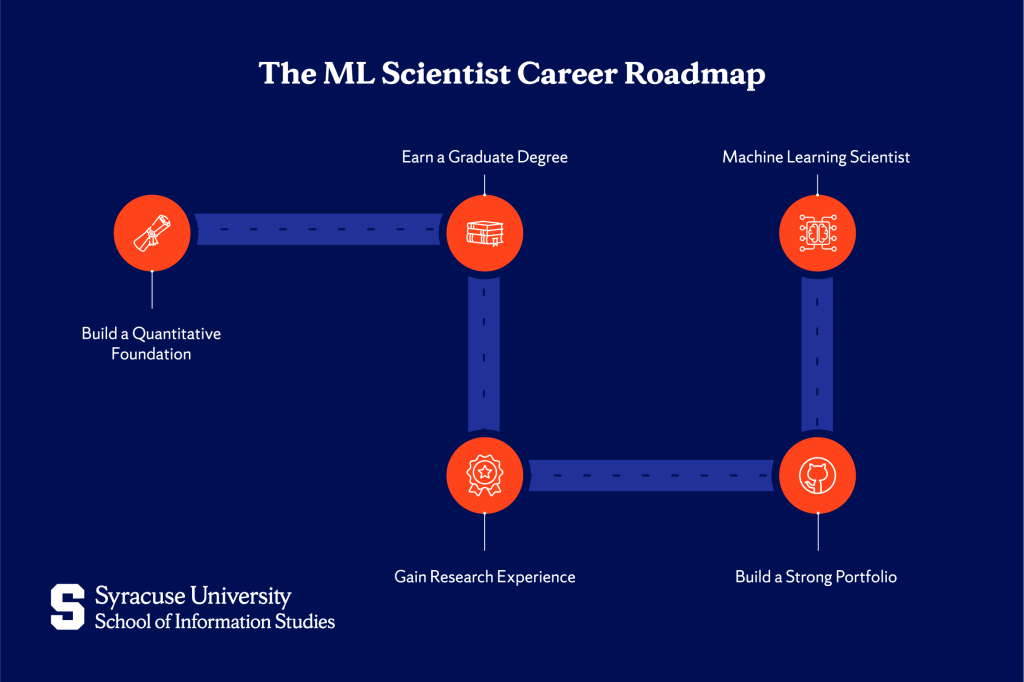
Few people start their careers with this title. Most get there through strong quantitative training and proof that they can do original research, roughly in this order:
- Build a quantitative foundation: Start with a bachelor’s in computer science, data science, mathematics, statistics, or a related field. At the iSchool, our Bachelor’s in Applied Data Science offers machine learning and big data courses. Students in other majors can add an AI focus through the Applications of AI Minor.
- Earn a graduate degree: A master’s or PhD program is where most candidates go deep on machine learning theory and learn to run research well. Which one you need depends on how research-heavy your target roles are.
- Get research and applied experience: Internships, research assistantships, capstone projects, and open-source contributions show employers you can test a hypothesis and report what you found. Many people earn the scientist title after a few years as a data scientist, ML developer, research assistant, or postdoctoral researcher.
- Build a visible portfolio: Publications, an active GitHub profile, strong Kaggle results, or a well-documented research project give hiring managers something concrete to review. Hiring for this role puts heavy weight on research you’ve actually done, alongside your degrees.
Final Reflections on the Machine Learning Scientist Role
A career as a machine learning scientist may appeal to you if you’re interested in understanding how AI models work and finding ways to improve them. The role involves extensive experimentation, and research projects may require repeated testing before producing useful results. Strong mathematical skills and an interest in solving complex problems are important, particularly for positions focused on developing new algorithms.
For students considering this career, graduate education offers an opportunity to develop advanced technical knowledge and gain experience applying machine learning methods. At Syracuse University’s iSchool, our Master’s in Applied Human-Centered AI includes coursework in deep learning and large language models, with responsible AI integrated into the required curriculum.
Our Master’s in Applied Data Science offers another option for students interested in machine learning alongside broader data science applications, with on-campus and online study options.
If you’re interested in developing your AI expertise, explore the admission requirements for our Master’s in Applied Human-Centered AI to learn more about getting started.
Frequently Asked Questions (FAQs)
How long does it take to become a machine learning scientist?
Plan on five to seven years of school: a four-year bachelor’s plus a one- to three-year master’s. PhD-track research roles take several years longer.
Can you become a machine learning scientist without a technical undergraduate degree?
Yes, though you’ll need to build college-level math and Python skills along the way. Our Applied Data Science master’s, for example, includes an introductory core course that requires no programming experience.
What industries hire machine learning scientists?
In BLS employment data for computer and information research scientists, the largest employers are the federal government (31%), computer systems design firms (16%), scientific research firms (14%), and public universities (7%).
How is generative AI changing the machine learning scientist role?
More research now goes into fine-tuning large models and improving their training data. Stanford’s 2026 AI Index notes a model nearly 90 times smaller than Grok 4 that matches it on several tests through data curation.
Do machine learning scientists work remotely?
It depends on the employer. BLS notes that some computer and information research scientists work with colleagues elsewhere and do much of their work online, which makes hybrid or remote schedules workable.