
Key Takeaways
- A master’s in AI qualifies you for technical roles like machine learning specialist, NLP specialist, and computer vision specialist, plus strategic positions like AI product manager.
- Master’s in AI graduates work across industries, including tech, healthcare, finance, manufacturing, and government, often with starting salaries well above national averages.
- A master’s in AI builds both technical depth (neural networks, reinforcement learning, NLP) and professional skills (collaboration, ethical reasoning, communication).
Artificial intelligence is reshaping industries at a speed we haven’t seen before. From healthcare diagnostics to autonomous vehicles, companies across sectors need professionals who can build, manage, and scale intelligent systems. That demand has created a skills gap; one that a master’s in artificial intelligence is designed to fill.
Many students pursue this degree to qualify for specialized, high-impact roles that weren’t mainstream even five years ago. The combination of advanced technical training, hands-on project work, and strategic thinking prepares graduates for careers that blend applied problem-solving, research, and business strategy.
If you’re looking to build models, lead product teams, or push the boundaries of what AI can do, this degree gives you the foundation to compete for some of the most exciting and well-compensated roles in tech.
Top Jobs You Can Pursue With a Master’s in Artificial Intelligence
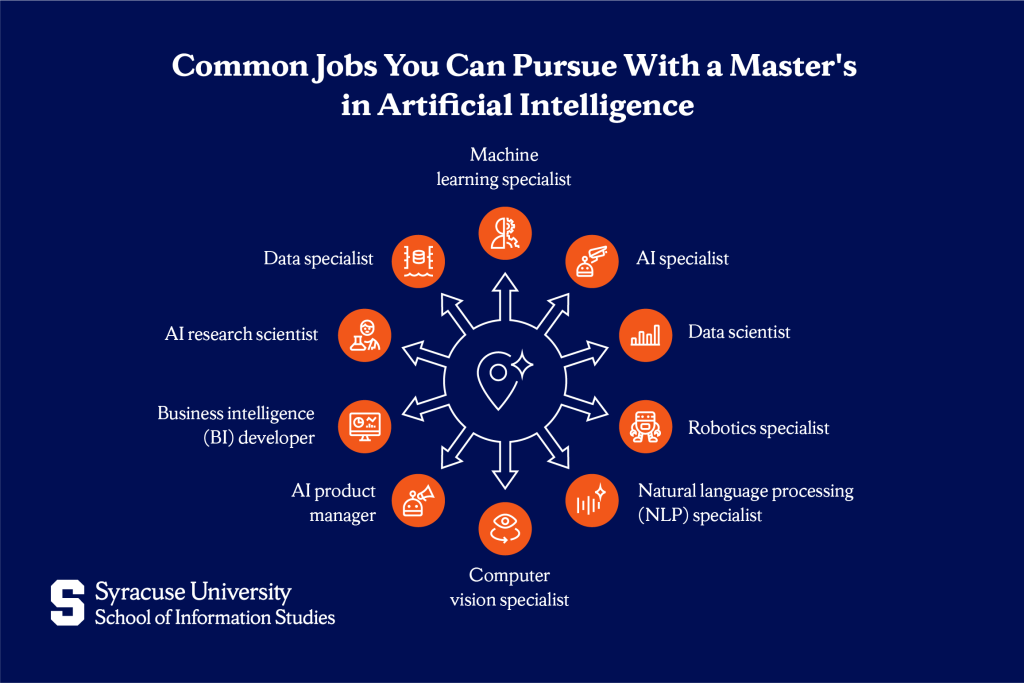
AI careers span technical development, research, design, and product strategy. The roles below represent some of the most common and in-demand paths for graduates, with each requiring a mix of specialized knowledge and practical problem-solving skills.
Machine learning specialist
Machine learning specialists build, train, and refine the models that power intelligent systems. They work on everything from recommendation engines to fraud detection algorithms, often collaborating with data scientists and software teams to deploy models at scale.
This role requires deep knowledge of supervised and unsupervised learning, feature design, and model optimization. You’ll use tools like TensorFlow, PyTorch, and scikit-learn to experiment with architectures, test performance, and fine-tune hyperparameters.
Industries with high demand include tech, finance, e-commerce, and healthcare. A master’s degree gives you the mathematical and computational foundation to take on complex modeling challenges that entry-level roles rarely encounter.
AI specialist
AI specialists design intelligent systems that integrate machine learning, automation, or decision logic into real-world applications. Rather than focusing on theoretical model development alone, this role combines applied AI knowledge with practical implementation, such as building chatbots, improving recommendation systems, or creating automated quality-control workflows.
You’ll work cross-functionally with software developers, data teams, and product managers to ensure AI features integrate smoothly into larger platforms. The role demands both coding fluency (Python, Java, C++) and an understanding of how models behave in production environments.
Data scientist
Data scientists turn raw data into insights and predictive models, often serving as the bridge between business questions and technical solutions. They explore datasets, identify patterns, and build statistical models to inform decision-making.
There’s an important distinction within this field:
- Data science focuses on model creation, algorithm exploration, and experimentation, asking “What patterns exist?” or “Can we predict this outcome?”
- Applied data science uses existing methods and tools to solve specific business problems, answering “How do we reduce churn?” or “Which customers should we target?”
Both paths require skills in SQL, Python, R, and visualization tools like Tableau. A master’s in AI strengthens your ability to work with complex datasets and apply advanced techniques like deep learning or time-series forecasting.
Robotics specialist
Robotics specialists build autonomous or semi-autonomous systems that sense, process, and respond to their environments. This work combines mechanical design, sensor integration, and AI, particularly in areas like computer vision, reinforcement learning, and motion planning.
You might work on warehouse automation, surgical robots, drones, or self-driving vehicles. The role requires knowledge of control systems, sensor fusion, and real-time processing, plus the ability to test and refine behavior in physical or simulated environments.
Industries hiring robotics specialists include manufacturing, logistics, healthcare, and defense. A master’s in AI gives you the depth needed to develop intelligent control algorithms that go beyond pre-programmed sequences.
Natural language processing (NLP) specialist
NLP specialists build systems that understand, generate, or translate human language. This includes large language models (LLMs), chatbots, voice assistants, sentiment analysis tools, and machine translation systems.
The rise of generative AI has made this one of the fastest-growing specializations. You’ll work with transformer architectures, fine-tune pre-trained models, and optimize text-based outputs for accuracy and relevance.
Typical tasks include training language models, improving chatbot responses, building question-answering systems, and creating summarization tools. Demand is especially high in tech, customer service, healthcare documentation, and legal automation.
Computer vision specialist
Computer vision specialists build systems that interpret image and video data. Applications range from facial recognition and medical imaging to autonomous driving and retail analytics.
This role requires expertise in convolutional neural networks (CNNs), vision transformers, object detection, and image segmentation. You’ll work with frameworks like OpenCV, TensorFlow, and PyTorch to train models that recognize patterns, classify objects, or track movement.
Industries with strong demand include healthcare (diagnostic imaging), transportation (autonomous vehicles), retail (cashierless stores), and security (surveillance systems). A master’s degree provides the technical depth needed to design and optimize complex vision pipelines.
AI product manager
AI product managers guide the strategy, development, and launch of AI-enabled products. They bridge communication between technical teams, designers, and business stakeholders, translating technical capabilities into user value and market opportunities.
You won’t necessarily write code every day, but you need to understand how models work, what trade-offs exist (accuracy vs. speed, for example), and how to prioritize features based on feasibility and impact.
A master’s in AI helps you communicate effectively with data scientists and development teams, ask the right questions during development, and make informed decisions about model behavior, data requirements, and deployment timelines.
Business intelligence (BI) developer
BI developers create dashboards, automated reports, and data workflows that help organizations make faster, better decisions. While traditionally focused on SQL and reporting tools, modern BI roles increasingly use AI for forecasting, anomaly detection, and automated insights.
You’ll work with platforms like Power BI, Tableau, and Looker to visualize trends, track KPIs, and surface actionable patterns. AI skills improve your ability to build predictive dashboards, automate report generation, and integrate machine learning outputs into business workflows.
Typical industries include finance, retail, healthcare, and consulting, anywhere data-driven decision-making is core to operations.
AI research scientist
AI research scientists advance the field by developing new algorithms, improving existing methods, or exploring theoretical questions about intelligence and learning. They work in academic labs, corporate R&D teams, or government research institutes.
This role focuses on experimentation, publication, and collaboration with other researchers. You might study reinforcement learning, generative models, explainability, or AI safety, often working on problems that don’t yet have commercial applications.
Some positions prefer a PhD, but many applied research roles accept a master’s degree, especially if you’ve published papers, contributed to open-source projects, or completed a thesis-based program.
Data specialist
Data specialists build the infrastructure that supports AI systems, including pipelines, data warehouses, cloud platforms, and ETL (extract, transform, load) processes. Without reliable, high-quality data, even the best models fail.
This role focuses on scalability, performance, and automation. You’ll work with tools like Apache Spark, Airflow, AWS, and Snowflake to ensure data flows smoothly from source systems to model training environments.
A master’s in AI helps you understand what optimized workflows look like from the perspective of model development: how data should be structured, versioned, and monitored to support experimentation and production deployment.
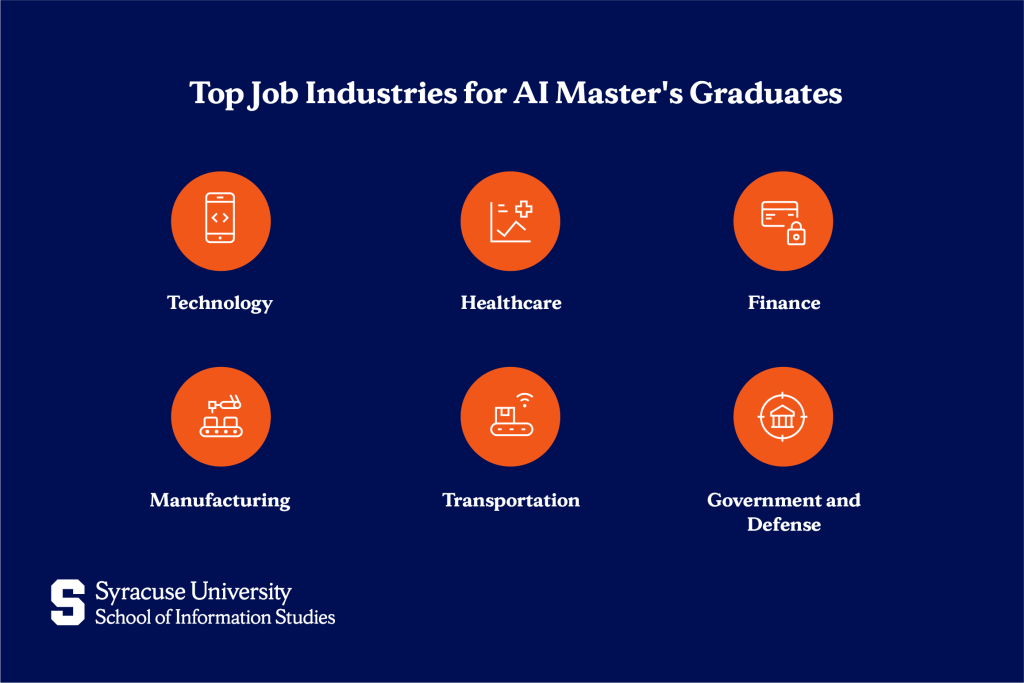
AI professionals contribute to nearly every major sector, with especially strong demand in the following areas:
- Technology: Companies like Google, Microsoft, Amazon, and Meta hire across all AI roles, building everything from search algorithms to cloud services.
- Healthcare: Hospitals and research centers use AI for diagnostic imaging, drug discovery, patient monitoring, and operational efficiency.
- Finance: Banks and fintech firms apply AI to fraud detection, risk assessment, algorithmic trading, and personalized financial advice.
- Manufacturing: Factories use AI for quality control, predictive maintenance, supply chain optimization, and robotics automation.
- Transportation: Autonomous vehicle companies, logistics providers, and urban planning agencies rely on AI for routing, safety, and efficiency.
- Government and Defense: Federal and local agencies use AI for cybersecurity, intelligence analysis, disaster response, and public service automation.
Each industry brings unique challenges (regulatory requirements in healthcare, real-time constraints in autonomous driving, or security demands in defense), making AI expertise both versatile and essential.
Skills You Gain in a Master’s in AI
Graduate programs in AI build competencies across three major areas:
Technical skills:
- Machine learning: Supervised, unsupervised, and reinforcement learning
- Neural networks: CNNs, RNNs, transformers, and generative models
- Natural language processing: Text classification, sentiment analysis, language generation
- Computer vision: Image recognition, object detection, video analysis
- Programming: Python, TensorFlow, PyTorch, scikit-learn, SQL
- Cloud platforms: AWS, Azure, Google Cloud for deployment and scaling
Analytical skills:
- Designing experiments to test model performance
- Interpreting results and identifying sources of error
- Optimizing hyperparameters and improving accuracy
- Evaluating trade-offs between speed, cost, and precision
Professional skills:
- Communicating technical concepts to non-technical stakeholders
- Collaborating across teams (technical, product, design, business)
- Applying ethical reasoning to AI decisions (bias, privacy, transparency)
- Managing projects from research to deployment
Syracuse iSchool’s Applied Human Centered Artificial Intelligence Master’s Degree emphasizes this combination of technical depth and human-centered design, preparing students to build AI systems that are both effective and responsible.
Salary Expectations
AI roles tend to be high-paying, with compensation varying by industry, location, specialization, and experience level. Entry-level positions in major tech hubs often start above $100,000, while senior roles can exceed $200,000.
Factors that influence salary include:
- Location: San Francisco and New York offer higher compensation than smaller markets, though remote work is expanding options.
- Industry: Tech and finance typically pay more than nonprofit or government roles.
- Specialization: In-demand skills like NLP, computer vision, and reinforcement learning often command premium salaries.
- Seniority: Experience with production systems, leadership, and strategic decision-making significantly increases earning potential.
Is a Master’s in Artificial Intelligence Worth It?
A master’s in AI degree makes the most sense for:
- Career changers who want to break into tech but lack a technical background. Structured programs provide the foundation, mentorship, and credibility employers look for.
- Professionals seeking specialization who already work in software or data roles but want to move into AI-specific positions that require deeper knowledge of modeling, neural networks, or deployment strategies.
- Aspiring researchers who want to contribute to advancing AI through academic or corporate R&D, especially if they’re considering a PhD later.
The job market for AI professionals remains strong. According to industry reports, demand for AI talent continues to outpace supply, with roles in machine learning and data science consistently ranking among the fastest-growing occupations. Long-term career stability is high, especially for those who stay current with evolving tools and methods.
If you’re looking for flexibility, career mobility, and work that shapes how technology impacts society, a master’s in AI offers a clear path forward.
Mapping Your Next Steps With a Master’s in AI
A master’s in artificial intelligence opens doors across technical, research, and strategic roles, spanning industries from healthcare to finance to transportation. Whether you’re building models, leading product teams, or advancing the field through research, this degree gives you the skills and credibility to compete for high-impact positions.
The roles listed here represent some of the most common career paths, but they’re far from the only options. As AI continues to reshape industries, new specializations and opportunities will emerge, and graduates with strong foundations will be ready to step into them.
If you’re ready to explore what a master’s in AI can do for your career, Syracuse iSchool’s Applied Human Centered Artificial Intelligence Master’s Degree offers the flexibility, mentorship, and hands-on experience to help you succeed. With a clear focus on applied work, students finish the program by developing and evaluating their own application portfolio, demonstrating the skills and experience they’ve gained.
Join us and gain the advanced training that opens an expansive range of career possibilities across many industries!
Frequently Asked Questions (FAQs)
Do I need a technical background to enroll in a master’s in AI?
Not always. Many programs accept students from non-technical backgrounds, though you’ll typically need to complete prerequisite coursework in programming, statistics, and linear algebra. Some programs offer bridge courses to help you build these foundational skills before starting the core curriculum.
How long does it take to complete a master’s in artificial intelligence?
Most full-time programs take one to two years. Part-time and online formats offer more flexibility, often allowing working professionals to complete the degree in two to three years. Accelerated tracks may be available for students with strong technical backgrounds.