
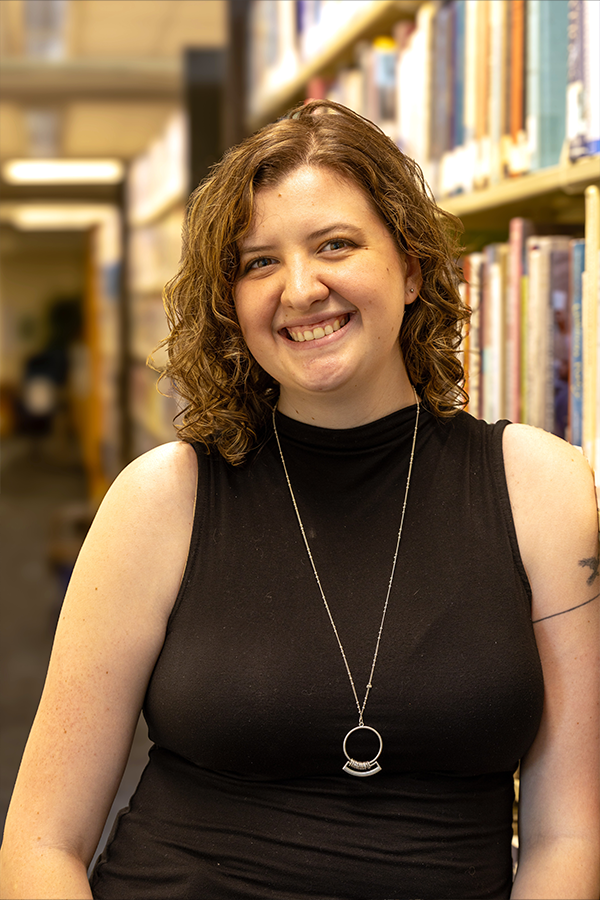
 Payton D. Cooke’s parents like to joke that they knew when she was six years old that she would become a librarian. Even then, the 2024 graduate from the iSchool’s library and information science (LIS) program loved reading, enjoyed organizing, and was always the one helping others find information. Now, years later, her instinct to connect people with knowledge has led her to work as the reference and outreach librarian at CT State Quinebaug Valley in Danielson, Connecticut, and to co-author an article on autistic librarianship in a recent issue of College & Research Libraries—one of a growing body of studies written by autistic librarians themselves about their experiences in librarianship.
A graduate of Mount Holyoke College with a B.A. in English, Cooke first connected to the idea of becoming a librarian while completing a master’s degree in Victorian literary studies at the University of Exeter in the United Kingdom. Analyzing perceptions of autism in that era’s detective fiction, she realized she enjoyed the research aspect more than writing and regularly found herself directing classmates to resources. “When I told my family and friends that I was going to library school, they all said ‘yeah, about time,’” she recalled.
At Syracuse, Cooke appreciated her program’s emphasis on experiential learning and the freedom it gave students to shape projects around their own interests. “I think that hands-on work is really important,” she said. “Every single class culminated in some sort of project.” In a cultural competence course, she used that flexibility to center disabled voices, reimagining the University Libraries’ Disability Pride Week print display and creating a related guide. “This is when I started to learn about the power and importance of disability as diversity,” said Cooke, who was diagnosed as autistic in middle school.
Just as important were the relationships Cooke built at Syracuse and beyond. With support from the Wilhelm Library Leaders Program, she was able to attend conferences and begin to build her network. A key moment occurred at a meeting of the Association of College and Research Libraries (ACRL), which hosted a panel by autistic librarians. “I thought, ‘other autistic people?!’” she said. Even though Cooke had grown up in a supportive environment, autism wasn’t widely recognized, particularly among girls, so this was the first time she met people with similar experiences. “I remember sitting in that panel and just vibrating with excitement. I’d never felt so validated.”
When she shared her excitement with Dr. Megan Oakleaf, the MSLIS program director encouraged Cooke to reach out to the panelists. Soon enough, Cooke became part of the collaboration, writing the literature review for the recently published article and appearing on a panel with some of her co-authors at the most recent ACRL conference in Minneapolis.
Written entirely by autistic authors, the article reflects what Cooke describes as “a good spectrum of autistic experiences, not to be punny.” Guided by the disability rights principle of “nothing about us without us,” the study shifts the conversation beyond autistic patrons to examine how academic library hiring and interview practices shape who is able to enter the profession. Rather than framing autism as a deficit, the authors argue that the systems themselves—particularly lengthy, high-pressure interviews—often create unnecessary barriers.
In her current role as a public-facing reference and outreach librarian, Cooke is putting what she has learned along her own path into practice through programming, including low-key NeurodiversiTEA gatherings, focused on student success and community-building. Open about her own neurodivergence, Cooke sees that visibility as one more way to make libraries more welcoming spaces.
Looking ahead, Cooke hopes to move into a full-time academic library role and eventually earn a Ph.D. “I would like to go back and teach the next generation, because I’m so grateful for the people that taught me,” she said.
That goal is reflected in her forthcoming chapter, “Future Autistic Librarians: Self-Advocacy and Neuroaffirmative Education.” It will be published in early 2026 in Autistic Academic Librarians, offering guidance for autistic LIS students and the faculty who support them.