
Key Takeaways
- Machine learning techniques are commonly grouped into four types based on how a model learns: supervised, unsupervised, semi-supervised, and reinforcement learning.
- Supervised learning uses labeled data for prediction or classification, while unsupervised learning looks for patterns in unlabeled data.
- Semi-supervised learning combines limited labeled data with a larger unlabeled dataset, making it useful when labeling is costly.
- The best technique depends on the task and the available data, as well as the level of interpretability the project requires.
Machine learning is already part of many systems people use every day. It helps email filters identify spam, streaming platforms recommend content, financial tools detect unusual activity, and navigation apps predict traffic conditions.
The basic idea is straightforward: a model learns from data so it can make predictions or find patterns without being given a separate rule for every possible situation. The difficulty comes later, when you start looking at the methods used to do that.
Machine learning spans dozens of techniques, and newcomers often struggle to see how they fit together. Some methods learn from labeled examples, while others work with unlabeled data or improve through feedback. Understanding those main groups makes the field much easier to follow.
The Main Types of Machine Learning Techniques
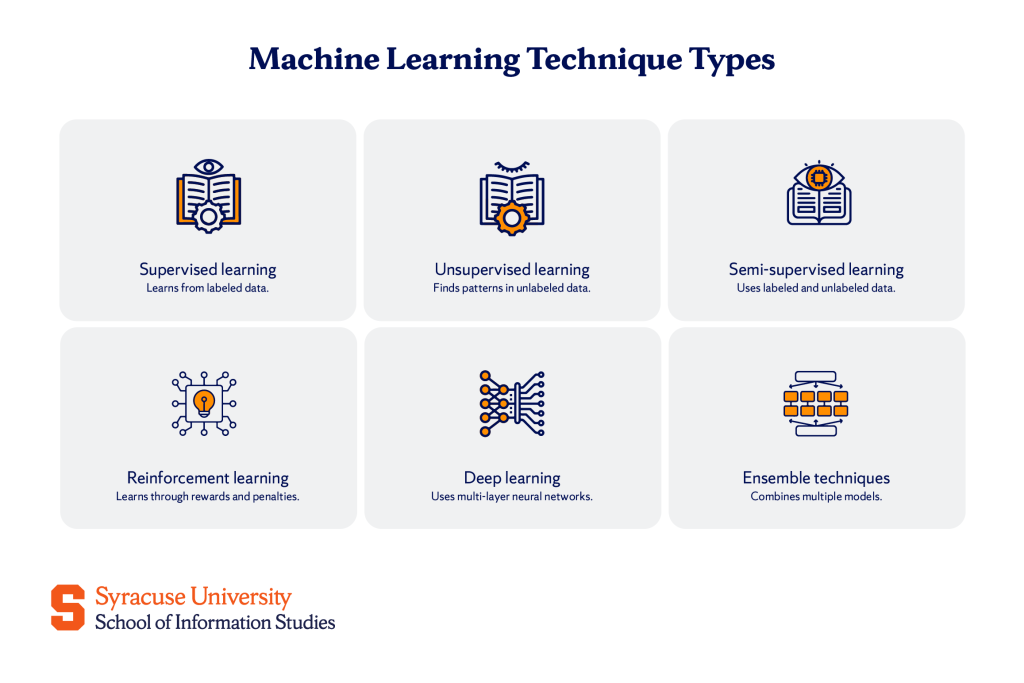
Machine learning is commonly divided into four types based on the information a model receives during training and how it learns from that information.
| Category | Example techniques | Learns from | Typical use |
|---|---|---|---|
| Supervised | Linear regression, decision trees, SVM | Labeled data | Prediction, classification |
| Unsupervised | k-means, PCA, association rules | Unlabeled data | Grouping, pattern discovery |
| Semi-supervised | Self-training, label propagation | Small labeled + large unlabeled set | Costly-to-label domains |
| Reinforcement | Q-learning, policy gradients | Rewards and penalties | Sequential decision-making |
These four categories describe the learning process. Individual methods within them may differ considerably in their complexity and suitable applications.
Supervised learning techniques
Supervised learning uses data in which the correct outcome is already known. The model studies the relationship between the inputs and those known outcomes, then applies what it has learned to new data.
Supervised learning generally supports two kinds of tasks. Regression predicts a numerical value, while classification assigns an observation to a category.
Linear regression
Linear regression estimates a continuous value based on the relationship between an outcome and one or more input variables. It is often used as an interpretable starting point for tasks such as forecasting sales or estimating costs.
The technique works best when the relationship is reasonably linear. More complex patterns may require a different model or changes to how the data is represented.
Logistic regression
Logistic regression is primarily a classification technique that helps estimate the probability that an observation belongs to a particular category. A common example of this technique in use is predicting whether an email is spam. The model produces a probability, which is then converted into a class based on a selected threshold.
Decision trees and random forests
A decision tree reaches a prediction through a series of rule-based splits. Its structure is relatively easy to follow, which makes it useful when people need to understand how the model reached its conclusion.
A random forest combines predictions from many decision trees. This often produces more stable results, although the final model is harder to explain than one tree.
Support vector machines (SVM)
A support vector machine finds a boundary that separates observations from different classes. It can perform well when a dataset has many features relative to the number of observations.
When a straight boundary cannot separate the classes effectively, the model can use a kernel to represent a more complex division.
K-nearest neighbors (k-NN)
K-nearest neighbors compares a new observation with nearby examples in the training data. It can assign the most common class among those neighbors or estimate a value based on their outcomes.
The method is easy to understand, but predictions can become slower as the training dataset grows.
Naive Bayes
Naive Bayes uses probability to classify data. It assumes that the input features are independent once the class is known, an assumption that is often unrealistic but can still produce useful results.
The technique is fast to train and commonly applied to text classification tasks such as spam detection.
Unsupervised learning techniques
Unsupervised learning works with data that does not include known outcomes. Instead of learning to reproduce a supplied answer, the model looks for structure within the data itself.
These methods are often used to find groups or simplify complex datasets.
K-means and hierarchical clustering
Clustering techniques group observations according to their similarities. K-means divides the data into a set number of clusters chosen before the model runs.
Hierarchical clustering builds a tree that shows how observations or groups relate at different levels. Both approaches may be used for customer segmentation, although the resulting groups still require interpretation.
Dimensionality reduction (PCA, t-SNE)
Datasets with many variables can be quite difficult to analyze or even visualize. Dimensionality-reduction techniques create a smaller representation that retains useful information from the original data.
Principal component analysis, or PCA, is commonly used to reduce correlated features into a smaller number of components. T-SNE is often used to create lower-dimensional visualizations of complex data, although its plots should be interpreted carefully.
Association rule learning
Association rule learning looks for items or events that frequently occur together. It identifies relationships in the form of one item being associated with another, rather than predicting a fixed target.
Market-basket analysis is a common application. A retailer might use it to examine which products customers often purchase in the same transaction.
Semi-supervised learning techniques
Semi-supervised learning uses a small amount of labeled data alongside a much larger amount of unlabeled data. It is useful when data is widely available but assigning accurate labels requires expert time or substantial expense.
In self-training, a model is first trained on the labeled examples. It then assigns provisional labels to unlabeled data and adds its most confident predictions to the training set.
Label propagation takes a different approach. It spreads label information through a network based on the similarity between observations.
These methods can reduce labeling demands, but incorrect provisional labels may also reinforce errors. Their performance still needs to be evaluated against reliable labeled data.
Reinforcement learning techniques
Reinforcement learning trains an agent to make decisions through interaction with an environment. Instead of receiving a correct answer for each example, the agent receives rewards or penalties based on the results of its actions.
The goal is to learn a strategy that produces the highest cumulative reward over time. This makes reinforcement learning suitable for problems in which one decision affects the choices available later.
Value-based methods estimate how beneficial a particular action is in a given situation. Policy-based methods learn the decision strategy more directly.
Reinforcement learning has been applied to robotics and game-playing systems. Related methods have also been used in the development of large language models, including reinforcement learning from human feedback.
Deep learning techniques (neural networks)
Deep learning is considered a subset of machine learning. It uses neural networks with multiple layers that allow a model to learn complex relationships directly from data.
Deep learning is particularly useful for large or unstructured datasets, including images and language. It usually requires more data and computing power than simpler machine learning methods.
Convolutional neural networks (CNNs)
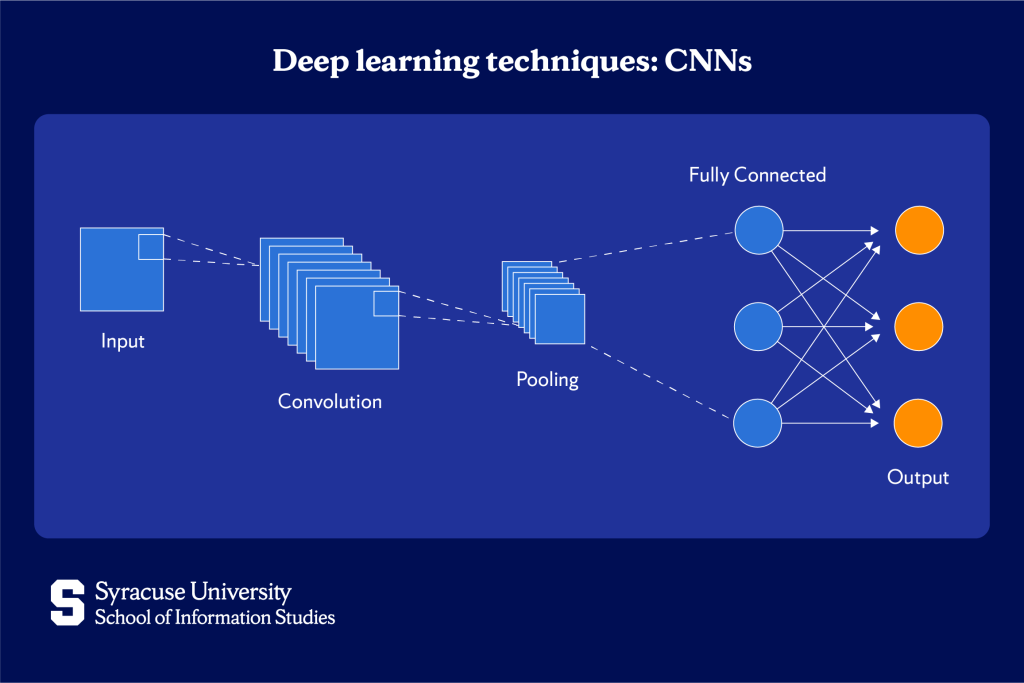
Convolutional neural networks, or CNNs, are designed to recognize local patterns in grid-like data. They have been widely used for computer vision tasks such as image classification and object detection.
A CNN learns simple visual features in its earlier layers. Later layers combine those features into more complex representations.
Recurrent networks and LSTMs
Recurrent neural networks were designed for sequential data, where the order of information affects its meaning. Long short-term memory networks, or LSTMs, were developed to help these models retain information across longer sequences.
They have been used for time-series analysis and language processing. Transformers have replaced them in many language applications, but recurrent models remain relevant for some sequential problems.
Transformers
Transformers use an attention mechanism to assess relationships between different parts of an input. This allows them to process long sequences more efficiently than earlier recurrent architectures.
They form the basis of many large language models. Transformer architectures are also used in areas beyond language, including computer vision.
Ensemble techniques
Ensemble methods combine several models to produce one final result. The aim is to reduce the weaknesses of an individual model and generate more reliable predictions. For example:
- Bagging trains several models on different samples of the data and combines their outputs. Random forests use this approach by combining multiple decision trees.
- Boosting builds models in sequence, with each one focusing more heavily on errors made earlier. Gradient boosting and XGBoost are widely used examples.
- Stacking trains several different models and then uses another model to combine their predictions. This can improve performance, although it also adds complexity.
Most familiar ensemble methods are used in supervised learning. The wider principle of combining models can also appear in other machine learning settings.
How to Choose the Right Machine Learning Technique
Selecting a machine learning technique should begin with the problem rather than the popularity of a particular model. Four questions can help narrow the options:
- What result do you need? Predicting a number points toward regression, while assigning a category requires classification. Grouping observations suggests an unsupervised method, and a sequence of connected decisions may call for reinforcement learning.
- Is the data labeled? A sufficiently large labeled dataset supports supervised learning. Unlabeled data may require an unsupervised approach, while a limited number of labels may make semi-supervised learning appropriate.
- How large and complex is the dataset? The number of observations affects which methods are practical. The number of features also influences model choice and computing requirements.
- How important is interpretability? A simpler model may be preferable when people need to understand or defend individual decisions. A more complex model may offer higher predictive performance but provide less insight into how it reached its result.
Key Concepts and Common Pitfalls
How the data is prepared and how the model is evaluated can have just as much influence on the result as the technique itself. Some key concepts and common pitfalls to keep in mind include:
- Training and test data: A model should be evaluated on data it did not encounter during training. This provides a more realistic indication of how it may perform on new examples.
- Overfitting and underfitting: An overfit model learns the training data too closely and performs poorly on new data. An underfit model is too limited to capture the relevant relationships.
- Evaluation metrics: Accuracy does not suit every problem. For datasets with a strong class imbalance, precision and recall may provide more useful information.
- Data quality and bias: A model learns from the examples it receives. Missing information or unrepresentative samples can affect its performance and produce unfair results.
Putting Machine Learning Techniques into Practice
Choosing among machine learning techniques requires a clear understanding of the data and the result the project is meant to produce. A more complex model is not automatically a better one, especially when a simpler approach is easier to explain and performs just as well.
Developing that judgment takes more than learning how individual models work. It also requires practice with data preparation, evaluation, and responsible use. Readers who want to build these skills in a structured setting can explore the Syracuse University iSchool’s M.S. in Applied Data Science, which combines technical training with applied problem-solving.
Frequently Asked Questions (FAQs)
What is the difference between machine learning techniques and algorithms?
A technique is a general method or model family, while an algorithm is a defined procedure used to train or apply it. The terms are sometimes used interchangeably, but they do not always refer to the same level of detail.
What is the difference between machine learning and deep learning?
Deep learning is a subset of machine learning that uses neural networks with multiple layers. It is often suited to large, unstructured datasets, while classical machine learning methods may be more practical for smaller or structured datasets.
Which machine learning technique should a beginner learn first?
Linear regression and logistic regression are common starting points because their results are relatively easy to interpret. The best starting technique still depends on the type of problem the learner wants to solve.
How much data do machine learning techniques need?
The required amount depends on the task and the model. Simpler methods may perform well with a modest dataset, while deep learning often requires substantially more training data.
What programming languages and tools are used for machine learning?
Python is widely used for machine learning, with scikit-learn supporting classical methods and frameworks such as TensorFlow or PyTorch supporting deep learning. R is also common in work with a stronger statistical focus.
Are machine learning techniques the same as artificial intelligence?
No. Machine learning is one area within artificial intelligence, while AI also includes approaches that do not learn directly from data.