
Key Takeaways
- A career in artificial intelligence is no longer reserved for PhD holders. There are clear entry points for both technical builders and non-technical professionals who want to work with AI tools.
- The benefits of AI extend across every industry, which means AI career opportunities are growing far beyond traditional tech companies.
- Technical AI careers require Python, math foundations, and hands-on project experience, but “AI-native” habits matter just as much as coding skills.
- Building a GitHub portfolio with real projects will do more for your AI job search than any certificate on its own.
AI isn’t just something happening inside research labs anymore. It’s changing how lawyers draft contracts, how nurses organize patient information, how marketers shape campaigns, and how supply chain managers predict demand. Knowing how to start a career in artificial intelligence has become a relevant question for people across nearly every profession.
This is a fundamental shift in how we work. The benefits of AI are showing up in real business results, and employers are responding by prioritizing AI fluency in hiring decisions across industries. That creates genuine opportunity. It also means the path into AI depends heavily on what you actually want to do with it.
This guide walks through both directions. One path focuses on technical AI careers, building, training, and refining models. The other looks at AI-native roles, where professionals integrate AI tools directly into their workflows. Whether you’re a recent graduate, changing careers, or looking to specialize in your current field, this roadmap helps you figure out where to begin and what steps come next.
What Does a Career in Artificial Intelligence Involve?
AI work is not the same in every role. Before choosing a learning path, it helps to understand what the work actually involves in different positions.
The 3 types of AI work
There are broadly three types of AI work in the current job market:
- Building custom solutions: Developers and researchers who create new AI models from the ground up. Examples include training a model to detect early signs of sepsis from patient vitals or building a computer vision system for manufacturing quality control. This requires the deepest technical background.
- Integrating AI features: Programmers and product teams adding AI capabilities to existing software, like embedding Gemini into Google Workspace, or adding a recommendation engine to an e-commerce platform. Requires solid coding skills and an understanding of APIs and model behavior.
- Using standalone AI tools: Professionals in any field using ChatGPT, Claude, Perplexity, or other tools to increase their output, automate repetitive tasks, and make faster decisions. No coding required, but deliberate skill-building still matters.
Core subfields
If you’re pursuing a technical AI career, you’ll encounter these subfields regularly:
- Machine learning (ML): The discipline of building systems that learn from data without being explicitly programmed for every scenario. It’s the engine under most AI applications.
- Deep learning: A subset of ML that uses neural networks with many layers. It powers image recognition, language models, and speech systems.
- Natural language processing (NLP): AI’s ability to understand, interpret, and generate human language. The technology behind chatbots, translation tools, and sentiment analysis.
- Robotics: AI systems that interact with the physical world through sensors and actuators, from warehouse automation to surgical robots.
Key distinction: AI vs. ML vs. data science
These terms are often used interchangeably, especially in discussions about data science vs. AI, but they refer to different concepts. Artificial intelligence is the broad goal of building systems that simulate intelligent behavior, while machine learning is one of the main methods used to achieve that goal. Data science is a related field focused on analyzing and extracting insights from data, and those insights often support or power AI systems.
Skills You Need to Start a Career in AI
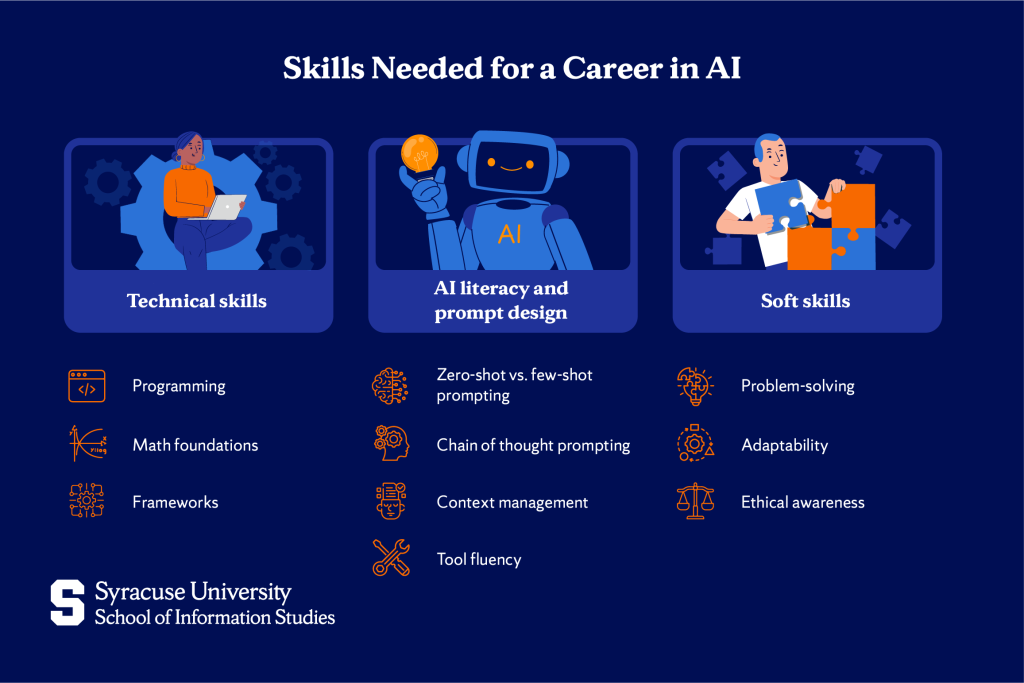
AI careers require a combination of technical ability, tool fluency, and human judgment.
Technical skills (the builder stack)
If you’re pursuing a role that involves building or fine-tuning AI systems, these are non-negotiable:
- Programming: Python is the primary language of AI development; it’s what most frameworks, libraries, and tutorials use. R is useful for statistical work. C++ matters in performance-critical applications like robotics and embedded systems.
- Math foundations: Linear algebra (how data is structured and transformed), statistics and probability (how models are evaluated and outputs interpreted), and calculus (how models learn through optimization). You don’t need to be a mathematician, but you need to be comfortable with these concepts.
- Frameworks: TensorFlow and PyTorch for deep learning; scikit-learn for classical machine learning algorithms. These are the tools you’ll use to build and train models.
AI literacy and prompt design (the user stack)
Even technical practitioners need to be AI-native, meaning they use AI tools throughout their own workflow, not just when building for others. This skill set is also the primary requirement for non-technical AI roles.
- Zero-shot vs. few-shot prompting: Zero-shot means asking the AI to complete a task with no examples. Few-shot means giving it two or three examples of the output you want before asking it to produce its own, which significantly improves consistency and quality.
- Chain of thought prompting: Breaking complex requests into a step-by-step reasoning sequence, either by asking the AI to “think through this step by step” or by structuring your prompt as a series of smaller tasks. This reduces errors on multi-step problems.
- Context management: AI models don’t know what you haven’t told them. Surfacing implied context, such as your role, your audience, and the constraints you’re working within, is what distinguishes surface-level outputs from high-quality results.
- Tool fluency: Knowing when to use a general-purpose chatbot versus a specialized tool. NotebookLM for grounded research where accuracy matters. Perplexity for real-time web search with citations, and MidJourney for image generation. Choosing the right tool for the task is a skill in itself.
Soft skills
These are underrated in AI job descriptions, and overrepresented in what determines career success:
- Problem-solving: AI models fail in non-obvious ways. Debugging a prompt, identifying why a model is underperforming, or tracing a data issue all require methodical thinking.
- Adaptability: The AI tool landscape changes faster than any other technology sector. The ability to pick up new tools quickly, without needing a full course on each one, is genuinely valuable.
- Ethical awareness: Understanding that AI models can be biased, can hallucinate, and can be wrong with complete confidence. Knowing when to trust output and when to verify it is a professional responsibility, not an optional extra.
Educational Pathways Into Artificial Intelligence
There’s no single correct path into AI. The right one depends on your timeline, your goals, and which type of AI work you’re targeting.
- University degrees: A degree in computer science, mathematics, or data science remains the strongest foundation for research-oriented and senior technical roles. If you want to become a data scientist or work in AI research, a formal degree gives you the theoretical depth those roles require.
- Bootcamps and self-directed learning: Faster and more project-focused. Appropriate for applied AI roles, such as ML specialist, AI developer, or data analyst, where demonstrated skill matters more than academic credentials. Requires more self-discipline but has produced strong practitioners.
- Certifications: Google’s AI Essentials, DeepLearning.AI’s specializations on Coursera, and fast.ai’s practical deep learning course are all well-regarded. Certifications work best as supplements to project experience, not replacements for it.
Step-by-Step Guide to Starting an AI Career
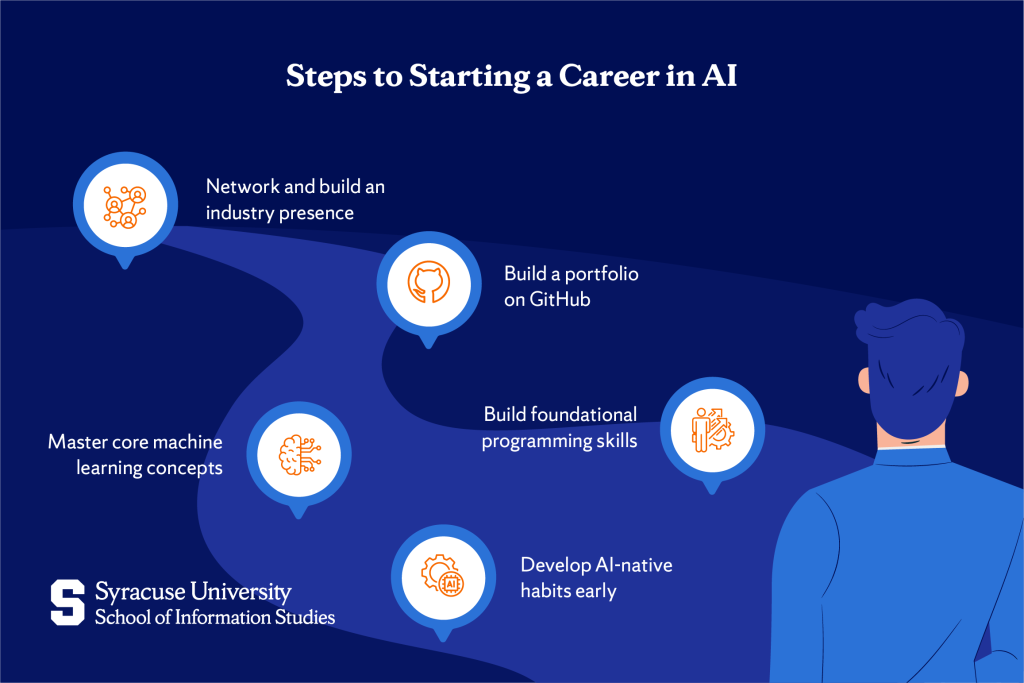
Starting an AI career can feel overwhelming, but it gets easier when you take it step by step. Focus on the basics first, then practice by building projects, and share your work as you improve.
Step 1: Build foundational programming skills
Start with Python and learn the basics: syntax, data structures, functions, and simple algorithms. Take your time, because weak fundamentals will make everything harder later. CS50 (Harvard, free on edX) and the official Python.org tutorial are both good places to begin. Plan to spend four to six weeks building a solid foundation before moving on.
Step 2: Develop AI-native habits early
Don’t just learn to code. Learn to code with AI. From the beginning, use AI tools to help you think, debug, and plan projects, not just as something you’re studying.
Two habits worth building immediately:
- Breadcrumbing: When you use AI to help solve a coding problem or plan a project, save the chat link in your code comments or project documentation. You’ll preserve the reasoning behind decisions (not just the outputs), which is invaluable when you return to a project weeks later.
- Swipe files: Create a personal collection of prompts and AI responses that worked well, such as clear code explanations, helpful frameworks, or structured outputs. Reuse these as examples when prompting in the future. Over time, this collection becomes one of your most valuable tools.
Step 3: Master core machine learning concepts
Learn the core ideas before relying on software tools. Make sure you understand what regression is and why it works before using a library like scikit-learn to run it. Know the difference between supervised and unsupervised learning in simple terms before focusing on which framework to use. Andrew Ng’s Machine Learning Specialization on Coursera, which you can audit for free, is a strong and well-structured place to build these fundamentals.
Step 4: Build a portfolio on GitHub
Keep your projects public and explain them clearly. In AI hiring, what you build matters more than the courses you list. A clear, well-documented project that solves a real problem (even a small one) shows more skill than a long list of certificates.
What to include:
- The problem you chose and why
- The data you used and how you cleaned it
- Which model or approach you selected and why you chose it over alternatives
- What the results showed and what you’d do differently
Write case studies in plain language. If a hiring manager can’t understand what you built, it won’t help your application.
Step 5: Network and build an industry presence
Share your work as you learn, not after. Post what you’re building on LinkedIn, even rough projects. Write short posts about what you learned from a Kaggle competition or a model that behaved unexpectedly. People hire practitioners who are visibly thinking about the field.
Specific actions that make a difference:
- Competing in Kaggle competitions, even finishing mid-leaderboard, shows engagement and gives you something to write about.
- Attending AI-focused hackathons, both for the learning and the connections.
- Engaging with researchers and practitioners on LinkedIn and X; thoughtful comments on technical posts get noticed.
Entry-Level AI Jobs and Career Paths
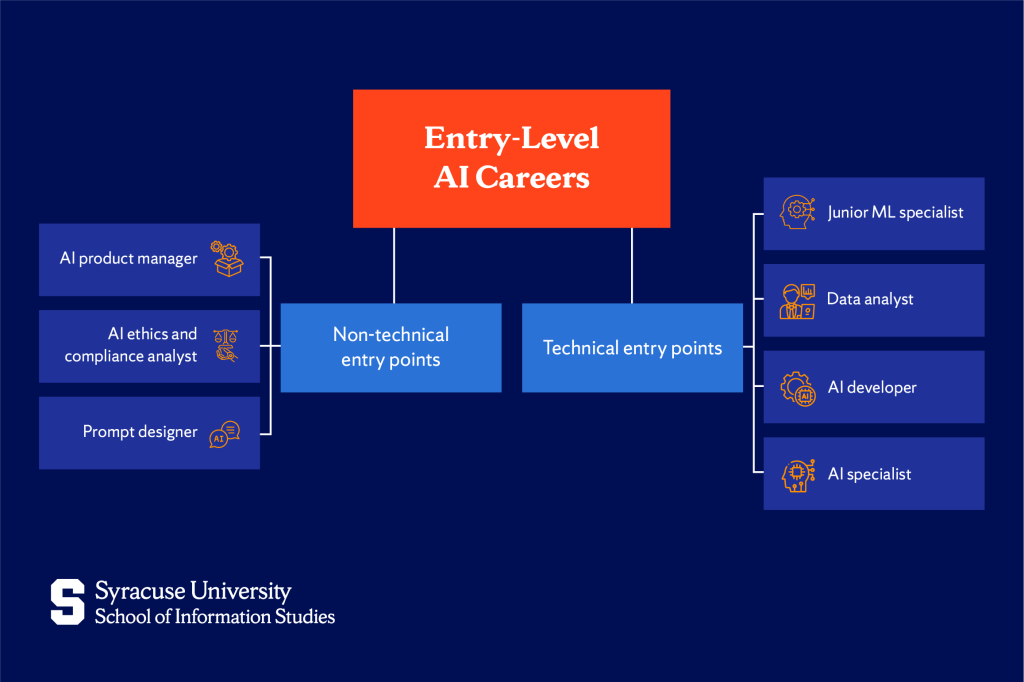
AI offers multiple entry points depending on your background, strengths, and long-term goals. Some roles are deeply technical, while others focus on strategy, operations, or governance within AI-driven teams.
Technical entry points
These roles require hands-on experience with coding, data, and machine learning concepts. They are ideal for those building programming skills and a project-based portfolio.
- Junior ML specialist: Builds and maintains machine learning pipelines. Typically requires Python, ML fundamentals, and a portfolio of projects.
- Data analyst: Works with structured data to produce insights that feed into AI systems and business decisions. A strong entry point for those with some coding ability.
- AI developer: Builds applications powered by AI models, integrating APIs, building agents, and creating end-user tools.
- AI specialist: Focuses on deploying and scaling AI systems in production environments.
Non-technical entry points
Not every AI role requires writing code. These positions focus on strategy, oversight, communication, and applied use of AI systems within organizations.
- AI product manager: Bridges technical AI teams and business stakeholders. Requires understanding of what AI can and can’t do, without necessarily being able to build it.
- AI ethics and compliance analyst: A growing function as regulation around AI expands. Background in law, policy, or philosophy combined with AI literacy is increasingly sought after.
- Prompt designer: A focused but steadily growing role, especially in content teams, legal firms, and healthcare organizations that use AI tools in their daily work. Requires deep fluency with LLM behavior and strong written communication skills.
Salary expectations
Entry-level technical AI roles in the U.S. typically start between $90,000 and $130,000, depending on location, company size, and technical depth. AI researchers regularly earn well above $100,000 in total compensation. Non-technical AI roles vary more widely but have seen significant compensation growth as demand has outpaced supply.
Common Challenges and How to Overcome Them
Stepping into AI often brings confusion, doubt, and frustration, but the obstacles are common and manageable once you understand what they are and how to respond to them.
The “black box” problem
Many beginners feel stuck because they do not fully understand how a model works on the inside. The truth is that even experts with years of experience still do not completely understand what happens inside large models. Instead of worrying about the internal details, focus on what you can see and control: the inputs, the outputs, and how the model behaves. Understanding every internal process is advanced research work, not something you need before you begin.
Hallucinations
AI models can produce confidently stated, completely incorrect information. Never treat AI output as ground truth without verification, especially for factual claims, code logic, or anything that will be published or acted upon. Build fact-checking into your workflow as a default, not an afterthought.
Imposter syndrome
The math anxiety is real and nearly universal among people entering AI from non-technical backgrounds. The antidote isn’t more math, but applied usage. Start building projects before you feel ready. The gaps in your understanding will become obvious through practice, and you’ll close them much faster when you have a specific problem to solve.
Your AI Career Starts With One Decision
An AI career in 2026 is a mix of coding ability, conceptual understanding, and smart tool usage. You now have the map: understand the landscape, build the right skills, create work you can show, and put yourself in rooms where the field is moving.
The most important next step isn’t picking the perfect course, but starting your AI swipe file today: a simple document where you save every prompt, output, and AI interaction that produced something genuinely useful. That file becomes your personal training data for working with AI more effectively over time.
If you want structured mentorship, career-aligned curriculum, and a credential from a nationally recognized program, Syracuse University iSchool’s Applied Human Centered Artificial Intelligence Master’s Degree prepares graduates to build, lead, and ethically deploy AI systems across industries.
Frequently Asked Questions (FAQs)
Is AI hard to learn?
It depends on which part of AI you’re learning. Using AI tools well takes days of deliberate practice, while building and training models from scratch requires months of study in Python, math, and ML fundamentals. Start with the application layer and deepen from there.
How can a beginner start learning AI?
Pick one tool (ChatGPT or Claude), spend a week using it daily for real tasks, and study the Role + Context + Task + Format prompting framework. If you want the technical path, install Python and complete the first module of CS50 before anything else.
Do I need a PhD for AI roles?
For most applied AI roles, like ML specialist, AI developer, data analyst, and AI product manager, no. A PhD is primarily required for research positions at AI labs and academia. Strong portfolios and demonstrated skills increasingly outweigh credential hierarchies in industry hiring.
What is the difference between an AI developer and a prompt designer?
An AI developer builds software systems powered by AI, writing code to integrate models, build agents, and create applications. A prompt designer specializes in crafting the inputs that direct AI behavior, often without coding, typically within content, legal, or operations teams that are building AI-assisted workflows.
How do I stay updated with AI trends?
Follow researchers and practitioners on LinkedIn and X, read the Hugging Face blog and Anthropic’s research updates, and subscribe to newsletters like The Batch (DeepLearning.AI). More importantly, build things: hands-on experimentation teaches you faster than passive reading.