
Key Takeaways
- Becoming a DBA includes four stages: a foundational degree, 1–3 years in an entry-level data or IT role, deep mastery of one database platform, and a vendor-specific certification that hiring managers often require by name.
- Most professionals reach the junior DBA level within two to four years and the senior DBA level within four to six years, depending on how quickly they specialize and which certifications they pursue.
- The U.S. Bureau of Labor Statistics reports a median annual wage of $100,000+ for database administrators, with employment projected to grow 4% through 2034.
Every time a bank processes a transaction or a hospital retrieves a patient record, a database is doing the work in the background, and a database administrator is responsible for keeping it running correctly and at speed. The stakes are high, and because of that, organizations don’t leave database management to chance.
A database administrator (DBA) manages the performance, security, availability, and integrity of an organization’s databases. The path to becoming one follows four stages: a degree that builds the foundational knowledge, hands-on experience in entry-level data or IT roles, deep mastery of a specific database platform, and the industry certifications that signal technical credibility to employers.
Steps to Become a Database Administrator
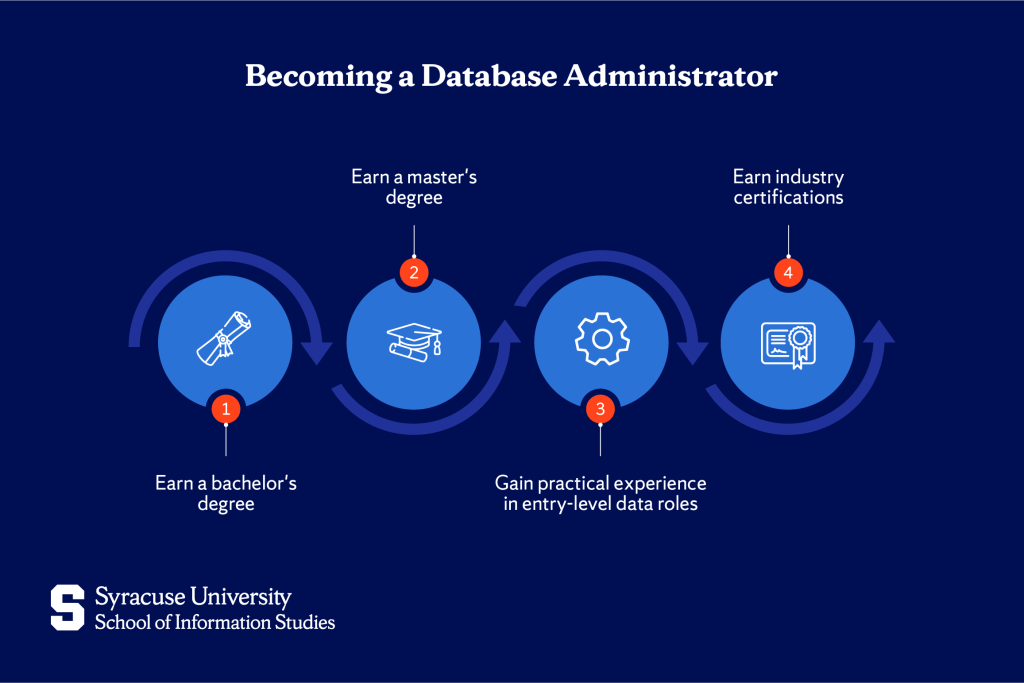
DBA roles are almost never filled directly from a bootcamp or a new graduate’s first job search. The field rewards specialization that develops over time, typically through two to three years in adjacent IT or data positions before moving into a dedicated DBA role.
Earn a bachelor’s degree
The most common undergraduate majors for aspiring DBAs are information systems, information management and technology, computer science, and applied data science. DBA work combines data and IT systems administration, meaning two distinct undergraduate tracks map well to the role: one IT-focused, one data-focused.
No matter which track you choose, some courses are especially important: database systems, SQL, operating systems, networking basics, and information security. These subjects give you the foundation for DBA work. You can find them in both IT-focused and data-focused programs, although each program may give them a different amount of attention.
At Syracuse University’s iSchool, two undergraduate pathways prepare students for DBA careers. The Bachelor’s in Information Management and Technology takes the IT-focused route, with deeper coverage of systems administration, networking, and information security (well-suited for students who see themselves moving into broader IT operations or database management in an enterprise environment). The Bachelor’s in Applied Data Science takes the data-focused route, with deeper coverage of database systems and analytics, which is a better fit for students who see themselves moving toward data architecture or cloud database work over time.
Earn a master’s degree
A master’s degree is genuinely optional for DBA work. Many working DBAs hold a bachelor’s plus certifications and never pursue a graduate degree, and that combination is enough to land and hold a strong junior-to-mid-level DBA role. A master’s becomes valuable when you’re targeting senior DBA positions at large enterprises, database team lead roles, or the longer-term transition into data architecture.
For the IT-focused track, iSchool’s Master’s in Information Systems covers enterprise systems, data management, IT governance, and project management, preparing DBAs to move into management or lead database infrastructure decisions at the organizational level. Working professionals already in junior DBA or IT roles can pursue the online Master’s in Information Systems as a flexible option that doesn’t require stepping away from a full-time position.
For the data-focused track, iSchool’s Master of Applied Data Science covers database systems, data engineering, machine learning, and large-scale data infrastructure. This technical depth bridges senior DBA work into data architecture roles. The online Master’s in Applied Data Science offers the same curriculum for working professionals who need scheduling flexibility.
Gain practical experience in entry-level data roles
Most DBAs start in positions that expose them to production databases without giving them full DBA responsibility. The pattern is consistent across the field: someone shows a strong aptitude for database work while in a broader IT or data role, then specializes. Trying to step directly into a DBA role without that foundation is difficult. Employers usually expect you to already know what a production database environment looks like under pressure.
There are three entry-level paths that most reliably lead to DBA careers. The most direct is usually database support or IT operations. People who start in IT support and spend a lot of time handling database tickets, such as slow queries, backup failures, and access requests, can often move into junior DBA roles within a year or two once they show the right aptitude.
The second is data analyst work. Analysts who go deeper into SQL and database internals, rather than into visualization or statistics, frequently find that their interests and skills align more closely with DBA work than with analysis.
The third is junior developer roles with a database focus. Application developers who spend more of their time on stored procedures, database design, and query optimization sometimes end up shifting into DBA work as that focus becomes more specific over time.
A realistic timeline looks like this:
- Years 1–2: Start in an entry-level data or IT role while building SQL fluency and getting regular exposure to databases.
- Years 3–4: Move into a junior DBA role and begin taking responsibility for specific database environments.
- Years 5–6: Grow into a mid-level DBA role, managing production systems with more independence.
- Year 7 and beyond: Progress into a senior DBA role, database team lead position, or move toward data architecture.
Earn industry certifications
In most fields, certifications are a plus, but in DBA work, they’re often a requirement. Many DBA job listings specify a vendor certification by name, and hiring managers at organizations running Oracle or SQL Server environments routinely filter candidates who lack the relevant credential. Treating certifications as optional in this field is a mistake.
The major certifications to know:
- Oracle Database Certified Professional (OCP), the most established DBA certification, still dominant in large enterprise environments that run Oracle databases.
- Microsoft Certified: Azure Database Administrator Associate, the current Microsoft path for DBAs working in SQL Server and Azure-managed database environments.
- MongoDB Certified DBA Associate, the standard credential for DBAs working primarily in NoSQL environments.
Which certification to pursue first depends on one thing: which database platform your current or target employer uses. If you’re not yet employed in a database role, research the job listings you’re targeting and match your first certification to the platform that appears most often.
Essential Skills and Qualities of a Successful Database Administrator
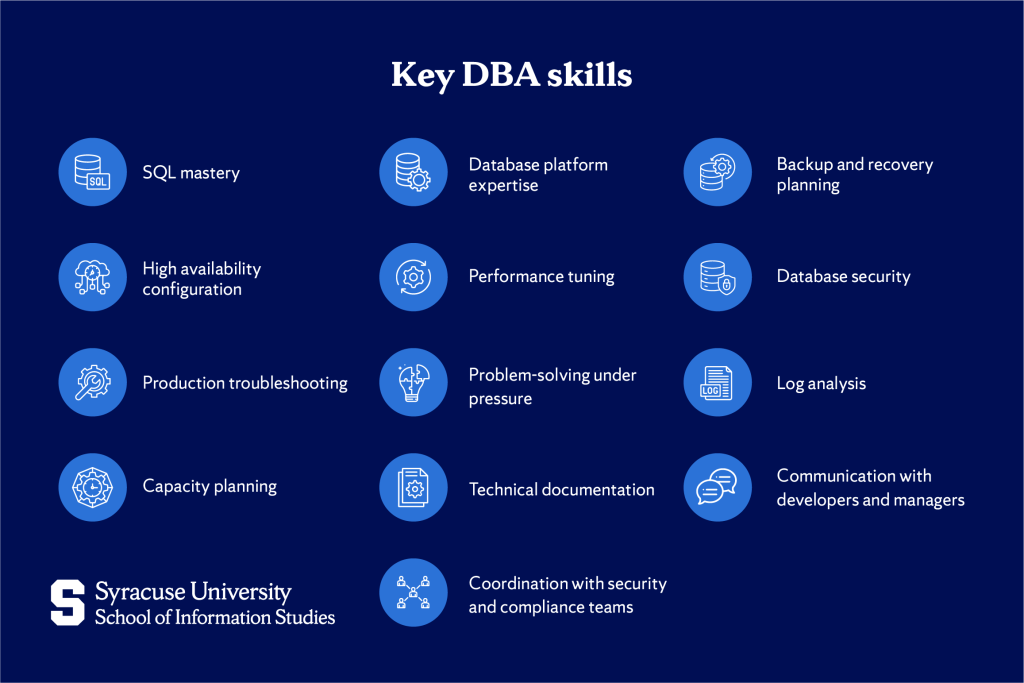
Working DBAs combine deep technical expertise in a specific database platform with the operational discipline to keep production systems running reliably, and the communication skills to coordinate with developers, security teams, and business stakeholders who all have competing priorities. Some of these skills develop through formal education; others only come from years of working with production databases.
Technical proficiency
A working DBA needs genuine fluency across several technical areas:
- SQL mastery: Query writing, query optimization, stored procedures, triggers, and index management. This is the foundation of all DBA work, regardless of which platform you specialize in.
- Database platform expertise: Deep knowledge of one or more of Oracle, Microsoft SQL Server, MySQL, PostgreSQL, or MongoDB. DBAs are platform specialists, not generalists, and depth in one platform consistently outperforms surface familiarity across several.
- Backup, recovery, and high availability: Replication, clustering, failover configuration, and disaster recovery planning. This is the operational side of DBA work that distinguishes the role from a developer who happens to know SQL.
- Performance tuning: Query optimization, index strategy, execution plan analysis, and capacity planning. This is where senior DBAs add the most value to their organizations, and it’s where the gap between good and exceptional DBA work is most visible.
- Database security: Access control, encryption at rest and in transit, audit logging, and compliance requirements such as SOC 2, HIPAA, and GDPR. Security is increasingly central to the DBA role as regulatory requirements tighten.
Problem-solving and troubleshooting
A working DBA spends a significant portion of their time diagnosing production problems: a query that ran in milliseconds yesterday is taking 30 seconds today; a backup completed successfully but won’t restore. The job rewards methodical thinking under pressure, including reading logs carefully, isolating variables, testing hypotheses, and making fixes without introducing new failures elsewhere in the system.
For example: tracing a 3 AM database slowdown to an index rebuild that ran incorrectly the previous evening requires reading the right logs, cross-referencing the change history, understanding the execution plan differences, and applying a fix in a window narrow enough not to affect morning operations. That kind of methodical, time-pressured reasoning is what the role demands daily.
Communication and documentation
Communication in a DBA role is concrete and practical. Three activities describe most of it:
- Writing runbooks for routine operations, like backups, restores, patching, and failover procedures, being clear enough that another team member can execute them correctly at 2 AM without guidance.
- Communicating database constraints and capacity limits to application developers and managers in terms they can act on. Example: not “the indexes are fragmented” but “this query is going to start timing out at the current data growth rate within six weeks.”
- Coordinating with security and compliance teams on access controls, audit logging, and regulatory requirements, translating technical database configurations into compliance language and vice versa.
Salary and Job Outlook
The U.S. Bureau of Labor Statistics reports a median annual wage of $104,620 for database administrators. Employment is projected to grow 4% from 2024 to 2034, about as fast as the average for all occupations, reflecting the continued need for professionals who can manage, secure, and maintain database systems as organizations expand their data infrastructure.
Platform-specific DBAs, such as Oracle DBAs in large enterprise environments or senior cloud DBAs working with AWS or Azure, may earn above the BLS median. Senior roles at major technology companies, financial services firms, and other data-heavy organizations can offer especially strong compensation, particularly when the role involves production systems, cloud migration, performance tuning, or database architecture.
Your Path Forward as a Database Administrator
The path to a DBA career comes down to four moves in the right order: earning a foundational degree, gaining entry-level exposure to production databases, specializing deeply in one platform, and adding the certification that proves that expertise.
One principle matters throughout that process: DBA careers reward depth over breadth. A DBA who knows Oracle or SQL Server extremely well will often out-earn someone who knows several platforms only at a surface level. The role is also changing rather than disappearing. Modern DBAs increasingly manage cloud database services such as AWS RDS, Azure SQL, and Google Cloud SQL instead of manually installing and patching server software. The technical demands are different, but the need for skilled people to manage those systems remains.
At Syracuse University’s iSchool, the Master’s in Information Systems and the Master of Applied Data Science both prepare graduates for senior database roles, one through an enterprise IT and database management lens, the other through a database systems and data engineering lens. The right fit depends on where you want to be in ten years: leading database infrastructure across an organization, or bridging senior DBA work into data architecture. Explore both programs to find your starting point.
Frequently Asked Questions (FAQs)
How long does it take to become a database administrator?
Most people reach a junior DBA role within two to four years, after completing a bachelor’s degree and spending one to two years in a database support or data analyst position. Senior DBA level is typically achievable within four to six years of starting that path.
Can you become a database administrator without a degree?
It’s possible but uncommon. Some DBAs enter the field through IT support roles and self-study, pairing platform certifications like Oracle OCP or CompTIA Database+ with hands-on experience, though most employers at established organizations list a bachelor’s degree as a baseline requirement in job postings.
Is becoming a database administrator worth it?
For people who enjoy methodical problem-solving and working close to production systems, the role offers strong compensation: a BLS median of $100,000+ and stable demand projected to grow 4% through 2034.