
Key Takeaways
- The clearest path to a data architect role follows four stages: a foundational bachelor’s degree, a master’s that develops systems-level depth, five to seven years of experience in adjacent data roles, and architecture-level certifications from vendors like AWS, Google, or Microsoft.
- Most professionals reach the data architect title within seven to ten years of entering the data field.
- Systems thinking is one of the most important skills for a data architect. It means designing data systems that can still work well years later as data volumes grow, regulations change, and business needs shift.
As organizations move critical data infrastructure to the cloud, build AI systems on top of that infrastructure, and face tightening regulatory requirements around data governance and privacy, the professionals who design those systems have become some of the most sought-after in the field. The data architect role has moved from a specialized database design function to a senior strategic position that influences how entire organizations structure, govern, and use their data.
Reaching that role is a 7–10 year progression. How to become a data architect involves combining a formal degree, hands-on experience in data-related roles, growing technical responsibility, and senior-level certifications that show employers you can design reliable data systems.
Strong data architects understand databases, data pipelines, cloud platforms, and system design, but they also know how to turn business needs into systems that can support the organization for years.
Steps to Become a Data Architect
Most professionals start with a relevant degree, then build experience in database administration, analytics, data systems, or other roles that involve managing data, layered with technical specialization and architecture-level certifications as the career progresses.
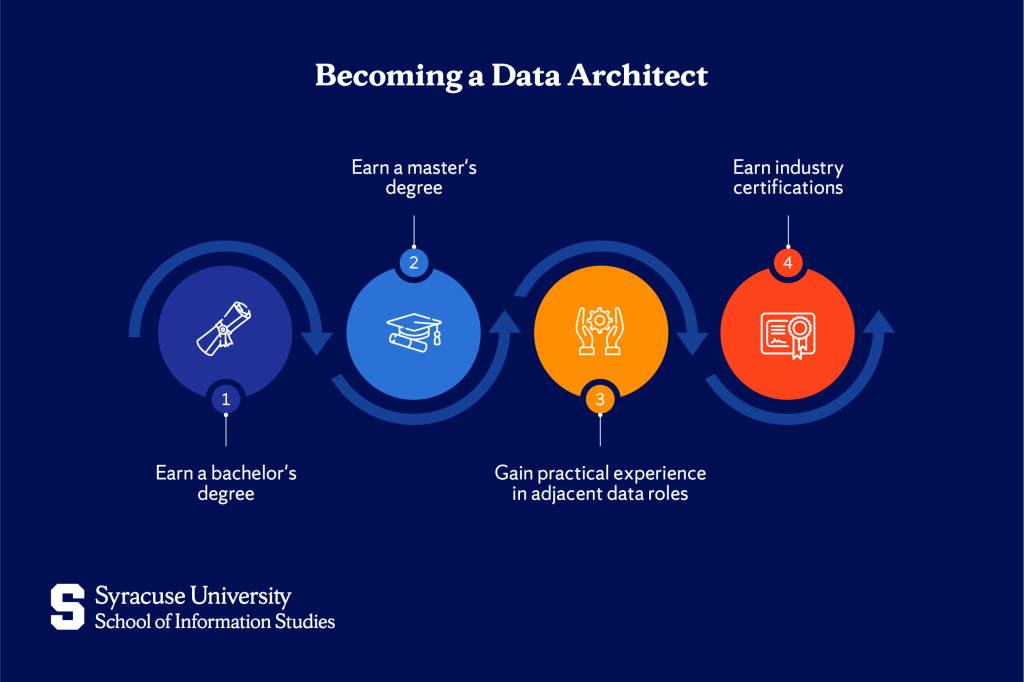
Step 1: Earn a bachelor’s degree
The most common undergraduate majors for aspiring data architects are computer science, information systems, and data science. The specific major matters less than what it teaches; strong foundational work in database systems, data structures, statistics, and systems design is what prepares a graduate for the kind of technical work that eventually leads to architectural responsibility.
Students choosing a degree path should look for programs that cover relational database design, SQL, software architecture, and introductory machine learning. Data architects may not use all of these every day, but each one helps build the systems-level thinking needed for senior data roles.
The iSchool’s Applied Data Science Bachelor’s Degree prepares students for advanced data roles through a curriculum that combines database management, applied analytics, programming, data mining, and big data analytics. That mix gives students the technical foundation needed for career paths that may later lead toward data architecture.
Step 2: Earn a master’s degree
A master’s degree is not required for every data architect role, but it can help candidates stand out for senior positions. It can also shorten the path to architect-level work by giving students deeper training in data modeling, governance, and systems design, areas that usually take longer to develop through work experience alone.
Employers in regulated industries, such as finance, healthcare, and government, may prefer or require a master’s degree for data architect roles specifically because the complexity of their data environments demands more than platform familiarity. In these roles, architects need to understand data governance, compliance requirements, data lineage, and system design. A structured graduate program is one of the most reliable ways to develop that breadth before being put in charge of it.
iSchool’s Master’s in Applied Data Science covers data modeling, machine learning, large-scale data systems, and applied data ethics. This combination of technical depth and governance awareness can support students preparing for architect-track roles in data-intensive industries. The program’s capstone work also gives students experience with end-to-end systems thinking, which is central to senior data architecture work.
That career focus also appears in the student experience. As Applied Data Science master’s student Lily Coyle wrote, “Our professors… infuse real-world applications into every lesson,” while showing how those skills “translate directly into our future careers.”
For working professionals who need scheduling flexibility, the Online Applied Data Science Master’s Degree delivers the same curriculum in a format designed for people already in data roles who are building toward more senior positions.
Step 3: Gain practical experience in adjacent data roles
The data architect title is usually earned through experience. Most data architects spend five to seven years in related roles before taking on architectural responsibility. That time matters because it teaches them how systems break, how data quality problems appear, and how business needs change over time.
Some adjacent roles lead into data architecture more directly than others, such as:
- Data pipeline specialist: This role focuses on building and maintaining data pipelines, ETL/ELT processes, and the systems that move data across an organization. Professionals in this area are closest to the architecture function because they work with the structures that data architects often design. When they begin asking why a system was built a certain way and how it could be improved, they are already developing architect-level thinking. This is the closest and most common path.
- Database administrator: A DBA manages database performance, security, reliability, and access at the operational level. This experience builds deep knowledge of how databases behave in production, especially under pressure. Data architects rely on that kind of knowledge when designing systems that need to remain stable and secure over time.
- Data analyst: A data analyst works closely with business stakeholders, translating business questions into data queries and findings. Analysts who develop strong SQL depth and start engaging with data model design frequently can move toward architecture because they understand both the business side and the technical side of data work.
A realistic career arc often starts with years one through three in a junior data or IT role, where professionals build technical fundamentals. Years four through six usually involve more responsibility as a senior data specialist, DBA lead, or analytics lead. By years seven through ten, professionals who specialize deliberately may begin moving into data architect or principal-level roles, with the formal architect title often appearing around years seven to nine.
Step 4: Earn industry certifications
Certifications signal current technical proficiency in a field where tools and platforms change quickly. They are most valuable when paired with real hands-on work, helping prove that your experience is up to date and tied to a specific platform.
For data architect careers, two categories of certifications matter:
- Platform-specific data certifications (most useful in years one through five): These credentials show experience with major cloud, database, analytics, and data management platforms, such as AWS, Google Cloud, Microsoft Azure, IBM, Oracle, or Snowflake. One relevant example for data architect careers is the IBM Certified Data Architect credential.
- Architecture and data management frameworks (most useful at the senior/architect transition): The TOGAF (The Open Group Architecture Framework) can support organization-wide architecture work. The CDMP (Certified Data Management Professional) credential from DAMA International is closely tied to data governance and data management at the architect level.
Vendor certifications should be refreshed every 18–24 months as platforms evolve; TOGAF and CDMP hold longer but benefit from continuing education to stay current with evolving data governance frameworks.
Essential Skills and Qualities of a Successful Data Architect
Data architects need strong technical skills, but they also need to understand how systems and business needs connect. Their work is less about managing one database or data process and more about designing how data should move, be stored, and support decisions across an organization. Some of these skills develop through formal education; others only emerge after years of working with different systems, teams, and business problems.
Technical proficiency
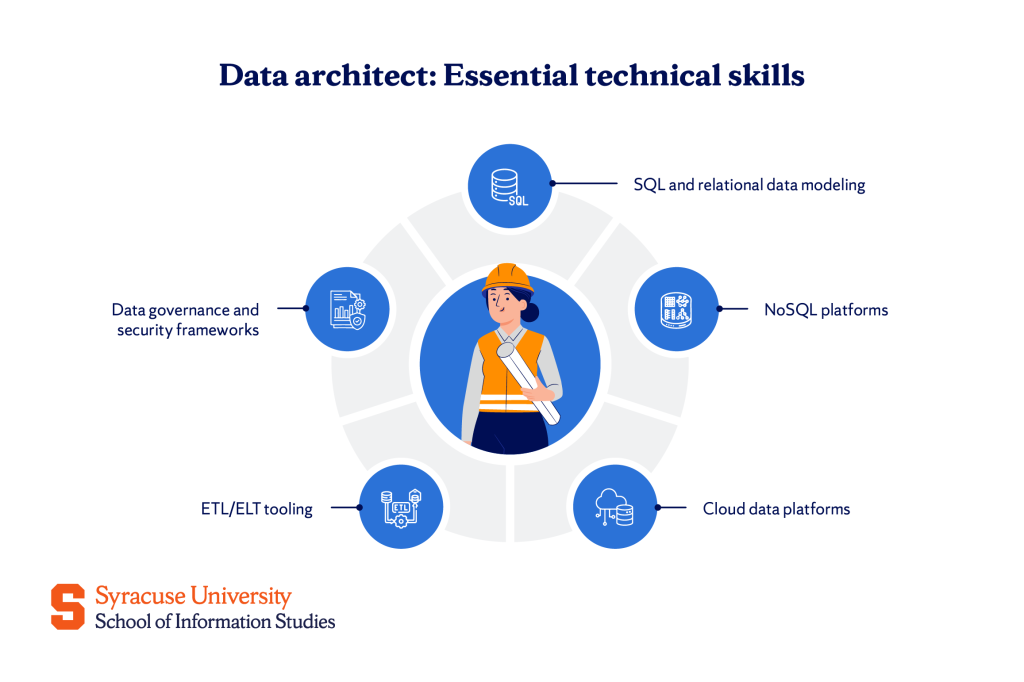
A data architect needs strong technical knowledge across several areas:
- SQL and relational data modeling: Data architects need an understanding of SQL, schema design, normalization, dimensional modeling, and the trade-offs between performance, flexibility, and long-term maintenance.
- NoSQL platforms: They should also understand when non-relational databases such as MongoDB, Cassandra, or DynamoDB are a better fit than traditional relational databases.
- Cloud data platforms: Modern data architects often work with platforms such as Snowflake, Amazon Redshift, Google BigQuery, and Azure Synapse. In many organizations, familiarity with more than one cloud environment is increasingly expected.
- ETL/ELT tooling: Tools such as Informatica, dbt, and Apache Airflow help move and prepare data. Architects need to understand how pipeline decisions affect data freshness, lineage, governance, and reliability.
- Data governance and security frameworks: Data architects must design systems with privacy, compliance, and security in mind from the beginning. This can include requirements tied to GDPR, HIPAA, SOC 2, or other industry standards.
Systems thinking and design
Systems thinking is one of the most important skills for a data architect. It means designing data systems that can still work well years later as data volumes grow, regulations change, and business needs evolve.
For example, a data architect designing a customer data platform has to think beyond the company’s current needs. The system may need to support a future acquisition, connect customer records from different sources, or share data safely across teams and applications. To prepare for that, the architect makes early decisions about schema flexibility, identity matching, access rules, and system connections.
That forward-oriented design thinking is what the architect’s role uniquely requires. It usually develops through years of working with complex systems and seeing how design choices affect performance, reliability, and long-term use.
Communication and stakeholder management
Data architects need to explain technical decisions in ways that different teams can understand. A large part of the role involves turning business needs into data models, which means understanding what stakeholders are really asking for before designing the system that supports it.
They also work across analytics, security, compliance, product, and IT teams, where priorities may not always match. One team may need faster access to data, while another may need stricter controls or clearer governance. The architect has to balance those needs without weakening the overall design.
This communication becomes especially important with senior leadership. Data architects often need to explain why a technical decision affects cost, risk, performance, or future flexibility. They also need to show when a business request is possible, what trade-offs it creates, and what the organization should consider before moving forward.
Career Paths and Specializations in Data Architecture
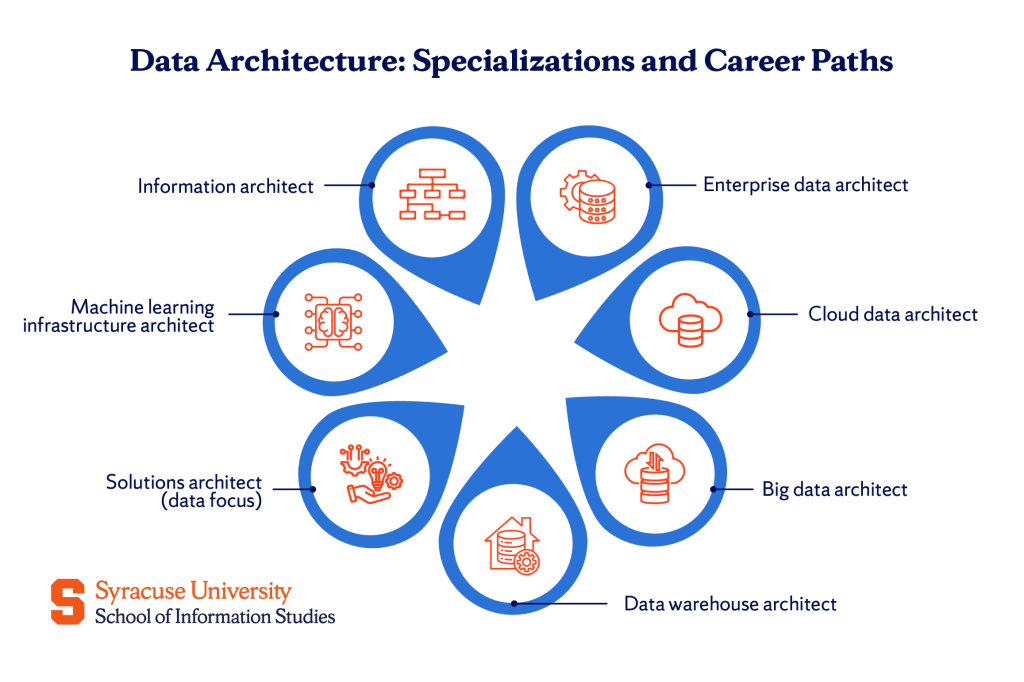
Data architect is a category of senior positions that branches based on the technology stack and industry context. Once professionals reach this level, they often specialize in one of the following directions:
- Enterprise data architect: Designs data systems across an entire organization. This role often works closely with senior technology and data leaders and requires strong coordination across departments.
- Cloud data architect: Designs data systems on cloud platforms such as AWS, Azure, or Google Cloud. This specialization is common in organizations moving more of their data storage, processing, and analytics work to the cloud.
- Big data architect: Focuses on large-scale data environments, including high-volume data, real-time streaming, and distributed systems. These roles are often found in technology, finance, telecommunications, and other data-heavy industries.
- Data warehouse architect: Designs analytical data stores that help organizations report on performance, study trends, and support decision-making. Common platforms include Snowflake, Amazon Redshift, Databricks, and similar tools.
- Solutions architect (data focus): Designs larger technology systems where data architecture is a major part of the overall solution. These roles may be client-facing, especially in consulting, cloud services, or professional services settings.
- Machine learning infrastructure architect: Designs the data and computing environment needed to support machine learning and AI work at scale. This can include data pipelines, model deployment systems, storage, processing, and monitoring.
- Information architect: Works with data, metadata, taxonomy, content structure, and knowledge management. This role may overlap with library and information science in organizations that manage large collections of documents, records, research materials, or unstructured content.
Salary and Job Outlook
The U.S. Bureau of Labor Statistics reports a median annual wage of $135,000 for database architects. Employment is projected to grow 4% from 2024 to 2034, as fast as the average for all occupations, reflecting the expanding need for professionals who can manage and design data systems across cloud platforms, AI-driven environments, and regulated industries.
Senior data architect roles often pay well above broad BLS medians for software and data occupations, with U.S. averages in the $135,000–$180,000 range and top-paying industries like technology, finance, healthcare, consulting, and large enterprises frequently offering total compensation well into six figures.
Tips for Success in a Data Architect Career
Earning the data architect title is an important milestone, but long-term growth depends on how consistently you keep your skills, visibility, and professional network current. Data architecture changes quickly, especially as cloud platforms, AI tools, governance rules, and data systems continue to develop.
- Keep certifications current: Cloud platforms change often, with new services, updated tools, and shifting best practices. For platform-specific certifications, it is useful to refresh your knowledge every 18–24 months or add a new credential when your role moves toward a new system.
- Build a portfolio of architecture diagrams: When possible, document systems you have helped design, while removing any confidential company details. A portfolio can include architecture diagrams, sample data flows, and short explanations of why certain design choices were made. A well-documented architecture decision record (ADR) can be more convincing than a certification.
- Share your work publicly: Presenting at industry events, local data groups, or professional association meetings can help build visibility. A short talk about a design decision, a lesson learned from a project, or a data architecture pattern you have used can show senior peers how you approach complex problems.
- Build a professional network: Organizations such as DAMA International can help data professionals connect with others working in data governance, architecture, and management. Joining a chapter or taking part in discussions can expose you to architect-level conversations before you formally hold the title.
The Bottom Line
Data architecture has become a strategic role in modern technology. Data architects now help decide how data systems support AI, governance, cloud platforms, and long-term business needs. That wider responsibility is why the path often takes 7–10 years and why the role carries strong value.
At Syracuse University’s iSchool, the Applied Data Science Master’s Degree helps students build the modeling, cloud, governance, and systems-thinking skills that can support architect-track careers. The program is a strong fit for students who want to move toward senior data roles, including enterprise data architecture, cloud data architecture, or machine learning infrastructure. Explore the curriculum to see how it connects with the direction you want to take.
Frequently Asked Questions (FAQs)
How hard is it to become a data architect?
The role is demanding, but it is achievable with the right preparation. The main challenge is that data architects need depth in several areas at once: database systems, cloud platforms, data governance, and stakeholder communication.
How many years does it take to become a data architect?
Most professionals reach the data architect title in seven to ten years after entering the data field. They typically spend the first six years in roles related to data systems, database administration, or analytics before moving into architect-level responsibility between years seven and ten.
Is becoming a data architect worth it?
For professionals who enjoy systems-level thinking and technical leadership, data architecture can be a strong career path. BLS reports a median annual wage of $135,000 for database architects, with 4% projected job growth from 2024 to 2034. Senior roles can pay higher, especially in technology, finance, healthcare, consulting, and large enterprises.