
Key Takeaways
- AI copilots embedded in analytics platforms, including Microsoft Copilot in Power BI, Tableau Pulse, and ThoughtSpot Sage, are changing what analysts do day-to-day by handling routine queries and surface-level narrative generation, not eliminating the role.
- Real-time streaming and cloud lakehouse architectures built on platforms like Snowflake, Databricks, and Microsoft Fabric are replacing batch reporting and on-premise warehouses as the default data stack across organizations of every size.
- Analysts who thrive in the next decade will combine foundational technical depth in SQL, statistics, and Python with AI literacy and one deliberate domain specialty (rather than chasing every new tool or framework).
The U.S. Bureau of Labor Statistics projects strong growth for data science and closely related analytics roles, with employment projected to grow 34% through 2034. That number alone suggests the data analytics field is expanding, not contracting. What it doesn’t show is how thoroughly the work itself is being reorganized.
The future of data analytics is undergoing the most significant change since cloud storage made warehousing affordable, driven by AI integration, real-time decision-making, stronger data governance requirements, and the spread of analytics across business functions. Each force is growing on its own, but together they are changing the profession faster than many training programs have adapted. The seven trends below explain what is changing, why it matters, and what it means for analysts building careers in this environment.
Why Data Analytics Is Evolving Now
Several forces are changing data analytics at the same time. Generative AI is making some analytical tasks easier for non-technical users, which raises expectations for what analysts need to contribute beyond basic reporting. Cloud platforms and streaming tools have also made real-time analytics more practical, so more businesses now expect faster answers instead of waiting for scheduled reports.
Laws and frameworks such as the EU AI Act, GDPR, CCPA, and new state-level AI rules are making data governance harder to ignore, especially when analytics affects hiring, finance, healthcare, education, or public services.
Business expectations have changed too. McKinsey’s 2025 State of AI report found that 88% of organizations now use AI in at least one business function, up from 78% the year before. At the same time, most organizations are still in the experimenting or piloting stage rather than fully scaling AI across the enterprise. That combination explains why analytics work is changing so quickly: leaders want predictive insights, automation, and clearer guidance from data, but many organizations are still learning how to build the systems, workflows, and governance needed to support them.
7 Trends Shaping the Future of Data Analytics
The trends below are connected, so understanding them as a system matters as much as understanding each one individually.
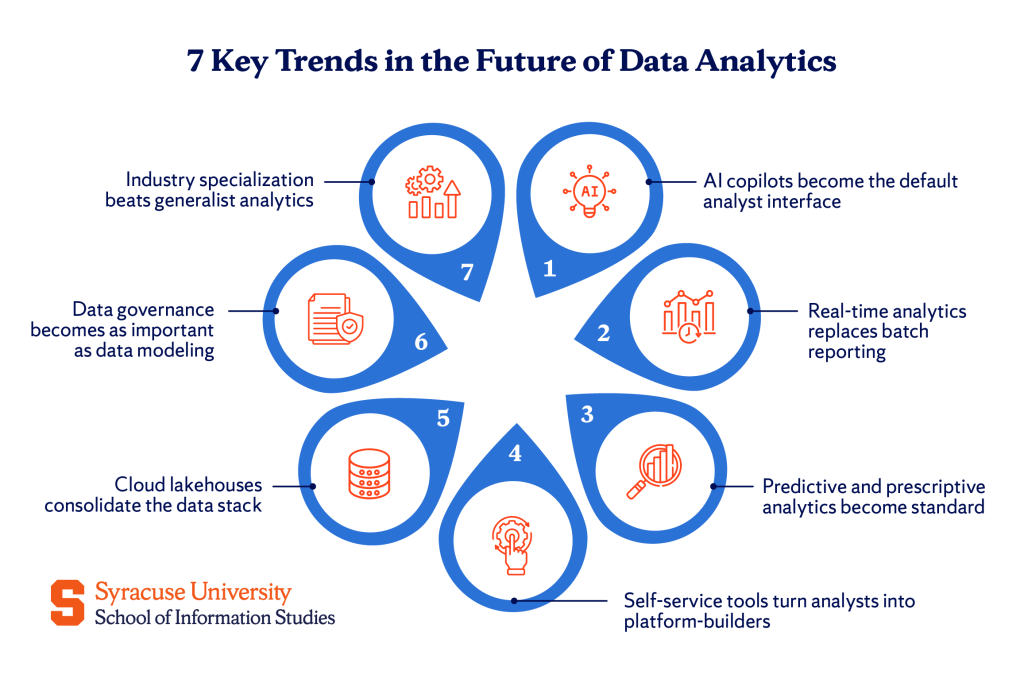
AI copilots will become the default analyst interface
The shift: Traditional BI tools required analysts to write SQL queries, build dashboards manually, and draft narratives from scratch. AI copilots embedded inside analytics platforms now generate queries from natural language, auto-create visualizations, write summary narratives, and surface anomalies the analyst never thought to ask about.
Why it matters: Routine analytical work that took hours now takes minutes. The cognitive bottleneck has moved from “how do I write this query” to “what question should I be asking,” which is a fundamentally different and more valuable kind of work.
Concrete signal: Microsoft Copilot in Power BI generates DAX formulas from plain English descriptions. Tableau Pulse surfaces insights proactively without being prompted. ThoughtSpot Sage answers business questions through chat. Snowflake Cortex embeds large language models directly inside the warehouse so analysts can query governed data in natural language.
What it means for analysts: AI literacy is becoming a baseline skill on par with SQL. Analysts who can effectively prompt, critically evaluate, and responsibly integrate AI-generated analysis into governed workflows will consistently outperform those who can’t.
Real-time analytics will replace batch reporting for most decisions
The shift: Analytics is moving from batch processing (data refreshed nightly or hourly) to streaming and real-time architectures where the window between event and insight has compressed from hours to milliseconds.
Why it matters: Business decisions that historically waited for the morning dashboard now happen continuously. Fraud detection, dynamic pricing, supply chain re-routing, and personalization all run on streaming data. Analysts need to think in event-driven terms rather than periodic-report terms.
Concrete signal: Apache Kafka is now used by more than 80% of Fortune 100 companies, which shows how central event streaming has become to modern data infrastructure. Companies such as Uber, Netflix, and Stripe rely on real-time data systems for use cases like marketplace decisions, personalization, operational monitoring, and fraud detection, where stale data can quickly lead to worse decisions.
What it means for analysts: Analysts who understand event-driven architecture, streaming SQL tools like Apache Flink or Materialize, and the practical difference between batch and stream processing will be in significantly higher demand than those whose mental model stops at the nightly refresh.
Predictive and prescriptive analytics will move from specialty to standard
The shift: Analytics is moving up the value chain, from descriptive (“what happened”) through diagnostic (“why it happened”) to predictive analytics (“what will happen”) and prescriptive (“what should we do”). The frontier is no longer dashboards; it’s recommendation engines, optimization models, and decision automation.
Why it matters: A descriptive dashboard tells you sales dropped 12% in Q3. A prescriptive model tells you which 47 customer segments to target with which offer to recover $4.2M in projected revenue. The value differential is substantial, and organizations are paying premiums for analysts who can build and interpret the latter.
Concrete signal: Amazon uses advanced forecasting systems to predict demand and guide inventory decisions at massive scale. In healthcare, prescriptive analytics helps identify patients at risk of readmission before discharge. Large retailers such as Walmart use AI and predictive analytics to improve demand forecasting, inventory placement, and supply chain decisions.
What it means for analysts: Statistics, machine learning fundamentals, and optimization techniques are migrating from data-science territory into the analyst’s expected toolkit. Knowing when to build a model versus when to build a dashboard is becoming a core judgment call.
Self-service tools will shift analysts from query-runners to platform-builders
The shift: Analytics tools are increasingly designed for non-technical users (marketers, product managers, operations leads) to build their own queries, dashboards, and reports without filing a ticket with the data team.
Why it matters: Business teams move faster because they no longer have to wait for analysts to answer every request. At the same time, analysts take on a more strategic role: building reusable data models, trusted metrics, and self-service templates that other teams can use safely.
Concrete signal: Google says more than 10 million people use the Looker product family each month, and Microsoft includes Power BI Pro in Microsoft 365 E5. As more teams use data directly, tools like Cube and dbt’s Semantic Layer help keep metrics consistent across the organization.
What it means for analysts: Senior analysts spend less time pulling numbers and more time designing the infrastructure that lets business users answer their own questions. Communication, data modeling, and stakeholder education skills rise in value; analysts who only run queries face increasing pressure from the tools themselves.
Cloud lakehouses will consolidate the data stack
The shift: The data stack is consolidating around cloud-native platforms that combine data warehouse capabilities (structured, SQL-friendly, and fast) and data lake capabilities (unstructured, scalable, and cheap) into a single lakehouse architecture.
Why it matters: Analysts no longer have to choose between SQL on structured data and Python or ML on unstructured data. They work in one environment with one set of analytics tools. Costs become usage-based rather than capacity-based, which changes how teams scope projects: more experimentation, less commitment up front.
Concrete signal: Snowflake reported more than $3.4 billion in fiscal 2025 product revenue and over 11,000 customers. Databricks reached a $62 billion valuation in 2024, after previously being valued at $43 billion in 2023. Microsoft Fabric, launched in 2023, brought Power BI, Azure Synapse Analytics, and Azure Data Factory into one unified analytics platform.
What it means for analysts: Cloud platform fluency, specifically, genuine depth in one of Snowflake, Databricks, or BigQuery, is now expected. On-premise data warehouse experience is increasingly viewed as legacy. Broad surface-level familiarity with all three platforms is worth less than real depth in one.
Data governance will become as important as data modeling
The shift: Regulatory pressure from the EU AI Act, GDPR, CCPA, and state-level US AI laws, combined with public scrutiny from high-profile AI failures, has moved data governance from an afterthought to a first-class infrastructure concern.
Why it matters: A poorly governed analytics function exposes organizations to regulatory fines, litigation, and reputational damage. High-profile cases, such as the COMPAS recidivism algorithm, Amazon’s hiring AI shutdown, and GDPR fines totaling hundreds of millions of euros, have made executives serious about treating governance as core infrastructure.
Concrete signal: Wavestone’s 2024 Data and AI Leadership Executive Survey found that 89.8% of participating senior data and AI leaders held the title of Chief Data Officer or Chief Data and Analytics Officer. Deloitte’s 2026 CDAO survey also found that 94% of CDAOs expect their influence to grow over the next year. Data observability tools such as Monte Carlo, Great Expectations, and Soda reflect the same shift: data quality and reliability are becoming core parts of the modern data stack.
What it means for analysts: Governance literacy, including data lineage, PII handling, model risk management, and regulatory requirements, is no longer optional. Analysts in healthcare, finance, and insurance will feel this shift first, but every analyst needs enough governance knowledge to work with data responsibly.
Industry specialization will beat generalist analytics
The shift: General-purpose data analysts are competing with industry specialists who combine analytical skill with deep domain expertise. The most active job postings specify the industry first (“healthcare data analyst,” “supply chain analyst,” “marketing analytics manager”) rather than the role-generic “data analyst.”
Why it matters: Generic analytics is becoming a commodity, especially as AI tools handle more routine work. The differentiator is domain depth: knowing the specific metrics, regulatory environment, data sources, and business model of an industry well enough to ask the right questions and interpret the answers accurately.
Concrete signal: Healthcare analytics is growing as providers, payers, and public health teams use EHR, claims, and population health data to improve decisions. Grand View Research values the healthcare analytics market at $65.6 billion in 2025 and projects it to reach $198.8 billion by 2033. Marketing analytics is also changing as Apple’s App Tracking Transparency and Google’s Privacy Sandbox limit older tracking methods, making privacy-aware measurement and attribution more important.
What it means for analysts: Analytical skills are stronger when paired with domain knowledge, such as healthcare informatics, financial modeling, or marketing science. As AI tools take over more routine reporting and analysis, analysts who understand a specific business context will be better positioned than those who rely only on general technical skills.
The Future of the Data Analyst Role
AI is changing what data analysts do, not whether they exist. The work AI now handles reliably includes routine SQL queries, basic dashboard generation, first-draft summary narratives, and anomaly detection at scale. These tasks moved from human-required to AI-assisted within roughly 18 months between 2024 and 2025. Understanding how AI in data science intersects with traditional analytical work is now a practical requirement.
What AI doesn’t handle: problem framing, business context, stakeholder communication, model interpretation under uncertainty, ethical review, and decisions about what to measure in the first place. The analyst’s role is moving upstream, from simply running the query to deciding which question is worth asking and whether the answer makes sense.
Programs that prepare students for the evolving role of data analytics need to combine technical training with AI literacy, governance awareness, domain knowledge, and strong communication. Syracuse University iSchool’s Master’s in Applied Data Science prepares students for advanced data roles through study in data and business analytics, artificial intelligence, big data, data pipelines, visual analytics, and project management. The Bachelor’s in Applied Data Science builds that foundation earlier, giving students practical training in Python, SQL, databases, statistics, data mining, visualization, machine learning, AI, and ethical data use for a field increasingly shaped by AI.
The Road Ahead for Data Analytics
The data analytics profession in 2035 will look meaningfully different from 2025: more strategic, more AI-augmented, more specialized by domain, and more accountable for governance and outcomes than the field has historically required of itself. But the underlying value proposition remains unchanged: turning data into decisions that organizations couldn’t make as well without it. The seven trends above are not signals that the field is contracting; they’re signals that it’s becoming more central to how organizations actually operate.
Students entering data analytics programs now will graduate into a profession that has been reshaped exactly when their skills are freshest and most applicable, which is as favorable a moment to enter a field as exists in the current labor market.
Frequently Asked Questions (FAQs)
Is data analytics still worth studying in 2026?
Yes. BLS projects 34% job growth for data science and closely related analytics roles through 2033, far above the average for all occupations, and the field is expanding in AI-augmented form, which means more roles with shifted skill requirements rather than fewer roles overall.
Will AI tools like ChatGPT make data analysts obsolete?
No. Consumer AI tools handle basic queries and explanations but lack the governed data access, domain context, and stakeholder accountability the analyst role requires; AI augments the work analysts do rather than replacing the judgment and communication that makes that work valuable.
What’s the difference between data analytics and AI?
Data analytics extracts insights from existing data using statistics and visualization to support human decisions; AI builds systems that learn from data and generate predictions or actions autonomously. Modern analysts use AI tools, but the two disciplines remain distinct in objective and method.