
Key Takeaways
- Both data science and cybersecurity are growing significantly faster than average.
- Data science and cybersecurity fields overlap in AI-driven threat detection and security analytics, where machine learning is increasingly applied to identify threats at scale.
- When choosing between a data science vs. cybersecurity career, people who enjoy finding patterns and making predictions may fit data science better. Those who prefer protecting systems, solving security problems, and responding to threats may be better suited to cybersecurity.
Organizations are generating more data than they know what to do with, and simultaneously facing more cyber threats than their security teams can track. Both pressures are creating sustained demand for skilled professionals, and according to ISC2’s Cybersecurity Workforce Study, the global cybersecurity workforce gap stands at around 4 million people and has remained in the multi‑million range for years.
Data science and cybersecurity overlap in tools and techniques, but differ fundamentally in goal. When comparing data science vs. cybersecurity, the clearest way to frame it is this: data science extracts insights and predictions from data; cybersecurity protects systems and data from threats.
Data Science vs. Cybersecurity at a Glance
| Dimension | Data Science | Cybersecurity |
|---|---|---|
| Primary Focus | Extracting insights, patterns, and predictions from data | Protecting systems, networks, and data from unauthorized access and attacks |
| Core Activities | Statistical modeling, machine learning, data visualization, and hypothesis testing | Threat detection, incident response, vulnerability assessment, and security architecture |
| Typical Tools | Python, R, SQL, TensorFlow, PyTorch, and Tableau | SIEM platforms (Splunk, QRadar), IDS/IPS tools, encryption suites, and vulnerability scanners (Nessus, Qualys) |
| Education Path | Bachelor’s or master’s degree in data science, statistics, or computer science; portfolio-driven | Bachelor’s degree in IT, computer science, or information management; certifications such as CISSP, CompTIA Security+, and CEH |
| BLS Median Salary | $110,000+ | $120,000+ |
| BLS 10-Year Growth | 34% (2024–2034) | 29% (2024–2034) |
Key Differences Between Data Science and Cybersecurity
Both fields work with data and code, but they differ on four dimensions that matter most for someone choosing a direction: focus, skills, daily work, and education.
Focus and objectives
Data science and cybersecurity use data in very different ways. Data science uses past data to understand patterns, explain what happened, and predict what may happen next. For example, a data scientist might find that customers are 23% more likely to cancel a service after a price increase, or build a model that flags fraudulent transactions with 94% precision.
Cybersecurity professionals focus on protecting systems, networks, and data from threats. They ask defensive questions about live systems, with outputs such as “this vulnerability is patched against the latest CVE” or “the breach was contained within 47 minutes.”
The fundamental orientation differs: data science aims to learn from data, while cybersecurity aims to protect it.
Required skills and tools
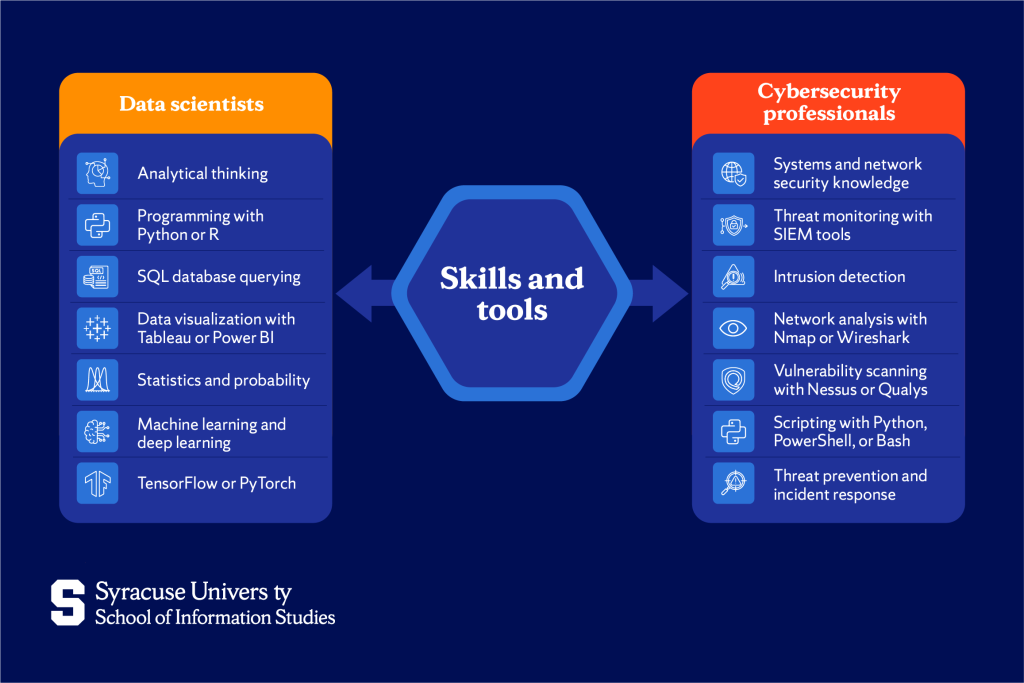
Data scientists need strong analytical and programming skills. They often use Python or R to analyze data, SQL to pull information from databases, and tools such as Tableau or Power BI to turn results into charts and dashboards. For more advanced work, they may use TensorFlow or PyTorch to build machine learning and deep learning models. Statistics and probability are the foundation behind much of this work because data scientists need to understand patterns, measure uncertainty, and test whether their findings are reliable.
Cybersecurity professionals need strong technical knowledge of systems, networks, and security risks. They often use SIEM platforms such as Splunk or IBM QRadar to monitor threats, intrusion detection systems to spot suspicious activity, and network tools such as Nmap and Wireshark to examine traffic and find weak points. They may also use vulnerability scanners such as Nessus or Qualys, along with scripting in Python, PowerShell, or Bash, to automate tasks and investigate issues.
The two fields use some of the same programming languages, but the purpose is different. Data scientists use code to analyze data and build models, while cybersecurity professionals use code and security tools to find, prevent, and respond to threats.
Daily work and responsibilities
A data scientist’s day often centers on projects. They may clean messy datasets, explore patterns, build and adjust models, and present results through dashboards, reports, or meetings. The work usually moves toward a clear deliverable, such as a prediction model, an analysis, or a business recommendation.
A cybersecurity professional’s day is more closely tied to ongoing protection. They may monitor alerts, investigate unusual activity, patch vulnerabilities, review access controls, and respond to active incidents. Some of this work is planned, but some of it depends on what happens across the company’s systems in real time.
Data scientists often work in a build-and-deliver rhythm, while cybersecurity professionals work in an always-on defense posture.
Education paths and credentials
Data science usually starts with a bachelor’s degree in data science, statistics, computer science, applied math, or a related field. Some senior, research-focused, or highly technical roles may prefer candidates with a master’s degree. Certifications can help, but they usually carry less weight than a strong portfolio of projects that shows you can clean data, build models, interpret results, and explain your findings clearly.
Cybersecurity often starts with a bachelor’s degree in information technology, computer science, information management, or a related field. Certifications tend to play a larger role in this field because they show knowledge of specific security practices and tools. Common examples include CompTIA Security+ for entry-level roles, CISSP for more senior security positions, and CEH for penetration testing.
Data science rewards advanced education and project portfolios, while cybersecurity places more value on certifications and hands-on experience.
Salary and Job Outlook Compared
Both data science and cybersecurity offer high earning potential. According to BLS data, data scientists earn a median wage of $112,590, while information security analysts earn $124,910. In this comparison, information security analyst is used as the closest BLS category for many cybersecurity roles, since the field includes a wide range of job titles across security analysis, threat detection, incident response, and risk management.
The difference between the two median salaries is relatively small compared with the effect of location, industry, experience, and employer type. A data scientist at a major technology company, for example, may earn far more than the national median, while a cybersecurity professional in finance, healthcare, or cloud security may also move well above the BLS figure.
The growth outlook is strong in both fields. Data scientist roles are projected to grow by 34% from 2024 to 2034, while information security analyst roles are projected to grow by 29% over the same period. Both rates are far above average, showing how much organizations need professionals who can make sense of growing data volumes and protect systems from rising cyber threats.
The clearest difference is where demand pressure comes from. Data science is growing because companies are collecting more data and need people who can turn it into useful decisions. Cybersecurity is growing because organizations face more frequent and more complex security risks.
Where Data Science and Cybersecurity Overlap
Data science and cybersecurity are distinct disciplines, but they intersect in two important areas. The first is AI in cybersecurity: machine learning models trained on network traffic, login patterns, or endpoint behavior to flag anomalies that human analysts would miss. The second is security data analytics, where data science methods are applied to large security log datasets to detect patterns, model attacker behavior, and predict future threats before they materialize.
This overlap has created roles that combine both skill sets, such as security data scientist and threat intelligence analyst. These roles remain a minority of total openings in both fields, but they’re growing. Readers who find data security as compelling as data analysis, who want to work at the boundary of insight and defense, should be aware that this hybrid track exists and is actively hiring.
Which Path Should You Choose?
The decision comes down to three practical considerations. First, what kind of question energizes you: predictive and analytical (data science) or defensive and investigative (cybersecurity)?
Second, which credentialing rhythm fits your preference: building a portfolio and potentially pursuing a master’s degree (data science) or earning certifications and rotating through hands-on security environments (cybersecurity)?
Third, the on-call reality: data science is largely project-rhythm work, while cybersecurity often includes 24/7 monitoring duty and incident response that doesn’t stop at 5 pm. Both fields pay well and have strong long-term demand, so neither choice is wrong on those grounds alone.
At Syracuse University’s iSchool, students can prepare for either direction through programs connected to these career paths. For data science, the Master’s in Applied Data Science builds the analytical, technical, and applied skills needed for roles such as data scientist, machine learning specialist, and analytics roles across industries.
For cybersecurity, the Bachelor’s in Information Management and Technology provides a foundation in systems, networking, information management, and security, with the option to add the Cybersecurity Studies Minor for focused specialization. Explore both programs to see which curriculum matches where you want to go.
The Bigger Picture
The data science vs. cybersecurity question is no longer as clear-cut as it once was. Both fields are growing, both offer strong salaries, and the connection between them is becoming harder to ignore. AI is now part of many security operations, while privacy and security rules affect how data scientists collect, use, and protect sensitive information.
That means professionals in one field increasingly benefit from understanding the other. A data scientist working with personal health records needs to understand security risks. A cybersecurity analyst using anomaly detection tools needs to understand how data models work.
Choosing one path is still important because each field requires its own depth of skill. But the strongest professionals will often be the ones who build expertise in one area while staying literate in the other. Data science and cybersecurity remain separate careers, but they are no longer distant from each other.
Frequently Asked Questions (FAQs)
Is data science or cybersecurity better?
Neither is objectively better. Data science is a better fit if you enjoy finding patterns in data and building models. Cybersecurity is a better fit if you want to protect systems, investigate threats, and respond to security risks. Both offer strong salaries and job growth, so the right choice depends on the work you prefer.
Which is harder, data science or cybersecurity?
Both fields require significant technical depth, but in different areas. Data science demands strong mathematics and statistical modeling skills, while cybersecurity demands broad systems knowledge and the ability to operate under pressure during active incidents. Most practitioners find whichever field they entered first harder to learn.
Are data science and cybersecurity related?
Yes. Data science and cybersecurity are related because both use data, code, and analytical thinking. They differ in purpose: data science uses data to find patterns and make predictions, while cybersecurity uses data to detect threats, protect systems, and respond to attacks. The overlap is strongest in areas like security analytics, fraud detection, threat intelligence, and AI-based threat detection.
Can you do both data science and cybersecurity?
Yes, but it is usually better to build depth in one field first, then add skills from the other. Some roles combine both, such as security data scientists and threat intelligence analysts. These jobs use data analysis, machine learning, and security knowledge to detect threats, study attacks, and improve cyber defense.