
Key Takeaways
- A master’s degree can raise your starting salary as a data scientist and help you reach higher earnings faster.
- Location matters when it comes to data science salaries, but smart geography choices maximize purchasing power: Charlotte offers high salaries with significantly lower living costs than San Francisco or New York.
- At top-tier tech companies, like Google, total compensation for mid-level data scientists can easily exceed $160,000.
Data science has become a practical requirement for modern organizations. Companies across nearly every industry now depend on data-driven decision-making. The Bureau of Labor Statistics projects 34% job growth from 2024 to 2034, outpacing most professions.
But as AI in data science continues to reshape the field, what does that mean for your earning potential?
This guide breaks down 2025 data science salary trends by experience, location, and specialization. Understanding these numbers helps you make informed decisions about education investments, specializations, and geographic choices that maximize your career ROI.
What Is the Average Data Science Salary?
As of 2025, the average base salary for data scientists in the United States is $122,000 per year. But, a closer look shows how wide the range can be:
- 25th percentile: $98,000 (entry-level, smaller markets)
- 50th percentile (median): $122,000
- 75th percentile: $136,000
- 90th percentile: $173,000+ (senior roles, major tech hubs)
Total compensation typically runs higher than base salary when you factor in annual bonuses, stock options, and performance incentives. At top-tier tech companies, like Google, total compensation for mid-level data scientists can easily exceed $160,000.
The range is wide because several factors influence where you’ll land: your experience, education, location, and specialization all play major roles. Let’s explore more.
Salary by Experience Level
Experience plays a big role in how much you earn as a data scientist, but it’s how you grow (not just the years) that drives the biggest salary jumps. Early in your career, you’re focused on executing tasks and supporting larger projects. As you gain experience, you begin to take ownership, leading projects, shaping strategy, and influencing decisions. That shift from doing the work to directing the work is where real salary growth happens.
Entry-level/junior data scientists
Experience: 1-4 years
Salary range: $66,000 – $120,000
If you’re just starting out, expect to land somewhere in this range. Your exact offer depends on whether you completed internships, bootcamps, or a relevant graduate program. A data science major with hands-on project experience typically commands the higher end of this band.
At this stage, you’re building foundational skills: cleaning data, running basic analyses, and supporting senior team members. You’re learning the business context behind the models.
Mid-level data scientists
Experience: 3-5 years
Salary range: $86,000 – $156,000
Three years in, you’re no longer a beginner. You own projects end-to-end: framing problems, selecting models, and presenting insights to stakeholders. Your work directly influences business decisions.
This is often where professionals with a Master of Applied Data Science degree tend to advance more quickly. The focused training and hands-on project work often lead to earlier promotions and stronger salary offers.
Mid-level is also when you start to specialize, whether that’s in natural language processing, computer vision, or MLOps deployment.
Senior and lead data scientists
Experience: 5+ years
Salary range: $99,000 – $200,000+
Senior data scientists set technical direction for teams. You’re evaluating what problems are worth solving, mentoring junior staff, and working directly with executives. At this level, many professionals transition into management or principal IC (individual contributor) tracks.
Total compensation frequently exceeds $220,000 when bonuses and equity are included. If you move into a Director of Data Science role, expect $250,000+.
Salary Differences by Location
Data scientist salaries can vary widely depending on where you work. Cities with strong tech companies or higher demand for data skills usually offer bigger salaries. In other areas, pay may be lower because the cost of living is cheaper or there’s less competition for talent. This means two data scientists with similar experience can earn very different salaries depending on where they work.
According to recent averages, San Francisco, Princeton-Trenton, Madison, and New York City are among the highest paying locations for data scientists, offering compensation well above typical industry ranges.
The Charlotte case study: high salary, lower cost
Charlotte is rising as a data science hotspot, largely due to the “fintech factor.” With Bank of America and Wells Fargo headquartered there, the city has a deep talent pool and high demand for data professionals. Salaries for data scientists in Charlotte range from $96,000 to $133,000, competitive with much pricier cities.
But here’s the advantage: median rent in Charlotte is around $1,600/month, compared to $3,600 in San Francisco. That difference adds up to $24,000 annually, money you can invest, save, or use to pay off student loans faster.
Remote work and pay scaling
Remote work has changed how companies think about salary ranges. Some organizations now pay the same amount regardless of location, while others adjust compensation based on where an employee lives. In many cases, remote workers in lower-cost areas may earn slightly less than employees based in major tech hubs, but their overall purchasing power can still be higher because their living expenses are lower.
Top-Paying Industries for Data Science
The sector you work in is just as important as the role you hold. Some industries are willing to pay significant premiums for data science talent because the stakes and profit margins are higher.
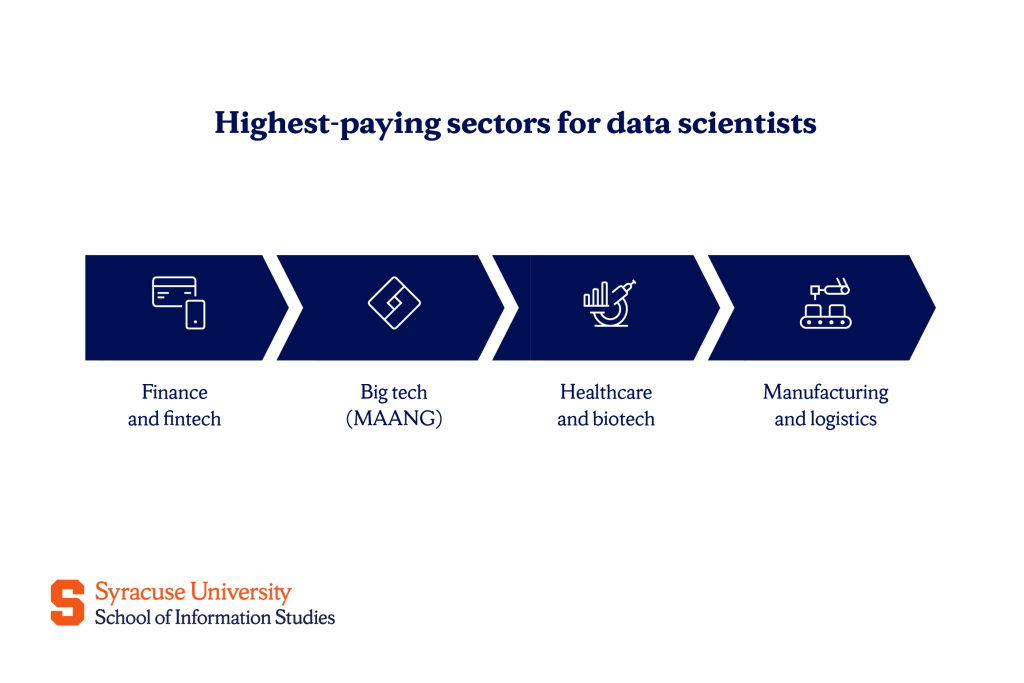
Highest-paying sectors
- Finance and fintech
Average salary: $98,000-$136,000 per year
Why: Regulatory compliance, fraud detection, and algorithmic trading require sophisticated data models. One mistake can cost millions.
- Big tech (MAANG)
Average salary: $150,000 – $200,000+
Why: Data drives product development, user experience, and advertising revenue. Companies like Amazon and Google treat data science as a core function, not a support role.
- Healthcare and biotech
Average salary: $122,000
Why: Predictive analytics in patient outcomes and drug discovery require advanced statistical methods. The work is complex and highly regulated.
- Manufacturing and logistics
Average salary: $133,000 – $170,000
Why: Supply chain optimization and predictive maintenance rely on big data technologies at scale.
Lower-paying sectors
Nonprofits, education, and government typically pay less than the private industry. A mid-level data scientist in the public sector might earn $90,000 to $110,000. However, these roles often offer better work-life balance, student loan forgiveness programs, and mission-driven work.
Factors That Influence Earning Potential
You can’t control the market, but you can control the skills you build. These are the specific levers that increase your market value.
Education: How much does it matter?
Education has a clear influence on both starting salary and long-term career growth in data science.
- Bachelor’s degree graduates typically earn an average of $95,000 to $110,000 early in their careers.
- For master’s degree holders, salaries generally begin higher than bachelor-level roles, with faster advancement into mid-level positions.
- Those entering specialized research roles (PhD holders) can command $140,000+ from the start, particularly in biotech or AI research.
A Certificate of Advanced Study (CAS) in Data Science is another option for professionals who want to upskill without committing to a full degree. Such programs focus on practical, applied training and can significantly boost your salary.
The Syracuse iSchool’s graduate programs emphasize hands-on experience (capstone projects, industry partnerships, and mentorship) that directly translate into higher starting offers.
Skills & tools: What’s worth learning?
Baseline requirements (expected, but not differentiators):
- Python
- SQL
- R
These are basic expectations. Without them, you won’t move forward in the hiring process. With them alone, you still won’t stand out enough to secure a top-tier offer.
High-value skills:
- Large language models (LLMs): As generative AI reshapes workflows, professionals who understand how to fine-tune and deploy LLMs are in high demand.
- MLOps and deployment: Includes knowing to productionize models, like Docker, Kubernetes, and CI/CD pipelines. Deployment skills often pay more than modeling skills because they deliver business value faster.
- Cloud platforms: AWS, Azure, or GCP expertise is increasingly non-negotiable. Companies want data scientists who can scale solutions in the cloud.
Understanding the difference between machine learning vs. AI and Data Science vs. ML specializations helps you position yourself for the highest-paying roles.
Specialization: Generalist vs. specialist
Generalist data scientists are valuable, but specialists command premiums. If you focus on:
- Natural language processing (NLP): $75,000 – $147,000
- Computer Vision: $84,000 – $158,000
- Reinforcement Learning: $98,000 – $144,000
These fields require deeper expertise and are harder to hire for, which drives up salaries.
Future-Proof Your Data Science Career
The path to $200,000+ requires three things:
- Build deep expertise in high-value skills: Focus on modeling, deployment, LLMs, and cloud infrastructure.
- Choose your geography strategically: High salary + low cost of living = wealth accumulation.
- Never stop learning: The tools keep changing. Continuous upskilling is non-negotiable.
If you’re serious about maximizing your earning potential, structured education accelerates the timeline. Programs like Syracuse iSchool’s Master of Applied Data Science combine technical strength with real-world application, giving you a portfolio of work that employers value.
Ready to build a high-earning data science career? Explore Syracuse iSchool’s data science programs and see how hands-on learning, industry mentorship, and a global alumni network can set you apart.
Frequently Asked Questions (FAQs)
What is the fastest salary trajectory to hit the $200k mark as a data scientist?
Move into a senior or principal IC role at a top-tier tech company or transition into management within five to seven years. Specializing in high-demand areas like MLOps or NLP accelerates this timeline.
Do specialized skills like NLP or Computer Vision command a higher premium than generalist roles?
Yes. Specialists overall earn more than generalists because the talent pool is smaller and the technical complexity is higher.
Is a remote data science salary significantly lower than an on-site salary in a tech hub?
It depends on the company. Some offer location-agnostic pay, while others may apply a 10-15% adjustment. However, living in a lower-cost area often results in higher net purchasing power.
Will starting as a data analyst hurt my long-term earning potential in data science?
No. Many successful data scientists start as analysts. The key is to continuously upskill in programming, statistics, and machine learning to make the transition within two to three years.