
Key Takeaways
- Data science supports decisions across industries, including but not limited to: streaming, retail, finance, healthcare, transportation, social media, sports, and public service.
- The same core methods can be adapted to different types of data and real-world problems.
- Data scientists prepare information, build and evaluate models, and explain how the results should be used.
- Privacy, fairness, and the consequences of inaccurate results matter most in high-stakes applications.
Data science is built into many of the systems people rely on each day, even when the process itself remains out of sight. Behind those systems is a common approach to working with information: gathering data, improving its quality, analyzing patterns, and turning the results into something useful.
What makes the field especially broad is that the same approach can support very different decisions across unrelated sectors. Looking at data science examples across industries helps show how one set of methods adapts to different types of problems and why data science has become so widely used.
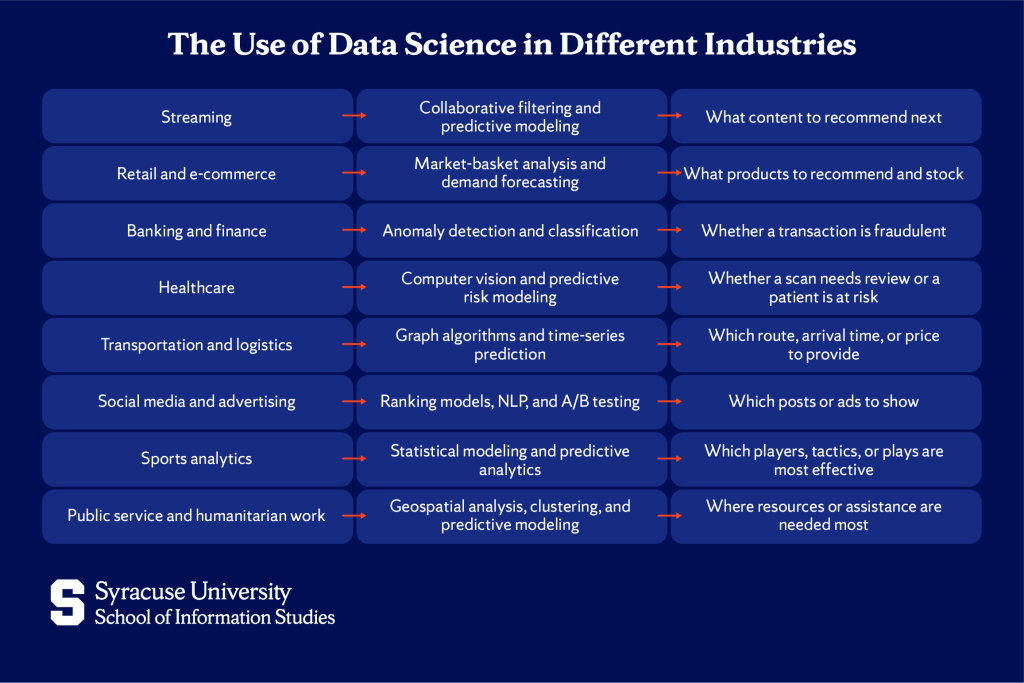
8 Real Data Science Examples Across Industries
Data science can support different decisions depending on where it is used. A streaming platform may need to decide what content to display, while a hospital may need to identify a patient who requires closer attention. The stakes and data differ, but both problems require reliable information and a method for finding useful patterns within it.
The examples below show how data scientists adapt similar methods to the needs of each industry:
1. Streaming recommendations
Streaming platforms have more films, programs, songs, and podcasts than any user could review individually. Recommendation systems reduce those choices by estimating which content each person is most likely to find relevant.
These systems learn from information such as viewing or listening history, previous interactions, and similarities between different pieces of content. Netflix uses several machine learning models for different parts of its personalized experience, including its “Continue Watching” and “Today’s Top Picks for You” features. Spotify also uses personalization algorithms to identify relationships between songs and recommend music that fits a listener’s preferences.
Data scientists working on these systems prepare behavioral data, develop recommendation models, and test how accurately the results reflect user interests. They also monitor whether a model continues to perform well as new content is added and user preferences change.
2. Retail and e-commerce
Retailers use data science to understand what customers may buy and how much stock will be needed. Online recommendations and inventory forecasts address different questions, but both depend on finding patterns in previous activity.
A recommendation system may compare browsing and purchase histories to identify products that are often viewed or bought together. Demand forecasting uses past sales alongside information such as seasons, holidays, local events, and weather to estimate how much of a product each location will need. Walmart, for example, uses forecasting and inventory data to anticipate demand and help keep products available.
A retail data scientist may work on customer personalization or operational planning. In both cases, the aim is to turn large amounts of transaction and inventory data into decisions about what to recommend, order, or distribute.
3. Banking and finance
Banks and payment providers use data science to assess transactions for possible fraud. When a card is used, a model can compare the transaction with known fraud patterns and the customer’s usual behavior.
The system may consider the purchase amount, location, device information, and the speed or frequency of recent transactions. It then assigns a risk score that helps determine whether the payment should be approved, declined, or sent for additional verification. Visa reports that machine learning systems perform this assessment within milliseconds.
The challenge is not simply to block as many transactions as possible. A model that is too sensitive may inconvenience customers by rejecting legitimate purchases. Data scientists therefore evaluate how well the system detects fraud while limiting unnecessary declines.
4. Healthcare
Healthcare organizations use data science to find patterns in medical images, patient records, and other clinical information. These patterns may help clinicians identify possible health problems or estimate which patients face a higher risk of a particular outcome.
For example, an imaging system may analyze a scan and highlight an area that deserves closer examination. A predictive model may use information from a patient’s record to estimate the risk of readmission after discharge. These systems are designed to support clinical decisions rather than make every decision independently. The FDA identifies diagnostic imaging and risk-estimation tools among the established applications of AI and machine learning in medical devices.
Healthcare data scientists work closely with clinicians to ensure that a model addresses a meaningful medical question. They must also examine whether it performs consistently across patient groups and presents its results in a form that healthcare professionals can interpret.
5. Transportation and logistics
Transportation systems depend on conditions that change throughout the day. Traffic builds, demand rises in particular locations, and previous estimates become outdated as new information arrives.
Route and arrival-time systems combine map information with current traffic and records from previous trips. Uber’s ETA system begins with an estimate from its routing engine, then uses machine learning to adjust that estimate based on the difference between predicted and actual travel times. The model considers factors such as the origin, destination, time, and current traffic conditions.
Data scientists in transportation build models that must produce accurate results quickly enough to be useful in real time. Their work may support route selection, arrival estimates, delivery planning, or the balance between passenger demand and available drivers.
The appeal of data science often comes from noticing small, real-world patterns and wanting to understand what causes them. For example, Syracuse iSchool alumnus SaiKumarReddy Pochireddygari became interested in machine learning after observing that the price of an Uber ride changed when he rebooked it. That simple experience raised questions about how pricing systems respond to demand and timing, which led him to study applied data science and later work in machine learning.
6. Social media and digital advertising
A social media feed contains more possible posts than can be shown at once. Ranking models estimate which content is most relevant to each user and determine the order in which it appears.
The models use signals such as previous interactions, the type of content, its recency, and the user’s relationship with the person or account that shared it. Meta has explained that its feed systems make several predictions, including how likely someone is to view or interact with a post, before combining them into a ranking. TikTok similarly ranks videos using signals drawn from a user’s activity and stated preferences.
Data scientists develop these ranking systems and test how changes affect user behavior. They must also consider the broader effects of the objectives they choose, since a model designed only to increase interaction may favor content that attracts attention without necessarily serving the user’s interests.
7. Sports analytics
Sports organizations use data science to evaluate player performance and examine what happens during a game. Traditional statistics provide part of the answer, while tracking systems record movement and positioning that would otherwise be difficult to measure.
The NBA uses player-tracking data and machine learning to produce statistics that account for details such as defensive pressure, player positioning, and shot difficulty. Teams can use this type of analysis to study tactics, support coaching decisions, and evaluate players more closely.
A sports data scientist turns tracking and game data into findings that coaches, scouts, or front-office staff can use. Technical accuracy is important, but the analysis must also be expressed in terms that connect directly to performance and strategy.
8. Public service and humanitarian response
Public agencies and humanitarian organizations use data science to decide where limited resources will have the greatest impact. This may involve identifying communities at higher risk during an emergency, planning relief efforts, or improving city services through traffic and energy data.
The use of data science at the Red Cross relies on this approach through programs such as its Home Fire Campaign. By combining information from local fire departments with demographic and community data, the organization estimates where smoke alarms and fire-safety support are most needed. Those findings help teams focus outreach and installations in areas where they may prevent the most harm.
Similar methods support smart-city initiatives, where public records and sensor data inform decisions about transportation, energy use, and other services. Data scientists working in these settings use geospatial analysis and predictive modeling to turn incomplete or rapidly changing information into practical guidance for public officials and response teams.
The Skills Behind Every Data Science Example
Regardless of industry, data science generally relies on the same set of skills, which include:
- Data collection and cleaning: Data scientists gather information from different sources, correct errors, address missing values, and organize it into a usable format.
- Statistics and probability: These skills help data scientists measure uncertainty, test assumptions, and determine whether a pattern is meaningful.
- Machine learning: Models identify patterns that support tasks such as making recommendations, classifying transactions, and analyzing medical images. Learn more about how data science relates to machine learning and AI.
- Programming: Python, R, and SQL allow data scientists to retrieve information, transform large datasets, and build repeatable analyses or models.
- Data visualization and communication: Charts and clear explanations turn technical results into information that clinicians, coaches, public officials, and business leaders can use.
Some applications also require close attention to privacy, fairness, and the consequences of an inaccurate result. These concerns are especially important in areas such as healthcare, financial services, public policy, and digital advertising, where a model may directly affect people’s opportunities or well-being.
Final Reflections on Data Science in Practice
Data science has spread far beyond the handful of tech companies that made it famous. In addition to the eight examples above, the next decade will likely bring the same tools into other fields too that haven’t fully connected to data science yet. What travels across every one of these domains is the same underlying skill: turning raw data into a decision someone can actually act on.
At Syracuse University’s iSchool, our Master’s in Applied Data Science is designed to build the modeling, programming, and communication skills behind every example in this article. Undergraduates can start with the Bachelor’s in Applied Data Science, working professionals often choose the online Master’s in Applied Data Science option for its flexibility, and students in other majors can add these skills through the data science minor. Explore the program that fits where you want to go next.
Frequently Asked Questions (FAQs)
How is data science used in everyday life?
Most people encounter data science dozens of times a day without noticing. Every recommended show, fraud-alert text, suggested driving route, and ranked social feed is the output of a model.
What companies use data science?
Nearly every large organization does, from tech companies like Netflix, Amazon, and Meta to banks, hospitals, retailers like Walmart, sports franchises, and nonprofits such as the American Red Cross.
What does a data scientist actually do in these examples?
The workflow stays consistent across industries: collect and clean data, build and test a model such as a recommendation engine or fraud classifier, then communicate results so a non-technical decision-maker can act on them.