
Key Takeaways
- Cloud computing careers aren’t typically entry-level. A background in IT support, systems administration, or development gives you the foundation companies expect.
- The cloud job market has split into clear paths, including development, strategy, security, and data or AI-focused roles, each requiring different skills.
- The strongest way to get hired in cloud computing is to combine focused learning with hands-on projects that show real infrastructure, automation, and security decisions in action.
Here’s the cloud paradox: companies are desperate for cloud talent, yet thousands of certificate holders can’t land their first role. Why? Because businesses need professionals who can actually build, secure, and optimize infrastructure, not just pass multiple-choice exams.
Cloud computing is no longer just about storage. It’s the engine for AI, Machine Learning, and Big Data, powering everything from recommendation engines to autonomous vehicles. This guide moves beyond generic career advice to show you the actual skills needed in 2026, including emerging specialties like FinOps and automation-focused roles, along with portfolio standards that hiring managers actually care about.
Is Cloud Computing an Entry-Level Role?
Cloud is rarely an entry-level role. Most employers won’t trust someone fresh out of college or a bootcamp with their entire infrastructure. The risk is too high, and CTOs know it.
You typically need foundational IT experience before moving into cloud roles. Here’s where beginners should actually start:
- IT Support or Help Desk, teaches you troubleshooting methodology and basic networking. You’ll learn how users actually break systems (and how to fix them under pressure).
- Junior Web Developer shows you how applications are built, how they consume resources, and why developers care about deployment speed. This context becomes critical when you’re building cloud infrastructure later.
- System Administrator (SysAdmin) gives you hands-on experience with Linux, user permissions, and server management. These are the fundamentals you’ll use daily when working with cloud platforms and managing scalable infrastructure.
This pathway matters because companies need cloud professionals who understand the full technical stack. Someone who’s only studied cloud concepts doesn’t know how a misconfigured security group can expose an entire database, or why a poorly designed auto-scaling rule can cost $50,000 overnight.
The good news is that if you’ve worked in IT for 1-2 years, you already have the foundation. Now you need to add cloud-specific skills through projects and targeted learning.
Emerging Cloud Roles for 2026
Emerging cloud roles in 2026 reflect how much cloud computing has matured. Companies need specialists who can build reliable systems, control costs, protect data, and support AI-driven workloads at scale. These roles fall into a few clear groups, each addressing a different part of how modern cloud environments actually operate.
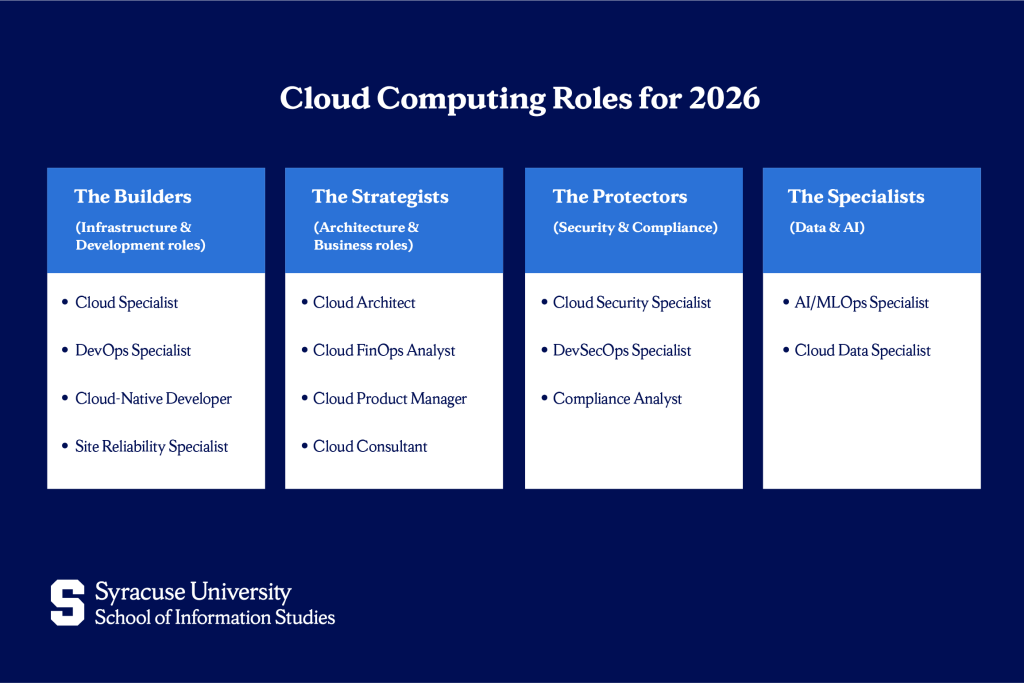
The builders (infrastructure & development roles)
These roles focus on creating and maintaining the infrastructure that runs modern applications.
- Cloud Specialist, the generalist in cloud computing jobs. You’ll build and maintain infrastructure across AWS, Azure, or Google Cloud. This role requires networking knowledge, scripting skills, and the ability to troubleshoot production issues at 3 a.m.
- DevOps Specialist, bridging the gap between developers and operations teams. Your job is automation: building CI/CD pipelines that let developers ship code safely and quickly. You’ll work with tools like Jenkins, GitLab, and Terraform daily.
- Cloud-Native Developer, writing code specifically for serverless platforms like AWS Lambda or Azure Functions. Instead of managing servers, you build applications that scale automatically based on demand. This role requires strong programming skills and cloud architecture knowledge.
- Site Reliability Specialist, focusing on system uptime and scalability. This is typically a senior role. You’re responsible for keeping services running even during traffic spikes or infrastructure failures, combining deep system knowledge with automation and monitoring practices.
The strategists (architecture & business roles)
These roles focus on the big picture: designing systems and aligning cloud strategy with business goals.
- Cloud Architect, designing the blueprint for entire cloud environments. You decide which services to use, how they connect, and how to scale for growth. This role commands high salaries but requires 5+ years of hands-on cloud experience.
- Cloud FinOps Analyst. One of the hottest emerging roles for 2026. Companies realize they’re overspending on cloud services, and they need specialists who can analyze bills, spot waste, and optimize costs. If you enjoy both technology and financial analysis, this path offers strong demand with fewer technical barriers to entry.
- Cloud Product Manager. A non-technical strategy role that translates customer needs into technical requirements. You don’t write code, but you need to understand cloud capabilities well enough to make product decisions. This role suits people who love both technology and business.
- Cloud Consultant, working as an external expert, hired for specific migrations or problems. You’ll move between companies, bringing specialized knowledge to complex challenges. This role requires deep technical expertise and strong communication skills.
The protectors (security & compliance)
Cloud security has grown into its own massive specialty. With data breaches costing companies millions, security professionals are in high demand.
- Cloud Security Specialist, focusing on securing the platform: configuring firewalls, managing identity and access controls, and monitoring for threats. You’ll need to understand both cloud architecture and security frameworks like NIST and CIS.
- DevSecOps Specialist, building security directly into the development pipeline. Instead of testing for vulnerabilities after code is written, you create automated security checks that run during every deployment. This role requires both security knowledge and DevOps automation skills.
- Compliance Analyst, ensuring cloud systems meet legal and regulatory standards like GDPR, HIPAA, and SOC 2. This role is less technical than the others but requires meticulous attention to detail and understanding of regulatory frameworks. If you enjoy policy, documentation, and audit preparation, this path offers steady demand.
The specialists (data & AI)
This category is growing fastest as companies invest heavily in AI and data analytics.
- AI/MLOps Specialist, managing the infrastructure that runs AI models. Machine learning models are resource-intensive: your job is building systems that train models efficiently, deploy them reliably, and scale them as usage grows.
- Cloud Data Specialist, building the “pipes” that move massive data sets between systems. You’ll create ETL (Extract, Transform, Load) pipelines that collect data from multiple sources, clean it, and prepare it for analysis. This role requires SQL expertise, Python skills, and an understanding of data warehousing concepts.
The Technical Stack: What You Actually Need to Learn
Cloud roles are often surrounded by lots of tools and trends, which can make it hard to know where to begin. Below, you can find the skills that matter most in real cloud work.
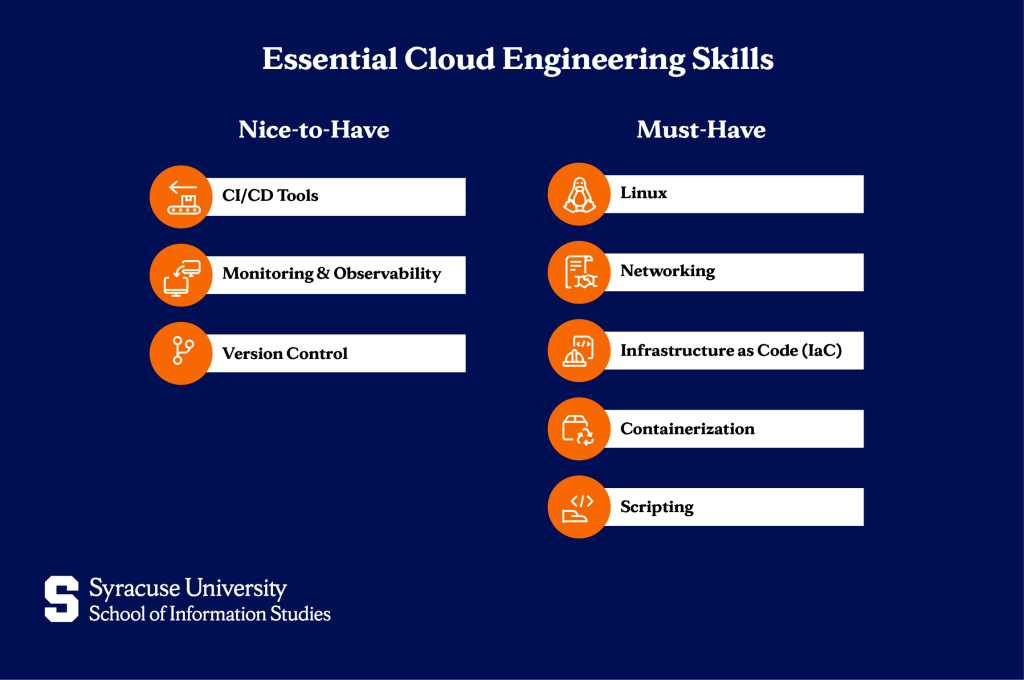
Must-haves
These are the core skills you need to work in cloud roles. Employers expect you to be comfortable with these from the start, since they come up in everyday tasks and real production environments.
- Linux (non-negotiable): Most cloud systems run on Linux, so you need to be comfortable working from the command line. That includes moving through directories, editing files, managing permissions, and troubleshooting services when something breaks. These skills are essential for real cloud work. Relying only on graphical interfaces isn’t enough, since many cloud tasks require direct command-line access.
- Networking: You must understand VPCs (Virtual Private Clouds), subnets, DNS (Domain Name System), firewalls, and HTTP status codes. These concepts determine how cloud services communicate and stay secure. A misconfigured network can expose your entire infrastructure.
- Infrastructure as Code (IaC): Professionals don’t click buttons in cloud consoles (dismissively called “ClickOps”). They write code to build servers, databases, and networks. Learn Terraform, as it is the industry standard. IaC makes infrastructure reproducible, testable, and version-controlled.
- Containerization: Docker packages applications with all their dependencies, making them portable across environments. Kubernetes runs those containers at scale, handling load balancing, automatic restarts, and rolling updates. Nearly every modern cloud application uses these technologies.
- Scripting: You don’t need to be a software specialist, but you must write scripts for automation tasks. Python is the most versatile option, used for cloud automation, data processing, and DevOps tooling. Bash is essential for Linux system tasks. Start with Python and add Bash as you need it.
Nice-to-haves
These skills aren’t required to land your first role, but they make your work easier and help you grow into more senior positions over time.
- CI/CD tools: Jenkins, GitLab CI, or GitHub Actions
- Monitoring: Prometheus, Grafana, or cloud-native tools
- Version control: Git is standard across all roles
The key difference is simple: must-have skills help you get hired, while nice-to-have skills help you move up.
Certifications vs. Portfolio: Avoiding the “Paper Tiger” Trap
Collecting five certifications with zero hands-on experience. The industry calls these people “Paper Tigers”: they look impressive on paper but can’t actually build anything. Hiring managers spot this immediately.
The golden ratio
1 Certification + 1 Major Project = Interview Ready
That’s it. One solid certification proves you understand concepts. One real project proves you can apply them. Together, they’re more valuable than a wall of certificate PDFs.
Top certifications to target
These certifications signal real cloud skills and are widely recognized by employers:
- AWS Solutions Architect Associate (SAA-C03) is the gold standard. It covers core AWS services, architecture patterns, and best practices. If you’re choosing just one certification, choose this.
- Azure Administrator (AZ-104) is best if you’re targeting corporate environments. Many large enterprises run on Microsoft Azure, and this certification shows you can manage Azure resources, implement security, and handle compliance requirements.
Portfolio standards
A “Hello World” app isn’t enough. You need a project that demonstrates real-world skills. Consider the Cloud Resume Challenge, where you’ll host a website, connect it to a database, build an API using Lambda or Azure Functions, and automate deployment with Infrastructure as Code.
Your portfolio should show:
- Infrastructure provisioned with Terraform or CloudFormation.
- Automation using CI/CD pipelines.
- Proper security configurations (no hardcoded credentials).
- Documentation explaining your architecture decisions.
When an interviewer asks, “Can you show me something you’ve built?”, you should have a GitHub repository and a live demo ready.
Salary Trends & Outlook
Let’s talk realistic numbers for 2026: since true entry-level cloud roles are rare, even “junior” positions often pay more than typical IT jobs.
Junior-level roles (1-3 years experience): $70,000-$95,000 annually. This includes Cloud Specialists, junior DevOps roles, and Cloud Support Specialists. Latest reports show that the average cloud computing salary in the U.S. is approximately $128,000 per year, though this varies significantly by role and experience.
Mid-level roles (3-5 years experience): up to $150,000 yearly. This range covers DevOps Specialists, Cloud Architects (early career), and Security Specialists. The majority of cloud architect salaries in the U.S. surpass $150,000 annually.
Senior-level roles (5+ years experience): $130,000-$180,000+ a year. Senior Cloud Architects, SREs, and specialized security roles command these salaries. Data shows that the average annual salary for a Senior Cloud Architect ranges between $130,000 to $165,500.
Employment in computer and information technology (including cloud roles) is expected to grow well above the average for all jobs between 2024 and 2034. On average, about 317,700 openings are projected each year, driven by both new job creation and the need to replace workers who leave these roles permanently.
The Bottom Line
The cloud computing job market in 2026 offers opportunities for every skill set, whether you’re drawn to technical development, strategy, security, or data specialization. The key is choosing a specific path and building real proof of your abilities.
Your next step: Pick one category from this guide that matches your interests. Research that specific role deeply: find job postings, identify required skills, and start building a project that demonstrates those capabilities. The Certificate of Advanced Study (CAS) in Cloud Management from Syracuse University can help you build these skills with hands-on learning and industry-recognized credentials.
You don’t need to master every skill before you begin. Start building, keep learning, and apply as you go.
Frequently Asked Questions (FAQs)
Is 28 (or 30+) too late to start a career in cloud computing?
No. Many successful cloud professionals switch careers in their late 20s or 30s. Your previous work experience (especially in IT, development, or systems administration) actually gives you an advantage in understanding business context and troubleshooting.
Do I need a computer science degree to get hired?
Not necessarily. Many cloud professionals come from non-CS backgrounds with relevant certifications, hands-on projects, and practical experience. Employers care more about what you can build than where you went to school, though a degree in information systems or related fields can accelerate your progress.