
Key Takeaways
- A business intelligence strategy defines how an organization will use data to support decisions and measure progress toward business goals.
- BI supports work across departments, including sales forecasting, budget monitoring, inventory planning, and customer retention.
- Building a BI strategy should begin with business objectives, followed by data governance, tool selection, and phased implementation.
- Long-term success depends on reliable data, clear ownership, and reports that employees understand and use.
Most organizations already have plenty of data. The problem is that different teams may calculate the same metric differently, or reports may arrive too late to inform a decision. Adding another dashboard does not solve either issue.
A business intelligence (BI) strategy gives the organization a shared plan for using data. It identifies the decisions BI should support and sets expectations for how reports will be developed. It also assigns responsibility for keeping the information accurate.
What Is a Business Intelligence Strategy?
A business intelligence strategy is an organization-wide plan for turning data into information that supports better decisions. It defines which business questions BI should answer and which metrics should be used to measure performance.
The strategy goes beyond selecting software or building dashboards. It determines where the data will come from, who is responsible for its accuracy, and how reports will reach the people who need them. It also helps ensure that different departments use consistent definitions instead of producing conflicting numbers.
For example, if an organization wants to reduce customer churn, its BI strategy would identify how churn is calculated and which data should be monitored. The resulting dashboard is one part of the work, while the strategy provides the wider structure that keeps the information reliable and connected to the business goal.
How Organizations Use Business Intelligence
Business intelligence gives employees a clearer view of current performance and past results. The exact use depends on the decisions each part of the organization makes.
Sales teams may use BI dashboards to review their pipeline and compare revenue against forecasts. Marketing teams can examine campaign results to see which channels generate useful responses.
Finance teams use BI to monitor spending and compare results with the approved budget. Operations teams may track inventory levels or examine where delays occur. Customer service teams can use account data to identify changes in retention.
A retailer, for example, could connect point-of-sale records with warehouse and supplier data. A shared dashboard would show which products are selling and how quickly stock can be replaced, giving buyers better information for weekly restocking decisions. The retailer could then reduce excess inventory without allowing popular products to run out.
Why a Business Intelligence Strategy Matters
A BI strategy helps people reach decisions faster because they do not have to reconcile competing reports before acting. It also gives them greater confidence that the information reflects agreed definitions and reliable data.
That consistency reduces data silos and creates a shared source for performance reporting. It can improve operational efficiency by directing attention toward problems that require action, while better information may also help the organization respond more effectively than its competitors.
A clear strategy strengthens a data-driven culture because decisions are based on evidence rather than habit or internal influence. Without one, dashboards can multiply without a clear purpose, reports may lose users’ trust, and spending on data tools may produce little value because the work is not connected to business goals.
How to Build a Business Intelligence Strategy
The single most important principle here: start with business goals, not with the data or tools you already happen to have. The following steps connect BI work to clear goals and establish how the organization will manage it over time:
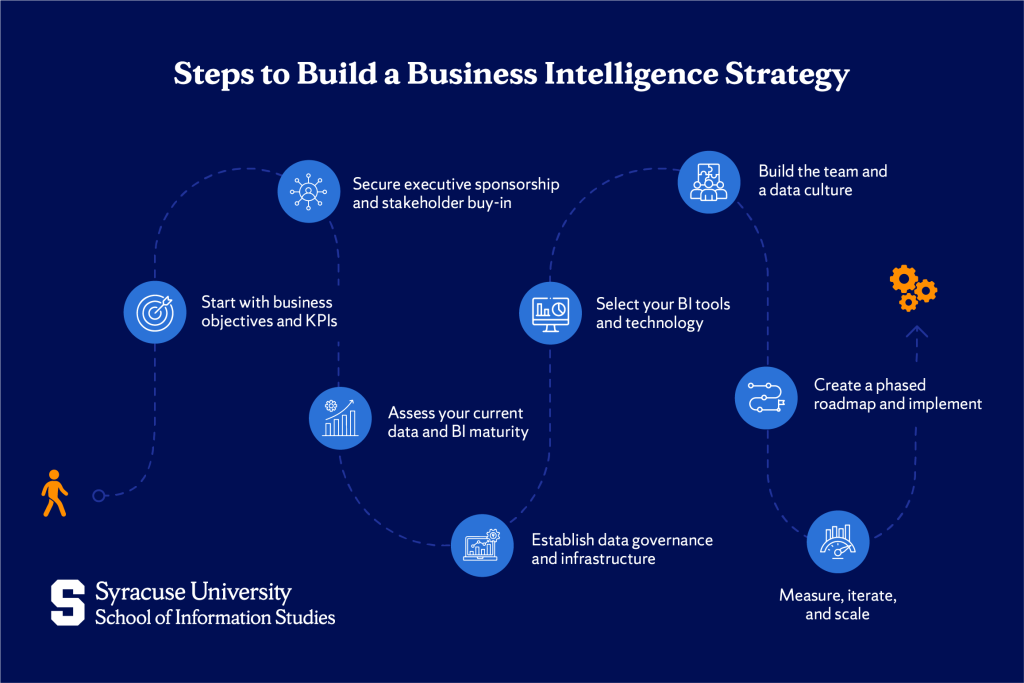
1. Start with business objectives and KPIs
Identify the result the organization wants to improve, then select the key performance indicators that will measure progress. Ask what people would do differently if they had better information.
For example, a goal to reduce customer churn should lead to an agreed definition of churn and a clear set of retention measures. The dashboard should be designed only after the organization knows what it needs to monitor.
2. Secure executive sponsorship and stakeholder buy-in
A senior sponsor gives the BI strategy authority and helps secure the resources needed to carry it out. This person can also resolve disagreements when departments use conflicting figures or have different priorities.
The people who will use the reports should be involved early. Their input helps ensure that the strategy reflects actual decisions rather than assumptions made by the BI team.
3. Assess your current data and BI maturity
Review the data sources and reporting tools already in use. Examine the team’s skills and identify systems that produce duplicate or inconsistent information.
The organization should also determine how advanced its current BI practices are. A company that still relies on manual reports will need a different first phase than one already using standardized dashboards or predictive analytics.
4. Establish data governance and infrastructure
Data governance sets the rules for how important information is defined and maintained. It should identify who owns each dataset and who is responsible for correcting errors.
The organization must also decide where approved data will be stored and how it will move between systems. Reports will remain unreliable if they are built on inconsistent or poorly managed data.
5. Select your BI tools and technology
Document what users need before comparing platforms. Consider how each option connects with existing systems and how much technical support it will require.
The team’s current skills should also influence the decision. A popular platform may still be a poor fit if employees cannot maintain it or use it effectively.
6. Build the team and a data culture
Assign responsibility for managing the BI program and maintaining its reports. Some of this work may be handled by existing employees if they receive the right training and support.
Employees also need to understand how BI relates to their work. They are more likely to use the reports when the information fits their regular processes and helps them make a specific decision.
7. Create a phased roadmap and implement
Begin with one use case that has a clear audience and a measurable purpose. Break the work into phases so the organization can address data problems and test the reporting process before expanding.
There is no standard implementation timeline for every BI project. The schedule should reflect the condition of the data and the complexity of the first use case.
8. Measure, iterate, and scale
Evaluate whether the BI work changes how people make decisions. The number of dashboards produced says little about success if employees do not use them or trust the information.
Review the strategy regularly and assign responsibility for keeping it current. Once the first use case is working, the organization can apply what it learned to another department or business need.
Common Challenges in BI Strategy and How to Overcome Them
Several problems can weaken a BI strategy after implementation begins. Some of the most common challenges include:
- Data silos and conflicting metrics: Different teams may maintain separate records or use different definitions. Establish shared definitions and assign an owner to each major metric.
- Reports that employees do not use: A dashboard may be well designed but disconnected from an actual decision. Confirm the intended audience and purpose before development starts.
- Poor data quality: A polished report cannot correct incomplete or inaccurate source data. Address quality problems at their source and document how corrections will be handled.
- Low user adoption: Employees may return to spreadsheets when the BI system adds unnecessary steps to their work. Review how the reports fit existing processes and provide role-specific support.
- Skill gaps: Teams may have access to advanced tools without the knowledge needed to use them correctly. Assess the required skills early and provide training before expanding access.
- Unclear executive direction: Scope can grow quickly when leaders disagree about priorities. The executive sponsor should confirm the first use case and the limits of the initial phase.
Turning Your Business Intelligence Strategy into Results
A business intelligence strategy produces value when trusted information reaches the people responsible for making decisions. That requires clear business goals and continued ownership after the first reports are launched.
Organizations do not need to transform every department at once. A focused first project allows the team to test its data and see how employees use the results. The lessons from that work can then guide the next stage of development.
Professionals who want to develop the strategy and governance skills behind this work can explore Syracuse University iSchool’s M.S. in Information Systems. The program connects technology management with business strategy. Additionally, the M.S. in Applied Data Science may suit those more interested in the analytical work behind BI, including data analysis and machine learning.
Frequently Asked Questions (FAQs)
What is the difference between a BI strategy and a data strategy?
A data strategy covers how an organization manages and uses data across the business. A BI strategy is a more focused part of that plan, addressing how data will support reporting and decision-making.
What is the difference between business intelligence and business analytics?
The terms often overlap, but business intelligence generally focuses on monitoring performance through reports and dashboards. Business analytics usually involves deeper analysis to explain results or estimate what may happen next.
How long does it take to implement a business intelligence strategy?
There is no standard implementation timeline because the work depends on the project’s scope and the condition of the organization’s data. A focused first phase may be completed relatively quickly, while organization-wide implementation continues as the strategy expands.
Which BI tools are most commonly used?
Established BI platforms include Microsoft Power BI, Tableau, Google Looker, and Qlik. The best option depends on how well the platform works with the organization’s existing systems and reporting needs.
Who should own the business intelligence strategy?
Day-to-day ownership should be assigned to a BI or analytics leader who can coordinate the work across departments. An executive sponsor should provide authority and help resolve larger disagreements, although the exact structure depends on the organization.
Does a small business need a business intelligence strategy?
Yes, but it does not need to be complex. A small business can begin with a limited set of agreed metrics and one report tied to a decision it makes regularly.