
Key Takeaways
- Data science emphasizes research, statistical modeling, and algorithm development, while applied data science focuses on implementing solutions and deploying models into production.
- Data scientists often work in exploratory environments; applied data scientists solve defined business problems with measurable outcomes.
- Both fields collaborate closely: data science creates innovations that applied data science transforms into scalable, real-world systems.
If you’re exploring data careers, you’ve probably noticed that “data science” and “applied data science” sound almost identical, but lead to very different types of work. One focuses on discovering new insights through experimentation and research. The other takes those discoveries and turns them into tools that businesses actually use.
With data-driven roles growing faster than most industries can fill them, choosing the right path matters more than ever. The difference shapes what you’ll study, the skills you’ll build, and the problems you’ll spend your career solving.
This guide breaks down the core differences between applied data science vs. data science: what each field does, the skills they require, and how to decide which path fits your strengths and goals.
What Is Applied Data Science?
Applied data science uses established data science methods to solve specific, real-world problems. Instead of developing new algorithms or conducting open-ended research, applied data scientists focus on implementation, taking proven techniques and applying them to business challenges.
This field is tightly connected to measurable outcomes. You might improve a recommendation system, reduce customer churn, optimize supply chain logistics, or automate quality control processes. The emphasis is on delivering value quickly, integrating solutions into existing systems, and ensuring models perform reliably in production.
Applied data scientists spend significant time on data pipelines, model deployment, and MLOps (machine learning operations). They transform research prototypes into hardened software that runs at scale, handles edge cases, and integrates with business workflows.
Syracuse iSchool’s Applied Data Science Bachelor’s Degree prepares students for exactly this type of work: building pipelines in Python for cleaning, extraction, wrangling, APIs, web scraping, and data product development through courses like Programming Techniques for Data Analytics.
What Is Data Science?
Data science is the broader, more research-driven field that focuses on discovering patterns, testing hypotheses, and developing new methodologies. Data scientists work in exploratory environments where the goal is often unclear at the start; they ask “What patterns exist?” or “Can we predict this outcome?” rather than solving predefined problems.
This field contributes to innovation and long-term knowledge development. You might develop a new approach to fraud detection, explore causal relationships in complex datasets, or build experimental models that push the boundaries of what’s currently possible.
Data scientists typically work with statistical modeling, algorithm design, and experimentation. They spend time validating approaches, comparing model architectures, and publishing findings, whether internally to guide product strategy or externally through research papers.
The work is often non-linear and open-ended, requiring deep mathematical foundations in probability, linear algebra, and optimization theory.
Differences Between Applied Data Science and Data Science
While both fields work with data, they differ fundamentally in objectives, daily activities, scope, and career outcomes. Understanding these differences helps you choose a path that matches your interests, strengths, and professional goals.
Primary goal
Data science aims to create new insights, discover patterns, or develop novel approaches. The goal is often discovery-oriented and open-ended: you might not know what you’ll find until you finish exploring. Success means uncovering a meaningful pattern, validating a hypothesis, or building a new feature that changes how the organization understands its data.
Applied data science focuses on creating measurable business value through defined solutions. Goals are specific and outcome-driven: reduce processing time by 30%, increase conversion rates by 15%, or automate a manual workflow. Success means delivering a system that works reliably in production and improves operations.
Key activities
Data science involves heavy work in initial modeling, experimentation, and validation. You’ll spend time exploring datasets, testing different algorithms, comparing model performance, and refining approaches based on statistical significance. The focus is on proof-of-concept work and research-grade prototypes.
Applied data science emphasizes MLOps, pipeline creation, deployment, and system integration. You’ll transform research prototypes into production-ready software, handling data quality issues, optimizing inference speed, monitoring model performance, and ensuring systems scale reliably. The focus is on operational excellence and long-term maintainability.
The transition between fields is critical: data science creates the breakthrough; applied data science turns it into something that runs reliably at scale.
Scope of work
Data science often explores multiple problem spaces, investigating various questions or testing different approaches across domains. A data scientist might work on customer segmentation one month and fraud detection the next, moving between projects as research priorities shift.
Applied data science is deeply embedded in a single domain: a specific product feature, customer experience, or operational process. Applied data scientists develop deep domain expertise, understanding the business context, user needs, and technical constraints that shape how solutions get built and deployed.
This depth allows them to anticipate edge cases, design better integrations, and communicate effectively with stakeholders who rely on their work.
Educational pathways
These fundamental differences shape how academic programs are designed.
Data science paths often require more abstract mathematics, including proofs, advanced probability theory, statistical inference, and algorithmic analysis. Programs emphasize research methods, experimental design, and theoretical foundations. Coursework includes topics like Bayesian statistics, optimization, and computational complexity.
Applied data science paths emphasize practical data pipeline skills, system design, and industry-relevant capstone projects. Programs focus on implementation techniques, production workflows, and collaboration with cross-functional teams.
Syracuse iSchool’s Applied Data Science Master’s Degree includes electives like Deep Learning in Practice, Advanced Big Data Management, Data Analysis and Decision Making, Scripting for Data Analysis, and Big Data Analytics, which deepen skills in building predictive models, working with large datasets, and applying analytical methods to real business problems, preparing students to build production systems, not just research prototypes.
Core courses cover data management, quantitative reasoning, business analytics, and machine learning, with attention to ethical considerations and real-world application contexts.
For those looking to build specialized expertise, Syracuse also offers a Certificate of Advanced Study (CAS) in Data Science Program designed for professionals who want to deepen technical skills without committing to a full master’s degree.
Typical audience/learner profile
Data science candidates are often essentially motivated by academic curiosity, theoretical challenges, and the pursuit of new knowledge. They enjoy reading research papers, testing hypotheses, and exploring problems with uncertain outcomes. Many come from academic backgrounds or plan to pursue PhDs.
Applied data science candidates are motivated by measurable business impact and complex technical challenges. They prefer solving clearly defined problems, seeing their work used by real people, and building solutions that can operate reliably at scale. Many come from backgrounds in software development, analytics, or technical consulting.
Syracuse iSchool programs attract both profiles. The Applied Data Science Bachelor’s Degree emphasizes proficiency in Python, R, visual and computational techniques, and advanced methods like machine learning and AI, preparing students to turn complex datasets into insights for sectors like healthcare, retail, sports, and government. The program reports a 96% job placement rate, reflecting strong employer demand for graduates who can deliver practical solutions.
Students must complete 12 credits of communication skills, 6–8 quantitative skills credits, and 36 credits across sciences, social sciences, and humanities, ensuring they develop both technical depth and professional breadth.
Required skills
Data science skills center on research and discovery:
- Statistical modeling and hypothesis testing
- Experimental design and A/B testing
- Algorithm development and optimization
- Mathematical foundations (linear algebra, calculus, probability)
- Research methods and literature review
- Model validation and interpretation
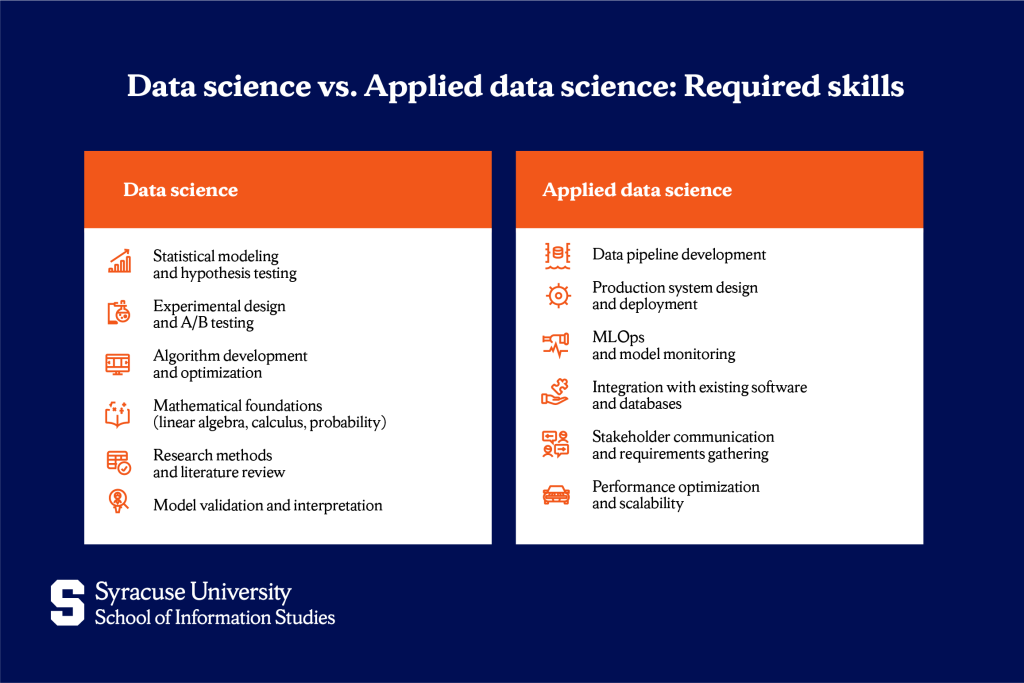
Applied data science skills focus on implementation and delivery:
- Data pipeline development
- Production system design and deployment
- MLOps and model monitoring
- Integration with existing software and databases
- Stakeholder communication and requirements gathering
- Performance optimization and scalability
Both fields require strong programming skills, but applied data science places greater emphasis on production-ready development practices, version control, testing, and documentation.
Tools and technologies
Data science tools emphasize research, experimentation, and algorithmic development:
- Python: Primary language for prototyping, statistical analysis, and machine learning
- R: Widely used for statistical modeling, visualization, and academic research
- TensorFlow/PyTorch: Deep learning frameworks for building and testing neural networks
- Jupyter Notebooks: Interactive environments for exploratory analysis and documentation
- Hadoop/Spark: Distributed computing for processing large research datasets
Applied data science tools focus more on production deployment, business intelligence, and operational systems:
- SQL: Essential for querying databases, joining datasets, and building data pipelines
- Tableau/Power BI: Business intelligence platforms for creating dashboards and reports
- Airflow: Workflow orchestration for scheduling and monitoring data pipelines
- Docker/Kubernetes: Containerization and orchestration for deploying models at scale
- Cloud platforms (AWS, Azure, GCP): Infrastructure for hosting production systems
Applied data scientists also use Python and R, but their work emphasizes integration with existing business systems rather than algorithm innovation.
Understanding the different types of data is critical for both fields, but applied data science requires deeper expertise in data quality, lineage, and governance.
Career outlook
Career paths diverge based on the goals, skills, and overall focus that guide each field, although they can also overlap in practice.
Data science careers often lead to research-focused roles:
- Data scientist: Explores datasets, builds experimental models, and validates hypotheses
- Research scientist: Develops new algorithms, publishes findings, and advances the field
- Machine learning researcher: Works on theoretical improvements to learning methods
- Quantitative analyst: Applies statistical methods to financial modeling and risk assessment
Applied data science careers typically lead to implementation-focused roles:
- Applied scientist: Deploys models into production and optimizes performance
- Machine learning specialist: Builds scalable ML systems and infrastructure
- Data platform specialist: Manages data pipelines, storage systems, and analytics workflows
- Analytics specialist: Builds scalable reporting systems, dashboards, and decision-support tools for business teams
Salary expectations vary by role and experience, but applied data science positions, especially those closer to MLOps, often see higher starting salaries due to in-demand production skills. Syracuse iSchool’s Applied Data Science master’s graduates earn an average annual salary of $104,444 (2024), $107,666 (2023), and $106,242 (2022), reflecting strong employer demand for implementation expertise.
Data science is highlighted as one of the fastest-growing U.S. fields by the Bureau of Labor Statistics, with both specializations experiencing sustained job growth.
How Data Science and Applied Data Science Teams Collaborate
Both teams complement each other within organizations, creating a workflow that balances innovation with practical impact.
Data scientists often develop new models, algorithms, or analytical approaches. They explore datasets, test hypotheses, and identify patterns that could solve business problems. Once they validate an approach, applied data scientists take over, transforming research-grade prototypes into production-ready systems.
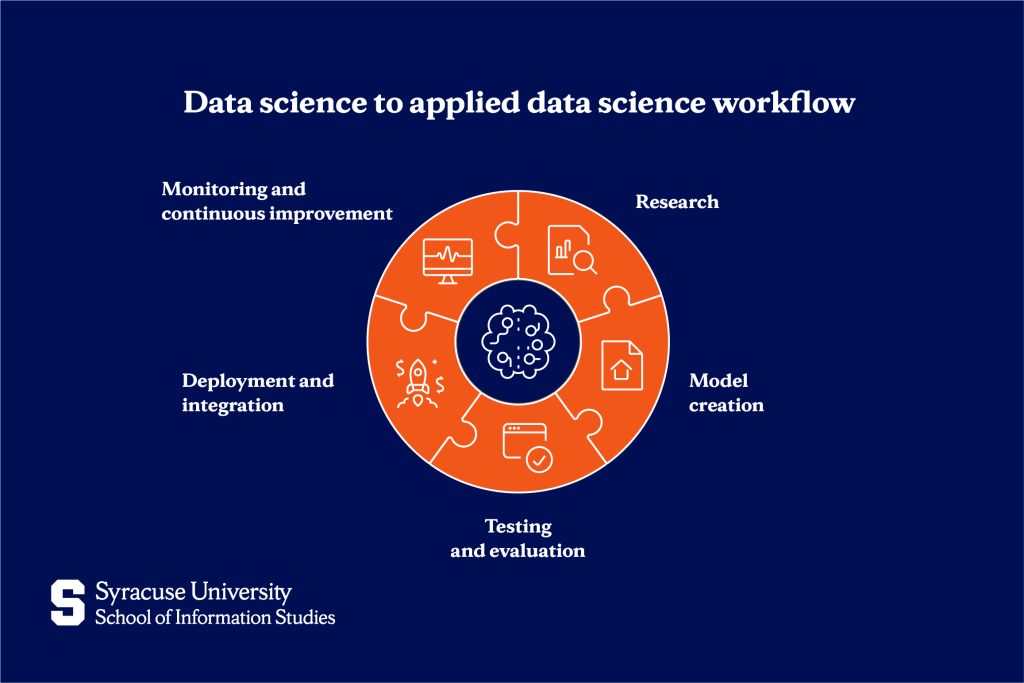
The typical workflow looks like this:
- Research: Data scientists explore a problem, test different modeling approaches, and validate results.
- Model creation: They build a proof-of-concept that demonstrates feasibility.
- Testing: Applied data scientists evaluate performance, scalability, and integration requirements.
- Deployment: They build pipelines, optimize inference, and launch the system into production.
- Monitoring: Both teams collaborate on feedback loops, model retraining, and continuous improvement.
Collaboration ensures that innovations actually reach users. Data scientists bring breakthrough ideas; applied data scientists ensure those ideas work reliably at scale. Both teams work together to refine models, handle edge cases, and align technical work with business needs.
This partnership strengthens organizations by combining exploration with execution, ultimately advancing what’s possible while delivering measurable results.
How to Decide Which Path Fits You
Choosing between data science and applied data science depends on your strengths, interests, and long-term career goals.
Consider data science if you:
- Enjoy theoretical challenges and exploring problems with uncertain outcomes
- Want to contribute to research, publish findings, or pursue academic work
- Prefer open-ended projects where discovery is the goal
- Have strong mathematical foundations and enjoy statistical reasoning
- Are motivated by intellectual curiosity and advancing the field
Consider applied data science if you:
- Prefer solving defined problems with measurable business impact
- Want to see your work deployed and used by real people
- Enjoy technical challenges related to scalability, performance, and system integration
- Are comfortable working with stakeholders and translating technical work into business value
- Are motivated by building systems that make organizations more effective
Both paths offer strong career prospects, competitive salaries, and opportunities for growth. The key is matching the type of work (exploration vs. implementation) to what energizes you most.
If you’re still uncertain, explore both through coursework, internships, or projects. Many professionals begin in one area and gradually shift to the other as their interests develop.
As iSchool graduate Mia Perry ’24 explains:
“…We work in an evolving industry, so the landscape and the definitions of our roles are always changing. That can be intimidating for people- I know it was for me, but the curriculum and environment of the iSchool prepared me not only to understand the technical needs of the job I do, but also how to address the dynamic needs of a business while considering the ethical implications of technology in decision-making.”
Start Your Data Science Career Today
Data science and applied data science serve different purposes, but both are essential to modern organizations. One advances knowledge through research and discovery, the other delivers value through implementation and scale.
The choice isn’t about which field is better; it’s about which aligns with your strengths, interests, and career vision.
If you’re ready to build the skills employers are seeking right now, Syracuse iSchool’s Applied Data Science Bachelor’s Degree and Applied Data Science Master’s Degree programs prepare you with hands-on experience, industry-aligned curricula, and strong placement outcomes.
Explore your options today and take the first step toward a career that combines technical depth with tangible impact.
Frequently Asked Questions (FAQs)
Is an applied scientist the same as a data scientist?
No. Applied scientists focus on deploying models and building production systems, while data scientists emphasize research, exploration, and developing new approaches.
What are the four types of data science?
The field is commonly divided into descriptive analytics (what happened), diagnostic analytics (why it happened), predictive analytics (what will happen), and prescriptive analytics (what should we do).
What will be the job growth for data scientists for the next 5-10 years?
The Bureau of Labor Statistics projects data science as one of the fastest-growing U.S. fields, with sustained demand across industries as organizations increasingly rely on data-driven decision-making.