
Key Takeaways
- AI specialist salaries range from roughly $100,000 to more than $140,000 per year.
- Career progression for AI specialists depends on a combination of experience, technical specialization, education, and the ability to deploy AI systems reliably.
- Major tech hubs like Washington and New York typically offer higher AI specialist salaries than the national average, though remote work is expanding geographic flexibility.
- Total compensation for AI specialists often extends well beyond base salary once equity, bonuses, and benefits are factored in at major tech companies.
AI specialists are among the most in-demand tech professionals in the US job market today. As organizations across every sector race to build intelligent systems, from chatbots and recommendation engines to autonomous vehicles and fraud detection, the need for professionals who can design, deploy, and scale AI solutions has never been higher.
This article provides an accurate, data-driven breakdown of the AI specialist salary in 2025, covering average compensation, top-end earning potential, and how geographic location influences pay. Whether you’re negotiating your first offer or planning your next career move, understanding these trends helps you make informed decisions about this high-growth, high-reward career path.
What is the Average AI Specialist Salary in the US?
AI specialists design, build, and deploy intelligent systems that use machine learning, natural language processing, computer vision, and other AI technologies to solve business problems. They work at the intersection of AI in data science and software development, requiring expertise across multiple technical domains.
Understanding the different types of AI technologies, from supervised learning models to generative AI, helps explain the specialization required and why compensation varies significantly.
US national average salaries show a wide range. Recent reports place the figures anywhere from around $100,000 to salaries surpassing $140,000 per year. This variance reflects differences in how roles are defined, the seniority levels included in each dataset, and regional representation.
Here’s the compensation breakdown by percentile, according to the latest data:
Percentile Annual salary
25th Percentile ~$94,000
75th Percentile ~$118,000
90th Percentile ~$132,500
Entry-level AI specialists typically start near the 25th percentile, while experienced professionals with proven track records of deploying production AI systems reach the upper ranges. Those at the 90th percentile often specialize in high-demand areas like large language models, reinforcement learning, or computer vision.
Understanding these percentiles helps you see how your experience and skills align with the broader market.
AI Specialist Salary by Location: How Remote Pay Compares
Location and work model (remote vs. office-based) significantly influence AI specialist pay. Cost of living, local talent supply, and company headquarters all affect compensation decisions.
Remote AI specialist roles range from $70,000 to $195,000. This figure reflects the competitive nature of remote hiring, where companies compete nationally for talent rather than limiting their search to a single metro area. Remote positions often pay closer to top-tier rates because employers can’t rely on geographic cost differences to reduce compensation.
While specific city-level salary data varies, general trends show that major tech hubs consistently offer higher compensation than the national average:
Washington and the District of Columbia lead the market, with salaries sitting well above national averages due to intense competition among tech giants, startups, and venture-backed companies. To compare, the Washington figure comes out about 13.3% higher than the overall AI specialist average salary, reaching roughly $118,500 a year.
New York City follows closely, at $114,000 annually, driven by demand from finance, media, enterprise tech, and AI research labs that need talent for trading algorithms, content recommendation, and intelligent automation.
Massachusetts also offers premium compensation, reflecting strong tech ecosystems and growing AI investment.
Remote work has expanded options considerably. Some companies maintain location-agnostic pay scales, while others adjust compensation based on where employees live. When evaluating offers, consider total purchasing power; for example, an average AI specialist’s salary in a mid-tier city may provide a better quality of life than a higher salary in San Francisco once housing costs are factored in.
Understanding Total Compensation and Salary Factors
Base salary represents only part of the compensation picture, especially at tech companies where total packages include equity, bonuses, and comprehensive benefits.
Total compensation packages at major tech firms typically include:
- Base salary: The guaranteed annual pay discussed throughout this guide
- Equity grants: Stock options or RSUs (restricted stock units) vesting over 3–4 years
- Annual bonuses: Performance-based cash bonuses, commonly 10–20% of base salary
- Sign-on bonuses: One-time payments to attract candidates, especially those with competing offers
- Benefits: Health insurance, retirement matching, professional development budgets, relocation assistance
Professionals at companies like Google, Meta, Amazon, or Microsoft, total compensation can exceed base salary by 50–100% when equity performs well. Senior and staff-level specialists may see even larger equity components as part of their packages.
Key factors influencing where you land in the salary range:
Experience level is the primary driver. Entry-level AI specialists with 0–2 years start near the lower percentiles, while those with 5+ years and proven records of successful AI deployments reach senior compensation tiers.
Technical specialization creates significant variance. Specialists with expertise in high-demand areas, such as large language models, reinforcement learning, computer vision, or MLOps, command premium salaries because fewer professionals have deep, proven experience in these domains. Understanding deep learning concepts and their practical applications is increasingly valuable.
Company size and stage affect compensation structure. Large tech companies offer higher total compensation through substantial equity packages, while startups may provide lower base salaries but potentially valuable early-stage equity. Mid-market companies typically fall between these extremes.
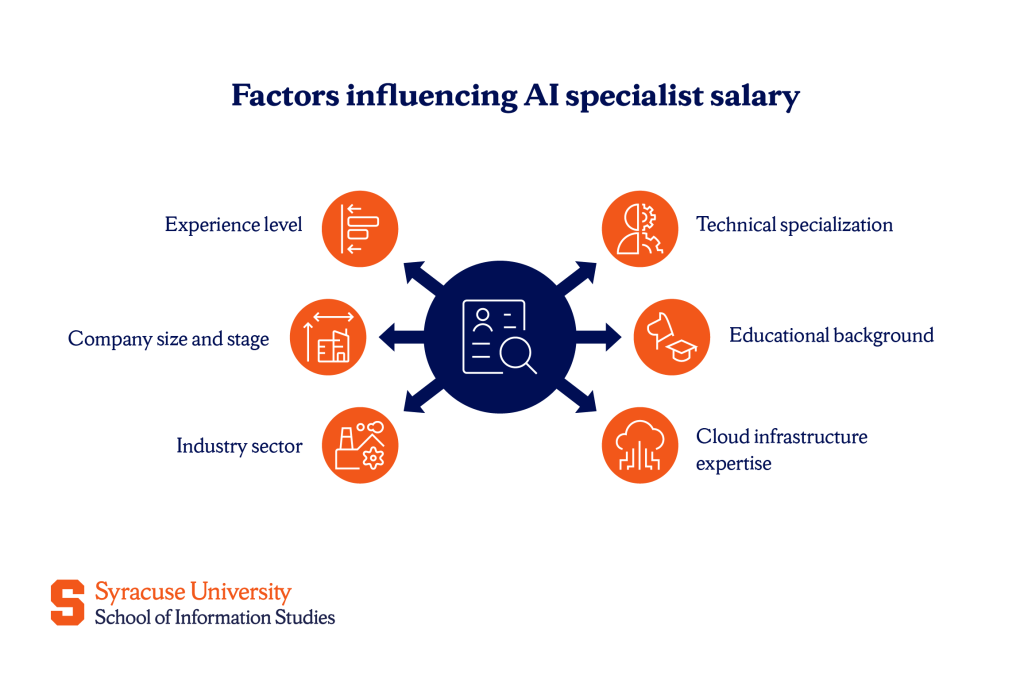
Educational background correlates with starting salary and progression speed. Advanced degrees, particularly master’s or PhD programs in computer science, AI, or related fields, often lead to higher initial offers and faster advancement. Programs like Syracuse iSchool’s Master’s Degree in Artificial Intelligence combine theoretical foundations with practical deployment experience, giving graduates the depth needed to understand complex models and the practical skills required to apply them in real environments.
Industry sector influences compensation, with technology, finance, and autonomous vehicles typically offering higher pay than nonprofit, education, or government roles, though the latter often provide better work-life balance and mission-driven opportunities.
Cloud infrastructure expertise is increasingly valuable, as AI systems require scalable deployment. Understanding how to architect AI solutions on platforms like AWS, Azure, or GCP adds to your market value.
Job Outlook and Future Demand for AI Specialists
The Bureau of Labor Statistics projects job growth in computer and information technology occupations (the category that includes AI specialists) to be much faster than the average for all occupations. Several factors drive this sustained, strong demand.
Business investment in AI continues to accelerate. Organizations aren’t just experimenting with AI anymore. They’re building production systems that create real competitive advantages. This shift from pilot projects to core business infrastructure creates an ongoing need for specialists who can deliver reliable, scalable solutions.
The “AI Premium” reflects strategic value. Companies recognize that AI capabilities drive better customer experiences, operational efficiencies, and entirely new product possibilities. Understanding the benefits of AI helps explain why organizations invest heavily in these roles even during economic uncertainty.
Generative AI has created new roles. The rapid adoption of large language models, image generation, and other generative technologies has spawned new job categories and expanded what AI specialists are expected to build and maintain.
Regulatory and ethical considerations add complexity. As AI systems increasingly affect consequential decisions (hiring, lending, healthcare, criminal justice), specialists who understand responsible AI development, bias mitigation, and compliance requirements become more valuable.
Talent shortage persists despite growing interest. While more people enter the field, the gap between demand and qualified candidates remains wide. Specialists with proven production experience, not just academic knowledge, command the highest compensation premiums.
These trends suggest strong long-term career stability and continued upward pressure on AI specialist salaries, especially for professionals who stay current with tools, methods, and emerging technologies.
Students interested in building foundational AI expertise might explore Syracuse iSchool’s Applications of AI Minor, which provides hands-on experience with AI technologies and practical applications.
The Bottom Line
AI specialists enjoy exceptional compensation and career growth potential. With average salaries ranging from $94,000 to $118,000, and top earners exceeding $132,500 in base salary, the financial rewards reflect both the specialized expertise required and the business impact these roles create.
Remote work has expanded geographic flexibility, while major tech hubs continue offering premium compensation. Location, experience, technical specialization, and total compensation structure all influence your earning potential significantly.
The field continues growing faster than most occupations, creating sustained opportunities for professionals who build the right expertise and demonstrate real-world results. Whether you’re negotiating your next offer or just starting to explore AI, understanding these compensation trends helps you make informed career decisions.
Use this data to negotiate confidently, or if you’re ready to start your career as an AI specialist, explore programs like Syracuse iSchool’s Master’s Degree in Artificial Intelligence that provide the technical depth and practical experience to position you for success in this high-growth, high-reward field.
Frequently Asked Questions (FAQs)
What degree is needed for an AI specialist?
Most AI specialists hold a bachelor’s degree in fields such as computer science, data science, artificial intelligence, mathematics, or information systems, with many employers preferring candidates with a master’s degree in artificial intelligence or a related field.
How to negotiate an AI specialist’s salary?
Research market rates for your location and experience level, document your specialized expertise and project impact, gather competing offers when possible, and discuss total compensation (base, equity, bonuses) rather than focusing solely on base salary.
Which country pays the highest salary for an AI specialist?
The United States consistently offers the highest AI specialist salaries globally, particularly in major tech hubs like Washington and New York, though the cost of living should be considered when comparing purchasing power.