
Key Takeaways
- AI is reshaping the technology careers of the future more than erasing them: the World Economic Forum expects 170 million jobs created and 92 million displaced by 2030, a net gain of 78 million.
- Data scientists lead U.S. growth projections at 35% from 2025 to 2035, with AI research roles (22%) and information security analysts (21%) close behind.
- Nearly every role on the list pairs AI fluency and data literacy with a human-centered or domain specialty, and the fastest growth sits where those layers overlap.
- The newest entries are human-centered AI design and AI governance, along with hybrid roles that combine AI skills with fields like healthcare or law.
The World Economic Forum surveyed more than 1,000 employers for its Future of Jobs Report 2025 and found AI and big data at the top of the fastest-growing skills, with networks and cybersecurity right behind. Those employers expect a net gain of 78 million jobs by 2030. For anyone weighing technology careers of the future, that number sets the scene: the work is changing quickly, and demand keeps rising.
Most of these careers are familiar roles with a wider scope, as data, security, cloud, and AI jobs absorb new responsibilities each year. A smaller group, including human-centered AI design and AI governance, barely existed a few years ago. The 10 careers below are ranked by growth signal.
The 10 Technology Careers of the Future
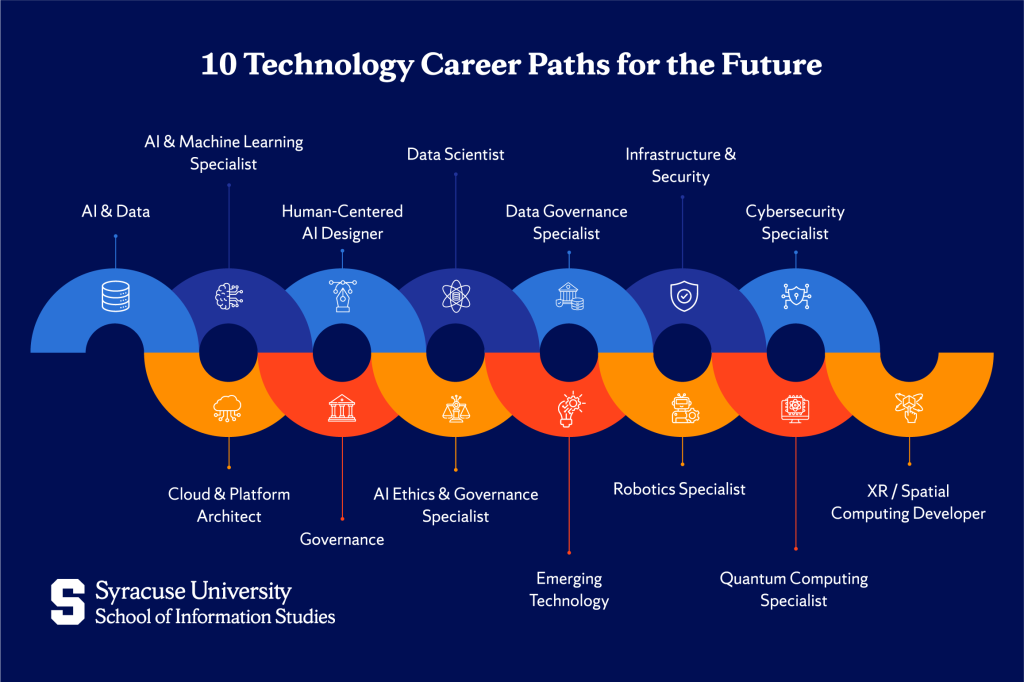
The order follows growth signals: Bureau of Labor Statistics (BLS) projections for 2025 to 2035 for the closest matching occupation, plus the WEF’s fastest-growing roles. Past the top three, the best pick depends on your background and interests more than on rank.
1. AI and machine learning specialist
These specialists build and train the models behind fraud detection, search ranking, medical image screening, and generative AI assistants, then keep them running. Demand is climbing because companies have moved large language models from pilots into products, and every deployment needs someone to test the model and fix it when accuracy drifts. Expect Python, PyTorch or TensorFlow, Hugging Face Transformers, and MLflow. The closest BLS match, computer and information research scientists, is projected to grow 22% from 2025 to 2035, with a May 2025 median wage of $140,300. It suits people who like building systems and measuring whether they work.
2. Human-centered AI designer / AI product lead
This role sits between the model and the people who rely on it, deciding what an AI feature should do, how it explains its answers, and where a person reviews its output. Companies are learning that user trust and misuse limit adoption more than model accuracy does, and the WEF ranks creative thinking and resilience among the fastest-growing skills. The work spans AI product management, conversational and agent design, explainable interfaces, and usability research. The closest BLS group, web developers and digital designers, earned a May 2025 median wage of $99,520. The iSchool’s Master’s in Applied Human-Centered AI was built for this role, which suits people who want to shape AI products without writing the model code.
3. Data scientist and big data specialist
Data scientists turn large, messy datasets into forecasts and decisions. Where the machine learning specialist puts a model into production, the data scientist frames the question and proves the answer holds up. Big data specialists top the WEF’s fastest-growing list, since every AI project depends on clean data upstream. Common tools include SQL, Python or R, Spark, and Snowflake or BigQuery. Data scientist employment is projected to grow 35% from 2025 to 2035, one of the fastest rates BLS projects for any occupation, with a May 2025 median wage of $120,230. It suits people who enjoy statistics, and the iSchool’s Master’s in Applied Data Science is designed around this path.
4. Cybersecurity analyst and security management specialist
Security analysts protect networks and data from attack, and the job now covers AI models themselves, which attackers can manipulate through prompt injection or poisoned training data. Ransomware and cloud sprawl keep widening the attack surface, and BLS credits rising AI use for part of the demand. The work touches cloud security, identity and access management, incident response, and frameworks like NIST and ISO 27001. Information security analysts are projected to grow 21% from 2025 to 2035, with about 14,100 openings a year. It suits people who enjoy thinking like an attacker, and one iSchool graduate turned that mindset into a career protecting the digital world.
5. Cloud and platform architect
Cloud architects design the infrastructure every other role here runs on, including the platforms that serve AI models at scale. AI workloads need GPU-backed capacity, and organizations need people who can scale systems while keeping costs under control. Expect AWS, Microsoft Azure, Google Cloud, Kubernetes, and Terraform. Computer network architects earned a median wage of $134,050 in May 2025, and BLS names AI investment and cloud expansion as growth drivers. It suits systems thinkers. The architect builds the platform; the security analyst defends it.
6. AI ethics, governance, and compliance specialist
Governance specialists write the policies and run the audits that keep AI systems lawful and explainable, including bias testing before and after launch. The designer in #2 shapes the product; the governance specialist sets the rules and checks the product against them. The EU AI Act and a growing number of U.S. state laws require documented risk management for high-risk AI systems. The work draws on the NIST AI Risk Management Framework, model audits, and privacy rules such as GDPR. BLS doesn’t track this role, but the IAPP found that 77% of organizations are already working on AI governance. It suits people from policy, law, or library and information science who want a technology career without a pure coding path.
7. Robotics and autonomous systems specialist
Robotics specialists build the software side of physical AI: robots, drones, autonomous vehicles, and warehouse automation. Autonomous and electric vehicle specialists rank among the WEF’s 15 fastest-growing jobs, and factories and hospitals are automating more physical tasks each year. Tools include ROS (Robot Operating System), OpenCV, sensor fusion, and simulation platforms. This is the most hardware-heavy role on the list, and employers often expect a technical degree. It suits people who want their code to move something in the physical world.
8. Quantum computing specialist
This is the “watch this” entry. Quantum specialists write algorithms for quantum hardware in cryptography, materials science, optimization, and drug research. IBM, Google, Microsoft, and AWS are investing heavily, and the security side is already present-day work: NIST finalized its first post-quantum encryption standards in August 2024 and urged organizations to begin switching. Tools include Qiskit, Cirq, and Q#. Production use is still limited in 2026 and the hiring market is small, so treat it as a role to track if you’re planning a career past 2030. It fits people with strong math or physics foundations.
9. Extended reality (AR/VR) and spatial computing developer
XR developers build immersive interfaces for training, healthcare, design, and remote teamwork. Much of the steady demand comes from enterprise uses such as surgical training and equipment maintenance, and generative AI is lowering the cost of producing 3D content. Expect Unity, Unreal Engine, visionOS and Meta Quest SDKs, and WebXR. The closest BLS group, software developers, quality assurance analysts, and testers, is projected to grow 10% from 2025 to 2035. It suits people who combine design sense with programming. The XR developer builds the interface; the human-centered AI designer decides how AI behaves inside it.
10. Data governance and information management specialist
Data governance specialists own the quality, lineage, access rules, and lifecycle of an organization’s data, which makes AI outputs trustworthy at the source. It’s the entry most readers overlook. Data warehousing specialists appear on the WEF’s fastest-growing list, and every AI governance program depends on someone who can document where data came from. The work covers metadata and taxonomy, data catalogs like Collibra and Alation, and retention policy. BLS projects modest 4% growth for this occupation group, though database architects earned a median wage of $139,500 in May 2025. Information management is a core iSchool discipline, and the role suits organized people, including those from library and information science.
Information skills also outlast the tools built on them. Keisuke Inoue, an iSchool graduate who works on conversational AI as a director of data science, put it this way:
“I am still thinking about information retrieval… 10 years after I graduated from the iSchool.”
Keisuke Inoue, G’02, G’05, G’13
Skills the Technology Careers of the Future Will Demand
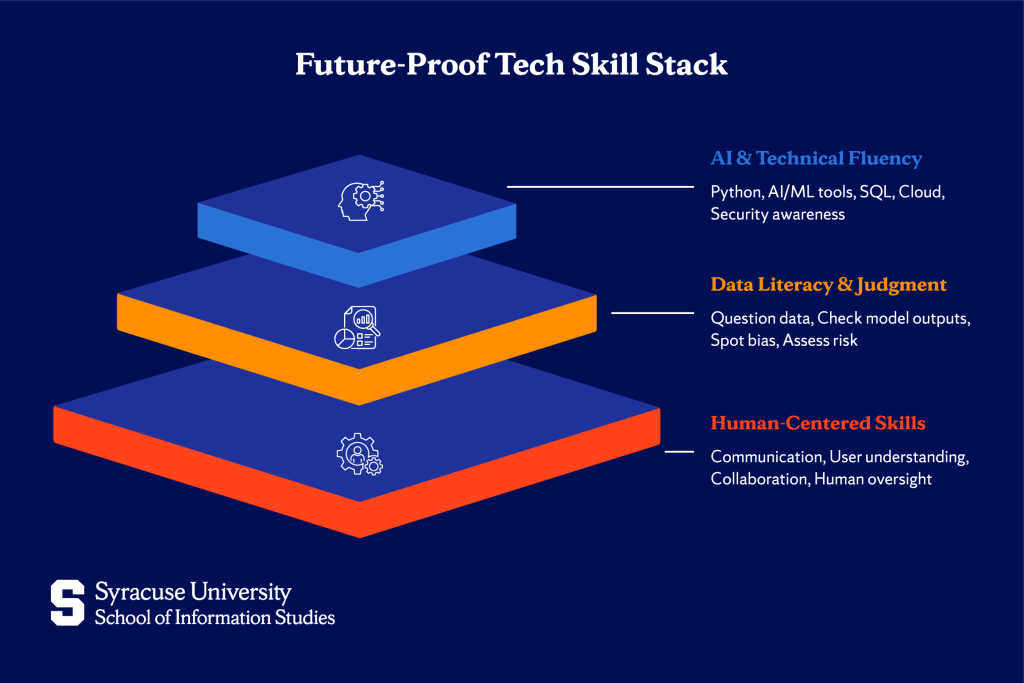
All 10 roles combine AI fluency and data literacy with a human-centered or domain layer. The WEF expects nearly 40% of workers’ core skills to change by 2030, so the honest answer to “which skills are actually future-proof?” is the ones that let you keep learning new tools, plus judgment no tool supplies.
AI and technical fluency
Knowing how AI systems are built and tested is now the baseline. In practice, that means comfortable Python, one machine learning framework, and hands-on practice prompting and fine-tuning large language models. Add enough cloud and SQL knowledge to follow data through a pipeline, and enough security awareness to spot a system’s risks even when security isn’t your title.
Data literacy and critical judgment
Data literacy means questioning a dataset, reading a model’s output with healthy doubt, and asking where the data came from. It separates people AI supports from people AI replaces, because AI can produce an answer while a person still has to stand behind it. PwC’s 2026 Global AI Jobs Barometer found employers putting more weight on judgment as AI spreads. Picture a specialist who notices a model’s training data barely includes rural customers and flags it before launch.
Human-centered and durable skills
These are specific activities. You’ll explain a model’s limits and trade-offs to people outside tech, and design around the people who will actually use a system, including the moments a human must stay in the loop. Most projects also mean working closely with product, security, and compliance teams at once. This human-centered layer is central to how the iSchool teaches.
How to Prepare for a Technology Career of the Future
Your best first target depends on what you already know. Each scenario below points to roles by number.
If you’re a student or complete beginner
Start with Python and statistics, then learn one cloud platform. Data scientist (#3) or an entry-level AI or security role (#1 or #4) is a realistic first step, since those paths have the clearest entry points. If you’re worried computer science has no future with AI, the data points the other way: the fastest-growing BLS occupations are AI-adjacent, and the WEF projects net job growth through 2030. The real risk is studying technology without working with AI. Undergraduates can start with the iSchool’s Applications of AI Minor.
If you’re a working professional transitioning into tech
Start from the role closest to your current work. Analysts tend to move toward data science (#3), IT staff toward cloud (#5) or security (#4), and people in product, design, or policy toward roles #2 or #6. A focused master’s plus a portfolio of real projects usually beats teaching yourself the whole stack. The iSchool’s Master’s in Applied Human-Centered AI is 31 credits, can be finished in as little as one year, and opens with a data science course that assumes no programming experience. The Master’s in Applied Data Science suits those who want to go deeper into analytics.
If you already have a domain
If you work in healthcare, finance, law, education, or library science, an “AI plus domain” hybrid usually beats starting over. Roles #2, #6, and #10 are where field knowledge counts most, and they tend to have less competition because few people hold both halves.
Salary and Job Outlook for Technology Careers of the Future
BLS projects that computer and information technology occupations will grow faster than average from 2025 to 2035, with about 280,000 openings each year. The group’s median annual wage was $109,470 in May 2025, more than double the $50,980 median for all occupations. AI skills add a premium on top: PwC’s 2026 barometer, built on more than one billion job ads, puts the average wage premium for AI skills at 62%. The iSchool answered this demand with a new AI master’s program that launched in fall 2025.
Final Reflections on the Technology Careers of the Future
A few years ago, “future-proof” meant learning to code. Today it means being the person who can direct AI and take responsibility for what it produces. AI is automating tasks faster than it removes whole careers, and it keeps creating new artificial intelligence jobs in categories like AI governance. Researchers at the iSchool’s Center for the Futures of Work, Information and Technology study how this plays out inside organizations. If you’re wondering which specialty feels safest, look for one where your judgment or field knowledge is part of what employers pay for.
At Syracuse University’s iSchool, our Master’s in Applied Human-Centered AI is designed to build the AI fluency and design judgment these careers ask for, and the Master’s in Applied Data Science covers the analytics side in depth. Pick the role on this list that fits you best, then explore the Applied Human-Centered AI curriculum to see how it maps to that path.
Frequently Asked Questions (FAQs)
Which tech jobs are safe from AI?
The most durable tech jobs pair AI skills with human accountability. BLS projects 35% growth for data scientists and 21% for information security analysts through 2035, against a 3% average.
What jobs will be gone by 2030 due to AI?
The WEF expects the steepest percentage declines in clerical roles such as bank tellers and data entry clerks. Most other jobs lose specific tasks to automation rather than disappearing.
Do I need a computer science degree for a technology career of the future?
Many roles accept other routes. BLS notes some information security analysts enter with industry certifications, and AI governance teams often hire from law and policy backgrounds.