
Key Takeaways
- An application architect designs how an organization’s software applications are built and connected, then sets the technical standards developers build against.
- The role sits between enterprise or solution architecture and day-to-day development. It owns the application layer specifically, while other architects cover the wider technology landscape.
- Architects pair technical depth in design patterns, APIs, data modeling, and cloud platforms with the systems thinking and stakeholder communication that set them apart from senior developers.
Even a mid-sized organization often runs dozens of applications: a customer portal, a billing system, a mobile app, internal dashboards, and the APIs and cloud services connecting all of them to older systems nobody wants to rewrite. Someone has to decide how each application is structured so the whole portfolio keeps working as it grows. In many organizations, that person is an application architect.
An application architect designs the blueprint for an organization’s software, including the components inside each application and the way they connect to each other and to shared data. The architect then sets the standards developers follow when they write the code. It’s a senior design role, usually reached after years as a developer, and most of the work happens in design documents and review meetings.
What Does an Application Architect Do?
Application architects make the structural decisions that developers then implement. They decide how an application is divided into parts and how it exchanges data with the systems around it, then stay involved during the build so those decisions hold up. Most of the job falls into five areas:
- Design application architecture: Define the components, layers, services, and data flows of new and existing applications. Document them in reference architectures and diagrams that development teams can build from.
- Set technical standards and patterns: Choose the frameworks and design patterns teams use, so applications built by different groups stay consistent and easier to maintain over time.
- Plan integrations and APIs: Design how applications talk to each other and to third-party systems, including the API contracts and middleware that carry those connections.
- Review designs and advise developers: Act as the technical authority in design reviews and settle architecture-level trade-offs, such as buying versus building a component or splitting a monolith into microservices. Much of this work doubles as mentoring for the developers involved.
- Connect designs to business and enterprise goals: Turn business requirements into application designs and confirm they fit the organization’s broader architecture, including its security and compliance requirements.
The mix changes with the employer. At a large enterprise, the role leans toward standards and governance across many teams, while at a smaller company an application architect may still write production code every week.
Essential Skills and Qualities of an Application Architect
Application architects combine deep technical knowledge with the ability to reason about whole systems and explain their decisions to people outside their field. Some of these skills come from coursework in software design and databases. Others develop only after years of building applications and connecting them to systems someone else designed.
Technical proficiency
An application architect needs working fluency in these areas:
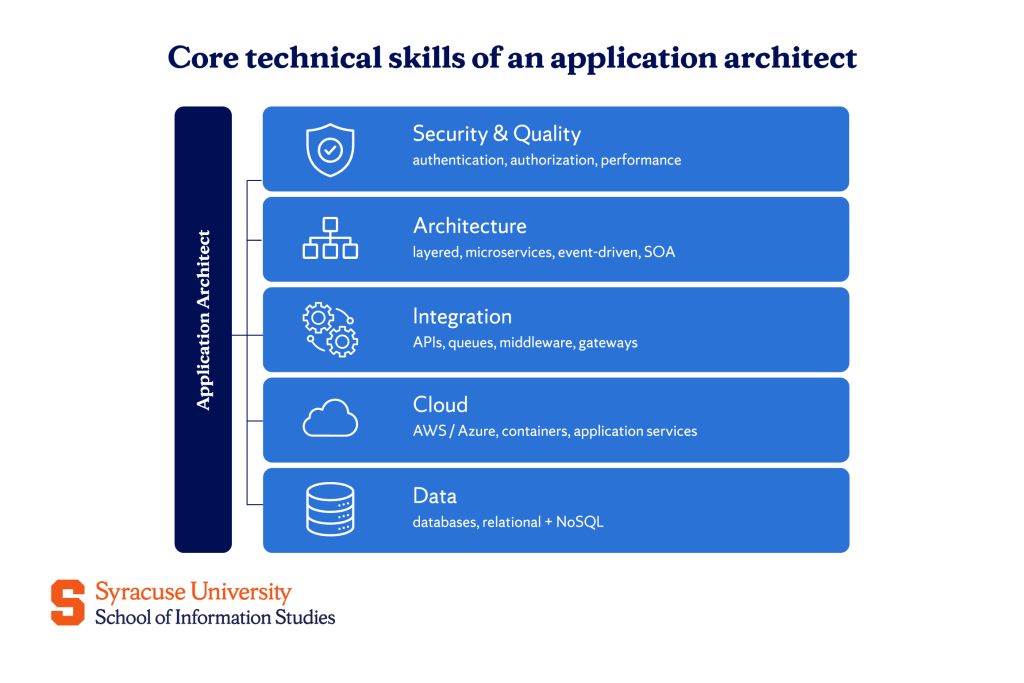
- Design patterns and architectural styles: Layered, microservices, event-driven, and service-oriented architectures, along with a clear sense of when each one fits.
- APIs and integration: REST and GraphQL APIs, message queues, middleware, and API gateway design.
- Data modeling and databases: Relational schema design, plus familiarity with NoSQL stores for application data.
- Cloud platforms: Fluency with at least one major provider, such as AWS or Microsoft Azure, including its application and container services.
- Application security and quality: Authentication and authorization patterns, along with planning for performance as usage grows.
Employers now treat cloud fluency and integration design as baseline expectations for the role.
Systems thinking and design
Systems thinking is the ability to design an application that stays coherent for years while requirements change, usage grows, and other teams connect new systems to it. It’s widely treated as the line between a strong senior developer and an architect. In practice, it might mean structuring a checkout application so the company can later add a second payment provider, or absorb an acquired company’s order system, without redesigning the whole platform.
Communication and stakeholder management
Much of an architect’s influence depends on how well they work with people who will never read the code:
- Translating business requirements into designs developers can implement
- Working with development, infrastructure, security, and product teams at the same time
- Explaining architectural trade-offs and their costs to non-technical leadership
- Writing design documents clear enough that teams can keep building from them after the architect moves to the next project
This skill carries across technical careers. For iSchool alum Kathryn Trainor ’21, who now works in technology partnerships at Hightouch, the program’s mix of technical and communication coursework paid off directly:
“It taught me how to talk about tech to both tech-savvy and non-tech folks.”
— Kathryn Trainor ’21, Technology Partnerships Associate at Hightouch
How an Application Architect Differs From Related Architect Titles
Architect titles are used loosely, and two companies can mean different jobs by the same one. The clearest way to separate them is by scope: how much of the technology landscape each role owns.
| Role | Scope |
|---|---|
| Software architect | The internal code structure of a single system; at smaller firms, often used interchangeably with application architect |
| Application architect | One application or a portfolio of applications, and how they connect to each other and to shared data |
| Solution architect | One business problem end to end, spanning applications and infrastructure, often in a client-facing role |
A useful mental model is a set of nested circles, with software architecture as the narrowest, enterprise architecture as the widest, and application architecture in between, while solution architecture cuts across all of them for a single problem. At a smaller organization, one person often covers several of these roles at once, and many application architects work closely with data architects, whose scope is how information is stored and governed across every layer.
How to Become an Application Architect
Like other architect titles, this role comes after years of software development work. Most people reach it through a relevant degree followed by working in senior roles.
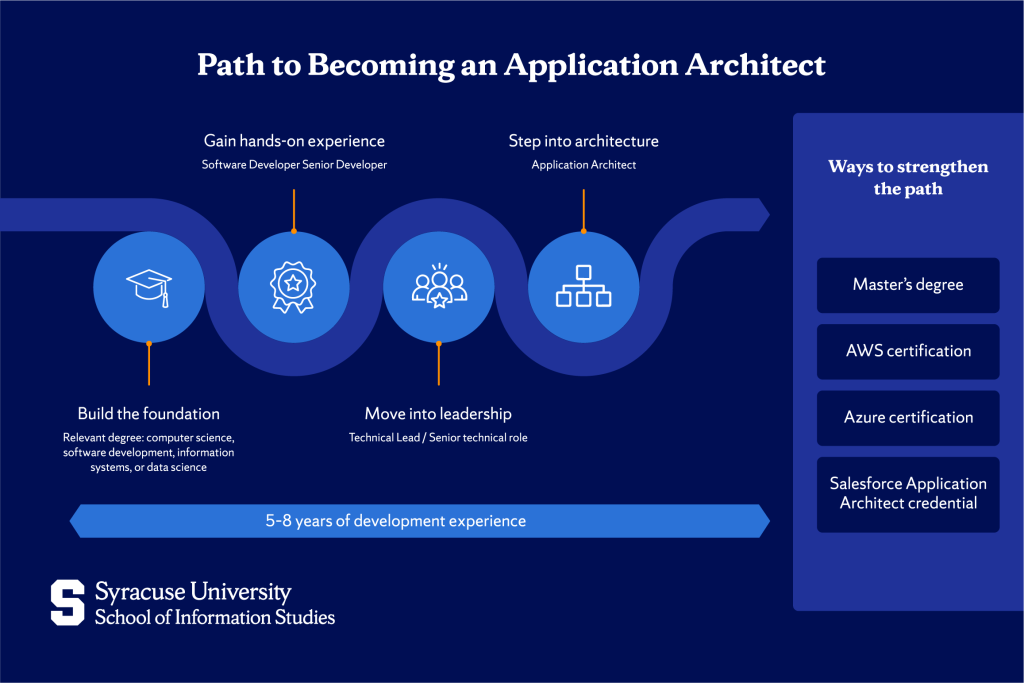
Common degree backgrounds include computer science, software development, information systems, and data science. The specific major matters less than a solid grounding in software design and data modeling. At the iSchool, the Bachelor’s in Applied Data Science builds a foundation for the data-intensive side of application work, and students majoring in a related field can add the Data Science Minor to cover the same ground in fewer courses.
Before earning the title, application architects commonly spend five to eight years as software developers and later as senior developers or technical leads. That time gives them credibility: teams trust design decisions from someone who has built and shipped systems themselves.
A master’s degree can speed the move into senior design roles, especially at data-heavy organizations. The iSchool’s Master’s in Applied Data Science suits developers moving toward the architecture of data-intensive applications, and the online Applied Data Science master’s offers the program in a format built for working professionals. Cloud certifications also help signal design skills, and two of the most widely recognized are the AWS Certified Solutions Architect Associate from Amazon Web Services and Microsoft’s Azure Solutions Architect Expert. If you work in Salesforce environments, the Salesforce Certified Application Architect credential covers data modeling and sharing design on that platform.
Application Architect Salary and Job Outlook
The BLS doesn’t track application architects as a separate occupation, so the closest official comparison is software developers, who earn a median annual wage of $135,980. BLS projects employment in the occupation to grow 10% from 2025 to 2035, much faster than the 3% average for all occupations. Self-reported data suggest architect titles earn more: Glassdoor puts typical total pay for application architects between about $170,000 and $268,000 a year, a figure that includes bonuses on top of base salary.
Final Reflections on the Application Architect Role
The application architect’s job has grown as more organizations run cloud-native applications connected through APIs, with AI features now built into many of them. Where the work once centered on a single large system, it now involves deciding how dozens of services can depend on one another safely at scale. That raises the technical bar, and it also gives architects a larger say in how the business runs.
At Syracuse University’s iSchool, our Master’s in Applied Data Science is designed to build the data skills that sit underneath many of today’s applications, and you can complete it on campus or online. If you’re ready to take the next step, review the Applied Data Science application checklist and map out your application. Wherever you start, the years you spend building and connecting applications are the preparation this role asks for.
Frequently Asked Questions (FAQs)
How is an application architect different from a data architect?
An application architect designs the software people use, while a data architect designs how the organization stores and governs the information behind it. The two roles overlap most on data modeling.
Do application architects still write code?
Many do, especially at smaller companies or when building a proof of concept to test a design. At large enterprises, design reviews and standards work usually take up most of the week.
Do you need a certification to become an application architect?
No certification is required. Credentials like Microsoft’s Azure Solutions Architect Expert, which centers on the AZ-305 exam, can strengthen a résumé, though employers look closely at your design track record.
Can you become an application architect without a computer science degree?
Yes. BLS notes developers typically hold a bachelor’s in computer and information technology or a related field, so information systems and data science graduates can follow the same path.
Which industries hire application architects?
Any organization with a large application portfolio. For the related developer occupation, BLS lists computer systems design (29% of jobs) and finance and insurance (11%) as the largest employers.
What tools do application architects use daily?
Diagramming tools such as draw.io or Lucidchart, the C4 model or UML for documenting designs, OpenAPI specifications for API contracts, and the console of whichever cloud platform the team runs on.