
Key Takeaways
- Data management combines various connected skills that cover how data is structured, cleaned, governed, moved, protected, and communicated.
- SQL and data quality provide the strongest starting point because professionals must first retrieve reliable data before they can analyze or use it.
- Career development depends on adding the skills most relevant to the next role, such as data modeling, ETL, cloud platforms, governance, or security.
- Strong data management skills help organizations trust their information and prepare professionals for greater technical or leadership responsibility.
Job descriptions often list “data management skills” without explaining what the term includes. For candidates, that lack of detail makes it difficult to know which abilities employers expect. Data management can refer to a diverse set of technical and professional competencies that can be learned and developed.
It covers how data is stored, maintained, governed, integrated, protected, and communicated. Employers rarely expect equal expertise in every area, but they do look for a balanced understanding of how these functions work together.
The Essential Data Management Skills
The following skills are ordered roughly by where they sit in the data lifecycle: first storing and structuring data, then keeping it clean and governed, then moving and securing it, and finally communicating what it shows. Past the first two or three, this isn’t a strict ranking, and the skills overlap constantly in practice.
1. SQL and database fundamentals
SQL, or Structured Query Language, is how data professionals get data into and out of relational databases, and comfort with it is assumed in nearly every data role today. Relational databases organize data into rows and tables, while NoSQL stores handle documents, key-value pairs, or graphs instead.
Tools to know:
- Relational databases: PostgreSQL, MySQL, Microsoft SQL Server, Oracle
- NoSQL databases: MongoDB, Cassandra, Redis, DynamoDB
- Query and analysis layers: SQL itself, plus BigQuery and Snowflake SQL dialects
Pulling a year of orders from three joined tables to answer a single business question is a routine example of this skill in action. It’s the one most readers should learn first, since almost everything else on this list depends on getting clean data out of a database in the first place.
2. Data modeling and database design
Data modeling is the discipline of designing how data is organized and related, its tables, keys, and relationships, so it stays accurate and performs well as it grows. Normalization reduces redundancy, while dimensional modeling, often built around star schemas, structures data for analytics.
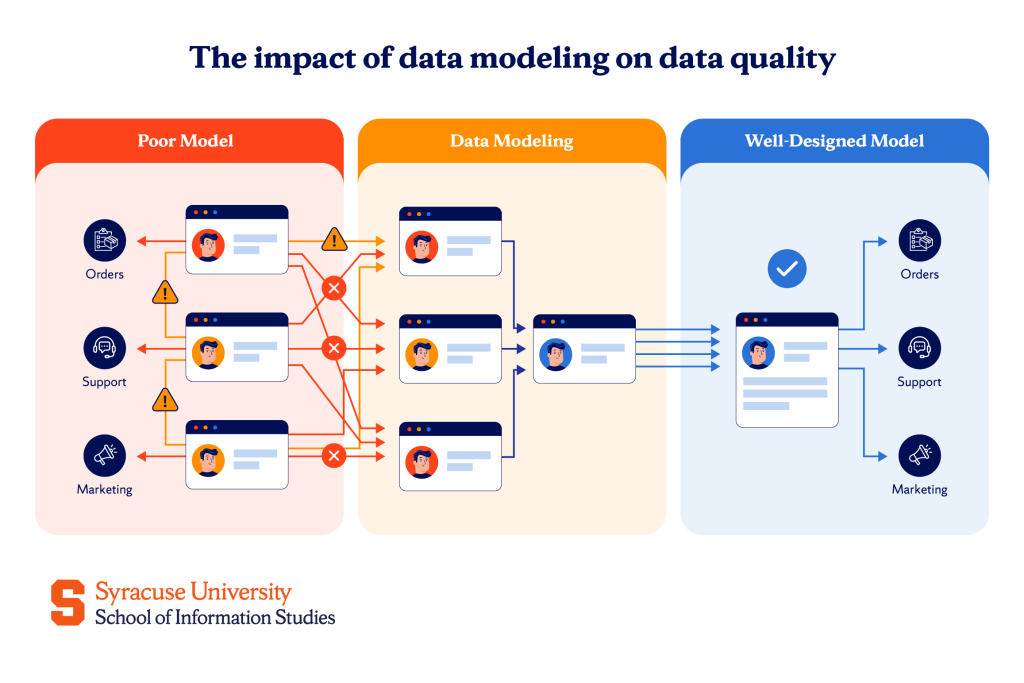
A poor model creates duplicate, conflicting records that no amount of clever querying can fix later. Designing a customer schema where one person can’t accidentally appear under three slightly different spellings is a concrete example. This is also where master data management begins: keeping a single authoritative version of core entities like customers or products across an organization.
3. Data quality and cleaning
Data quality work means profiling data to find errors, then cleaning it: removing duplicates, fixing inconsistent formats, filling or flagging missing values, and enforcing validation rules. It matters because every downstream analysis, dashboard, and AI model is only as good as the data feeding it.
Merging contact records from three systems with mismatched date formats and blank fields, before any report can be trusted, is a daily reality of this work. Readers are often surprised that this, not modeling or analysis, is where most of the actual time goes, a point data professionals raise constantly when describing what the job is really like.
4. Data governance and compliance
Data governance refers to the framework of policies, roles, and standards that keep data trustworthy, compliant, and well-documented across an organization. It matters more than ever because tightening privacy regulations and the rise of AI training data have pushed governance into a board-level concern rather than an IT afterthought.
Key concepts and tools to know include:
- Privacy regulations: GDPR, HIPAA, CCPA
- Governance concepts: data stewardship, data lineage, retention and access policy
- Metadata and cataloging tools: Collibra, Alation, Microsoft Purview
Defining who may access patient records and how long they’re retained under HIPAA is a concrete governance decision. Data stewardship, having clear ownership of each dataset, is the practical core of the whole discipline, and it’s the fastest-rising skill on this list, precisely because it’s the one job seekers most often overlook.
5. ETL and data integration
Data integration is the work of extracting data from multiple sources, transforming it into a consistent format, and loading it into a destination like a warehouse, the ETL, or increasingly ELT, pattern. Some of this happens in scheduled batches; some happens in real time as data streams in.
Tools most important for this skill include:
- ETL/ELT and orchestration: Apache Airflow, dbt, Informatica, Talend
- Streaming and ingestion: Apache Kafka, Fivetran
- Warehouse destinations: Snowflake, Amazon Redshift, Google BigQuery
Most organizations hold data across dozens of disconnected systems, and value only appears once those sources are joined. Nightly pipelines that pull sales, web, and CRM data into one warehouse for reporting are a textbook example of this skill at work.
6. Cloud data platforms
Cloud data platforms are the managed services, data warehouses, data lakes, and lakehouses that store and process data at scale without anyone maintaining on-premises hardware. A warehouse holds structured, analytics-ready data; a data lake holds raw data in a more flexible form.
Platforms worth looking into when developing this skill include:
- Cloud providers: Amazon Web Services (AWS), Microsoft Azure, Google Cloud (GCP)
- Warehouses and lakehouses: Snowflake, Databricks, BigQuery, Amazon Redshift, Azure Synapse
A team standing up a Snowflake warehouse on AWS instead of maintaining its own servers is the norm now, not the exception. Fluency with at least one major cloud platform is an industry baseline today, not a differentiator on a resume.
7. Data security and privacy
Data security covers the controls that keep data confidential and protected: role-based access control, encryption at rest and in transit, data masking for sensitive fields, and a working understanding of how breaches happen and get contained. It matters because a single breach can carry real regulatory penalties and erase customer trust in a way that’s hard to rebuild.
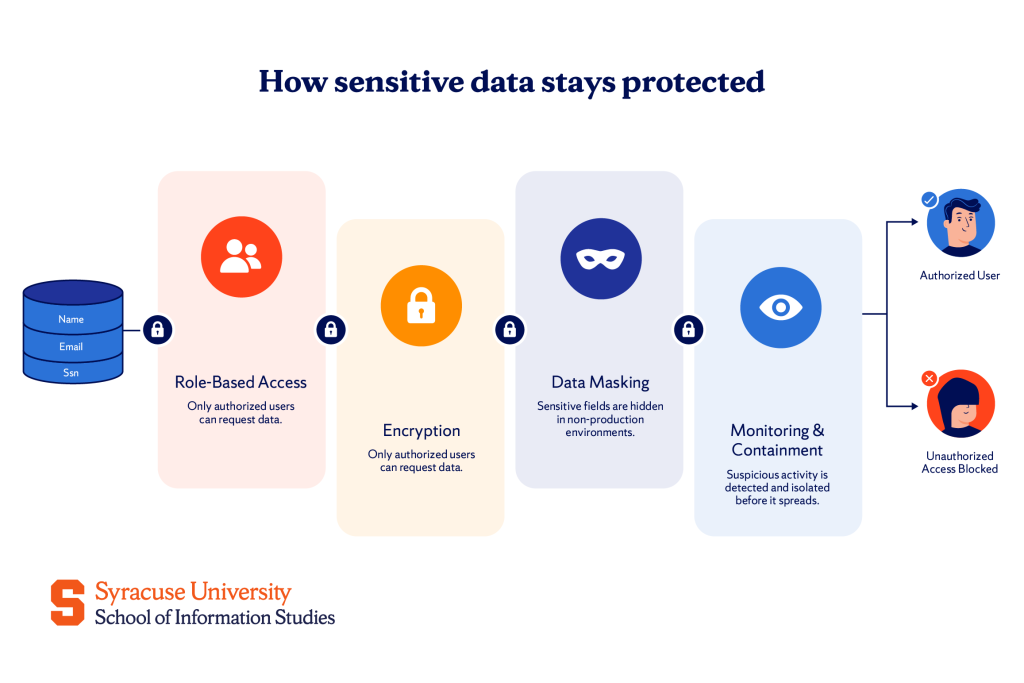
Masking Social Security numbers in a test database, so developers never see real values while they work, is a common example. Security and governance work closely together, but they’re distinct skills: governance decides who should have access, and security is what actually enforces it.
8. Data communication and visualization
Data communication is translating results into clear reports, dashboards, and recommendations: choosing the right visual, cutting clutter, and framing the “so what” for a business audience that doesn’t have time to parse a raw table. An insight no stakeholder understands or trusts changes nothing, no matter how technically sound the underlying work is.
Tableau, Power BI, and Looker are the common tools here. A single, well-labeled dashboard that convinces leadership to change a retention strategy is worth more than a technically impressive model nobody acts on. Increasingly, data professionals are judged on influence, not just on the queries they can write.
How to Build Your Data Management Skills
The right place to begin with developing these skills depends on your current experience and career goals:
If you’re just starting out
Begin with SQL, then learn how to assess and improve data quality. SQL gives you access to the information stored in databases, while data quality skills help you determine whether that information is accurate enough to use.
Once those foundations are secure, add experience with AWS, Azure, or Google Cloud based on the platforms used by employers in your target field. Syracuse University’s Applied Data Science Minor and B.S. in Applied Data Science provide structured undergraduate options for developing these skills through coursework and applied projects.
If you’re already working with data
Focus on the skills that your current role gives you the least opportunity to practice. Analysts with strong SQL and reporting experience may study data modeling, ETL, and pipeline development to prepare for data specialization or development roles.
Professionals in regulated industries such as healthcare and finance may benefit more from governance, compliance, and security expertise. Projects involving incomplete records, access restrictions, or multiple data sources are particularly valuable because they require you to apply several data management skills together.
If you want to specialize or lead
Senior data roles require more than technical depth. Professionals must also be able to establish governance practices, manage data across systems, explain risks, and connect technical decisions with organizational priorities.
Graduate study offers one way to build that combination of technical and managerial expertise. Syracuse University’s M.S. in Applied Data Science covers database management, data preparation, analytics, machine learning, visualization, and communication through work with real-world datasets. The degree is available on campus and online, with the online format designed to provide greater flexibility for working professionals.
Graduate student Lily Coyle described this practical focus during her first week in the program, writing that professors “infuse real-world applications into every lesson.” She also explained that they connect the material directly with the skills students will use in their careers. Her experience illustrates the value of learning data management in context rather than studying each tool or concept in isolation.
Why Data Management Skills Matter for Your Career
Most data work depends on information being accurate, well-structured, and available to the right people. When data is poorly managed, teams spend more time correcting records, reconciling conflicting sources, and questioning whether the results can be trusted. Strong data management skills help professionals prevent those problems before they affect reports, business decisions, or AI systems.
These skills also make it easier to move into more advanced roles. Early-career professionals may use them to prepare reliable datasets and maintain databases, while experienced professionals take responsibility for how data is governed across an organization. The ability to manage data effectively therefore supports both day-to-day performance and long-term career progression.
Final Reflections on Data Management Skills
As professionals take on greater responsibility, they move beyond completing individual tasks and begin making decisions about how data should support the wider organization.
Syracuse University’s iSchool offers several ways to build that expertise. Undergraduates can begin with the Applied Data Science Minor or B.S. in Applied Data Science, while graduates can develop more advanced technical and professional skills through the M.S. in Applied Data Science. Working professionals can pursue the same field through the online M.S. in Applied Data Science program, which provides a more flexible route into data-focused work or career advancement.
Frequently Asked Questions
What does “data management skills” mean on a job posting?
“Data management skills” on a job posting usually means the ability to organize, maintain, retrieve, and protect data so it remains accurate and usable. Depending on the role, employers may be looking for experience with SQL, data cleaning, database design, data pipelines, governance, security, or reporting.
What are some examples of data management skills?
Concrete examples include writing SQL queries, designing a normalized database schema, deduplicating records, enforcing GDPR or HIPAA retention rules, building an Airflow or dbt pipeline, and managing data in Snowflake or BigQuery.
Are Excel skills enough for a data management role?
Excel is a useful starting point, but most data roles now expect SQL and at least one database or cloud platform skill; treat Excel as a foundation to build on, especially for roles beyond entry-level.
How can I improve my data management skills?
Start with SQL and data quality on real, messy datasets, add one cloud platform such as AWS or Azure, then layer governance and integration through projects rather than courses alone.