
Key Takeaways
- An enterprise architect aligns technology decisions with business strategy and considers how changes affect the organization as a whole.
- Enterprise architecture includes four connected domains: business, data, application, and technology architecture.
- Enterprise architects need technical knowledge, business judgment, and the ability to influence teams without relying on direct authority.
- Enterprise architecture is generally a senior career goal reached after experience in technology or information systems, with graduate study offering additional preparation for broader leadership responsibilities.
Few people would question the need for an architect when a large building is being planned. Someone has to consider how each decision affects the structure beyond a single room or immediate requirement.
Organizations make similarly consequential decisions about technology, although the need for that wider perspective is often less obvious. A new platform may solve one problem while limiting future choices elsewhere in the business.
The role of enterprise architect reflects this parallel. It applies the logic of architectural planning to an environment built from technology rather than physical space.
What Is an Enterprise Architect?
An enterprise architect is a senior technology professional who helps ensure that an organization’s technology decisions support its business strategy. Rather than concentrating on one application or project, the role considers how technology operates across the organization and how today’s choices may affect future plans.
The comparison with a building architect only goes so far. An enterprise architect does not personally design every system. The role is closer to overseeing the wider plan, setting principles that guide individual projects, and identifying decisions that could create problems elsewhere.
These architects have become more important as organizations adopt more platforms and depend on technology across nearly every function. Without a shared direction, separate investments may duplicate one another or make future change more difficult.
What Does an Enterprise Architect Do? Key Responsibilities
The exact responsibilities of an enterprise architect depend on the size of the organization they work for and how its technology teams are structured. In most cases, the work combines long-term planning with oversight of major technology decisions.
Strategic planning and roadmapping
Enterprise architects connect business priorities with future technology needs. They develop plans that show which capabilities the organization will require and how its current environment must change to support them.
These plans help leaders decide where to invest and which projects should take priority. They also reduce the risk of approving technology purchases that solve an immediate problem but conflict with longer-term goals.
Architecture design and governance
Enterprise architects establish the principles and standards used to guide technology decisions across the organization. They may review proposed systems to determine whether they fit the wider architecture and meet internal requirements.
Governance does not mean controlling every technical choice. It gives teams a shared basis for making decisions while limiting unnecessary duplication and incompatibility.
Technology evaluation and innovation
New technology is not valuable simply because it is new. Enterprise architects assess whether a platform addresses a genuine business need and whether it can work within the organization’s existing environment.
They may recommend adopting a new system or replacing one that no longer serves its purpose. They also help leadership recognize when adding another platform would create more complexity than value.
Risk management and change leadership
A major technology decision can affect operations well beyond the team introducing it. Enterprise architects look for risks that may not be visible within a single project, including weak integrations or systems that will be difficult to scale.
They also help organizations prepare for larger changes. This may involve explaining why older systems need to be replaced and helping teams understand how the proposed architecture will affect their work.
Stakeholder communication and modeling
Enterprise architects often work between technical teams and business leaders. They turn complex technology environments into diagrams or explanations that make the consequences of a decision easier to understand.
This communication is central to the role. An architecture plan has little influence if decision-makers cannot see how it supports the organization or why a proposed change deserves investment.
Architecture Domains and Specializations
Enterprise architecture covers too much ground for every organization to approach it in the same way. The Open Group Architecture Framework (TOGAF) organizes the work into four connected domains: business, data, application, and technology architecture. These domains help architects examine the organization from different perspectives while keeping decisions tied to the same overall direction.
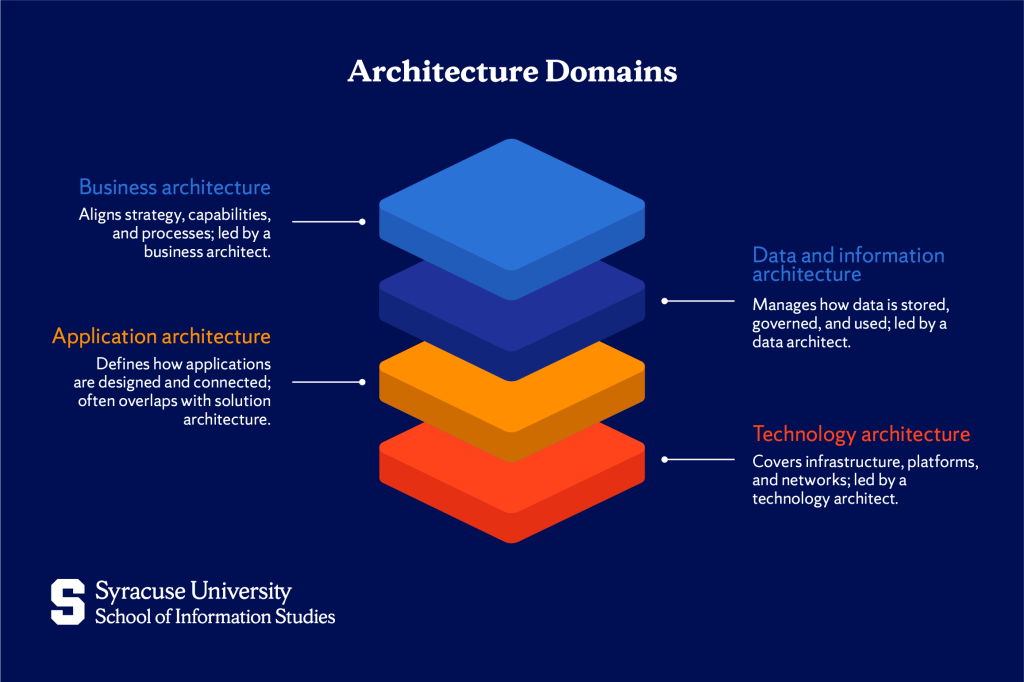
Business architecture
Business architecture starts with what the organization is trying to accomplish. It examines how its operating model and capabilities support that direction, then identifies where change may be needed.
A business architect may help connect a strategic priority to the organizational capabilities required to carry it out. This work gives the other architecture domains a business context, reducing the risk that technology plans develop separately from the needs they are meant to support.
Data and information architecture
Data architecture addresses how information is structured and made available across the organization. It considers where data comes from, how it moves between systems, and which rules govern its use.
A data architect may establish shared data models or address inconsistencies that prevent different parts of the organization from using the same information effectively. The role becomes especially important when separate systems contain conflicting versions of the same records.
Application architecture
Application architecture focuses on the software the organization uses and the relationships between those applications. It considers which business functions each application supports and how information passes between them.
An application architect may identify unnecessary overlap between platforms or define how a new application should connect with existing systems. This domain often overlaps with solution architecture, although a solution architect usually concentrates on a particular initiative rather than the organization-wide application environment.
Technology architecture
Technology architecture covers the technical foundation on which applications operate. This includes the platforms and infrastructure needed to support the organization’s technology environment.
A technology architect may establish infrastructure standards or assess whether the current environment can support future requirements. Titles such as infrastructure architect and cloud architect may fall within this area, depending on how the organization structures its architecture team.
Security architects and solution architects also work across these boundaries. Security concerns affect every domain, while individual solutions often involve business requirements as well as application and technology decisions. These roles may therefore collaborate closely with the enterprise architect without fitting entirely within one domain.
Core Skills Required
Enterprise architects need a broad skill set because their work involves both technology planning and organizational decision-making. They must understand enough about each area to evaluate options and then guide decisions across teams.
Technical skills
Enterprise architects do not need to build every system themselves, but they need enough technical depth to assess proposed designs and recognize how one decision may affect the wider environment. Key technical skills include:
- Systems integration: Understanding how applications exchange data and where compatibility problems may arise.
- Cloud and infrastructure knowledge: Evaluating hosting models, platform requirements, and infrastructure constraints.
- Data architecture: Understanding how data is structured and governed across systems.
- Cybersecurity awareness: Identifying security implications within proposed architecture decisions.
- Architecture modeling: Using diagrams and frameworks to represent current systems and future plans.
Business and strategic skills
The role also requires an understanding of how the organization operates and where it intends to invest. Enterprise architects use this context to connect technology decisions with business priorities. Important skills include:
- Strategic planning: Translating organizational goals into long-term technology priorities.
- Roadmap development: Sequencing changes so that investments build toward a shared direction.
- Business-case analysis: Evaluating the expected value and practical implications of proposed initiatives.
- Financial awareness: Considering costs, resource demands, and the long-term effects of technology choices.
- Risk assessment: Identifying decisions that may restrict future growth or create unnecessary dependence.
Interpersonal and leadership skills
Enterprise architects often influence people they do not manage directly. Their recommendations therefore depend on how clearly they communicate and how effectively they build support. Core interpersonal skills include:
- Communication: Explaining technical issues in language that business leaders and project teams can understand.
- Stakeholder management: Balancing the priorities of departments with different needs.
- Negotiation: Reaching workable decisions when teams disagree about standards or investment priorities.
- Change leadership: Helping employees understand why a technology change is needed and how it will affect their work.
- Influence: Building support for architecture decisions without relying on formal authority.
Enterprise Architect vs. Solution and Technical Architects
Returning to the city-planner analogy: the enterprise architect sets the overall plan and standards for the whole city. A solution architect is closer to the professional designing one specific building within that city, whereas a technical architect handles the detailed implementation of a particular technology inside that building.
| Scope | Time horizon | |
|---|---|---|
| Enterprise architect | Whole organization | Long-term, strategic |
| Solution architect | A specific project or system | Medium-term, project-based |
| Technical architect | Detailed implementation of a given technology | Short-term, implementation-focused |
The distinctions get more nuanced in practice, but this is enough to place the enterprise architect role relative to its closest neighbors.
Prepare for a Career in Enterprise Architecture
Enterprise architecture is usually a senior career goal, so professionals often reach it after building experience in information systems, technology management, or data. Graduate study can help strengthen the broader business and technical perspective the role requires.
Syracuse University’s M.S. in Information Systems offers the most direct preparation, while the M.S. in Information Systems for Executives is designed for experienced professionals moving into higher-level technology leadership. Those interested in data architecture may also consider the M.S. in Applied Data Science. Each program supports a different route toward the knowledge used in enterprise architecture roles.
Frequently Asked Questions (FAQs)
How do you become an enterprise architect?
Most enterprise architects begin in technical roles such as systems analysis, software development, infrastructure, or solution architecture before taking on broader architecture responsibilities. A master’s degree in information systems can strengthen the strategic and leadership skills needed for the role, although practical experience also remains essential.
What degree or qualifications do you need to be an enterprise architect?
Most employers prefer a bachelor’s degree in computer science, information systems, or a related field, although requirements vary. Some candidates also earn a master’s degree or professional certification to strengthen their qualifications.
Do enterprise architects need to know how to code?
Enterprise architects do not usually spend much time writing production code, but they need enough technical knowledge to evaluate designs and communicate with other teams. Coding experience can be helpful, but it is not required for every role.
How much do enterprise architects earn?
The average U.S. enterprise architect salary is estimated to be about $158,800 per year. However, pay varies by experience, location, industry, and employer.
Is enterprise architect a good career?
Enterprise architecture can be a strong career for experienced technology professionals who want to influence organization-wide decisions. It offers senior-level responsibility, although opportunities depend on the employer’s size and investment in enterprise architecture.
Is TOGAF certification required to become an enterprise architect?
No, TOGAF certification is not required to work as an enterprise architect. Some employers prefer it, but relevant architecture experience and a record of successful technology planning often carry more weight.