
Key Takeaways
- The core difference between supervised vs. unsupervised learning comes down to data: supervised learning requires labeled examples, unsupervised learning does not.
- Supervised learning is used when you know the outcome you’re trying to predict; unsupervised learning is used when you’re looking for structure the data hasn’t revealed yet.
- Supervised models are easier to evaluate because you can measure predictions against known correct answers.
- Unsupervised learning is harder to validate but valuable when labeled data is scarce or when the goal is exploration rather than prediction.
- Choosing between supervised vs. unsupervised learning depends on your data, your goal, and how much labeling effort you can invest.
The distinction between supervised and unsupervised learning is based on whether labels are present in the data. In supervised learning, each input is paired with a known outcome, allowing the model to learn how to make predictions, while unsupervised learning enables the model to identify patterns, groupings, or relationships on its own. This comparison outlines both approaches, explains their common use cases, and clarifies how each is applied in different contexts.
Supervised vs. Unsupervised Learning
Supervised learning uses labeled data. Every training example comes with an input and a known output, and the model learns to map one to the other.
Unsupervised learning uses unlabeled data. There are no predefined answers. The model works with inputs alone and finds patterns or groupings without being told what to look for.
That difference changes the objective, the type of output produced, and the way you measure whether the model is working. Other distinctions between the two approaches follow from it.
What Is Supervised Learning?
Supervised learning is a model training approach where the algorithm learns from examples that already have correct answers attached. Given an input (say, a customer’s transaction history) and a labeled output (say, whether that customer churned), the model learns to recognize patterns that predict the outcome. The more labeled examples it sees, the better it gets at generalizing to new data.
The defining characteristic is that the target is known. You’re not asking the model to find something unexpected; you’re asking it to replicate a known judgment at scale.
Main goals of supervised learning
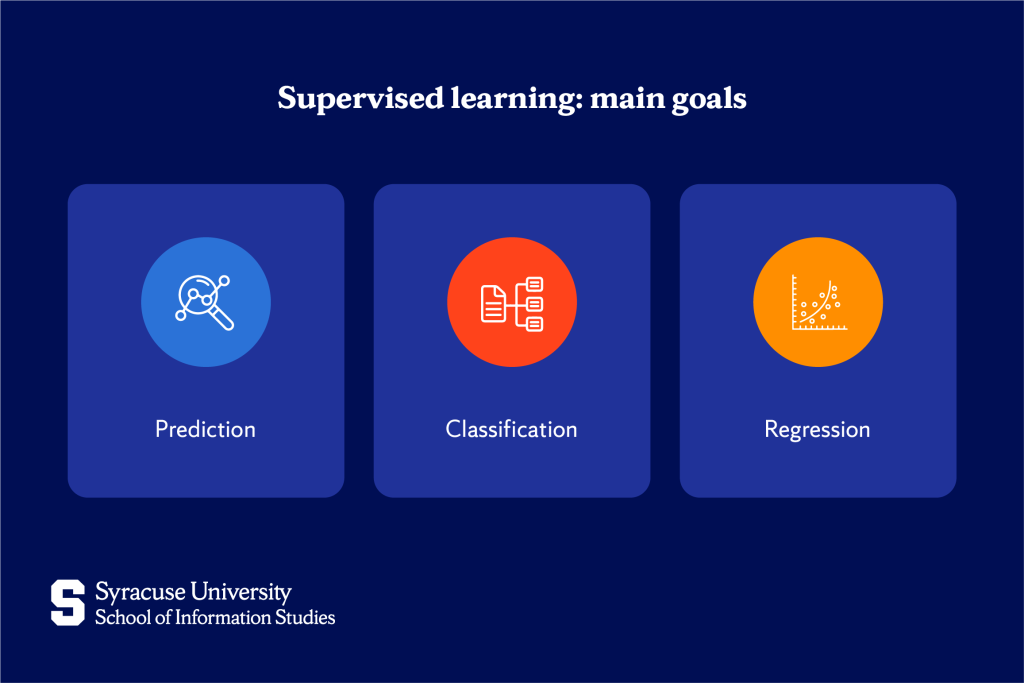
Supervised learning is built around three core objectives:
- Prediction: Estimating a future or unknown value based on historical patterns, such as forecasting demand or predicting customer lifetime value. This is the foundation of predictive analytics in applied data work.
- Classification: Assigning inputs to discrete categories, for example, spam or not spam, approved or denied, high risk or low risk.
- Regression: Predicting a continuous numerical output, such as a price, a score, or a probability.
When supervised learning is useful
Supervised learning works best when you have a meaningful volume of labeled data and a clear target you’re trying to predict. If you need a system that can make consistent, repeatable decisions at scale, like flagging fraudulent transactions, scoring leads, or estimating churn risk, supervised learning is the right starting point. The clearer and more consistent your labels, the more reliable the model will be.
What Is Unsupervised Learning?
Unsupervised learning is a model training approach where the algorithm works with data that has no labels attached. There’s no predefined output to predict; instead, the model identifies structure, groupings, or relationships that exist in the data itself. The goal is discovery, not prediction.
This makes unsupervised learning particularly useful when you don’t yet know what you’re looking for, or when labeling data would be too costly or time-consuming to be practical.
Main goals of unsupervised learning
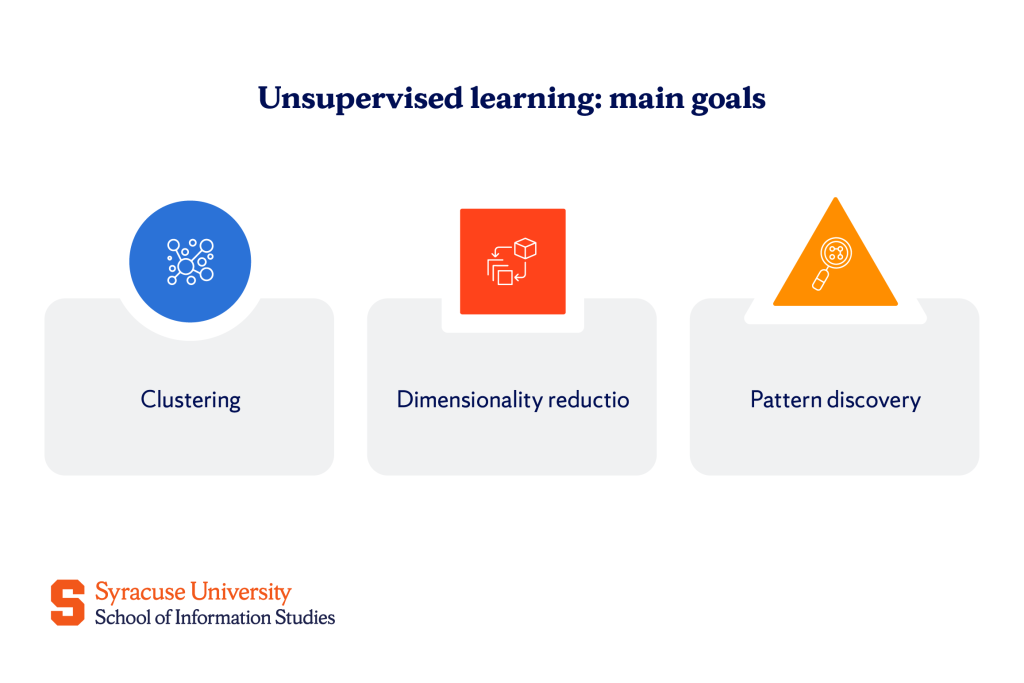
Unsupervised learning is used to achieve three main things:
- Clustering: Grouping similar data points together based on shared characteristics, such as finding customer segments, identifying document topics, or detecting behavioral patterns.
- Dimensionality reduction: Compressing data with many variables into a simpler representation while preserving the most important structure; useful for visualization and as a preprocessing step for other models.
- Pattern discovery: Identifying associations or relationships in data without a predefined hypothesis, such as finding which products are frequently purchased together.
When unsupervised learning is useful
Unsupervised learning is the right choice when labels don’t exist, when you’re exploring unfamiliar data, or when the goal is to find natural groupings rather than predict a specific outcome. It’s especially useful early in a project when you’re trying to understand what the data contains before deciding what to model. It also works well when the volume of data makes manual labeling impractical.
Key Differences Between Supervised and Unsupervised Learning
Understanding how these two approaches differ helps clarify when each should be used and what kind of results to expect.
Labeled vs. unlabeled data
This is the most important distinction. Supervised learning requires labeled examples, or data where someone has already identified the correct output for each input. Creating those labels takes time, subject matter expertise, and sometimes high cost. Unsupervised learning removes that requirement entirely, which makes it accessible for large datasets where labeling every record would be impractical.
The type of data available is often what determines which approach is feasible before any other factor is considered. Understanding the range of data in your dataset (structured, unstructured, categorical, numerical) guides both the labeling effort required and the modeling options available.
Known outcomes vs. hidden patterns
Supervised learning works toward a predefined target. The outcome is known before training begins, and the model’s job is to learn to reproduce it accurately on new examples. Unsupervised learning has no predefined target. The model surfaces a structure that may not have been visible before, producing output that can inform hypotheses, strategy, or further modeling work.
Evaluation and accuracy
Supervised learning is straightforward to evaluate. Because the correct answer is known for held-out test data, you can measure exactly how often the model is right, and in what ways it gets things wrong. Metrics like accuracy, precision, recall, and F1 score all rely on having ground truth to compare against. This connection to statistical modeling principles makes supervised model evaluation well-established and reproducible.
Unsupervised learning is harder to evaluate directly. Without a known correct answer, you can’t measure accuracy in the same way. Evaluation tends to be more qualitative: do the clusters make sense? Are the groupings actionable? Metrics such as silhouette score or inertia can help, but they do not replace the need to assess whether the output is useful.
Output and business value
Supervised learning produces predictions or classifications, such as probabilities, labels, scores, or recommended actions. These outputs integrate directly into decision-making workflows, supporting actions like approval or denial, flagging or passing, and ranking or filtering.
Unsupervised learning produces clusters, groupings, or reduced representations of data. The business value is less immediate but no less real: understanding that your customer base contains five distinct behavioral segments can reshape how you market, price, or support them. The output informs strategy rather than automating a specific decision.
Common Use Cases for Supervised Learning
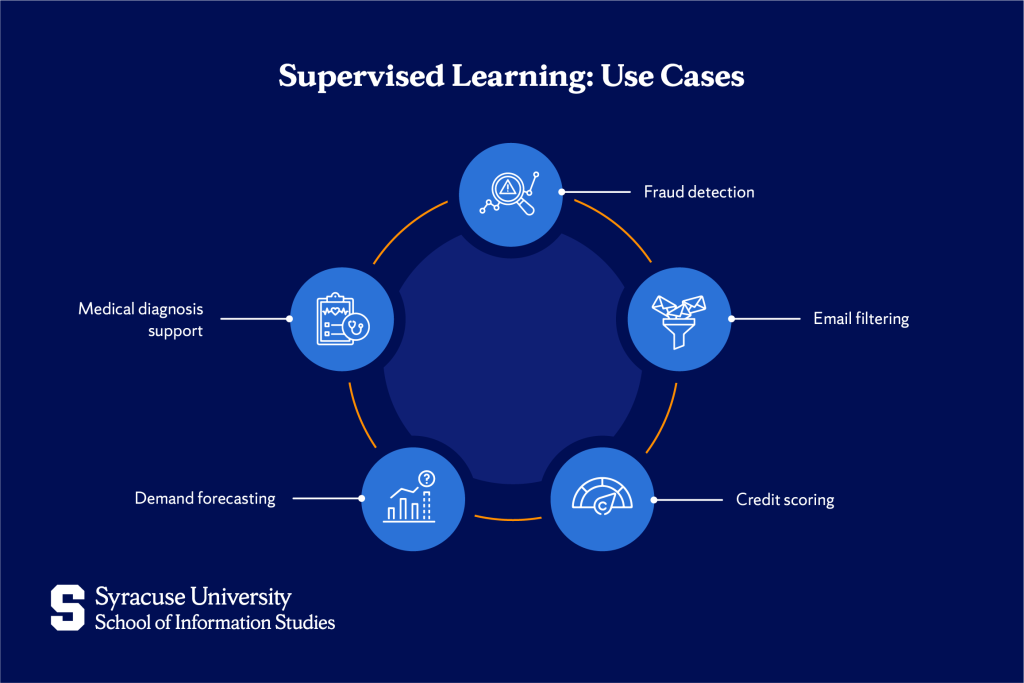
Supervised learning powers most production prediction systems in use today:
- Fraud detection: Classifying transactions as fraudulent or legitimate based on historical labeled examples.
- Email filtering: Sorting messages into spam and non-spam categories using labeled training data.
- Credit scoring: Predicting the likelihood of loan default based on applicant history.
- Demand forecasting: Estimating future sales volume from historical sales and contextual variables.
- Medical diagnosis support: Classifying test results or imaging data against labeled clinical outcomes.
In each case, the model is asked to produce a consistent, scalable version of a judgment that humans have already made and documented.
Common Use Cases for Unsupervised Learning
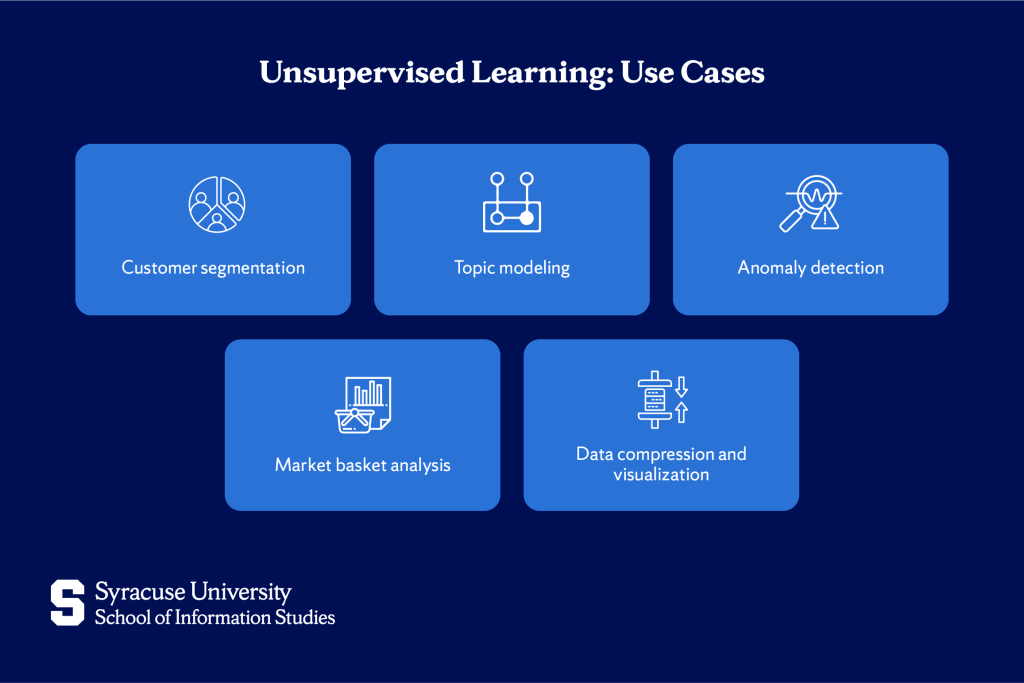
Unsupervised learning is used where discovery and exploration are the goal:
- Customer segmentation: Grouping customers by purchasing behavior, demographics, or engagement patterns without predefined categories.
- Topic modeling: Finding recurring themes across large collections of documents or support tickets.
- Anomaly detection: Identifying data points that fall outside established patterns; useful for tasks such as security monitoring or quality control, particularly when labeled anomaly data is limited.
- Market basket analysis: Discovering which products or services tend to appear together, without defining what associations to look for in advance.
- Data compression and visualization: Reducing high-dimensional datasets to two or three dimensions for visual exploration, often as a step before further analysis.
More advanced pattern discovery, including approaches that use neural networks like autoencoders, falls within the unsupervised category and extends its reach into complex, high-dimensional data.
Advantages and Limitations of Each
Supervised learning offers a clear objective and straightforward evaluation. Because the target is defined, model performance is measurable, and results are reproducible. The trade-off is the labeling requirement: clean, consistent labeled data takes effort to produce and maintain, and models trained on biased or narrow labels will reflect those limitations.
Unsupervised learning requires no labeling, which makes it accessible for large or newly collected datasets. It’s genuinely useful for exploration and for surfacing structure that wouldn’t be visible otherwise. The trade-off is interpretation: the output of an unsupervised model is often ambiguous, and deciding whether clusters are meaningful or whether a reduced representation captures what matters requires careful judgment.
Both approaches operate within the broader context of machine learning and deep learning. More complex models can improve performance in either case, but increased complexity also raises the demands on data, computational resources, and interpretability.
When to Use Supervised vs. Unsupervised Learning
| Use Supervised Learning When | Use Unsupervised Learning When |
|---|---|
| Labeled data is available | Labels are unavailable or costly |
| A clear target variable exists | There is no predefined target |
| The goal is prediction or automation | The goal is exploration and pattern discovery |
| Measurable accuracy is required | There is no direct accuracy metric |
| Validation is required before deployment | The analysis is in an early exploratory stage |
| Outputs will support decisions or automated actions | Outputs are intended to provide insights and understanding |
Use supervised learning when:
- You have labeled data and a clear target variable to predict
- The goal is to automate a decision or prediction at scale
- You need to measure model performance against known correct answers
- Accuracy and validation are required before deployment
Use unsupervised learning when:
- Labels are unavailable or too costly to produce at scale
- The goal is exploration (finding groupings, patterns, or structure)
- You’re in an early stage of analysis and don’t yet know what questions to ask
- The value lies in insights and understanding rather than prediction
In practice, many projects use both. Unsupervised methods can clean, reduce, or segment data before a supervised model is trained on it, making the two approaches complementary rather than competing.
Semi-Supervised Learning
Semi-supervised learning sits between the two. It uses a small amount of labeled data combined with a much larger pool of unlabeled data, allowing the model to learn from both. This is useful when labeling everything is impractical, but some labeled examples are available. It’s common in natural language processing and image recognition, where labeled data is expensive to produce but unlabeled data is abundant.
The Bottom Line
Supervised learning focuses on predicting known outcomes using labeled data, while unsupervised learning identifies structure in data without predefined labels. The choice between them depends on the nature of the data and the goal, whether that involves making predictions or exploring patterns that are not immediately visible.
A solid understanding of both approaches is essential for working effectively in data science and machine learning. The Applied Data Science Bachelor’s Degree and the Master of Applied Data Science at Syracuse University’s iSchool provide structured, career-focused training in these areas. Students work with real datasets, build models using Python and SQL, and develop skills in data analysis, statistical methods, and machine learning. The programs emphasize practical application, including hands-on projects that reflect real industry problems, preparing graduates to apply these techniques in professional settings.
Frequently Asked Questions (FAQs)
Which is better for prediction: supervised or unsupervised learning?
Supervised learning is the right choice for prediction. It’s specifically designed to map inputs to known outputs, and its performance can be measured directly against ground truth labels.
Can supervised and unsupervised learning be used together?
Yes, and they often are. Unsupervised methods like clustering or dimensionality reduction are frequently used to prepare or enrich data before a supervised model is trained on it.
Is clustering supervised or unsupervised learning?
Clustering is unsupervised. It groups data points by similarity without any predefined labels or target categories guiding the process.
Is anomaly detection supervised or unsupervised?
It can take either approach. Unsupervised anomaly detection identifies data points that deviate from established patterns without relying on labeled examples, while supervised anomaly detection learns from labeled instances of known anomalies. The more effective method depends on whether labeled anomaly data is available. Understanding the distinction between machine learning and AI can also clarify how anomaly detection fits within broader AI systems.