
Key Takeaways
- Core data architect responsibilities include data modeling, governance, systems planning, and cross-team alignment.
- Data architects combine deep technical knowledge with the ability to communicate complex decisions to non-technical stakeholders.
- Demand for data architects continues to grow as organizations expand their use of cloud systems, analytics, and AI.
A data architect designs the structures, systems, and standards that define how an organization’s data is modeled, stored, and accessed. The role combines technical design and business priorities, influencing how data supports decision-making.
Rather than focusing only on building databases, data architects make choices that impact how effectively an organization can use its data in the long term. This includes defining responsibilities, required skills, the tools involved, and how the role differs from related positions.
What Is a Data Architect?
A data architect is the person responsible for designing how data is organized, managed, and made accessible across an organization. Where other roles focus on analyzing data or building the systems that move it, the data architect focuses on the overall structure: how different data sources connect, how information is defined consistently across systems, and how the architecture supports current needs while remaining flexible for future ones.
These professionals work with technical teams, business analysts, compliance teams, and senior leadership, translating business requirements into technical design decisions and making sure those decisions hold up at scale. It’s a strategic role as much as a technical one, and the best data architects are comfortable operating in both areas.
What Does a Data Architect Do?
In practice, a data architect’s work covers planning, design, governance, and coordination. On any given project, they might be mapping out the structure of a new data warehouse, reviewing how a proposed system change will affect downstream reporting, or working with a compliance team to make sure data access policies are properly enforced.
While technical teams focus on building and operating pipelines and analysts focus on extracting insights, data architects are thinking about the overall structure, assessing whether data is being defined consistently, whether the systems in place today can scale to meet tomorrow’s demands, and whether the right people have the right access.
Data architects also translate technical architecture decisions into language that non-technical stakeholders can understand and act on. They write documentation, present proposals, and gather requirements.
Core Responsibilities of a Data Architect
The responsibilities of a data architect combine technical design with coordination and long-term planning, ensuring that data systems remain consistent, scalable, and aligned with business needs.
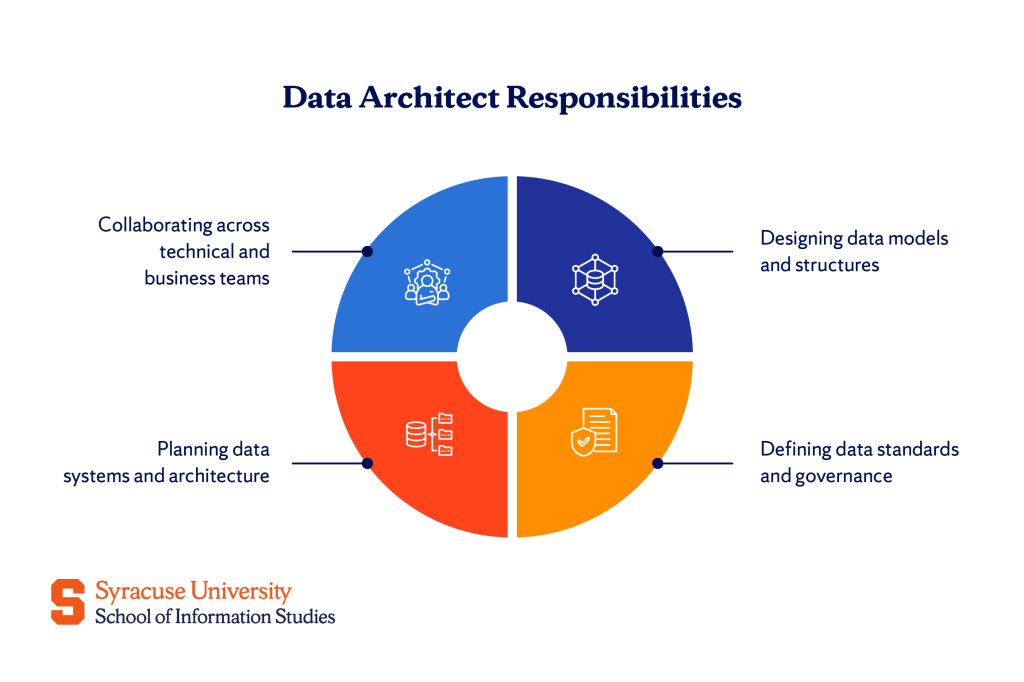
Designing data models and structures
Data architects create the conceptual, logical, and physical designs that define how data is organized across systems. A conceptual model defines what data exists and how it relates to other data. A logical model adds more structure, including data types, relationships, and constraints. A physical model translates those decisions into the actual database design that gets implemented.
These design decisions have long-term consequences. Poor data models create inconsistencies that compound over time, such as mismatched definitions, duplicate records, and reporting that produces different numbers depending on which system you query. Understanding the types of data across structured, semi-structured, and unstructured formats is foundational to this work, since design decisions have to account for the full range of information an organization collects.
Defining data standards and governance
Data architects set the standards that determine how data is named, defined, classified, and managed across the organization. This includes ownership rules, like who is responsible for which data, as well as quality standards, access controls, and policies that ensure data is used appropriately and consistently.
This work connects directly to IT governance at the organizational level. When data definitions vary across departments, reporting becomes unreliable. When access controls are unclear, security and compliance risks follow. Data architects provide the structural foundation that prevents those problems, making governance an ongoing responsibility.
Planning data systems and architecture
Data architects plan the overall technology landscape for how data is stored, integrated, and accessed. This includes making decisions about databases, data warehouses, and data lakes, each suited to different types of storage and retrieval needs. Understanding big data and the infrastructure required to manage it at scale is central to this planning work.
They’re also responsible for thinking ahead. Architecture decisions made today have consequences for scalability, reliability, and cost years down the line. A data architect evaluates not just whether a system works now, but whether it can grow with the organization without requiring a complete rebuild. Decisions about information systems and how they connect to each other sit firmly within this scope.
Collaborating across technical and business teams
Data architects spend a significant portion of their time in rooms, virtual or otherwise, with people who have very different priorities. Analysts want data that’s accessible and well-documented. Business leaders want answers quickly and reliably. Compliance teams want guarantees about security and access.
The data architect’s job is to hold all of those needs simultaneously and make design decisions that serve them collectively. That requires technical depth as well as the ability to listen carefully, ask the right questions, and explain trade-offs in plain language. Without strong collaboration skills, even technically excellent architecture decisions can fail to get implemented correctly.
Essential Data Architect Skills
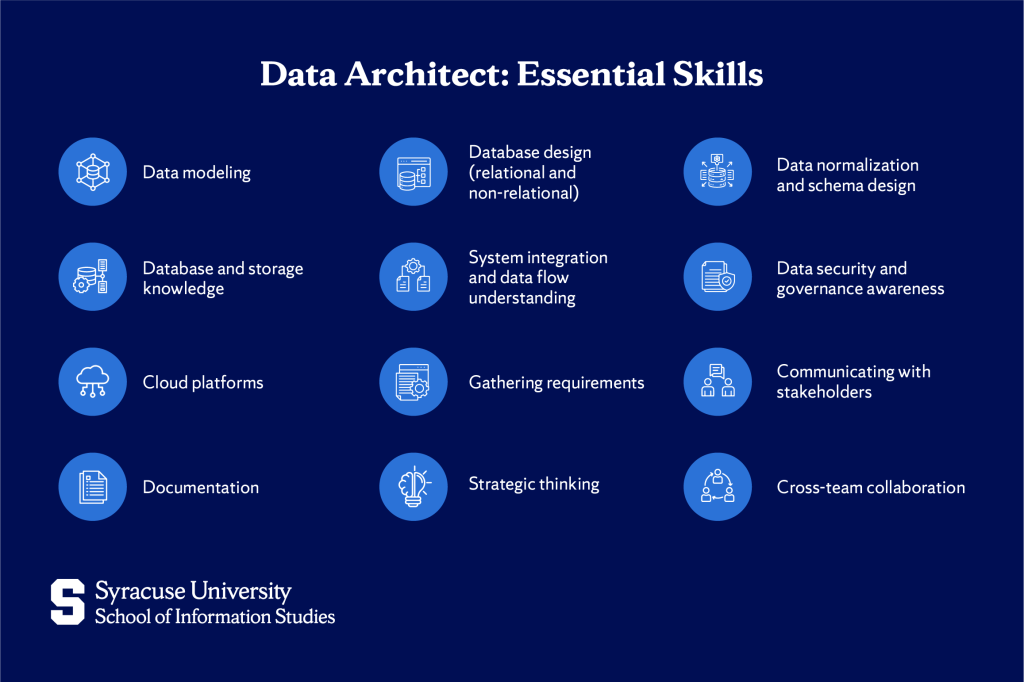
The effectiveness of a data architect depends on a combination of technical expertise and the ability to translate complex requirements into practical, long-term solutions.
Technical skills
Strong data modeling ability is the core technical skill: understanding how to design relational and non-relational structures, handle normalization, and make schema decisions that balance performance with flexibility. Database and storage knowledge across multiple environments is also essential, since most organizations use a mix of technologies rather than a single platform.
Architecture thinking at a broader level, like understanding how systems integrate, where data flows, and how design decisions affect the full data ecosystem, distinguishes data architects from more narrowly focused technical roles. Security and governance awareness matters too; data security is not just an IT concern but an architectural one. Cloud platform familiarity completes the technical skill set, as most modern data architectures rely heavily on cloud infrastructure.
Business and communication skills
Technical skill alone isn’t enough. Data architects need to gather requirements from stakeholders who may not speak technical language, translate those requirements into design decisions, and then communicate those decisions back in terms that stakeholders can evaluate and approve.
Documentation is a distinct and important skill. Data architects produce reference materials that teams rely on long after the initial design work is done. Strategic thinking, the ability to see how today’s decisions affect future flexibility, is equally important. Cross-functional collaboration, including working with analysts, compliance teams, and executives without losing coherence, is what ensures that architecture decisions are implemented and sustained.
Tools and Technologies Data Architects Work With
Data architects work across multiple tool categories. Broad familiarity with different ecosystems is more important than deep specialization in any one product.
Data modeling and database technologies
Data architects use modeling tools to create and document conceptual, logical, and physical designs. On the database side, they work across relational environments like PostgreSQL, Oracle, and SQL Server, as well as non-relational options suited to document, key-value, or graph data. The specific tools vary by organization; the underlying skill is knowing which design approach fits which problem.
Cloud and modern data platforms
Most data architecture work today involves cloud environments. Platforms like AWS, Azure, and Google Cloud each offer ecosystems of storage, processing, and integration services that influence how architecture decisions get implemented. Understanding cloud management at a conceptual level (how resources scale, how services integrate, and where architectural trade-offs appear) is a baseline expectation for the role.
Salary and Job Outlook
Compensation for data architects varies significantly based on location, industry, experience level, and the technical complexity of the environment. According to the latest data, the average salary for data architects ranges from $130,000 to $160,000 annually. Roles at large technology companies or in financial services tend to sit at the higher end; positions in government or nonprofit settings typically fall lower. Senior data architects with cloud specialization and experience at scale are among the more highly compensated professionals in the data field, earning close to $200,000 per year.
The job outlook for the role is strong. As organizations collect more data across more systems, the need for professionals who can design coherent, governed, and scalable data environments continues to grow. Cloud migration projects, regulatory compliance requirements, and the expansion of analytics and AI programs all contribute to sustained demand for architectural expertise.
The Bottom Line
A data architect ensures that an organization’s data is not only available, but structured, governed, and accessible in ways that support business needs. The role combines technical design with strategic thinking and cross-functional communication, which contributes to both its complexity and its value.
For those interested in work that connects system design with organizational priorities, where decisions influence how data is used across the business, data architecture is a field worth exploring. The Applied Data Science Bachelor’s Degree at Syracuse University’s iSchool develops skills in data modeling, database design, data preparation, statistical analysis, and machine learning, along with hands-on experience working with real-world datasets.
Frequently Asked Questions (FAQs)
What industries hire data architects?
Data architects work across virtually every data-intensive industry. Technology, finance, healthcare, retail, government, and media are among the most active employers, with any organization managing complex data environments likely to have the role.
Is a data architect a technical or strategic role?
It’s both. Data architects need strong technical depth in data modeling, systems design, and cloud platforms, but the role also requires strategic thinking, stakeholder communication, and the ability to align technical decisions with business goals.
Does a data architect write code?
Some do, particularly earlier in their careers, but writing production code is generally not a core part of the role. Data architects focus on design, standards, and architectural decisions rather than day-to-day development.
What is the difference between a data architect and a database architect?
A data architect works at a broader, organizational level, designing data systems, governance frameworks, and architectural standards across the entire business. A database administrator role focuses on managing, maintaining, and optimizing specific databases rather than designing the overall data landscape.